
Choosing the right Transitional Year (TY) residency can shape your clinical confidence, lifestyle, and readiness for advanced training. As an MD graduate planning a transitional year before a specialty like radiology, dermatology, anesthesiology, PM&R, or ophthalmology, you need a deliberate program research strategy—especially with how competitive some transitional programs have become.
This guide walks you step‑by‑step through how to research residency programs effectively, interpret information critically, and build a realistic, well‑balanced list tailored to your goals.
Understanding the Transitional Year and Your Personal Goals
Before you dive into spreadsheets and program websites, clarify why you’re pursuing a transitional year and what you want from it. Everything about evaluating residency programs depends on this foundation.
What Exactly Is a Transitional Year Residency?
A Transitional Year (TY) residency is a 1‑year, broad‑based clinical internship accredited by the ACGME. It’s designed to provide a mix of inpatient, outpatient, and elective experiences across multiple specialties. Common characteristics:
- Duration: 1 year (PGY‑1)
- Structure: Rotations in internal medicine, surgery, emergency medicine, and electives in fields like radiology, neurology, anesthesia, etc.
- Goal: Build general clinical competence and flexibility before entering an advanced residency (PGY‑2+).
This is distinct from:
- Preliminary Medicine or Surgery: More specialty‑focused and often heavier inpatient loads.
- Categorical Programs: Multi‑year training in one specialty from PGY‑1 onward.
Clarify Your Objectives Before You Research
As an MD graduate, you may already have a designated advanced position (e.g., radiology PGY‑2) or you may be applying to both TY and advanced programs simultaneously. Your goals for the year might include:
- Clinical breadth: Exposure to multiple fields, especially if you still feel undecided or want confirmation that your chosen specialty fits.
- Work‑life balance: Time to study, engage in research, or simply recharge before a demanding subspecialty.
- Geographic preference: Being close to family or a partner, or within commuting distance of your PGY‑2 program.
- Academic vs. community exposure: Preference for a tertiary academic center vs. a smaller hospital where you may get more hands‑on autonomy.
- Competitiveness and reputation: Some TY programs are highly sought after; others are more relaxed but less known.
Write down your top 3–5 priorities. For example:
- Close to partner’s job (Northeast preferred).
- Light to moderate call schedule; no malignant culture.
- Solid internal medicine training to build confidence before radiology.
- Supportive of scholarly work and board preparation.
You’ll use these priorities to anchor your program research strategy and to filter information as you review options.
Building Your Initial List: Where and How to Start
Once you have a clear sense of what you need, the next step in how to research residency programs is assembling a target list before you start narrowing and ranking.
Step 1: Use Official Databases and Directories
Start with comprehensive, authoritative sources:
1. AAMC’s Residency Explorer (if available to you)
Use filters for:
- Specialty: “Transitional Year” or “Transitional.”
- Region/geography.
- Program type (university, community, community/university).
- Prior applicant data (US MD, US DO, IMG) if available.
You can also see typical Step scores, number of interviews, and match rates historically for applicants like you. This is particularly useful for an MD graduate residency applicant to ensure a realistic spread of programs (reach, target, safety).
2. FREIDA (AMA) and NRMP resources
- FREIDA Online: Filter by “Transitional Year” and then by state, program size, and setting.
- NRMP Program Descriptions & Data Reports: Check how many positions each TY program offers and if they’re linked to specific advanced specialties.
From these, build a spreadsheet with:
- Program name
- City/state
- Number of TY spots
- Affiliation (university vs community)
- Notes column
This becomes your central document for evaluating residency programs and tracking your application process.
Step 2: Factor in Your Advanced Program Match (If Applicable)
If you’ve already matched into an advanced program (for example, radiology PGY‑2), your TY program research strategy should prioritize:
- Geographic proximity to your advanced program.
- Culture and schedule alignment with your upcoming demands (e.g., some advanced programs recommend strong inpatient medicine exposure, others value easier schedules to allow research/boards).
Many advanced programs even recommend specific TY or preliminary programs. Ask:
- Your future program coordinator or chief residents.
- Recent residents in your subspecialty who just finished a transitional year.
This targeted advice often yields a “shortlist” of programs that are tried‑and‑true paths for your specialty.
Step 3: Leverage Networking and Word of Mouth
For an allopathic medical school match candidate, one of the best ways to learn how to research residency programs is to start locally:
- Your home institution residents: Ask those going into the same specialty which TY programs they applied to and how they evaluated them.
- Recent graduates: Alumni often share honest, practical insights about specific TY programs: workload, culture, housing, and supports.
- Specialty mentors: Faculty in your chosen specialty can often name well‑regarded TY programs that have a track record of preparing residents well.
Ask focused questions:
- “Which TY programs are known for solid training but a humane lifestyle?”
- “Are there programs I should avoid due to culture or instability?”
- “Are there TY programs that send multiple grads to our specialty every year?”

Deep Dive: How to Research Individual Transitional Year Programs
Once you have a preliminary list, the next step is systematically evaluating residency programs one by one. This is where you move from “name recognition” to real fit.
1. Start with the Program’s Official Website
A program’s website is your primary source—but remember, it showcases the best version of the program. Read critically and look for specific, verifiable details.
Key sections to review:
a. Curriculum and Rotations
Ask:
- How is the year structured?
- Months of internal medicine?
- Months of surgery or ICU?
- Required ED?
- Electives (and how many)?
- Are there protected elective blocks that can be tailored toward your future specialty?
- Are there rigid vs flexible scheduling options?
Example:
If you’re going into radiology, a strong TY program for you might offer:
- At least 3–4 months of electives
- Opportunities in radiology, neurology, or ICU
- Not excessively heavy surgical call months
Document this in your spreadsheet: “Electives: 4 months – radiology, anesthesia, ICU available.”
b. Call Schedule, Workload, and Duty Hours
Look for concrete descriptions:
- Night float vs traditional call.
- Weekend frequency.
- Typical daily census on medicine and how admissions are handled.
- Whether interns cover multiple services at night.
Beware of vague language like “manageable workload” with no specifics. If information is missing, list this as a question to ask on interview day or via email.
c. Educational Structure and Support
A well‑run TY program should have:
- Structured didactics (medicine, surgery, EBM, simulation).
- Morning report and/or noon conference.
- Faculty mentorship and advisor assignments.
- Specific support for those entering your target specialties (e.g., radiology, anesthesia).
Ask: “Does this program support my transition to my PGY‑2 specialty, or is it more oriented to those continuing at that institution in other specialties?”
2. Examine the Program’s Track Record and Outcomes
A crucial component of how to research residency programs is understanding where graduates go next.
Questions to guide your review:
- Do they list recent graduates and where they matched or continued training?
- Are there multiple TY graduates going into your intended specialty each year?
- Are there any integrated or linked advanced positions (e.g., many TYs feed into local radiology, derm, or anesthesia programs)?
If the website doesn’t list this, ask directly on interview day:
“Can you share the typical destinations of your TY graduates over the last 3–5 years?”
3. Use Third‑Party and Unofficial Sources (Carefully)
Beyond official pages, explore:
- Doximity Residency Navigator: Offers rankings, resident reviews, and reputation data. For TY programs, rankings are limited but culture feedback can be useful.
- Reddit (r/medicalschool, r/residency) and Student Doctor Network (SDN):
- Search the program’s name.
- Look for patterns, not isolated horror stories.
- Social media (Instagram, X/Twitter):
- Many programs have accounts where they showcase resident life, wellness events, education sessions, and volunteer work.
- This can give a feel for culture and diversity.
Use these sources as supplemental, not primary, data. Anonymous opinions should be weighed cautiously and corroborated when possible.
4. Evaluate Culture, Wellness, and Support
Culture can make or break your transitional year. Key indicators:
- Resident bios and photos: Do the residents look diverse? Do they stay for fellowship or advanced training nearby? Do they seem engaged in educational or scholarly work?
- Wellness initiatives: Protected wellness days, retreats, mentoring programs, mental health access.
- Faculty accessibility: Is there mention of open‑door policies, feedback mechanisms, or regular check‑ins?
Concrete questions to ask current residents (on interview days or virtual socials):
- “What does a tough week look like here? What about an easy week?”
- “Have residents ever raised concerns, and how did leadership respond?”
- “Do you feel the program genuinely respects duty hours?”
- “Would you choose this program again for your transitional year?”
Document their answers. Over time, patterns will emerge across programs.
Quantitative and Qualitative Filters: Narrowing Your List
After gathering data, the next phase of your program research strategy is to prioritize and realistically narrow your list.
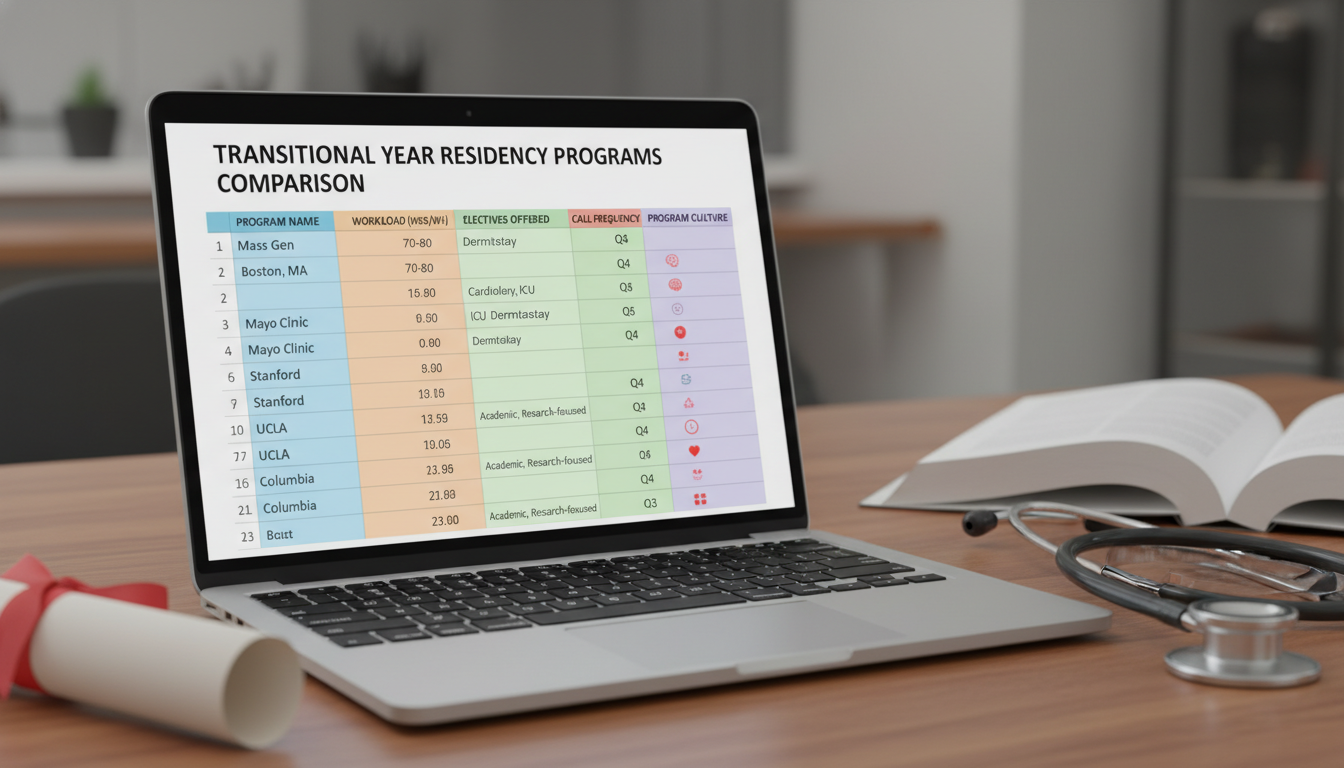
Build a Structured Comparison Tool
Use your spreadsheet to assign both quantitative and qualitative scores for each TY program.
Suggested columns:
- Location (city/state)
- Proximity to family/partner or PGY‑2 program
- Program type (academic, community, hybrid)
- Number of residents (size)
- Elective months available
- Night call structure
- Reputation for lifestyle (subjective, from talks and reviews)
- Track record for your specialty
- Notes from resident conversations
Optional: Add a 1–5 rating for:
- Clinical training strength
- Schedule/lifestyle
- Culture/support
- Fit with your long‑term goals
Weigh Competitiveness and Your Applicant Profile
As an MD graduate residency applicant from an allopathic medical school, you may have a relative advantage at several TY programs, but transitional year slots can still be intensely competitive—especially those with:
- Lighter schedules
- Desirable locations
- Affiliated advanced specialties
Consider:
- Your USMLE/COMLEX scores (if applicable)
- Class rank/AOA status
- Research output and letters
- Specialty competitiveness (e.g., derm vs PM&R vs anesthesia)
Build a balanced list:
- Reach programs: Prestigious, highly sought‑after TY programs or top geographic locations.
- Target programs: Solid training with moderate competitiveness aligned to your profile.
- Safety programs: Less competitive locations, smaller markets, or programs with more positions.
There’s no magic number, but many competitive MD applicants may apply to 15–25 TY programs, adjusting up or down based on their risk tolerance and the competitiveness of their advanced specialty.
Look for Red Flags in Program Stability
During evaluation, note potential warning signs:
- Sudden loss of accreditation or probation (check ACGME listings and program announcements).
- High turnover of program directors or cores faculty.
- Persistent negative reviews citing duty hour violations, abusive culture, or lack of supervision.
- Chronically unfilled positions in the Match (sometimes a signal of deeper issues).
Red flags don’t automatically disqualify a program, but they warrant deeper questioning and caution.
Strategically Engaging with Programs and Using Interviews for Final Evaluation
As interview offers come in, your research shifts from broad data gathering to detailed, interpersonal evaluation.
Preparing for Interviews Based on Your Research
Before each interview:
- Review your spreadsheet notes for that program.
- Revisit the website, focusing on curriculum and recent changes.
- Write down 3–5 specific questions tailored to your goals.
Examples:
- “How many elective months can a TY resident realistically spend in [your future specialty]?”
- “How often are TY residents on night float, and what does a typical night look like?”
- “Where have your recent TY graduates gone for advanced training, especially in [your specialty]?”
These questions demonstrate that you’ve done your homework and help you evaluate whether the program truly fits you.
Using Resident Interactions to Assess Fit
Most TY interviews include a resident panel or informal session. This is your best source for honest information.
Ask:
- Workload & culture: “What was your most challenging month? What made it challenging?”
- Support: “How responsive is leadership when concerns are raised?”
- Specialty transitions: “How did the program support you as you prepared for your PGY‑2 role in [specialty]—letters, flexibility, study time?”
- Reality vs website: “Is there anything you wish you had known before coming here?”
Listen for consistency among different residents’ answers. Large discrepancies may signal variable experiences or selective transparency.
Post‑Interview Reflection and Updating Your Rankings
After each interview day:
- Immediately jot down impressions: pros, cons, gut feeling.
- Re‑rate the program in your spreadsheet (using the same criteria).
- Note any major updates:
- “Better lifestyle than expected.”
- “Fewer electives than website claimed.”
- “Residents seemed tired and disengaged” vs “Residents clearly happy, strong camaraderie.”
When it’s time to certify your rank list in the allopathic medical school match (NRMP), these notes will be invaluable for recalling nuances between programs that may otherwise blur together.
Putting It All Together: A Concrete Example Program Research Strategy
Here’s a sample step‑by‑step plan for an MD graduate researching transitional year residency programs.
Month 1: Build the Universe and Define Priorities
- Clarify your goals (location, lifestyle, clinical exposure, specialty focus).
- Use FREIDA and Residency Explorer to list all TY programs in 3–4 preferred regions.
- Populate a basic spreadsheet with:
- Program names
- Locations
- Number of spots
- Program type (academic vs community)
- Talk to:
- Your specialty advisor
- One senior resident in your intended specialty
- One recent grad who did a TY
Month 2: Deep Dive on Top 30–40 Programs
- For each program, review:
- Curriculum, call schedule, electives.
- Resident outcomes and advanced placements.
- Any publicly available rotation schedules (if posted).
- Search for:
- Doximity reviews
- Reddit/SDN threads referencing the program
- Program social media accounts
- Narrow your list to about 20–25 programs using:
- Your rating system
- Red flag identification
- Competitiveness assessment
Month 3: Finalize Application List and Prepare Materials
- Confirm each program’s ERAS requirements:
- Letters (especially from your advanced specialty)
- Any specific evaluations or supplemental materials
- Craft program‑specific notes to personalize:
- Your personal statement (if you tailor for TY)
- Potential talking points for interviews (e.g., a resident’s publication that interests you)
- Submit applications and track responses in your spreadsheet.
Throughout interview season, continue to refine evaluations of residency programs, update scores, and maintain a running “preliminary rank list” that you adjust as you gather more information.
FAQs: Researching Transitional Year Residency Programs as an MD Graduate
1. How many Transitional Year programs should an MD graduate apply to?
The number varies with your competitiveness and specialty, but many US MD applicants apply to 15–25 TY programs. If you’re planning to match into a particularly competitive advanced specialty (like dermatology or radiation oncology) or you have geographic restrictions, lean toward the higher end. If you have strong scores, solid letters, and geographic flexibility, you may be comfortable with fewer.
2. Are academic or community TY programs better?
Neither is universally better—this depends on your goals:
- Academic programs often have:
- More subspecialty exposure
- Research opportunities
- Closer proximity to academic advanced programs
- Community programs may offer:
- More direct patient care
- Tighter‑knit resident communities
- Sometimes more favorable lifestyle schedules
Focus on how each environment aligns with your needs for your PGY‑2 specialty and personal life, rather than assuming one type is automatically superior.
3. How important is the “name” or prestige of a TY program?
For most specialties, the prestige of your transitional year is less important than your performance, letters, and the reputation of your advanced residency. However, certain highly competitive fields may value well‑known TY programs with a history of sending strong graduates into those specialties. If forced to choose, prioritize:
- A program where you will learn well and be supported.
- A schedule that allows you to prepare for your advanced specialty.
- A culture where you can thrive, not just survive.
4. What if a program doesn’t publish much information online?
If details about curriculum or workload are scarce:
- Email the coordinator with a few targeted questions (e.g., elective time, call schedule).
- Ask residents during interviews to fill in gaps.
- Check if the program is newly established or undergoing changes, which may explain limited information.
Lack of information isn’t automatically a deal‑breaker, but it does require more cautious, active questioning to ensure the program aligns with your expectations.
By approaching your transitional year search systematically—clarifying your goals, using structured tools, and critically evaluating residency programs—you can build a TY program list that supports both your immediate clinical growth and your long‑term career in your chosen specialty. As an MD graduate preparing for the residency match and applications phase, this deliberate research process is one of the most high‑yield investments you can make in your future training.