
Choosing the right residency is one of the most consequential decisions in your medical career. The programs you apply to—and ultimately rank—will shape your clinical skills, career trajectory, professional identity, and daily life for years. With hundreds of Residency Programs across the country, narrowing down your list can feel overwhelming, especially amid exams, applications, and interviews.
This guide breaks the process into clear, practical steps so you can move from “I have no idea where to start” to a focused, intentional list that aligns with your Career Goals, values, and desired Work-Life Balance.
Understanding Why Residency Program Selection Matters
Residency is more than a training requirement—it’s the bridge between medical school and independent practice. Where and how you train affects:
Clinical competence and confidence
Volume, acuity, supervision style, and case mix determine how prepared you’ll feel on day one as an attending or fellow.Fellowship and advanced training opportunities
Some programs have strong pipelines into competitive fellowships, while others excel at preparing residents for community practice or academic careers.Geographic and professional networks
Training in a region often leads to jobs in that same region. The mentors, peers, and alumni you meet can open doors throughout your Medical Career.Research and academic potential
Programs differ widely in expectations and support for research, quality improvement (QI), education, and leadership.Work-Life Balance and well-being
Schedule design, call structure, culture, and support systems influence burnout risk, personal relationships, and overall life satisfaction.
Recognizing the stakes helps justify investing serious time and thought into Program Selection rather than relying on brand names or word of mouth alone.
1. Clarify Your Career Goals Before Building Your List
Before comparing programs, you need a clear picture of what you want from your Medical Career—at least for the next 5–10 years. Even if you’re undecided, you can still define priorities that will guide you.
Reflect on Your Long-Term Career Vision
Ask yourself:
Specialty fit
- What specialty (or specialties) genuinely energizes me on rotation?
- Do I prefer acute care (e.g., EM, surgery, ICU) or longitudinal relationships (e.g., FM, IM, pediatrics)?
- Do I enjoy procedural work, diagnostic puzzles, or communication-heavy roles?
Practice setting
- Do I see myself in an academic medical center, community hospital, outpatient clinic, or mixed role?
- Do I want to teach students and residents regularly?
Research and scholarship
- Do I want research or QI to be a major part of my career?
- Am I aiming for a research-heavy fellowship or academic position?
Lifestyle and Work-Life Balance
- Am I comfortable with frequent nights/weekends, or do I prefer more predictable hours?
- How important are geographic stability, family considerations, and hobbies?
Write your answers down. Turning vague thoughts into concrete statements will make it easier to compare programs objectively.
Define “Non-Negotiables” vs “Nice-to-Haves”
To narrow choices effectively, separate your criteria into:
Non-negotiables (must-have)
- Location constraints (partner’s job, family, visa, childcare)
- Certain program features (e.g., minimum case volume, fellowship tracks, categorical vs advanced position)
- Safety or financial considerations (e.g., cost of living, neighborhood, commuting feasibility)
Nice-to-haves (preferences)
- Size of the residency class
- Presence of specific electives or tracks
- Level of research support
- Specific scheduling models (night float vs traditional call)
This framework prevents you from getting stuck in analysis paralysis and helps you make realistic trade-offs.
2. Evaluate Program Reputation, Outcomes, and Culture

Reputation and “fit” both matter, but they’re often misunderstood. A famous name does not automatically mean a better experience for you, and a smaller or community-based program can provide outstanding training.
Understanding Residency Program Reputation and Outcomes
Look beyond vague prestige and focus on concrete signals of quality:
Board pass rates
- Check the program’s board certification exam pass rates over several years.
- Consistently strong performance suggests effective teaching and support.
Case volume and clinical exposure
- Ask: Do residents see enough complexity and acuity to become confident and independent?
- For procedural specialties, look for minimum expected procedure numbers by graduation.
Fellowship match outcomes
- Where do graduates go for fellowship? Are they matching in the subspecialties and locations you might want?
- If you want to practice generalist medicine, ask where graduates are working (academic vs community, urban vs rural).
Graduate satisfaction
- Programs often share alumni testimonials or can connect you with recent graduates.
- Ask them how prepared they felt for independent practice or fellowship.
Use resources like:
- FREIDA (Fellowship and Residency Electronic Interactive Database)
- Program websites and annual reports
- Specialty-specific organization websites and match data
Assessing Residency Culture and Environment
Program culture can make or break your day-to-day experience. You’re not just training—you’re living there for 3–7 years.
Key culture questions:
Wellness and support
- How does the program respond to resident illness, family emergencies, or burnout?
- Are there formal wellness initiatives (counseling, retreats, protected wellness time)?
- Does the program genuinely respect duty hour rules?
Resident relationships
- Do residents seem to like and support each other?
- Is the atmosphere primarily collaborative or subtly competitive?
- Ask about how senior residents treat interns.
Faculty engagement
- Are attendings approachable and invested in teaching?
- Do residents feel comfortable asking for help or admitting uncertainty?
- Is feedback constructive and regular?
Leadership responsiveness
- When residents raise concerns, does leadership act?
- Has the program made visible changes based on resident feedback?
Sources of culture insights:
- Conversations with current residents during interview days or virtual socials
- Anonymous online forums (with caution and skepticism)
- Alumni from your medical school who trained there
- Rotations/sub-internships if feasible
3. Compare Curriculum, Training Models, and Learning Opportunities
The structure of your clinical training will determine how you spend most of your waking hours for years. A thoughtful review of the curriculum is essential for smart Program Selection.
Examine the Core Curriculum and Training Model
Key elements to review on program websites and during interviews:
Rotational structure
- How is time divided between inpatient, outpatient, ICU, electives, and night shifts?
- Is there a night float system, traditional call, or hybrid?
- Does the schedule allow for recovery and learning, or is it nonstop service?
Educational time
- Is there protected didactic time where residents are excused from clinical duties?
- What types of teaching occur (morning report, noon conference, simulation, journal club, bedside teaching)?
Supervision and autonomy
- How much independence do seniors have versus interns?
- How does responsibility evolve over your training years?
- Does the program trust residents while maintaining patient safety?
Exposure across care settings
- Academic tertiary center, community hospitals, VA, clinics, rural sites, etc.
- Diverse settings can broaden your skills and job options.
Procedural and Hands-On Experience
For procedure-heavy specialties (EM, surgery, OB/GYN, anesthesia, radiology, etc.), dig into:
- Minimum requirements and typical numbers for key procedures
- Simulation labs, bootcamps, or skills workshops
- Whether procedures are resident- or fellow-driven (some places fellows may do most advanced procedures)
In more cognitive fields (IM, neurology, psychiatry, pediatrics), ask:
- How often are you the primary decision-maker?
- How are complex cases handled—are residents actively involved in discussions and care planning?
Electives, Tracks, and Subspecialty Rotations
Electives and tailored training pathways can greatly support your Career Goals:
Subspecialty exposure
- Are there rotations in areas that interest you (e.g., cardiology, ID, rheumatology, sports medicine, palliative care)?
- Can you spend time at outside institutions or international sites?
Special tracks or pathways
- Primary care, hospitalist medicine, global health, women’s health, clinician-educator, research, quality improvement, leadership, etc.
- Ask about expectations, mentorship, and how many residents can realistically participate.
Senior year flexibility
- Do upper-level residents have block time for electives, research, or interview travel?
- Are you able to tailor your schedule to your intended post-residency job or fellowship?
4. Investigate Resident Life, Workload, and Work-Life Balance
Clinical training is demanding everywhere—but the way workload is structured and supported varies widely. Understanding this is critical for your health and relationships.
Work Hours, Call Schedules, and Workload
Ask specific, concrete questions:
- What is the typical weekly hour range on busy rotations vs lighter rotations?
- How often are 24-hour calls used vs night float or shift work?
- How many days off per month, and are they truly protected?
- How often do residents stay significantly beyond their scheduled hours?
Clarify:
- How admissions are distributed (drip vs burst, cap systems, etc.)
- Whether there is ancillary support (pharmacy, phlebotomy, transport, scribes, APPs)
- How often residents cover extra shifts for sick colleagues and whether they are compensated
Lifestyle, Location, and Cost of Living
Your life outside the hospital is not a trivial detail—it’s key to sustainability.
Consider:
Cost of living vs salary
- Will your resident pay realistically cover housing, food, transportation, and loans in that city?
- Compare rent estimates (e.g., one-bedroom apartment) across cities.
Commute
- Is housing within walking distance or a short commute?
- Are you likely to be driving home post-call in heavy traffic?
Personal and family needs
- Childcare availability and cost
- Schools and family support nearby
- Employment options for partners
Community and amenities
- Access to parks, gyms, religious communities, cultural centers, and opportunities to decompress
- Safety and comfort in the surrounding neighborhoods
Work-Life Balance is not just a buzzword; the combination of workload, support, and location will strongly influence whether you feel burned out or fulfilled.
5. Connect Thoughtfully with Current Residents and Alumni
Residents and recent graduates are among your most valuable information sources—if you approach them respectfully and ask the right questions.
How to Reach Out Effectively
You can connect via:
- Your medical school’s alumni network
- Specialty interest groups or national organizations
- LinkedIn or other professional platforms
- Emails facilitated by program coordinators or residents after interviews
When reaching out:
- Keep messages concise and professional.
- Introduce who you are, how you found them, and what specialty/program you’re exploring.
- Request a brief 15–20 minute call or to answer a few questions by email.
High-Yield Questions to Ask Residents
Instead of generic “Do you like your program?” ask targeted questions like:
- What surprised you most—good or bad—after starting residency here?
- How does the program respond when someone is struggling academically or personally?
- What changes has leadership made in response to resident feedback in the last few years?
- How manageable is the workload on the hardest rotations?
- Do you feel supported in your Career Goals (fellowship, academic path, community practice)?
- If you had to choose again, would you choose this program—and why or why not?
Look for patterns in multiple residents’ responses rather than a single anecdote.
6. Make the Most of Open Houses, Interviews, and Visits
Whether in-person or virtual, program-specific events are opportunities to assess fit beyond the website brochure.
What to Observe During Open Houses and Interview Days
Pay attention to:
Resident demeanors
- Do they seem exhausted and guarded or reasonably tired but positive?
- Do they joke with each other and faculty?
Faculty-resident dynamics
- Is there mutual respect?
- Are residents comfortable asking questions or disagreeing respectfully?
Transparency
- Are your questions answered directly, or do responses feel rehearsed and vague?
- Are programs open about areas they’re trying to improve?
If you attend in-person:
- Look at workspaces: call rooms, resident lounges, workstations.
- Check if there are quiet areas for studying and documentation.
- Notice whether facilities feel clean, safe, and functional.
7. Use a Structured Residency Program Selection Checklist
With many variables, it’s easy to lose track of what matters most. A structured checklist helps you compare programs objectively.
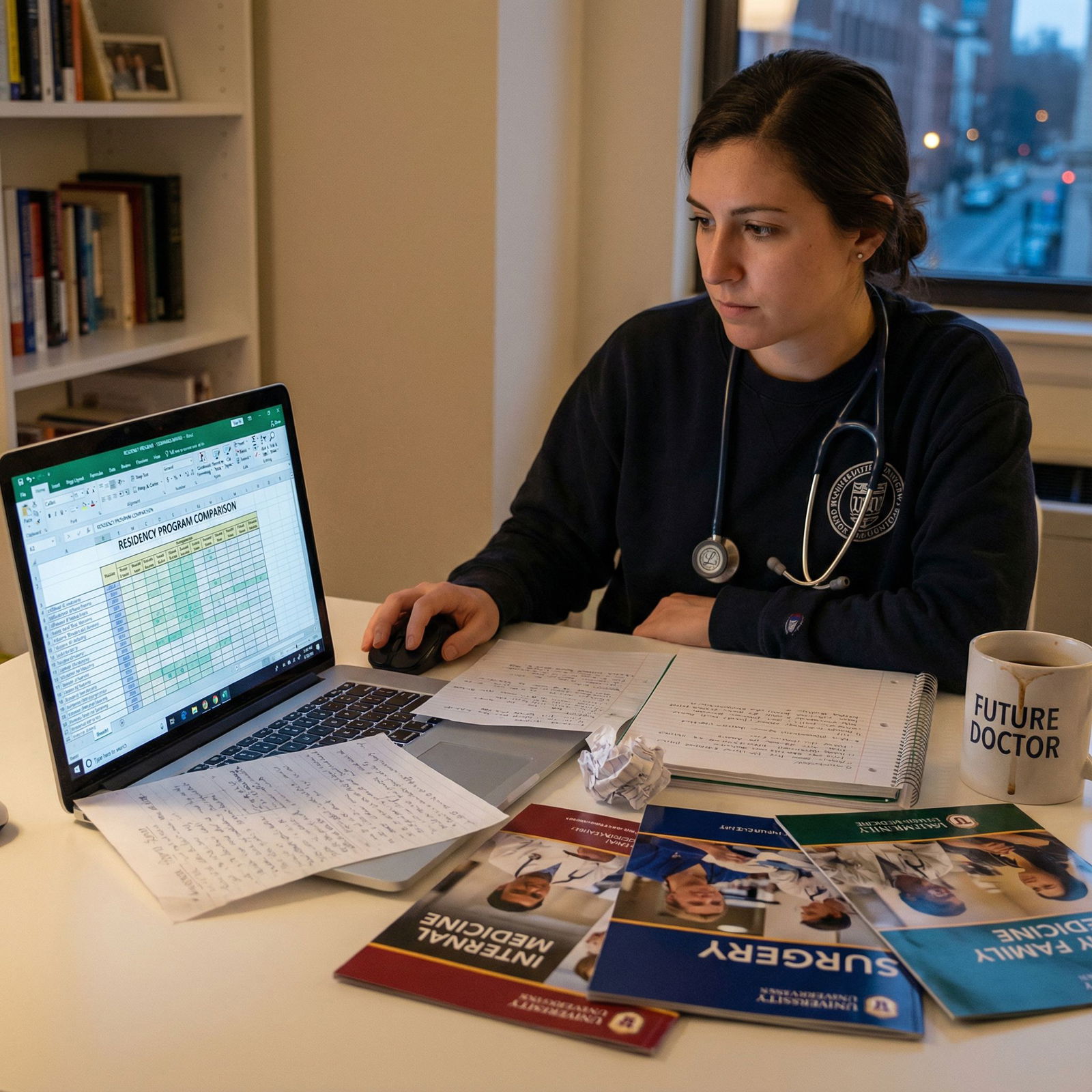
Create a spreadsheet or scoring system with categories such as:
- Training quality
- Case volume, complexity, supervision, educational time, board pass rates
- Career alignment
- Fellowship match record, subspecialty exposure, research/tracks, mentorship strength
- Culture and support
- Wellness programs, responsiveness to feedback, resident camaraderie
- Workload and schedule
- Hours, call structure, days off, ancillary support
- Location and lifestyle
- Cost of living, commute, family needs, community amenities
- Intangibles
- Gut feeling, sense of belonging, alignment with your values
Rate each factor on a consistent scale (e.g., 1–5) and include short notes for context. This tool is especially powerful as you approach ranking season and memories of different programs start to blur.
8. Consider Location Strategically: Beyond the Map
Geography is not just about climate and city size—it’s deeply tied to your long-term Medical Career and personal life.
Geographic Preference and Future Job Prospects
Ask:
- Do I want to practice long-term in this region?
- Is this state or region saturated or short of my specialty?
- Do local hospitals and clinics tend to hire from this residency program?
Many physicians settle within a few hours of where they trained. If you have a preferred region, strongly prioritize programs there, especially in more location-dependent fields.
Personal Well-Being and Social Support
Consider:
- Proximity to family or a trusted support network
- Cultural or religious communities that are important to you
- Climate and its impact on your mood and lifestyle (e.g., seasonal affective disorder)
You will be working hard; being in a place where you can recharge meaningfully matters.
9. Seek Guidance from Mentors and Advisors
You do not have to navigate Program Selection alone. Mentors can help you interpret information, set realistic expectations, and avoid common pitfalls.
How Mentors Can Help
Mentors in your specialty (and outside it) can:
- Suggest programs aligned with your competitiveness and Career Goals
- Help you distinguish between marketing language and substantive strengths
- Offer insight into fellowship pipelines and academic vs community outcomes
- Review and refine your application strategy (number and type of programs)
- Role-play interview scenarios and help you frame good questions
Try to assemble a small “advisory board”:
- One mentor in your desired specialty
- One general advisor (e.g., dean, advisor) who knows your broader story
- Possibly a recent graduate who just matched in your field
Be honest with them about your strengths, weaknesses, and constraints so their advice can be tailored to you.
10. Stay Open-Minded but Disciplined in Your Choices
Narrowing your program list is both strategic and emotional. It’s easy to drift toward extremes—either applying everywhere or unrealistically limiting yourself.
Be Open to Diverse Programs
- Don’t dismiss community programs; many offer superb training, autonomy, and mentorship.
- Some “mid-tier” programs may be outstanding fits for your specific Career Goals.
- Be wary of chasing prestige at the expense of culture, support, or Work-Life Balance.
Be Disciplined with Your Application Strategy
- Discuss an appropriate number of applications with mentors, based on your specialty and competitiveness.
- Use your non-negotiables and checklist to trim programs that clearly don’t fit.
- As interviews progress, update your impressions and be willing to adjust your ranking based on new information.
Trust both your data and your instincts. If something feels consistently off about a program despite looking good on paper, pay attention. Likewise, if a program feels like home and supports your growth, that matters—even if it’s not a household name.
FAQs: Narrowing Down Your Residency Program Choices
1. How many residency programs should I apply to?
There is no one-size-fits-all number. It depends on:
- Specialty competitiveness (e.g., dermatology vs family medicine)
- Your application strength (USMLE/COMLEX scores, clinical performance, research, letters)
- Geographic restrictions (e.g., needing to be in a specific city)
Broad general ranges (not strict rules):
- Highly competitive specialties: often 40+ programs
- Moderately competitive: often 20–30 programs
- Less competitive or broader specialties: 12–20 programs may be sufficient
Discuss your specific situation with a specialty advisor or mentor; they know current match trends and typical numbers in your field.
2. What’s the best way to assess residency program culture before I match?
You can’t fully know culture until you’re there, but you can get a strong sense by:
- Talking with multiple current residents at different levels of training
- Asking specific questions about how leadership responds to feedback and crises
- Observing interactions between residents, faculty, and staff during interview day
- Looking for tangible wellness initiatives (not just buzzwords)
- Asking about recent program changes—strong programs evolve in response to resident input
Patterns in feedback from multiple sources are more reliable than one glowing or negative comment.
3. How important is program prestige versus fit and Work-Life Balance?
Prestige can influence certain pathways (e.g., ultra-competitive fellowships or academic careers), but it is just one factor. In practice:
- Fit and training quality matter most for your day-to-day life and long-term competence.
- Work-Life Balance and support can determine whether you thrive or burn out.
- Many graduates from “non-elite” residencies have stellar careers, including academic and leadership roles.
If a prestigious program has a toxic culture or lifestyle that is unsustainable for you, it may not be the “best” choice, even if it looks impressive on paper.
4. What resources can I use to research Residency Programs effectively?
Useful tools include:
- FREIDA (AMA) – for program characteristics and filters by location, size, setting
- Program websites – for curriculum, faculty, electives, tracks, and official data
- NRMP and specialty organizations – for match statistics and specialty-specific guidance
- Residency fairs, webinars, and open houses – for direct interaction with programs
- Your medical school advisors and alumni – for candid insights and lived experiences
Use multiple sources rather than relying solely on rankings or anonymous forums.
5. I’m undecided about my long-term Career Goals. How should that affect my program selection?
If you’re unsure about your ultimate path:
- Favor programs with broad exposure and flexible elective time.
- Look for strong general training plus access to various subspecialties.
- Prioritize environments with good mentorship and advisors who can help you explore options.
- Consider locations with diverse practice settings where you can see different careers in action.
Choosing a residency that keeps doors open and supports exploration is often wiser than committing early to a very narrow track you may later regret.
By approaching Program Selection with reflection, research, and intentionality, you can confidently narrow down your residency choices to a list that truly supports your Medical Career aspirations and personal well-being. Your goal is not to find a “perfect” program, but a place where you can grow, be mentored, and build the foundation for a satisfying, sustainable life in medicine.