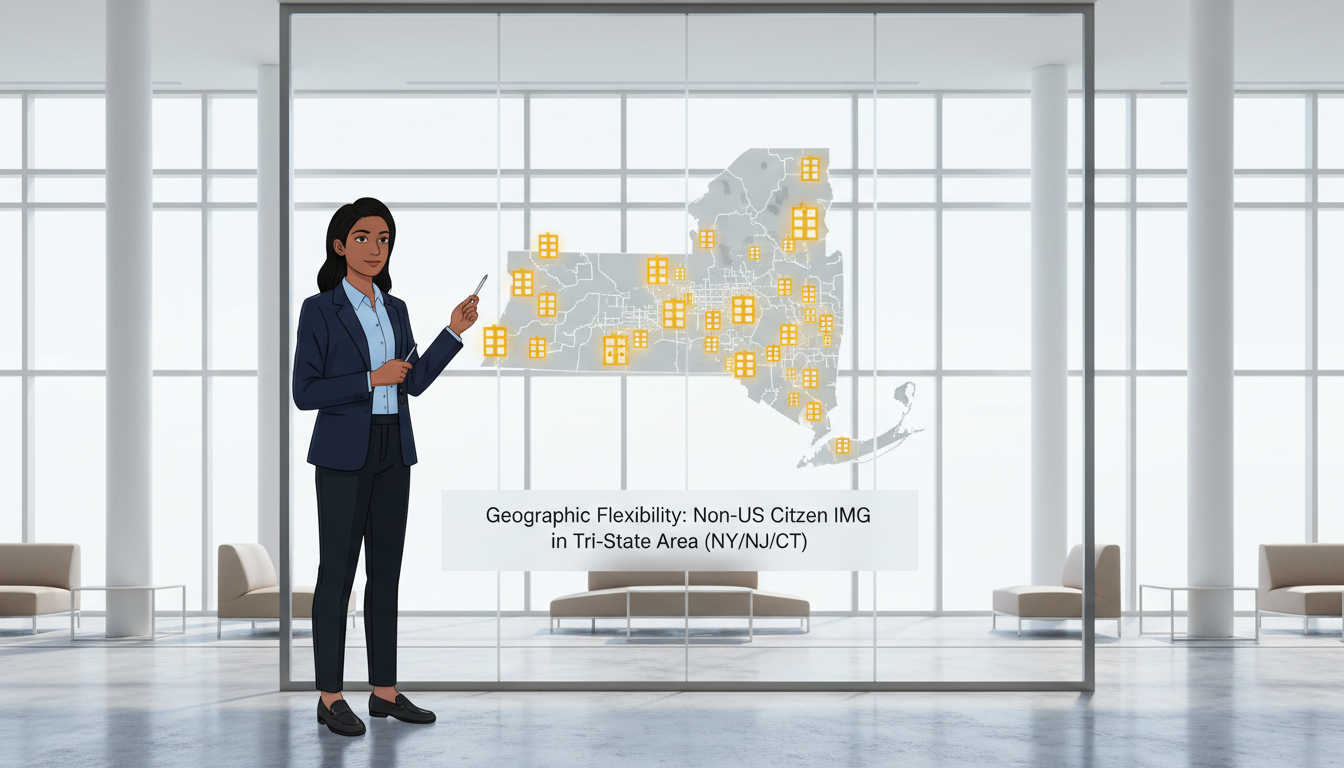
Choosing where to train is never just about the map. For a non-US citizen IMG, especially in the tri-state area, “where” can determine “if” you match at all. Geographic flexibility is not simply being willing to move; it’s a deliberate strategy that integrates visa realities, program density, family considerations, and long-term career goals.
This guide focuses on how a non-US citizen IMG can use geographic flexibility in the Tri-State Area (New York, New Jersey, and Connecticut) to strengthen their residency application and match strategy.
Understanding Geographic Flexibility in the Tri-State Context
What “Geographic Flexibility” Really Means
For a foreign national medical graduate, geographic flexibility has several layers:
- Willingness to train in different cities (NYC vs. smaller cities vs. suburban areas)
- Openness to different states in the tri-state region (not just New York, but also New Jersey and Connecticut)
- Adaptability to different hospital types (academic vs. community vs. hybrid)
- Visa flexibility (willingness to consider programs with J-1 only vs. those that sponsor H-1B)
- Willingness to commute or relocate within the region
In the context of the New York New Jersey Connecticut residency landscape, this flexibility can significantly expand the pool of realistic programs for a non-US citizen IMG.
Why Geographic Flexibility Matters More for Non-US Citizen IMGs
Compared with US graduates, a non-US citizen IMG often faces:
- Limited number of programs that sponsor visas
- Higher competition at “popular” locations (e.g., Manhattan, Brooklyn, Queens)
- Additional scrutiny of clinical experience, exams, and communication skills
By demonstrating location flexibility for the Match, you:
- Increase the number of places that may rank you
- Reduce reliance on a few “dream” locations
- Signal commitment and practicality to program directors
Geographic flexibility is not “settling” for less; it is maximizing options in a system where constraints (especially visa-related) are real.
Mapping the Tri-State Area: How Each State Differs for IMGs
The tri-state residency ecosystem is rich but uneven. Understanding the nuances helps you craft a regional preference strategy that looks flexible, but is still purposeful.
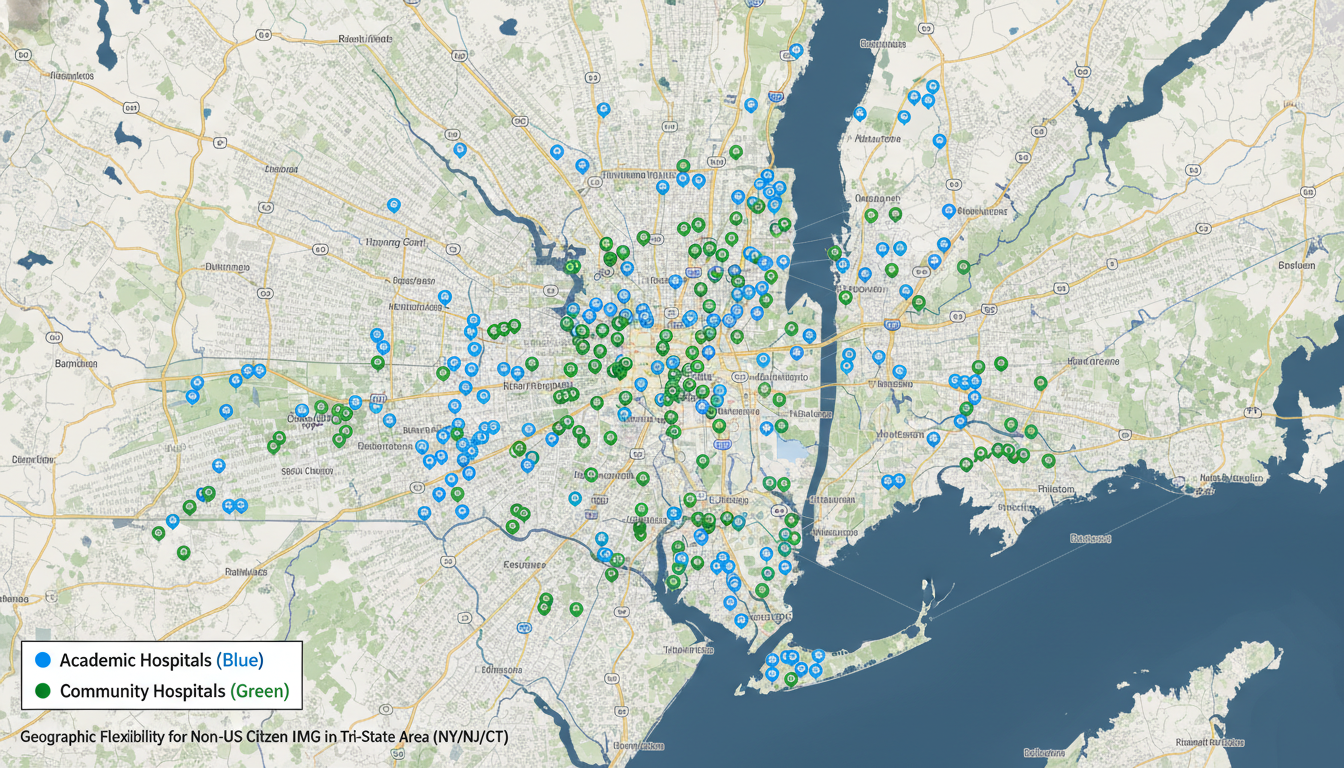
1. New York: High Program Density, High Competition
Strengths for a non-US citizen IMG:
- One of the highest densities of residency programs in the US
- Many programs are historically IMG-friendly
- Multiple large academic centers and safety-net hospitals
- Broad exposure to diverse patient populations and pathologies
Challenges:
- Visa sponsorship is not universal—some institutions avoid H-1B
- Very competitive locations: Manhattan, parts of Brooklyn and Queens
- Cost of living is high (NYC metro and surrounding suburbs)
- Programs may receive huge numbers of IMG applications, making it harder to stand out
Practical implications:
- If you restrict yourself to “NYC only,” you may drastically shrink your realistic chances.
- Broaden your scope to Upstate New York (e.g., Buffalo, Rochester, Syracuse) and smaller cities, which can be easier entry points.
2. New Jersey: Community Strength and Proximity Advantage
Strengths:
- Many community and hybrid academic-community programs
- Several institutions are known to be IMG-friendly and visa-friendly
- Lower cost of living than New York City, with reasonable access to NYC
- Smaller programs where strong performance can yield high visibility
Challenges:
- Fewer programs overall compared to New York
- Some programs may have specific visa preferences (e.g., J-1 only)
- Competition can still be intense for locations near NYC (e.g., Jersey City, Newark, Hoboken)
Practical implications:
- New Jersey can serve as a strategic “middle ground”: close to NYC’s network and prestige, but competitive thresholds may be slightly more manageable.
- Emphasizing willingness to relocate to suburban or non-coastal parts of New Jersey can stand out in your geographic preference residency section.
3. Connecticut: Smaller Market, Significant Opportunity
Strengths:
- Smaller state, with clusters of programs around key cities (e.g., New Haven, Hartford, Bridgeport, Stamford)
- Combination of highly academic centers and community programs
- Often overlooked by IMGs who focus on NYC, leaving relatively more room for flexible candidates
- Some programs have a long-standing tradition of training IMGs
Challenges:
- Fewer total programs compared to NY/NJ
- Less “name recognition” for some community hospitals, which may matter to some applicants focused on prestige
- Some areas are less diverse or more suburban, which may feel culturally different if you are used to a large city
Practical implications:
- If you openly express willingness to train in Connecticut (and explain why), you may appeal to programs that struggle to attract applicants committed to their region.
- For a non-US citizen IMG, programs here can be hidden gems with strong training and better interview chances than ultra-competitive NYC programs.
Building a Smart Regional Preference Strategy as a Non-US Citizen IMG
Step 1: Clarify Your Non-Negotiables
Before you talk about flexibility, define what is not flexible:
- Visa type:
- Are you strictly seeking H-1B, or are you open to J-1?
- Many tri-state programs sponsor J-1 only. A hard H-1B requirement will significantly reduce your options.
- Specialty constraints:
- Highly competitive specialties (e.g., Dermatology, Plastic Surgery, Radiology) are already difficult for IMGs. If you also confine yourself to Manhattan, your odds may be extremely low.
- Family/school constraints:
- If your spouse or children must remain close to a specific area (e.g., Queens or Jersey City), define a realistic commuting radius.
- Financial constraints:
- Can you manage NYC-level rent, or do you need to aim for areas with lower living costs?
Write these down. Clear boundaries make it easier to demonstrate genuine flexibility within those limits.
Step 2: Expand, Then Prioritize
Once you know your constraints, build a wide list of programs across New York, New Jersey, and Connecticut that:
- Accept IMGs
- Sponsor your visa type (or at least J-1 if you are open to it)
- Are within broader geographic zones you can realistically consider
Then, prioritize using a three-tier system:
Tier 1 – Ideal but Realistic Programs
- Mix of academic and community
- Possibly in or near desired cities (e.g., NYC, northern NJ, southern CT)
- You meet or exceed their typical USMLE/clinical profile
Tier 2 – Solid but Less Popular Locations
- Upstate NY, central NJ, parts of Connecticut outside major metro areas
- Programs less well-known internationally but with good training reputations
- Slightly more flexible in scores or gaps
Tier 3 – Safety/Stretch in Underserved or Remote Areas
- Small cities or towns
- You are well above or clearly at their typical applicant profile
- They may have difficulty filling or rely more heavily on IMGs
Your regional preference strategy should show you are open to all three tiers, not just Tier 1.
Step 3: Show Location Flexibility in ERAS and Personal Statements
ERAS Geography Signals (if applicable):
- If ERAS or specialty-specific applications include questions about geographic preference residency or regions, the tri-state region should appear as a clear but not exclusive preference.
- Avoid listing “NYC only.” Instead, state something like:
- “Northeast with a focus on the Tri-State Area (NY/NJ/CT), including both urban and suburban settings.”
Application Content:
- In your personal statement, you can mention:
- Ties to the tri-state area (family, prior observerships, research, language skills useful in local communities)
- Your willingness to work in underserved or high-need areas within the region
- In your program-specific paragraphs, tailor reasons for:
- New York programs: exposure to complex, diverse patient populations
- New Jersey programs: community-based care with strong patient continuity
- Connecticut programs: smaller, close-knit teaching environments and balanced lifestyle
You want program directors to feel you are intentionally choosing their region, not just sending mass applications everywhere.
Applying to New York, New Jersey, and Connecticut: Practical Tactics

1. Be Strategic with Program Selection
For a typical non-US citizen IMG applying Internal Medicine, Pediatrics, Family Medicine, or Psychiatry, a realistic approach may include:
- Casting a wide net within the tri-state region:
- 40–60 programs in NY (including Upstate and Long Island, not just NYC)
- 15–30 in NJ (mix of community and academic-affiliated)
- 10–20 in CT (especially if you are open to smaller cities)
Adjust numbers depending on your profile, specialty competitiveness, exam scores, and budget.
Key filters to apply:
- Visa sponsorship history:
- Check program websites and the NRMP/ERAS data if available.
- Search past residents’ LinkedIn profiles to see if they are IMGs and on J-1/H-1B.
- IMG friendliness:
- Look at current residents: if you see several foreign national medical graduates, that is a positive sign.
- Location realism:
- Avoid clustering all your applications in just a few high-demand NYC ZIP codes.
2. Use Observerships and Research to Anchor Your Geographic Story
If you are aiming for tri-state residency, try to obtain:
- Observerships or externships in any of the three states
- Research experiences or quality improvement projects affiliated with regional institutions
- Volunteer roles with local community organizations or clinics (if possible)
Then, reference these in your application:
- “During my observership at a community hospital in New Jersey, I learned how closely integrated primary and specialty care can be in a suburban setting…”
- “Working with underserved patients in the Bronx reinforced my interest in continuing my training within the New York New Jersey Connecticut residency region, where my language skills and cultural background are particularly valuable.”
This turns your location flexibility into location commitment with evidence.
3. Master the Commute Question
In interviews, you may be asked directly or indirectly about commuting vs. relocating:
- Realistic commuting patterns:
- Living in one borough of NYC and training in another
- Living in northern NJ and commuting to a NYC hospital (or vice versa)
- Living in Connecticut and commuting regionally via train or car
However, residency is demanding. Program directors often prefer residents who will live reasonably close to the hospital to:
- Safely handle night call and emergencies
- Avoid chronic lateness or fatigue from long travel
When asked, emphasize:
- Willingness to relocate close to the hospital area, not just commute from afar
- Understanding of the time demands of residency
- Practical considerations (e.g., already researching housing near the hospital’s neighborhood)
Being clear and pragmatic reassures programs that you understand the lifestyle implications.
Communicating Flexibility in Interviews and Rank Lists
In Interviews: What Program Directors Want to Hear
As a non-US citizen IMG, you will often be evaluated for:
- Genuine interest in the program and its specific location
- Realistic understanding of living conditions (crowded city vs. small town)
- Stability and likelihood you will complete the program
To demonstrate location flexibility match:
Connect your background to their setting
- Urban NYC program: “I trained in a large, crowded city abroad with similar resource and patient diversity challenges. I feel at home in high-volume environments.”
- Suburban Connecticut program: “I appreciate the chance to know patients over many years and to be part of a tight-knit medical community. This environment fits my long-term goal of community-based practice.”
Acknowledge trade-offs honestly
- “I understand that living in New York City can be expensive, but I have researched shared housing options and am prepared to manage my budget accordingly.”
- “I grew up in a large city, so training in a smaller town will be an adjustment, but I’m excited about the opportunity for stronger continuity and closer relationships with attendings.”
Address visa concerns confidently
- Clearly state your visa history and flexibility:
- “I am currently on a J-1 research visa and will need a J-1 clinical visa for residency.”
- “I am open to both J-1 and H-1B if the institution supports it.”
- Show that you have researched their institution’s usual visa practices (if known).
- Clearly state your visa history and flexibility:
Rank List Strategy With Geographic Flexibility in Mind
When creating your NRMP rank list:
- Rank programs in your true order of preference, not by prestige alone.
- Don’t artificially push a “famous” NYC program above a strong NJ or CT program that:
- Offers a more supportive environment for IMGs
- Has proven visa sponsorship
- Gives you more realistic training and growth opportunities
For many foreign national medical graduates, the best long-term career move is to match into a supportive program—whether in Manhattan, Newark, or New Haven—rather than risk going unmatched by over-focusing on prestige locations.
Example of thoughtful ranking pattern:
- Strong university-affiliated hospital in NJ where you had an observership and felt a great fit
- Academic-community program in CT with high IMG retention and H-1B history
- University hospital in Upstate NY with a balanced call schedule and robust fellowships
4–10. Mix of NYC community programs and other tri-state community hospitals where your interview went well
This pattern shows both geographic flexibility and realistic self-awareness.
Frequently Asked Questions (FAQ)
1. As a non-US citizen IMG, is it risky to focus mostly on the tri-state area?
It depends on how you define “focus.” If you limit yourself to a few NYC neighborhoods and apply only to highly competitive universities, your risk of going unmatched is high. However, if you treat the New York New Jersey Connecticut residency region as a broad, multi-state area—including Upstate NY, suburban NJ, and multiple CT cities—and you apply widely and strategically, it can be a solid approach.
To reduce risk further, many IMGs add a few programs outside the tri-state in nearby states (e.g., Pennsylvania, Massachusetts) while still centering their core strategy on the tri-state.
2. How can I show geographic flexibility without sounding desperate?
Avoid generic statements like “I will go anywhere” or “I have no preferences.” Instead:
- Mention specific reasons you are drawn to different parts of the tri-state area.
- Show that you have researched neighborhoods, hospital types, and patient populations.
- Emphasize your willingness to adapt while still explaining your positive interest in their region.
For example: “I am very open to both urban and suburban programs within the tri-state region because I value exposure to diverse patient populations. At the same time, I am particularly excited about communities with large immigrant populations where I can use my language skills.”
3. Should I prioritize programs that offer H-1B over J-1 as a foreign national medical graduate?
It depends on your long-term plans and risk tolerance:
- H-1B:
- Pros: More flexible for long-term US settlement and certain fellowship paths.
- Cons: Fewer programs offer it; you may severely limit your options if you insist on H-1B only.
- J-1:
- Pros: Widely supported, especially in New York; more program options.
- Cons: Requires two-year home country rule or waiver after training.
For many non-US citizen IMGs, being open to J-1 and H-1B within the tri-state region expands opportunities. If you must have H-1B, compensate with extra geographic flexibility (e.g., including more states, not just NY/NJ/CT).
4. Is it better to match at a small community program in Connecticut or wait for another cycle to try for a big-name New York program?
For almost all IMGs, matching now into a solid, supportive program is better than going unmatched and reapplying. A good community program in Connecticut (or New Jersey, or Upstate New York) can:
- Provide strong clinical skills
- Offer solid letters of recommendation
- Position you for future fellowships or jobs in the region
Waiting purely for prestige often backfires, especially when visa timing and age limits may affect your options. A completed residency—even from a less-famous program—gives you far more leverage than another application cycle.
Bottom line: For a non-US citizen IMG, geographic flexibility in the tri-state area is one of your strongest tools. By understanding the unique features of New York, New Jersey, and Connecticut; being honest about your constraints; applying widely and strategically; and clearly communicating your willingness to adapt, you transform geography from a limitation into a competitive advantage in the Match.