Understanding Your Unique Position as a Non‑US Citizen IMG
As a non-US citizen IMG or foreign national medical graduate targeting neurology residency in the United States, your program research strategy must be more deliberate and data-driven than that of US graduates. You face three overlapping filters:
- Neurology as a moderately competitive specialty
- IMG status (regardless of where you trained)
- Non-US citizenship (visa requirements, institutional policies)
Most programs do not openly advertise how they view each of these factors, so you must learn how to read between the lines and systematically evaluate residency programs.
This article will walk you step by step through:
- How to research residency programs specifically for the neurology neuro match
- How to interpret program websites and databases as a non-US citizen IMG
- How to create and refine a realistic, targeted program list
- How to evaluate residency programs beyond just “do they sponsor visas?”
Throughout, we’ll focus on practical, actionable strategies you can start using immediately.
Step 1: Clarify Your Applicant Profile and Constraints
Before you research individual programs, you must understand your own profile clearly. This will guide which data points matter most when evaluating residency programs.
1. Academic & Exam Profile
Key elements:
- USMLE Step 1: Pass date and number of attempts
- USMLE Step 2 CK score and attempts
- OET or TOEFL (if applicable)
- Any gaps, leaves, or extensions in medical school
For neurology, programs often place more weight on Step 2 CK now that Step 1 is pass/fail. As a non-US citizen IMG, Step 2 CK is often a critical filter.
Action:
- Write down your Step 2 CK score and any red flags (attempts, gaps).
- Decide your realistic competitiveness bracket (e.g., strong, average, or below-average applicant for neurology).
2. Clinical Exposure & Neurology-Specific Experiences
Programs will look closely at:
- US clinical experience (USCE), especially in neurology or internal medicine
- Neurology electives, sub-internships, observerships
- Neurology-related research, case reports, QI projects, or poster presentations
- Strong neurology-focused letters of recommendation
Action:
- List your neurology-relevant experiences and categorize them:
- Direct US neurology exposure
- Home-country neurology exposure
- Research and scholarly work in neurology or neuroscience
3. Visa and Immigration Reality
As a non-US citizen IMG, visa feasibility is often the first hard filter programs apply. The main categories:
- J-1 visa (ECFMG-sponsored)
- Most common; many programs accept it.
- H-1B visa
- Fewer neurology programs sponsor it; requires all USMLE Steps passed, including Step 3 by the time of H-1B application.
- Other visas (O-1, etc.) are rare in the residency context.
Action:
- Decide your visa openness:
- “J-1 only is fine”
- “Strong preference for H-1B programs”
- “Will only consider H-1B” (this will dramatically shrink your list)
Your visa preference will heavily shape your program research strategy.
Step 2: Build Your Initial Neurology Program Universe
Your first goal is to assemble a comprehensive list of neurology residency programs, then progressively filter and prioritize.
1. Use Official Sources First
Start with neutral, structured databases before going to Google:
FREIDA (AMA Residency & Fellowship Database)
- Filter by “Neurology” and “Residency.”
- Note total positions, IMG percentage (if available), and program type (university, community, university-affiliated).
ERAS Program List (during application season)
- Shows which neurology programs will be in the upcoming match.
- Some programs skip a year or change size; ERAS is usually current.
NRMP Data Reports
- Not program-specific, but useful for understanding IMG match trends in neurology.
- Look at “Charting Outcomes in the Match” and “NRMP Program Director Survey” for neurology.
Action:
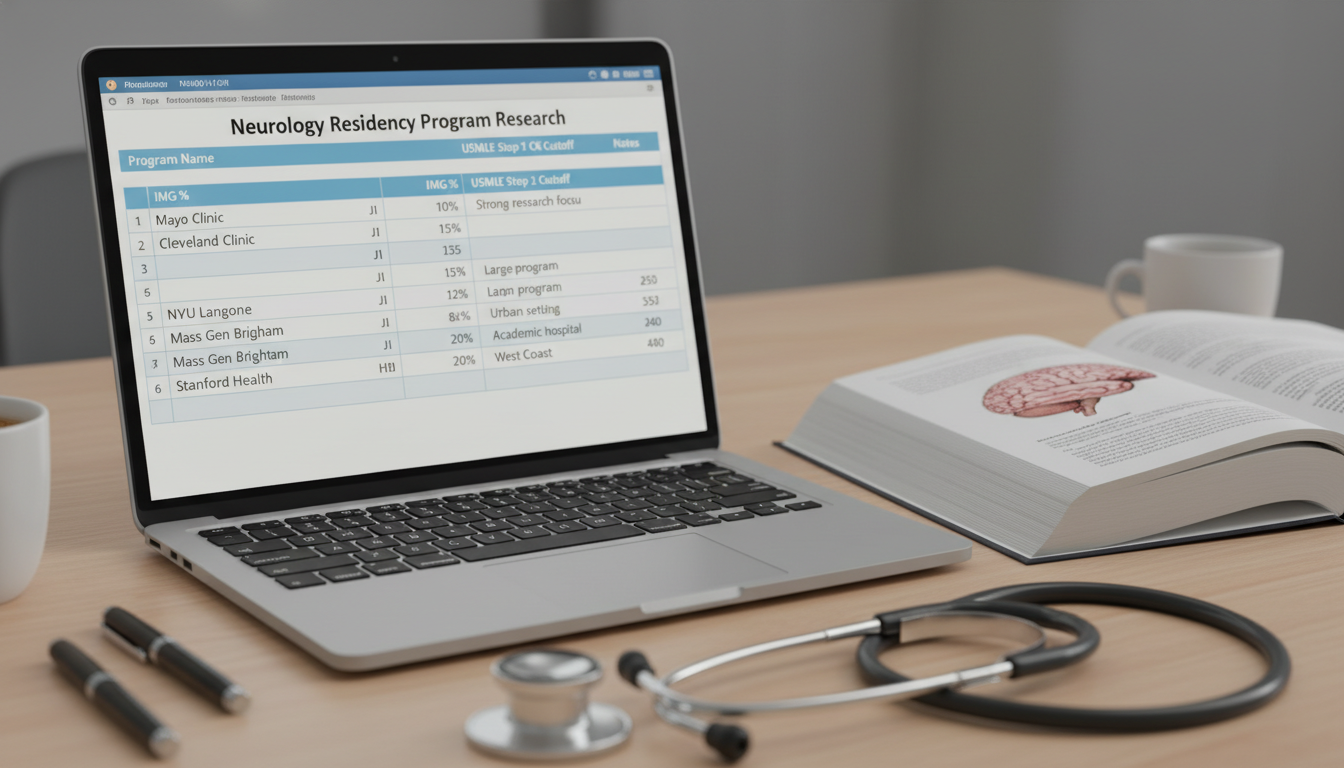
- Export or manually record all neurology programs into a spreadsheet (Excel, Sheets, or Notion). Include columns for:
- Program name
- City/State
- University vs. community
- Preliminary year arrangement
- Website URL
2. Add Supplementary Sources
After establishing the base list, layer on other resources:
- Program websites (official, most authoritative for policies)
- Doximity Residency Navigator (useful for reputation, alumni opinions, subspecialty strength—but not perfect)
- Resident physician Reddit, Student Doctor Network, and specialty forums
- Use cautiously; good for “soft” information (culture, workload) but verify facts.
- LinkedIn searches
- Look at current and past residents for patterns in IMG representation and visa sponsorship.
Step 3: Identify Neurology Programs Open to Non‑US Citizen IMGs
For a foreign national medical graduate, the first critical filter in researching programs is not prestige—it’s eligibility and visa policy.
1. Visa Sponsorship: Reading Between the Lines
Program websites vary from very clear to extremely vague. Look for:
- Explicit statements like:
- “We sponsor J-1 visas only.”
- “We sponsor J-1 and H-1B visas.”
- “We do not sponsor visas; applicants must have US work authorization.”
- Departments often have a separate GME or institutional page for visa policies. Always check both the neurology and the GME site.
Red flags and gray zones:
“We accept only applicants who are legally authorized to work in the US”
→ Usually means no visa sponsorship; requires Green Card, citizenship, or other independent authorization.“Visa sponsorship decisions are made by the GME office” without details
→ Call or email the coordinator if time allows. Document their response in your spreadsheet.
Action:
- Add a “Visa” column in your sheet:
- J-1 only
- J-1 + H-1B
- No sponsorship / US work authorization required
- Unclear (needs verification)
2. Evidence of IMG-Friendliness
You’re not just a non-US citizen—you’re also an IMG. Look for signs of real IMG inclusion:
- Current residents’ profiles:
- How many are IMGs?
- Are there foreign medical schools represented?
- Are there non-US citizens (often inferred from medical school locations or LinkedIn profiles)?
- Alumni list:
- Do they have a track record of training foreign national medical graduates?
- Program website text:
- Phrases like “We welcome applications from international medical graduates” vs. no mentions at all.
Action:
- Add an “IMG-Friendliness” column, graded as:
- Strong evidence (many IMGs currently or recently)
- Some evidence (a few IMGs)
- Minimal/unclear (rare or no visible IMGs)
3. Minimum Requirements That Affect IMGs
Pay close attention to:
- USMLE cutoffs:
- Explicit Step 2 CK minimums (e.g., 220, 230)
- “Must pass on first attempt” or “No failures”
- Graduation year limits:
- Many programs require graduation within 3–5 years.
- US clinical experience requirements:
- “At least 3 months of USCE”
- “Hands-on clinical experience required” (observerships may not count)
Action:
- Add columns for:
- Step 2 CK minimum (if stated)
- Attempts policy (if stated)
- Max years since graduation
- USCE requirement
Then mark each program as:
- “Likely compatible”
- “Possibly compatible”
- “Not compatible” with your profile.
Step 4: Evaluate Neurology Training Quality and Fit
Once you’ve filtered for eligibility and IMG openness, your next task is evaluating residency programs for training quality, educational environment, and long-term fit within neurology.
1. Core Neurology Training Structure
Key aspects of a strong neurology residency:
- Scope of clinical exposure:
- Stroke, epilepsy, neurocritical care, neuromuscular, movement disorders, MS, neuroimmunology, cognitive/behavioral neurology, neurology ICU exposure.
- Patient mix:
- Academic centers often see complex tertiary referrals.
- Community programs may offer more hands-on autonomy and broader general neurology.
Check:
- Curriculum pages
- “Sample rotation schedule”
- PGY-2 through PGY-4 distribution of inpatient vs. outpatient neurology
Action:
- Add “Academic vs community” and a brief note on subspecialty breadth.
2. Subspecialty and Fellowship Opportunities
If you have an interest in a subspecialty (stroke, epilepsy, neurocritical care, movement disorders, etc.), this becomes especially important.
Look for:
- In-house neurology fellowships
- Number of faculty in your area of interest
- Recent fellows’ match outcomes (where do residents go after graduation?)
For a non-US citizen IMG, being in a program with active fellowships can create:
- More opportunities for research
- Easier pathway into fellowship (particularly valuable if you remain on a visa)
Action:
- Add a “Fellowships/Research potential” column:
- Strong (multiple in-house fellowships, active research)
- Moderate
- Limited
3. Educational Culture and Support
As a foreign national medical graduate, you may have additional adaptation needs (language nuance, system differences). Look for:
- Protected didactics (regular, non-service interrupted teaching)
- Board review sessions
- Simulation training (codes, stroke alerts, lumbar puncture practice)
- Evidence of support for remediation or individualized coaching
On websites or forums, look for:
- “We prioritize education over service”
- “Residents have protected half-day of didactics weekly”
- Positive comments from former IMGs about support and teaching
Step 5: Develop a Structured Program Research Strategy
Now you have the components. Next is creating a systematic approach to how to research residency programs so you don’t get overwhelmed.
1. Organize Your Spreadsheet into Tiers
Based on your findings so far, create three main tiers:
Tier 1 – Strong Fit and Eligibility
- Visa clearly sponsored (matching your needs)
- IMG-friendly track record
- Requirements align with your USMLE scores, graduation year, and USCE
- Neurology training meets your educational goals
Tier 2 – Possible Fit / Needs Clarification
- Some uncertainty: unclear visa policy, borderline score cutoffs, or limited IMG history
- Training seems reasonable, but data incomplete
Tier 3 – Low Probability / Mismatch
- No visa sponsorship or incompatible visa
- Strict score or recency cutoffs you clearly don’t meet
- Strong evidence of US grad preference only
Your ultimate application list should be heavily weighted toward Tier 1 and selected Tier 2 programs.
2. Prioritize by Geography and Lifestyle
Realistically, you will spend 3–4 years in one place. Consider:
- Proximity to family or support networks
- Cost of living (high in major cities vs. moderate/small cities)
- Tolerance for climate (winters in the Midwest/Northeast vs. milder climates)
- Availability of cultural/religious communities important to you
Geography also interacts with IMG-friendliness:
- Many IMGs match to neurology programs in the Midwest, South, and some East Coast community/university-affiliated hospitals.
- Ultra-competitive coastal programs may accept fewer IMGs and often fewer non-US citizens.
Action:
- Add a personal preference score (1–5) for each location.
- Programs with both strong fit and good geographical preference become your top targets.
3. Use a Time-Blocked Research Schedule
To avoid burnout:
- Dedicate 1–2 hours per day for 2–3 weeks to research neurology programs.
- Each day, fully review 5–10 programs:
- Website
- GME/visa page
- Resident profiles
- Quick search on forums/LinkedIn
- Immediately enter information into your spreadsheet.
By the end, you’ll have a clear, evidence-based view of your realistic neurology neuro match landscape.
Step 6: Communicate Proactively (Without Crossing Boundaries)
Reaching out to programs as a non-US citizen IMG can be helpful if done strategically and respectfully.
1. When to Contact Program Coordinators
Good reasons to email:
- Visa policy is unclear and not answered on their website.
- Graduation year or USCE requirements are ambiguous.
- You have a very specific, factual question not answered online.
Sample concise email for visa clarification:
Subject: Inquiry About Visa Sponsorship – Neurology Residency
Dear [Coordinator’s Name],
I hope you are well. I am a non-US citizen IMG interested in applying to the [Institution Name] Neurology Residency Program for the upcoming match. I have carefully reviewed the program and GME websites but could not find a clear statement regarding visa sponsorship.
Could you please confirm whether your program sponsors J-1 visas, H-1B visas, or both for incoming residents?
Thank you very much for your time and assistance.
Sincerely,
[Your Full Name]
[Medical School, Country]
AAMC ID: [if available]
Document any responses directly in your sheet.
2. When to Contact Residents or Alumni
Appropriate goals:
- Understanding work environment, culture, and support for IMGs
- Gaining insight on day-to-day life, call schedule, and education
- Clarifying how IMGs have historically been integrated into the program
Use professional channels:
- Program “Meet the Residents” pages if they list emails
Keep your messages short, respectful, and specific. Avoid asking for favors (e.g., “Please recommend me to your PD”) in the first contact.
3. Using Virtual Open Houses and Webinars
Many neurology programs now host:
- Virtual open houses
- Q&A webinars
- Specialty nights for IMGs or international applicants
Use these to:
- Observe how program leadership talks about IMGs and visa sponsorship
- Ask one or two specific, thoughtful questions
- Take notes on how supportive and organized the program appears
Participation in such events can also subtly reflect seriousness and interest.
Step 7: Finalizing Your Application List and Strategy
Once your research is complete, you need to convert it into a concrete plan.
1. Balance Your List by Competitiveness and Fit
For a non-US citizen IMG applying in neurology, consider:
- The total number of applications needed varies by profile, but often falls between 60–100 neurology programs, especially if you have any red flags.
- Distribute applications:
- 20–30% to “Reach” programs
- 40–50% to “Realistic” programs (where your scores and profile match or slightly exceed typical residents)
- 20–30% to “Safety” programs (more IMG-friendly, lower average scores)
Use Doximity reputation and available match data only as secondary indicators; your primary concern is eligibility + IMG track record + neurology training quality.
2. Customize Your Application Narrative
Your program research affects more than where you apply—it should also shape how you present yourself. In your personal statement and experiences:
- Emphasize neurology commitment with specific experiences and cases.
- Acknowledge your status as a foreign national medical graduate positively, highlighting:
- Adaptability
- Cross-cultural communication skills
- Unique perspectives for diverse patient populations
- If applying heavily to programs known for stroke, epilepsy, or neurocritical care, subtly highlight your interest or experiences in those areas.
3. Prepare for Supplementals and Interviews
Some programs might ask:
- Why our program?
- Why this region?
- How do you see yourself contributing as an IMG?
Because you’ve invested in program research, you’ll be ready to answer in a specific, sincere way:
- “I’m particularly drawn to your strong neurocritical care exposure with a dedicated NCCU rotation in PGY-4…”
- “As a non-US citizen IMG, your clear history of supporting international residents, including J-1 sponsorship and successful fellowship placement, is important to me…”
Your prior research enables you to be precise and believable.
Frequently Asked Questions (FAQ)
1. How many neurology programs should a non-US citizen IMG apply to?
The answer depends on your competitiveness, but many non-US citizen IMGs target 60–100 neurology programs, especially if:
- Step 2 CK is below the average of matched neurology applicants
- There are exam attempts, older graduation year, or limited USCE
- You are restricted to H-1B only
If you are a strong applicant (higher scores, recent graduation, USCE, neurology research), you may do well with fewer applications, but it’s safer to err on the higher side given visa-related filters.
2. Where can I find reliable information on which programs sponsor visas?
Use a layered approach:
- Program website → “How to Apply,” “International Applicants,” or “Visa Information” sections
- Institutional GME Office website (often has a dedicated visa policy page)
- Direct email to program coordinator for unclear or conflicting information
- Current residents or alumni (to confirm what actually happens in practice)
Never rely solely on forum comments or outdated lists; always cross-check with current official sources.
3. How do I know if a program is truly IMG-friendly?
Look for concrete indicators:
- Multiple current or recent residents from international medical schools
- Profiles of foreign national medical graduates on the residency website
- Clear, welcoming language toward IMGs on the program site
- Reasonable score and graduation year policies (not clearly excluding most IMGs)
- Positive reports from IMGs on forums or social media (interpreted cautiously)
One or two IMGs alone doesn’t guarantee a fully supportive environment—but a consistent pattern of IMGs over years is a strong sign.
4. Is it realistic for a non-US citizen IMG to match into neurology?
Yes. Neurology has historically been more accessible to IMGs compared to some other specialties, and many neurology programs actively value the diversity and perspective that IMGs bring. However, your chances depend on:
- Solid USMLE scores (especially Step 2 CK)
- Some US clinical exposure (ideally neurology-related)
- Strong letters and a clear narrative of commitment to neurology
- A well-researched, broad, and strategically constructed program list
By following a structured program research strategy—focusing on visa eligibility, IMG-friendliness, and training quality—you significantly improve your odds of a successful neuro match as a non-US citizen IMG.