Why Thoughtful Program Research Matters for a Non-US Citizen IMG in Pathology
For a non-US citizen IMG interested in pathology residency, what you apply to matters as much as how strong your application is. Visa policies, institutional culture, and the structure of pathology training vary widely between programs. Without a deliberate program research strategy, even a strong foreign national medical graduate can end up:
- Wasting money on applications to programs that never sponsor visas
- Applying disproportionately to places that rarely interview or rank IMGs
- Missing hidden “IMG-friendly” programs that fit them well
- Landing in programs with weak board pass rates or minimal subspecialty exposure
The goal of this guide is to walk you through how to research residency programs in a systematic, efficient way—specifically tailored to a non-US citizen IMG pursuing pathology residency.
You’ll learn:
- Where to find reliable program information
- How to evaluate program fit as a foreign national medical graduate
- How to prioritize programs based on your goals, metrics, and visa status
- Practical examples and workflows you can start using today
Step 1: Understand the Pathology Training Landscape as a Non-US Citizen IMG
Before diving into specific program websites, you need context on how pathology residency works in the US and what it means for a non-US citizen IMG.
1.1 Types of Pathology Programs (AP, CP, AP/CP)
US pathology residency is typically 3–4 years and comes in different tracks:
AP/CP combined (most common)
- 4 years
- Training in both anatomic pathology (AP) and clinical pathology (CP)
- Most graduates pursue fellowships afterward (e.g., cytopathology, hematopathology, GI, molecular, etc.)
AP-only or CP-only
- Less common for IMGs as first entry
- Sometimes better for specific career plans but more limiting early on
As a non-US citizen IMG, AP/CP programs tend to provide the broadest opportunities, especially if you’re not yet certain which subspecialty you’ll pursue.
1.2 Key Extra Challenges for a Non-US Citizen IMG
When you plan your program research strategy, keep these IMG-specific issues at the center:
Visa Sponsorship
- Some programs:
- Sponsor J-1 only
- Sponsor J-1 and H-1B
- Do not sponsor any visas (only accept US citizens/green card holders)
- A non-US citizen IMG must filter programs by visa policy first, or risk a lot of wasted applications.
- Some programs:
US Clinical/Research Experience
- Many pathology programs prefer:
- US pathology observerships/externships
- US-based research or publications
- Some are more forgiving and explicitly state openness to IMGs with strong overall credentials, even without extensive US experience.
- Many pathology programs prefer:
IMG Friendliness
- % of current residents and recent graduates who are IMGs
- Historical match patterns (do they regularly rank foreign national medical graduates?)
- Program culture—supportive vs. skeptical of IMGs
State Licensing Rules
- Some states have stricter requirements for foreign medical schools and years of training
- This can indirectly affect how some pathology programs view non-US citizen IMGs
Understanding these constraints helps you research programs in a targeted way instead of relying on random lists or hearsay.
Step 2: Build Your Information Base – Sources for Pathology Program Research
To research pathology residency programs effectively, you’ll combine multiple sources. Each has strengths and limitations, so using several in parallel gives the most accurate picture.
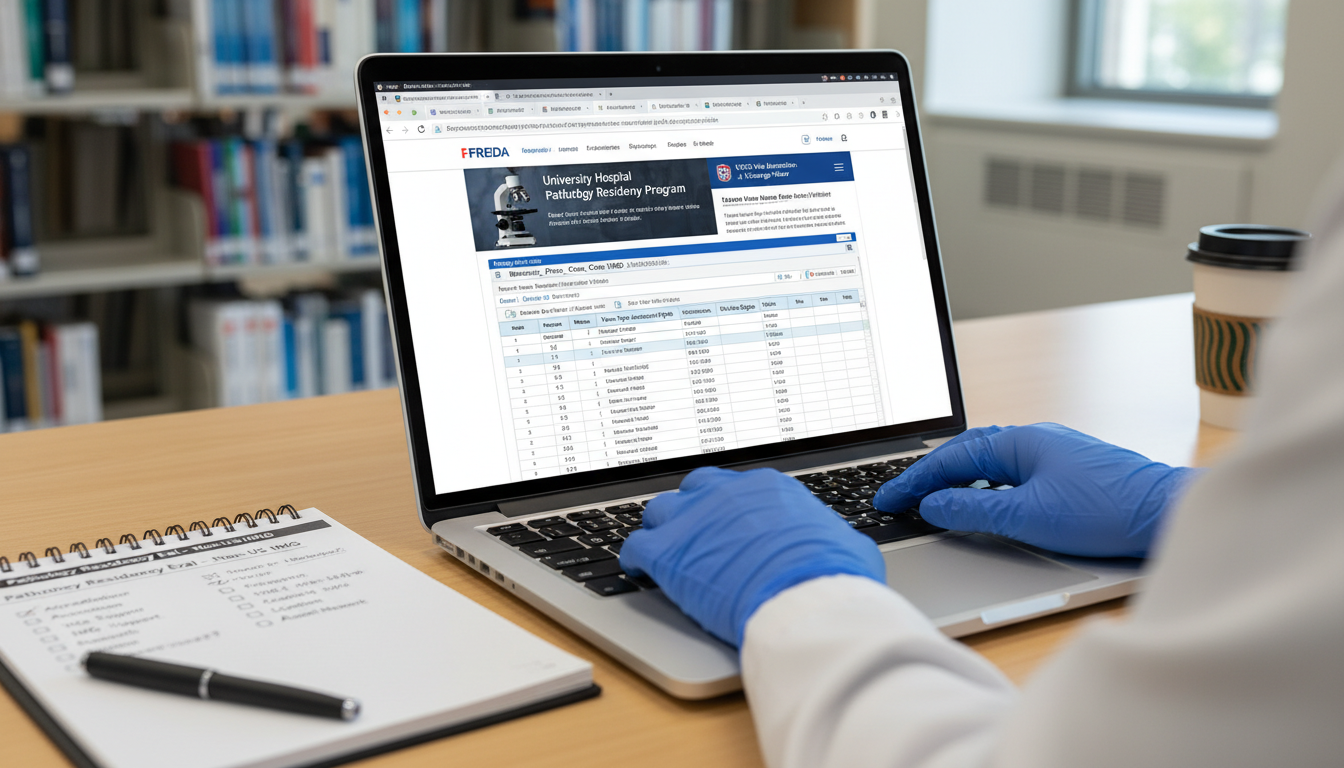
2.1 FREIDA (AMA Residency & Fellowship Database)
What it’s good for:
- List of ACGME-accredited pathology programs
- Program size (number of residents)
- Basic stats (board pass rates sometimes, benefits, etc.)
- Visa information (J-1, H-1B, none)—though not always perfectly updated
How to use it for a non-US citizen IMG:
- Filter for Pathology – Anatomic and Clinical (AP/CP)
- Use filters for:
- Visa types accepted
- Program size (small vs. large departments)
- Export or record program names for your spreadsheet.
2.2 NRMP “Charting Outcomes” and Program Data
NRMP resources:
- Charting Outcomes in the Match (US Seniors and IMGs)
- Program Director Survey
They help you understand:
- USMLE score ranges for matched vs. unmatched IMGs in pathology
- Importance of:
- USMLE scores
- Letters of recommendation
- US experience
- Research
- Relative competitiveness of pathology compared to other specialties
Use this to calibrate your expectations and decide whether to focus on more academic vs. community-oriented programs.
2.3 Official Program Websites
This is where the most accurate program-specific information lives.
On each pathology residency website, look for:
- Visa sponsorship details (J-1 vs. H-1B vs. none)
- Statements like “We welcome applications from international medical graduates”
- Requirements for:
- USMLE cutoffs (Step 1, Step 2 CK, sometimes Step 3 for H-1B)
- Time since graduation (e.g., “within 5 years”)
- US clinical or pathology experience
- Resident profiles:
- Medical school backgrounds
- Proportion of US grads vs. IMGs
- Curriculum:
- AP/CP balance
- Rotations at academic vs. community hospitals
- Research:
- Subspecialty areas (hematopathology, molecular, neuropathology, etc.)
- Mentor availability for residents
- Outcomes:
- Recent fellowship placements
- Board pass rates (AP and CP)
2.4 ERAS and Program Websites During Application Season
ERAS program descriptions sometimes include:
- Whether they consider foreign national medical graduates
- Explicit statements on visa sponsorship
- Application requirements and deadlines
- Any deal-breakers (USMLE attempts limit, graduation year limit)
Compare this information with FREIDA and official program sites; if there’s a conflict, trust the program’s official site or email them for clarification.
2.5 Alumni Networks, Forums, and Social Media
While less “official,” these can fill in gaps:
- Your own school’s alumni in US pathology residencies
- Online communities:
- Specific IMG/pathology forums or Discord groups
- Reddit (e.g., r/medicalschool, r/Residency) – use cautiously
- Program Instagram, Twitter (X), or LinkedIn accounts:
- See diversity of residents
- Sense of culture and resident life
Use these to validate your impressions from official data—but avoid basing major decisions solely on anonymous posts.
Step 3: Design a Practical Program Research Strategy (Spreadsheet + Filters)
You need a system to track all this information. A structured spreadsheet is the core of any good program research strategy.
3.1 Create Your Master Spreadsheet
Suggested columns for a foreign national medical graduate applying in pathology:
Basic Program Info
- Program name
- City, State
- Type (academic / community / hybrid / county)
- AP/CP vs. AP-only / CP-only
- Program size (number of residents per year)
Visa & IMG-Related
- Visa types accepted (J-1 / H-1B / none / unclear)
- IMG-friendly? (Yes/No/Unknown)
- % current residents who are IMGs (approximate)
- Max years since graduation allowed
- USMLE cutoffs (if given)
- US experience required/preferred? (Observerships, research, etc.)
Training & Outcomes
- Board pass rate (if available)
- Fellowship placements (strong/average/unclear)
- Subspecialties available (hematopath, cytopath, GI, derm, molecular, etc.)
- Research opportunities (strong/average/limited)
Location & Lifestyle
- Region (Northeast, South, Midwest, West)
- City size (rural, suburban, mid-sized city, major metro)
- Cost of living (approximate: low/medium/high)
Subjective & Logistical
- First impression of website (clear/organized vs. vague)
- Culture based on resident photos/social media (diverse? welcoming?)
- Application deadline
- Special notes (e.g., “requires Step 3 for H-1B,” “excellent hematopath program,” “no visa info—must email”)
3.2 Filtering Programs by Visa and Eligibility
As a non-US citizen IMG, the first filter is non-negotiable:
Delete or mark in red all programs that clearly state:
- “We do not sponsor visas” or
- “We only accept US citizens or permanent residents”
Among remaining programs, create categories:
- J-1 only
- H-1B + J-1
- Unclear / need clarification
If you plan to pursue an H-1B, note additional barriers:
- Some require USMLE Step 3 passed before ranking you
- Some limit H-1B to specific departments or have institutional caps
For many foreign national medical graduates, J-1 is the default path. If you’re open to J-1, your pool of programs will be larger.
3.3 Matching Programs to Your Profile (Scores, Graduation Year, Experience)
Next, filter based on your competitiveness and background:
USMLE / Step 2 CK scores
- If a program lists a hard minimum (e.g., 220) and you are below this, mark it as a reach or consider skipping.
- If no cutoff is given, use NRMP “Charting Outcomes” to gauge whether your scores are in the typical range for matched IMGs in pathology.
Years since graduation
- If you graduated >5–7 years ago, look for programs that:
- Do not specify a recency requirement, or
- Explicitly state willingness to consider older graduates with strong experience.
- If you graduated >5–7 years ago, look for programs that:
US Experience & Research
- If you have significant US pathology observerships or research:
- Include more academic/university programs—they may value your research profile.
- If you lack US experience:
- Lean more heavily toward programs that do not require US experience and have a track record with IMGs from overseas.
- If you have significant US pathology observerships or research:
This process helps you define tiers of programs:
- Tier 1 (Strong fit): Visa-friendly, IMG-friendly, your scores and background clearly within range
- Tier 2 (Moderate fit): Somewhat competitive for you, or less clear on IMGs but still possible
- Tier 3 (Reach): Higher scores, top academic centers, or vague about IMGs but worth a few applications if they align with your dreams
Step 4: Evaluating Residency Programs for Fit (Beyond Visa and Scores)
Once you have a filtered list of programs that can take you, you need to determine where you will actually thrive.

4.1 Academic Reputation vs. Training Quality
Reputation matters, but in pathology, case mix, teaching quality, and fellowships are more important than “brand name” alone.
Key questions to ask in your research:
- Does the program have strong AP and CP training or is it skewed?
- Are there in-house fellowships (e.g., cytopath, hemepath, GI, molecular, neuropathology)?
- Do graduates consistently match into good fellowships (whether internal or external)?
- Are attendings known for education, or is the department heavily service-driven?
Look at:
- Fellowship placement lists on program websites
- Research publications from the department
- Resident presentations at national pathology meetings
4.2 Case Volume and Diversity
Pathology is a pattern-recognition and exposure-based specialty. You want programs where you’ll see:
- A wide variety of surgical pathology cases
- Adequate volume in cytopathology, hematopathology, transfusion medicine, microbiology, molecular
Large academic centers often excel in complex and rare cases, while some community-based or county programs provide high-volume bread-and-butter pathology—both are valuable. The best programs have a balanced mix, sometimes through affiliations with multiple hospitals.
Check:
- Number of surgical cases/year (if listed)
- Whether they are tertiary referral centers or mainly community hospitals
- Rotations in VA/County/Children’s hospitals (broadens exposure)
4.3 IMG Friendliness and Department Culture
To evaluate residency programs for IMG friendliness:
- Review the current residents’ list:
- How many are non-US citizen IMGs or IMGs in general?
- Are multiple countries represented?
- Check faculty backgrounds:
- IMGs among faculty are a positive sign—they may understand your journey.
- Look for language on the website like:
- “We value diversity and welcome international medical graduates”
- “A significant number of our residents are IMGs”
A foreign national medical graduate is more likely to feel supported in a program that has:
- Systems in place for visa and immigration issues
- Experience helping IMGs adjust to the US healthcare system
- A collegial environment (look for photos of residents together, wellness activities, mentorship programs)
4.4 Research, Teaching, and Career Development
Even if you’re not aiming for a pure academic career, strong academic infrastructure offers significant benefits:
- Better preparation for boards and fellowships
- Mentors who can write strong, detailed letters
- Opportunities to present at national conferences (good for your CV and networking)
Ask in your research:
- Are there required scholarly projects?
- Do residents frequently publish or present?
- Is there protected time for:
- Journal clubs
- Slide conferences
- CP conferences
- Board review sessions
4.5 Location and Lifestyle Considerations
As a non-US citizen IMG, you should also think practically about:
- Cost of living
- Can you manage financially on a resident salary given your visa restrictions (often limiting moonlighting)?
- Weather and transportation
- Harsh winters vs. mild climates; public transport vs. needing a car
- Community
- Presence of cultural communities or religious centers important to you
- Support for families
- If you’ll bring a spouse or children, check:
- Schools
- Childcare options
- Job market for spouse (within visa constraints)
- If you’ll bring a spouse or children, check:
While this might seem secondary, poor alignment with location can significantly affect your well-being during training.
Step 5: Reaching Out and Filling Information Gaps
Some critical questions—especially around visa sponsorship and IMG policies—might not be clearly stated anywhere. In those cases, polite, targeted emails can clarify.
5.1 When to Email a Program
It’s reasonable for a foreign national medical graduate to email when:
- Visa information is unclear or conflicting between FREIDA and the website
- You need to confirm whether:
- They sponsor H-1B
- They consider applicants more than X years after graduation
- You have a very specific question (e.g., “Is Step 3 required by the rank list deadline for H-1B?”)
Avoid asking questions that are clearly answered on their website or ERAS page.
5.2 How to Write a Concise, Professional Email
Structure:
- Brief self-introduction (name, non-US citizen IMG, interested in pathology)
- Express specific interest in their program (1 line, not flattery)
- Ask 1–2 focused questions
- Thank them for their time
Example:
Subject: Question about Visa Sponsorship – Pathology Residency
Dear Dr. [Program Director Last Name],
I am a non-US citizen international medical graduate from [Medical School, Country] interested in applying to your pathology residency program. I have reviewed your website and FREIDA listing, but I wanted to clarify your current visa policy.
Could you please let me know whether your program sponsors J-1 and/or H-1B visas for incoming residents?
Thank you very much for your time and consideration.
Sincerely,
[Your Full Name]
[Medical School, Graduation Year]
Record the responses in your spreadsheet to keep your data organized.
Step 6: Turning Research Into a Smart Application List
After you’ve completed your program research, the final step is to translate information into decisions about where and how broadly to apply.
6.1 Balancing Safety, Target, and Reach Programs
As a non-US citizen IMG in pathology, consider a rough distribution:
50–60% Target programs
- Your scores, graduation year, and profile match their usual range
- They have a history of taking IMGs and sponsoring your visa type
20–30% Safety programs
- Clearly IMG-friendly
- Possibly in less competitive locations
- May have more modest research or prestige, but solid training
10–20% Reach programs
- Strong academic centers or highly desirable locations
- Less clear about IMGs, but not explicitly closed to them
Actual numbers depend on your budget and how competitive you appear based on NRMP data and self-assessment.
6.2 Common Pitfalls to Avoid in Program Research
- Ignoring visa details and applying to programs that will never interview you
- Overemphasizing reputation and underestimating the importance of daily training quality and culture
- Relying only on word-of-mouth or anonymous forums without checking official sources
- Not tailoring your list to your actual metrics and profile
- Applying only to programs in big cities and missing excellent, IMG-friendly training in smaller cities or moderate-sized towns
6.3 Continuous Updating During Interview Season
Keep your spreadsheet active:
- When you receive an interview, highlight the program and add a column for:
- Interview date
- Impression (after the interview)
- Strengths/concerns
This will help you later when you form your rank list, again balancing:
- Training quality
- Visa certainty
- IMG friendliness
- Personal and family needs
Frequently Asked Questions (FAQ)
1. How many pathology programs should a non-US citizen IMG apply to?
The “right” number varies, but many foreign national medical graduates applying to pathology target:
- 30–60 programs if they are moderately competitive and have J-1 eligibility
- 40–70+ programs if:
- Scores are borderline
- Graduation is >5–7 years ago
- Limited US experience
The key is not just number, but smart program research—applying to programs that actually accept and sponsor non-US citizen IMGs with your profile.
2. How can I quickly identify IMG-friendly pathology residency programs?
Use a combination of:
- FREIDA filters for visa sponsorship
- Program websites:
- Check resident lists for IMGs
- Look for explicit mention of welcoming international graduates
- Alumni or networks from your medical school
- NRMP data and online communities (as secondary sources)
If a program has multiple current IMGs, sponsors J-1 or H-1B, and does not list harsh cutoffs against older graduates, it is likely more IMG-friendly.
3. Is research experience important when evaluating pathology programs?
Yes, especially if you are interested in:
- Academic careers
- Competitive fellowships (molecular, hemepath, GI, etc.)
While you can still become a competent pathologist from a less research-heavy program, programs with active research environments:
- Offer better mentorship and networking
- Strengthen fellowship applications
- Often provide more structured teaching and conferences
When researching residency programs, check for faculty publications, resident presentations, and whether research output is visible on the website.
4. Should I prioritize programs that offer H-1B over J-1 as a non-US citizen IMG?
It depends on your long-term immigration plans:
H-1B
- Advantage: May offer a smoother transition to long-term work visas/green card
- Disadvantages:
- More competitive to secure
- Many programs do not offer it
- Often requires USMLE Step 3 before starting
J-1
- More widely available
- Well-understood by teaching hospitals
- Requires a J-1 waiver job after training if you wish to remain in the US
In your program research strategy, you can mark which programs sponsor H-1B, but most non-US citizen IMGs keep J-1 as the primary expected path and apply broadly to J-1–sponsoring programs.
By approaching your pathology residency search with a structured, data-driven program research strategy, you move from hopeful guessing to informed decision-making. As a non-US citizen IMG, this systematic approach—focusing on visa policies, IMG friendliness, training quality, and personal fit—will significantly increase your chances of matching into a pathology residency where you can thrive and build the foundation for a successful career.