
Choosing where to apply is just as important as how strong your application is—especially if you are a non-US citizen IMG targeting the highly specialized Pediatrics–Psychiatry–Child & Adolescent Psychiatry (Triple Board) pathway. Because programs are limited in number and visa policies are complex, your program research strategy must be deliberate, data-driven, and tailored to your immigration status and training goals.
Below is a step-by-step guide on how to research residency programs in Pediatrics-Psychiatry as a foreign national medical graduate, with a focus on practical tools, red flags, and actionable strategies.
Understanding the Triple Board Pathway and Its Unique Challenges
Triple Board programs are structured 5-year residencies that integrate:
- Pediatrics
- General Psychiatry
- Child & Adolescent Psychiatry
Graduates are eligible for board certification in all three areas. There are very few Triple Board programs in the US (typically fewer than 15), all highly competitive and predominantly academic and university-based.
For a non-US citizen IMG, this creates a unique set of challenges:
- Small number of programs → limited seats, higher competition
- High expectations for academic preparation → strong scores, clinical exposure, and letters
- Variable visa support → not every program sponsors J-1 or H-1B
- Preference for US clinical experience (USCE) → often pediatric or psychiatry rotations are expected
Understanding these realities shapes how you should prioritize and evaluate residency programs.
Step 1: Clarify Your Personal Priorities and Constraints
Before you open any program list, define what you actually need. This will prevent you from wasting time on programs that are a poor fit from the start.
1. Immigration/Visa Needs
As a foreign national medical graduate, your first filter is immigration:
- Are you eligible for a J-1 visa through ECFMG?
- Do you strongly prefer (or require) an H-1B visa?
- Are you currently in another US status (e.g., F-1, H-4) and planning a change of status?
Write down:
- Which visas you are willing to consider (J-1 only, J-1 or H-1B, H-1B only).
- Any obligations (e.g., home-country return requirement after J-1, government scholarship conditions).
This will become your first “hard filter” when researching programs.
2. Academic and Professional Profile
Assess your current competitiveness:
- USMLE/COMLEX scores and attempts
- Medical school type (recognized vs. lesser-known)
- Amount and quality of US clinical experience, especially in pediatrics and psychiatry
- Research or publications in child psychiatry, developmental pediatrics, or mental health
- Graduation year (recent graduate vs. older graduate)
This helps determine whether you should:
- Aim straight for Triple Board
- Apply broadly to Peds-Psych combined, standalone Pediatrics, and standalone Psychiatry programs as well
- Consider a preliminary or transitional year (less common and less ideal here, but sometimes considered as a stepping stone)
3. Personal and Lifestyle Priorities
Triple Board is intense. Location and environment matter:
- Geographic preferences or constraints (family, finances, climate, safety)
- Cost of living (urban academic centers vs. smaller cities)
- Cultural and religious community availability
- Interest in academic, research-focused programs vs. more clinically heavy environments
Write these into a simple priority list:
- “Non-negotiable” (e.g., must sponsor J-1; must consider IMGs)
- “Strongly preferred” (e.g., family-friendly city, lower cost of living)
- “Nice to have” (e.g., strong global health electives)
You’ll use this framework to evaluate residency programs later.
Step 2: Build a Master List of Potential Programs
With your needs clear, start building your program research strategy using multiple sources.
1. Use Official Directories
Start with:
FREIDA (AMA Residency & Fellowship Database)
- Filter by:
- Program type: “Combined Pediatrics/Child Psychiatry/Adult Psychiatry” or search “Triple Board”
- State(s) of interest
- Review each program profile:
- Program type and length
- Program director details
- Visa information (if listed—always verify directly)
- Filter by:
NRMP/ERAS Program Listings
- During application season, search for Pediatrics-Psychiatry-Child and Adolescent Psychiatry combined programs.
- Note ACGME program codes, which you’ll need for ERAS.
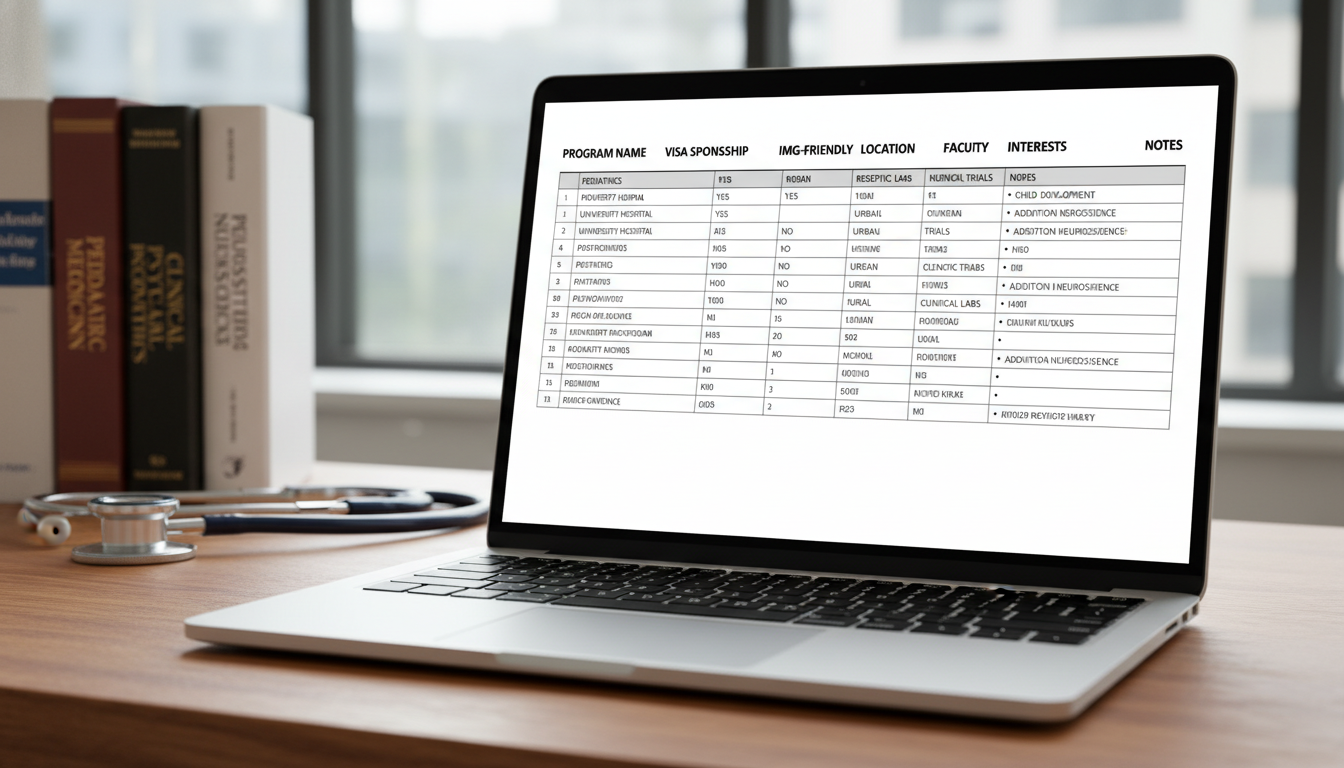
Create a spreadsheet with:
- Program name
- City/State
- ACGME/NRMP code
- Website link
- Head of program / program coordinator contact
This is your master program list.
2. Add Related and Alternative Programs
Because Triple Board slots are limited, a smart program research strategy for a non-US citizen IMG includes:
- Standalone Pediatrics programs (especially those with strong behavioral pediatrics or child mental health tracks)
- Standalone Psychiatry programs with:
- Strong child & adolescent psychiatry departments
- Available child psychiatry electives during residency
- Other combined Peds-Psych pathways (where available)
Add these to separate tabs in your spreadsheet:
- “Triple Board (Peds-Psych-Child)”
- “Pediatrics (child mental health emphasis)”
- “Psychiatry (strong child focus)”
This ensures you maintain a broad but strategically relevant list.
Step 3: Systematically Investigate Visa and IMG-Friendliness
For a non-US citizen IMG, two core questions dominate early program screening:
- Will this program sponsor my visa?
- Does this program actually interview and match IMGs, especially foreign nationals?
1. Verify Visa Policies
Do not rely only on FREIDA or third-party websites. Use this multi-step approach:
Program website
- Look under “Eligibility,” “International Medical Graduates,” or “FAQ.”
- Look for:
- “We sponsor J-1 visas through ECFMG”
- “We sponsor H-1B visas for eligible candidates”
- Or statements like “We do not sponsor visas” (automatic filter-out)
Email confirmation (when unclear)
If the website is vague or outdated, write a short, professional email to the coordinator:
Subject: Visa Sponsorship for International Applicants – [Program Name]
Dear [Coordinator’s Name],
I am an international medical graduate (non-US citizen) very interested in your Pediatrics–Psychiatry–Child and Adolescent Psychiatry (Triple Board) program.
Could you please confirm whether your program sponsors J-1 visas, H-1B visas, or both for incoming residents?
Thank you for your time and assistance.
Sincerely,
[Your Name], MD
Record in your spreadsheet:
- J-1: Yes/No
- H-1B: Yes/No
- Notes: any conditions (e.g., “H-1B only for US grads,” “must have Step 3 for H-1B”)
Any program that does not support any visa for foreign nationals should be moved to an “exclude” list.
2. Evaluate IMG-Friendliness with Data
Triple Board programs are few, so data may be limited, but you can still:
- Check current residents on the program website
- Where did they attend medical school?
- Are there IMGs among them, especially non-US citizen IMGs, not just US-IMGs?
- Look at alumni lists for previous years
- Have they historically matched graduates from outside the US/Canada?
- Search match lists or program brochures
- Sometimes residencies publish where their residents went to medical school or where graduates go next
Add columns to your spreadsheet:
- “Recent IMG residents? (Y/N)”
- “Non-US citizen IMG observed? (Y/N/Unclear)”
- “General impression: IMG-friendly / Unclear / Not IMG-friendly”
This helps you prioritize programs more likely to genuinely consider foreign nationals, not just claim “we accept IMGs” as a formality.
Step 4: Deep-Dive into Program Content, Training, and Culture
Once you confirm visa and baseline IMG openness, the next step is evaluating residency programs for training quality and fit with your career plans in pediatrics-psychiatry.
1. Analyze Curriculum and Rotation Structure
For Triple Board programs in particular, review:
- Distribution of years between Pediatrics, Adult Psychiatry, and Child & Adolescent Psychiatry
- When you start child psychiatry exposure (early vs. later years)
- Opportunities for:
- Developmental-behavioral pediatrics
- Integrated care (peds/psych co-located clinics)
- Autism, neurodevelopmental disorders, trauma-related care
On program websites, look for:
- “Curriculum” or “Rotation Schedule” pages
- Sample block diagrams by PGY year
Assess whether the structure supports:
- Balanced identity as both pediatrician and psychiatrist
- Adequate time in child psychiatry to align with your interest in children/adolescents
- Reasonable workload (Triple Board can be intense; watch for signs of overburden)
2. Evaluate Clinical Sites and Patient Populations
Triple Board often involves multiple hospitals (children’s hospitals, psychiatric centers, community clinics). Consider:
- Academic vs. community hospital mix
- Exposure to:
- Urban underserved populations
- Rural or suburban communities
- Diverse cultural and linguistic groups
For a non-US citizen IMG, training in diverse populations can:
- Strengthen your adaptability
- Prepare you for a future J-1 waiver job in underserved areas (if applicable)
Look for descriptions of:
- “Safety net hospital,” “community mental health center,” or “federally qualified health center (FQHC)”
- Clinics focused on:
- Autism spectrum disorders
- ADHD and disruptive behavior
- Mood and anxiety disorders in children
- Consultation-liaison (psych consults on pediatric inpatients)
3. Check Faculty Expertise and Research Opportunities
If you’re interested in academics, fellowships, or leadership, faculty strength matters.
On each program’s site, examine:
Faculty list with interests
- Child psychiatry, developmental pediatrics, early childhood interventions
- Trauma, immigrant/refugee child mental health
- School-based mental health or integrated pediatric-psychiatric care
Research opportunities
- Active projects in child mental health, neurodevelopment, or psychopharmacology
- Opportunities for residents to publish, present at conferences, or pursue scholarly tracks
Add columns such as:
- “Child psych faculty interests (high/moderate/low)”
- “Research intensity (high/moderate/low)”
- “Resident scholarly requirements”
This helps match programs to your goals (e.g., academic vs. community-focused path).
Step 5: Assess Fit Through Hidden Signals and Culture
Not everything is visible in a curriculum outline. You must look for subtle but important signs of resident support, well-being, and culture, which are critical in such a demanding combined training path.
1. Resident Well-Being and Support
Look for:
- Explicit sections on wellness, mental health resources, and fatigue management
- Policies on:
- Parental leave (relevant if you anticipate family changes during residency)
- Vacation and sick leave
- Any mention of burnout prevention, peer support groups, or mentorship programs
Read between the lines:
- Programs that highlight well-being and work-life balance usually care about resident sustainability—important in Triple Board, where burnout risk is real.
2. Support for International Graduates
Specific signs that a program understands the needs of a non-US citizen IMG:
- Website section specifically for IMGs
- Mention of ECFMG certification or assistance with J-1 processing
- Current residents or alumni with international backgrounds
- Responsiveness and clarity when you email about visas or application requirements
If possible, try to identify IMGs among current residents and read any profiles or interviews. Programs that showcase diversity typically have more experience onboarding international trainees.
3. Alumni Outcomes
Triple Board alumni often go into:
- Academic child psychiatry
- Leadership roles in pediatric mental health
- Integrated care clinics or hospital-based services
On the program website or via online searches, look for:
- “Graduate outcomes” or “Where our graduates are now”
- Evidence of graduates:
- Working as Triple Board-trained specialists
- Obtaining academic or leadership positions
- Completing fellowships (beyond required child psych) if relevant
This helps you judge whether the program will help you reach your career goals.

Step 6: Use Direct Contact and Networks to Refine Your List
Online information has limits. For a nuanced understanding—especially for such a niche field—use networking and direct communication.
1. Reach Out to Current Residents or Fellows
Respectfully contact residents, ideally those with international backgrounds or evident interest in diversity.
Sample email:
Dear Dr. [Name],
I am an international medical graduate (non-US citizen) applying to Pediatrics–Psychiatry–Child and Adolescent Psychiatry (Triple Board) programs this cycle. I am very interested in [Program Name] because of its [specific feature you admire].
If you have a few minutes, I would greatly appreciate any advice you might share about:
- The culture and support for residents, especially those from international backgrounds
- How the program balances pediatric and psychiatric responsibilities
- Any tips for an IMG applicant interested in Triple Board
Thank you for considering my message.
Sincerely,
[Your Name]
Keep it concise and polite. Not everyone will respond, but even a few replies can provide invaluable inside information.
2. Attend Virtual Open Houses and Webinars
Many programs now host:
- Virtual open houses
- Q&A sessions with program leadership and residents
- Specialty-focused webinars (e.g., about Triple Board, child psychiatry in general)
Use these to:
- Ask about visa sponsorship and IMG experience (when not clearly addressed)
- Clarify how rotations are structured across the 5 years
- Explore what makes their peds psych residency unique
Take notes and add them to your spreadsheet under “Open House notes.”
3. Leverage Professional and Social Platforms
Use:
- LinkedIn and Doximity to:
- Find graduates of your medical school now in US Pediatrics, Psychiatry, or Triple Board
- Ask for short informational conversations
- Specialty societies:
- American Academy of Child and Adolescent Psychiatry (AACAP) student/resident sections
- American Academy of Pediatrics (AAP) sections (e.g., Section on Developmental and Behavioral Pediatrics)
These contacts can help you refine how to position yourself and evaluate which residency programs align best with your background and interests.
Step 7: Score, Rank, and Finalize Your Application List
By this stage, your spreadsheet should contain:
- Visa data
- IMG-friendliness impression
- Curriculum structure
- Faculty/research strength
- Wellness and culture impressions
- Geographic notes and cost-of-living considerations
- Open house or resident feedback
Now, convert your information into a structured scoring system.
1. Create a Simple Scoring Model
For each Triple Board (and related) program, assign scores (e.g., 1–5) for:
- Visa compatibility
- 5 = J-1 + H-1B; 4 = J-1 with strong support; 1–2 = not clear or no support
- IMG-friendliness
- 5 = current non-US citizen IMGs + explicit supportive language
- 3 = some IMGs but unclear about visas
- 1 = no visible IMGs, unclear or negative tone
- Training structure and fit (Peds-Psych emphasis, child focus, integrated care)
- Faculty and research fit with your interests
- Location/lifestyle suitability
- Program culture and wellness
Weight these categories based on your priorities (e.g., visa compatibility and IMG-friendliness might count double).
2. Create Tiers
After scoring:
Tier 1 (High Priority)
- Strong visa support for non-US citizen IMGs
- Good history of international residents
- Excellent fit with your career interests
Tier 2 (Moderate Priority)
- Acceptable visa policies
- Some IMG presence, but less clear historical support
- Reasonable fit with training goals
Tier 3 (Low Priority / Stretch)
- Very competitive, minimal IMG visibility, unclear visa stance
- But outstanding academic reputation or unique opportunities
Your final application list should balance:
- Ambitious programs (some Tier 1, selected Tier 3)
- Realistic options (primarily Tier 1 and Tier 2)
- Geographic and program-type diversity (Triple Board + closely related Pediatrics/Psychiatry programs as needed)
Step 8: Common Pitfalls for Non-US Citizen IMGs and How to Avoid Them
1. Relying on Outdated Visa Information
Programs change visa policies year to year. Always:
- Verify current year information
- Save email confirmations (if given)
- Recheck websites close to ERAS season
2. Ignoring Alternative but Relevant Pathways
If you strongly want to work in child and adolescent mental health but Triple Board positions are limited:
- Apply to Pediatrics residencies with strong behavioral and developmental pediatrics
- Apply to Psychiatry residencies with robust child psychiatry training and fellowships
- Focus your electives and research on child mental health during residency
You can still build a strong peds psych career even without formally completing a Triple Board program.
3. Underestimating the Importance of Location and Support
As a non-US citizen IMG, you will be adapting simultaneously to:
- A demanding training schedule
- A new healthcare system
- A new culture and often a new language environment
Programs that show strong resident support and have diverse communities may ease this transition significantly. Do not ignore your own well-being in the decision-making process.
Frequently Asked Questions (FAQ)
1. Are Triple Board programs realistic for a non-US citizen IMG?
Yes, but they are highly competitive and few in number. Your chances improve if:
- You have strong USMLE scores and no exam failures
- You possess meaningful US clinical experience in Pediatrics and/or Psychiatry
- You demonstrate clear, sustained interest in child mental health (research, volunteer work, electives)
- You apply with a broad strategy that includes related Pediatrics and Psychiatry programs, not only Triple Board.
2. How many Triple Board programs should I apply to as a foreign national medical graduate?
Because there are so few programs, many applicants interested in Triple Board apply to all programs that are visa-compatible and at least somewhat IMG-friendly. However, you should also:
- Apply to a wider set of Pediatrics and/or Psychiatry programs aligned with your child mental health interests
- Use your scoring system to emphasize programs with realistic visa and IMG track records.
3. How can I tell if a program is truly IMG-friendly?
Look for multiple aligned indicators:
- Presence of current or recent non-US citizen IMGs in residency classes
- Clear website language about supporting IMGs and visas
- Positive or detailed responses when you email about eligibility and visas
- Resident or alumni comments (during open houses or private communication) that reflect inclusivity and support.
No single sign is enough; use a combination.
4. Should I prioritize programs that offer H-1B over J-1 as a non-US citizen IMG?
Not always. H-1B can be advantageous, but:
- Fewer programs offer it, especially in smaller specialties like Triple Board
- H-1B often requires passing USMLE Step 3 before starting residency
- J-1 is widely used, and many IMGs successfully complete a J-1 waiver job afterward
Your decision should consider:
- Your long-term immigration plans
- Your ability to complete Step 3 in time
- The overall training quality and support at J-1-only programs
In most cases, for a peds psych residency focus, it is wise to be open to J-1 sponsorship, as long as the program itself is strong and supportive.
By following a systematic, data-driven program research strategy, you can build a targeted application list that respects your visa needs, supports your career in pediatrics-psychiatry, and maximizes your chances as a non-US citizen IMG. The process takes time and discipline, but the clarity it provides will help you invest your effort—and your ERAS applications—where they truly count.