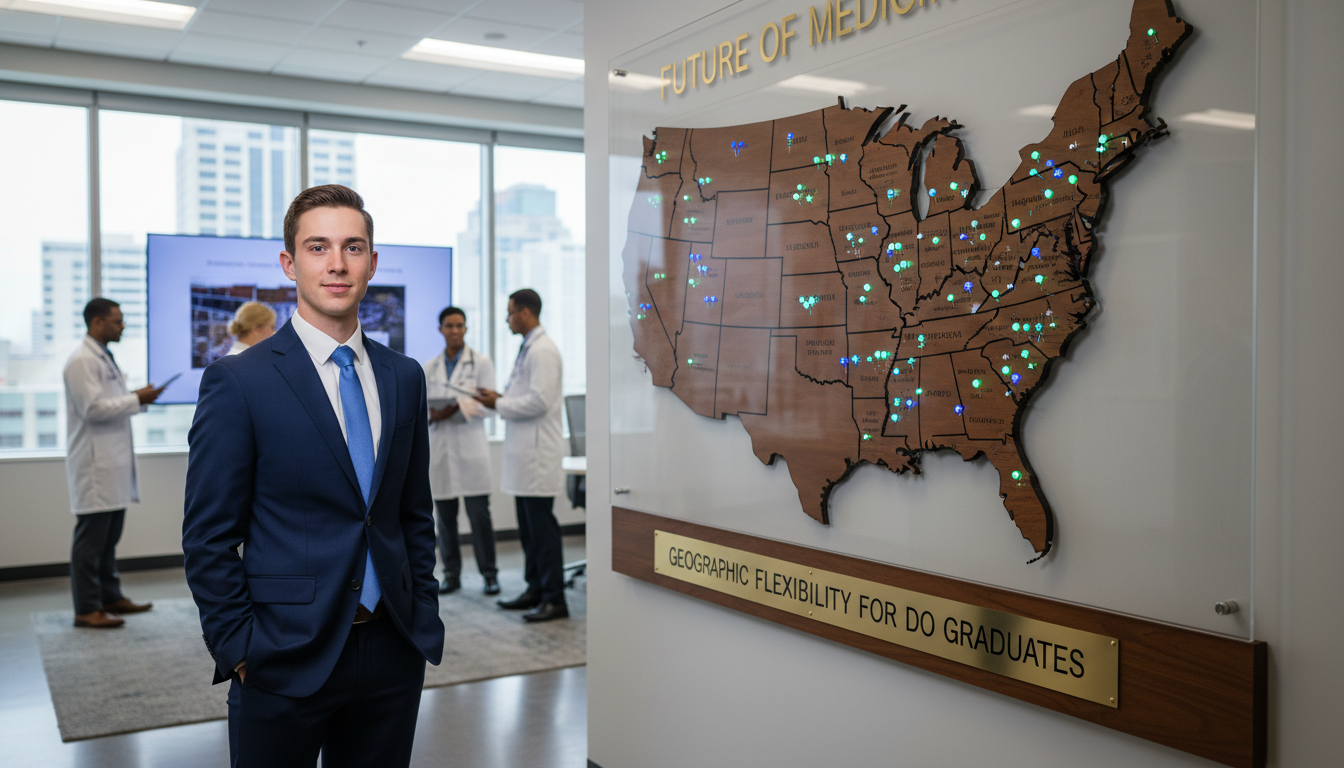
Understanding Geographic Flexibility as a DO Graduate
Geographic flexibility is one of the most powerful—and underused—advantages you can bring to the osteopathic residency match, especially if you are targeting county hospital residency and safety net hospital residency programs.
For a DO graduate residency applicant, being clear and strategic about where you can train (and why) can:
- Open doors at programs that are overlooked by more geographically rigid applicants
- Strengthen your application narrative (“Why here?”)
- Improve your chances in competitive specialties or regions
- Give you access to rich, hands-on training environments that county and safety net hospitals often provide
This article breaks down how to think about geographic flexibility in the context of osteopathic residency match, with specific attention to county hospital and safety net hospital programs, and how to align your regional preference strategy with your personal life, training goals, and long-term career plans.
Why County and Safety Net Hospitals Are a Strong Fit for DO Graduates
County hospitals and other safety net hospital residency programs occupy a unique space in graduate medical education. They primarily serve uninsured, underinsured, and vulnerable populations, often with high patient volumes and complex pathology. For many DO graduates, these programs are an excellent match in both mission and training style.
Mission Alignment
Osteopathic training emphasizes:
- Whole-person care
- Community health
- Primary care and continuity
- Service to underserved populations
County hospital and safety net programs mirror these values. They often:
- Care for diverse, high-need populations
- Offer rich exposure to social determinants of health
- Encourage advocacy, public health engagement, and community outreach
If you can articulate this alignment in your personal statement and interviews, you create a compelling argument for why you are a good “fit” beyond scores alone.
Hands-On, High-Volume Training
In many county hospital residency programs, residents:
- Have significant responsibility early
- See a wide spectrum of disease severity
- Manage limited-resource environments
- Develop strong procedural and triage skills
This environment can be ideal if you value:
- Learning by doing
- Broad clinical exposure
- Building confidence managing complex, “sicker” patients
Geographic flexibility helps here because many of these hospitals are outside the most popular training hubs. Being willing to consider a wider range of cities and regions substantially increases the number of such programs accessible to you.
DO-Specific Advantages
For a DO graduate residency candidate, county and safety net programs may be particularly receptive if:
- The program historically matches DOs or is DO-friendly
- The institution has prior AOA-accredited roots or is in a region with strong osteopathic schools
- Faculty are familiar with COMLEX or trained alongside DOs
When you combine these DO-friendly factors with flexible geographic preference residency planning, you significantly widen your set of realistic, high-quality options.

Defining Your Geographic Flexibility: A Structured Approach
“Geographic flexibility” doesn’t have to mean “I will go anywhere.” In fact, vague answers can hurt you during interviews. Instead, think of it as having a thoughtful, tiered strategy for where you are willing to live and train, and why.
Step 1: Clarify Your Non-Negotiables
Before you build a regional preference strategy, identify your true limits. Examples:
Family obligations:
- Must stay within 2–3 hours of an elderly parent needing care
- Spouse/partner tied to a specific city for work or visa reasons
Financial constraints:
- Need relatively low cost of living
- Cannot afford high housing costs in top-tier metropolitan areas
Lifestyle or health needs:
- Need access to specific specialty healthcare for yourself or a family member
- Cannot tolerate very cold or very hot climates for health reasons
Be honest with yourself. Once you know your actual boundaries, everything else becomes potential flexibility you can leverage.
Step 2: Create Geographic “Tiers”
Construct a three-tier system to guide your osteopathic residency match list:
Tier 1 – Ideal Regions (“High Priority”)
- Cities/regions where you strongly prefer to live
- Often where you have personal ties, existing support systems, or strong lifestyle preferences
Tier 2 – Preferred but Not Essential (“Flexible Regions”)
- Places you would be genuinely happy to train, even if not your first choice
- Often include mid-sized cities, less popular states, or areas with lower applicant interest
Tier 3 – Acceptable with Trade-offs (“Strategic Regions”)
- Regions that you’re willing to rank for educational or match-strength reasons
- You understand and accept the lifestyle trade-offs (distance from family, weather, etc.)
Most successful DO graduate residency applicants who maximize match odds use all three tiers, especially if they are aiming at moderately or highly competitive specialties.
Step 3: Align Tiers with County and Safety Net Programs
Now overlay your tiers on a map of county hospital residency and safety net hospital residency programs:
- Tier 1: Are there county or safety net hospitals close to your home region or in cities you already love?
- Tier 2: Are there mid-sized cities with strong safety net institutions where you could see yourself thriving for 3–7 years?
- Tier 3: Are there underserved regional programs in areas like the Midwest, South, or less densely populated states that offer strong training but attract fewer applicants?
This framework lets you:
- Approach programs with a clear narrative (“Here’s why this region is in my top tier…”)
- Avoid overconcentrating applications in a narrow geography
- Communicate both your seriousness about their region and your broader openness
How Geographic Flexibility Improves Your Match Strategy as a DO
Geographic flexibility intersects with nearly every component of the osteopathic residency match process. For a DO graduate residency applicant, it often directly translates into more interviews and better odds.
1. Increasing Volume and Diversity of Applications
Because DO applicants sometimes face extra hurdles at certain academic centers or in historically MD-dominant regions, expanding your geographic reach is one of the most reliable ways to gain more opportunities.
Consider two examples:
- Applicant A: DO, applies only to coastal major cities (New York, Boston, SF, LA, Seattle)
- Applicant B: DO with similar stats, applies to coastal cities plus Midwest, South, Mountain West, and tier-2 cities with county and safety net hospital residency programs
Applicant B usually ends up with:
- More interviews
- Greater program diversity (academic, county, community, hybrid)
- Better resilience if a preferred geographic pocket is saturated with competitive applicants
2. Targeting Less Saturated Regions
Some regions reliably receive fewer applications relative to their number of positions. These may include:
- Certain Midwestern states
- Some Southern states
- Mountain and rural Western areas
- Post-industrial cities with less national name recognition
Many of these areas host strong county hospitals and safety net systems with:
- Superb procedural exposure
- High patient complexity
- Broad, hands-on training
If you’re willing to expand your geographic preferences, you can “trade” name-brand city prestige for higher clinical volume and broader responsibility—which can be more beneficial long-term.
3. Leveraging DO-Friendly and Historically Osteopathic Regions
Certain regions have:
- More osteopathic schools
- Long-standing exposure to DO physicians
- Program leadership that actively embraces DO applicants
Examples often include parts of the Midwest and East Coast with nearby DO schools, as well as regions where formerly AOA-accredited programs transitioned into ACGME. A geographic preference residency strategy that deliberately emphasizes these zones:
- Increases your odds of being fairly evaluated
- Avoids the occasional institutional bias against non-MD degrees
- Aligns you with faculty who understand COMLEX and osteopathic training
4. Combining Geographic Flexibility with Program Type Flexibility
You can extend your flexibility beyond location:
- Mix of academic, county, community, and hybrid sites
- Programs with strong affiliation to state universities or major safety net systems
- Varying program size (small, mid-size, large)
A DO graduate with both location flexibility match strategy and program-type flexibility will almost always be in a stronger position than an equally qualified applicant who constrains both.

Communicating Geographic Preference Effectively
How you talk about geographic preference in your application often matters as much as where you apply. Program directors and faculty pay close attention to whether you have:
- A coherent geographic preference residency narrative
- A plausible reason to stay in their area
- Evidence that you understand their patient population and institutional mission
In the ERAS Application and Personal Statement
You can signal regional preference strategy without sounding rigid:
- Mention family or personal ties (grew up there, went to undergrad nearby, partner’s job)
- Highlight mission fit with county hospital residency or safety net hospital residency (interest in underserved care, community health, public hospital systems)
- Refer to long-term plans (interest in practicing in that region, joining FQHCs, or academic tracks in that state)
For DO graduates, it can help to note how your osteopathic training aligns with:
- Whole-person care in resource-limited settings
- Interprofessional collaboration in public hospitals
- Primary care or community-focused specialties
In the Program-Specific Signaling and Supplemental Applications
When completing preference signaling (if available) or geographic supplements:
- Be explicit about your location flexibility match stance—e.g., “I am open to training anywhere in the Midwest and South, with particular interest in safety net systems.”
- Avoid sending contradictory messages (e.g., claiming strong interest in one region but only applying to a couple of programs there).
- Where allowed, explain why you are drawn to county or safety net training environments: high acuity, underserved communities, strong procedural exposure, etc.
During Interviews: Talking About Geography Without Sounding Indifferent
Programs want residents who are likely to stay for the length of training, not people who will be unhappy or leave. You can convey both openness and intention by:
Connecting the region to your values:
- “I’m drawn to this region’s large immigrant population and the opportunity to work in a true safety net system—that’s closely aligned with my DO training and long-term goals in underserved medicine.”
Acknowledging distance trade-offs honestly but positively:
- “I’ll be farther from family than I’m used to, but I believe the training here, especially in your county hospital residency track, is worth that sacrifice.”
Showing knowledge of the area:
- Mention local public health challenges, community organizations, or unique population needs you’d be excited to work with
Avoid vague answers like “I’m open to anywhere” without context—they can sound rehearsed or disingenuous. Instead, anchor your flexibility in a clear framework: “My top priority is a high-volume safety net hospital where I can care for underserved patients; I’m open to any region that offers that environment.”
Balancing Personal Life, Wellness, and Career Goals
Geographic flexibility should support, not undermine, your well-being. A realistic plan accounts for both training quality and life outside the hospital.
Considering Support Systems
Ask yourself:
- How far can I realistically be from my primary support system and still function well under stress?
- Can I build a new network (friends, mentors, community) in a region where I know no one?
- Would a moderately less prestigious location with stronger personal support be better than an isolated but “top name” city?
In county hospital and safety net environments—often intense, high-volume settings—emotional and social support can significantly affect your resilience and performance.
Cost of Living and Financial Stress
Many county and safety net hospitals are in:
- Urban centers with high living costs, or
- Lower-cost cities with fewer amenities but more affordable housing
Weigh:
- Resident salary vs. local cost of living
- Loan repayment plans or PSLF opportunities (often favorable at public or safety net institutions)
- The trade-off between urban “brand name” and financial stability
For some DO graduate residency applicants with significant debt, a slightly less famous city but much lower financial stress can be a smarter long-term choice.
Long-Term Career Trajectory
Think beyond residency:
- Do you want to practice in an underserved or safety net environment long term? Training in such a setting is a strong foundation.
- Are you considering fellowships?
- County and safety net hospitals affiliated with academic centers can still offer strong fellowship placement.
- Do you eventually want to return to a specific region?
- Training in a region near your desired practice area often helps with networking, state licensure familiarity, and job opportunities.
Be clear about which choices are about training vs. lifestyle vs. future practice location—they won’t always align perfectly, and that’s okay as long as you are intentional.
Putting It All Together: A Sample Strategy for a DO Applicant
Consider a DO graduate interested in Internal Medicine with a strong interest in underserved care and potential future fellowship.
Applicant Profile
- COMLEX and/or USMLE: Solid but not top-decile
- No significant geographic constraints
- Strong interest in county hospital and safety net environments
- Long-term goal: Work in a public hospital or FQHC, possibly in a leadership role
Example Geographic and Program Strategy
Tier 1 Regions (High Priority)
- Regions with larger urban county hospitals and strong safety net systems (e.g., metro areas in the Midwest and South, not just coastal cities)
- Prioritize programs that explicitly mention underserved missions and DO-friendliness
Tier 2 Regions (Flexible Regions)
- Mid-sized cities with public hospitals or academic–county hybrids
- States that may not be “name brand” but have high-need populations and good fellowship connections
Tier 3 Regions (Strategic Regions)
- Less popular states with lower applicant density but solid county hospital residency options
- Programs where DOs have historically matched and gone on to fellowships
The applicant:
- Applies widely across all three tiers
- Clearly states in the personal statement an interest in safety net hospital residency and underserved care
- During interviews, frames geographic flexibility as mission-driven:
- “My priority is high-volume, underserved training, and I’m open to different regions that offer that environment, including here.”
This combination of mission focus + geographic flexibility usually yields more interviews and a stronger match outcome for a DO graduate.
FAQs: Geographic Flexibility for DO Graduates in County Hospital Programs
1. As a DO graduate, should I be completely geographically flexible to maximize my chances of matching?
Not necessarily. You do not need to say “anywhere” to be successful. Instead, define clear non-negotiables (family, health, finances) and then create broad, realistic tiers of acceptable regions. Flexibility within a thoughtful framework—especially toward DO-friendly and underserved regions—is more valuable than indiscriminate openness.
2. Are county hospital and safety net hospital residency programs DO-friendly?
Many are, but it varies. Programs serving underserved populations often value the osteopathic emphasis on whole-person care and community health. Look for signs of DO-friendliness: current or recent DO residents, faculty with DO degrees, explicit mention of COMLEX acceptance, and a track record of matching DOs. Your geographic preference residency planning should include regions and institutions known to be receptive to DO applicants.
3. How do I explain being far from family without sounding like I won’t stay in the program?
Acknowledge the distance honestly, then emphasize your reasons for committing to that region and training environment. For example: “I’ll be farther from my family than I’m used to, but I value the clinical exposure and underserved mission of your county hospital residency program and am prepared to build a support system here. This is the type of setting where I want to train and practice.” Programs want to hear that you’ve thought this through and are committed.
4. If I’m interested in a competitive specialty, does geographic flexibility matter even more?
Yes. For a DO graduate pursuing a competitive field (e.g., certain surgical or subspecialty disciplines), location flexibility match can be one of the biggest levers you control. Applying broadly—especially to regions and safety net hospital residency programs that are less flooded with applicants—may be the difference between having enough interviews to match versus falling short. Even then, you can still prioritize geographic tiers rather than abandoning all preferences.
By approaching geography as a deliberate, mission-driven choice rather than a constraint, you can position yourself as a strong, adaptable DO graduate residency candidate—especially in the rich, hands-on training environments of county and safety net hospitals.