
Understanding the Landscape: Plastic Surgery Residency for the MD Graduate
As an MD graduate aiming for plastic surgery, you’re entering one of the most competitive specialties in the allopathic medical school match. The integrated plastics match is data-driven, time-consuming, and emotionally intense—and your success depends heavily on the quality of your program research strategy.
Researching residency programs isn’t just “making a list.” It’s a structured process of:
- Identifying programs that fit your career goals and personal needs
- Understanding how programs truly differ beyond their glossy websites
- Assessing where you are likely to match as an MD graduate in plastic surgery
- Strategically organizing your application and interview efforts
This article walks you step-by-step through how to research residency programs in plastic surgery as an MD graduate, with a strong focus on integrated programs. You’ll learn how to build and narrow your list, what questions to ask, how to interpret websites and reputation, and how to gather the “hidden curriculum” information that residents rarely put in writing.
Step 1: Clarify Your Goals and Constraints Before You Research
Before you start googling programs, define what you are looking for. This will guide every subsequent decision and prevent you from wasting time.
A. Clarify Your Career Goals
Ask yourself:
What kind of plastic surgeon do I want to be?
- Academic surgeon with NIH-level research and a niche (e.g., craniofacial, nerve, transplant)?
- High-volume reconstructive surgeon in an academic or community setting?
- Aesthetic-focused surgeon planning for private practice?
- Surgeon interested in global health, health policy, or innovation?
How research-heavy do I want my training to be?
- Programs with mandatory research years (often 1–2 years dedicated research in the middle of training)
- Programs with optional research time or built-in “flex” time
- Programs with minimal formal research but strong clinical volume
Do I need strong exposure in specific subspecialties? For example:
- Microsurgery and complex reconstruction
- Hand surgery (including orthopedic/hand exposure)
- Craniofacial and pediatric plastic surgery
- Gender-affirming surgery
- Aesthetic surgery with robust cosmetic cases and private-practice mentorship
Your program research strategy will differ if your priority is publishing 40 papers versus developing elite aesthetic operative skills versus balancing career with family life.
B. Define Your Personal and Geographic Constraints
Be honest and explicit about:
Geography:
- Tied to a specific city or region (partner’s job, family support, visa issues)?
- Open to any U.S. location?
Lifestyle factors:
- Need proximity to family, specific schools, or cultural community?
- Tolerance for cost of living in places like NYC, SF, Boston?
Visa / citizenship considerations (if applicable):
- Are you a U.S. citizen/perm resident or on a visa?
- Some plastic surgery residencies prefer or only accept U.S. citizens/green card holders; check this early.
Writing your constraints down will help you filter your list later in a rational way rather than in a panic when ERAS opens.
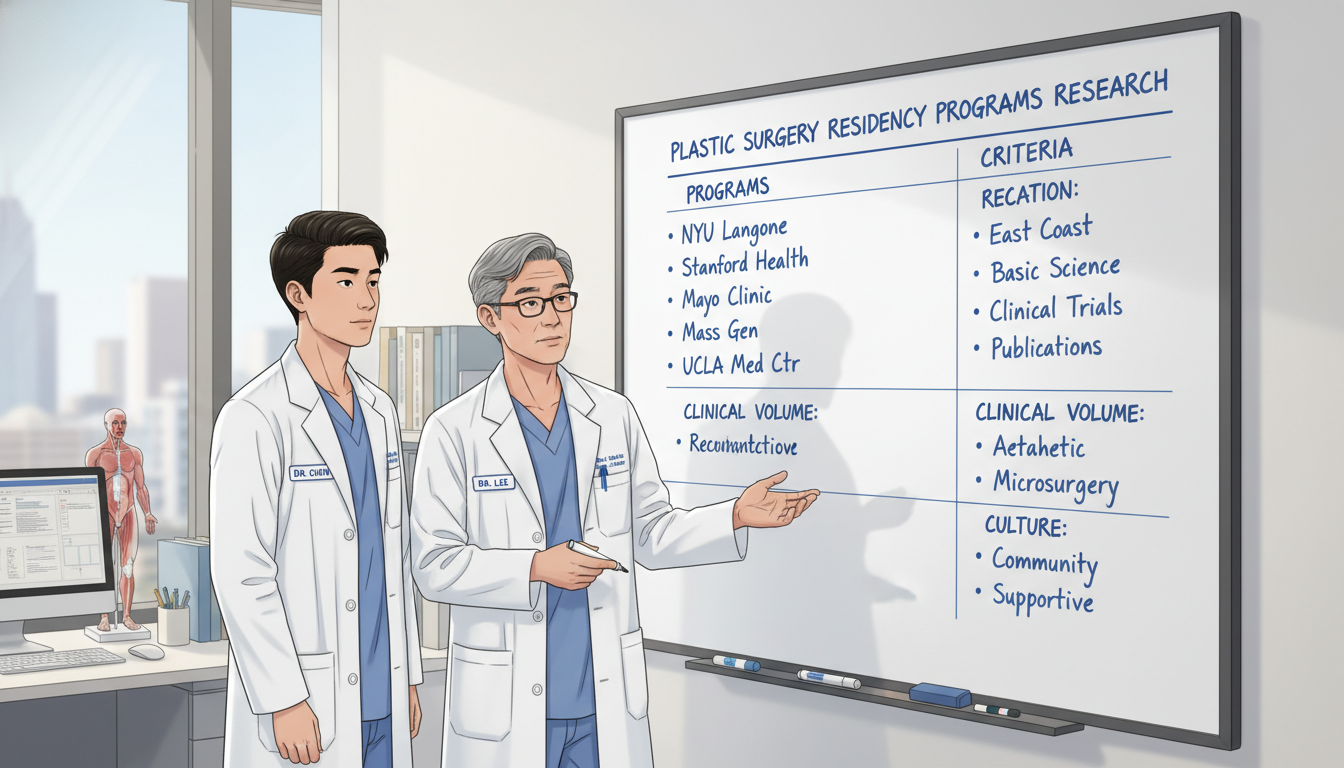
Step 2: Build a Comprehensive Preliminary List of Plastic Surgery Programs
Once you know your priorities, build a broad initial list, then refine.
A. Where to Find Integrated Plastic Surgery Programs
Start with official sources:
- ACGME website:
Use the ACGME Program Search to identify all ACGME-accredited integrated plastic surgery residency programs. - ERAS / AAMC program listings:
Cross-check program names, locations, and application requirements. - American Council of Academic Plastic Surgeons (ACAPS) website:
Frequently lists integrated plastic surgery programs, updates on application cycles, and program-specific resources.
Create a spreadsheet with columns such as:
- Program name and institution
- City and state
- Duration (usually 6 years for integrated plastics)
- Contact info and website
- Research year (mandatory/optional/none)
- Notes column (for impressions and follow-up questions)
Aim to start with all integrated programs unless you’re absolutely constrained by geography.
B. Include Independent Pathways (If Relevant)
While your primary focus is likely the integrated plastics match, as an MD graduate you should at least understand:
- Some surgeons match via general surgery → independent plastic surgery.
- This path is longer and highly competitive; it may be a Plan B if your profile is stronger for general surgery initially.
For now, focus your deep research on integrated programs but be aware of independent tracks at the same institutions in case your long-term planning evolves.
Step 3: Deep Dive into Official Information – Websites, Data, and Case Volume
Once you have your preliminary list, start gathering structured data for each program. This is where a lot of MD graduates fall short—they read the “About” page but don’t critically analyze the details.
A. Program Website: What to Look For
On each program’s website, systematically look for:
Curriculum structure
- How are the six years distributed?
- Early general surgery vs early plastics exposure
- Dedicated rotations in hand, craniofacial, burn, microsurgery, aesthetics
- Are there outside rotations (e.g., pediatric hospital, cancer center, VA, community hospitals)?
- How are the six years distributed?
Research opportunities
- Is there a dedicated research year?
- Named labs or investigators (e.g., “Microsurgery lab,” “Outcomes research group”)?
- Formal mentorship structure for scholarly projects?
- Evidence of residents presenting at national meetings (ASPS, ASAPS, AAPS)?
Case logs and operative exposure
- Does the site provide average case numbers for graduates?
- Is there strong aesthetic exposure vs primarily reconstructive?
- Do residents perform substantial microsurgical or complex recon cases?
Fellowship and job placement
- Where do graduates go after residency?
- Top fellowships (hand, craniofacial, microsurgery, aesthetics)?
- Prestigious academic positions vs private practice?
- This helps you understand program strength and external perception.
- Where do graduates go after residency?
Program culture and wellness
- Any mention of:
- Resident wellness initiatives
- Formal mentorship pairings
- Support for parental leave or part-time research years
- Pay attention to how this is described. Is it generic or specific?
- Any mention of:
Take structured notes. Example:
- Program A:
- Early plastics exposure, mandatory 1-year research, strong craniofacial, average aesthetic volume, grads to top academic fellowships, high cost of living, seems research-heavy culture.
B. Objective Data: Case Logs, Match Data, and Board Pass Rates
Some programs and/or national bodies share data such as:
- ABPS board pass rates for graduates
- Number of cases by category per resident
- Residency class size and faculty-to-resident ratio
While plastic surgery residency data is not as standardized publicly as some other specialties, even partial data can show patterns, such as:
- Programs with small volume in certain case types you care about (e.g., limited hand surgery)
- Programs where graduates consistently go to specific types of roles (e.g., 90% private practice vs 90% academic)
Combine website data with:
- FREIDA Online (AMA) for basic stats: program size, benefits, and sometimes board pass info
- Doximity Residency Navigator (interpret cautiously; more on that later)
Step 4: Go Beyond the Website – Reputation, Culture, and Hidden Curriculum
Two plastic surgery residencies can look identical on the website and be vastly different in reality. This is where “soft data” and back-channel information matter.
A. Reputation and Perception (Use Carefully)
As an MD graduate pursuing plastic surgery, you’ll hear about “top” programs. While reputation can matter for academic aspirations, don’t let it override fit.
Sources:
Doximity Residency Navigator:
- Useful to get a sense of how programs are perceived in terms of research output and academic reputation.
- Limitations: survey-based, biased toward brand-name institutions.
Faculty comments and letters:
- Ask mentors in plastic surgery: “Which programs are particularly strong for [research, craniofacial, aesthetics]?”
- Many attendings trained at or know specific programs intimately.
Use reputation to:
- Understand why a program is well-regarded (research? complex recon? aesthetics?)
- Cross-check your impressions from program websites.
Do not use reputation alone to decide where to apply or rank; it doesn’t reflect your individual goals or the program’s culture.
B. Resident Culture and Work Environment
Culture is critical, especially in an intense specialty like plastic surgery. To evaluate residency programs on culture:
Social media (Instagram, X/Twitter, LinkedIn)
- Look at:
- Residency program accounts (photos from conferences, social events, OR)
- Resident accounts (if public and professional)
- Clues to interpret:
- Are residents engaged and seemingly collegial?
- Is there diversity in gender, ethnicity, and backgrounds?
- Does the program highlight wellness and mentorship in a way that feels genuine?
- Look at:
Virtual open houses and webinars
- Many plastic surgery programs hold sessions through ACAPS or independently.
- Use these to:
- Hear from residents directly
- Ask about call structure, case distribution, and wellness
- Assess how transparent leadership seems
Word of mouth
- Talk to:
- Plastic surgery residents at your home institution or where you did away rotations
- Fellows and junior attendings (they often know “where people are happy”)
- Specific questions:
- “How approachable are the attendings?”
- “How is feedback handled?”
- “Are residents generally happy, or is there a lot of burnout and turnover?”
- Talk to:
Capture this information in your spreadsheet in a “culture/impressions” column.

Step 5: Assessing Fit – Matching Programs to Your Profile as an MD Graduate
Knowing how to research residency programs also means knowing how to map your specific application strengths and weaknesses to realistic program lists.
A. Take an Honest Inventory of Your Application
For the competitive allopathic medical school match in plastic surgery, consider:
- USMLE/COMLEX scores (USMLE Step 2 CK now particularly important)
- Research portfolio:
- Number of publications, presentations, and projects
- Relevance to plastic surgery vs other fields
- Letters of recommendation:
- From plastic surgeons, especially known faculty in the field
- Strength and specificity of letters
- Clinical performance:
- Honors in key clerkships and sub-internships
- Performance on plastic surgery rotations or away rotations
- Unique factors:
- Dual degrees (MD/PhD, MD/MPH, etc.)
- Significant leadership, innovation, or prior career experience
- Strong narrative tying your background to plastic surgery
This self-assessment is crucial for building a tiered list of programs: aspirational, solid, and safety.
B. Tiering Programs: Aspirational, Target, and Safer Options
For each program, based on your research and your profile, ask:
- Is this a top-tier academic powerhouse with substantial research expectations?
- Is this a balanced academic program with strong clinical volume, moderate research?
- Is this a clinically focused program with less emphasis on research?
Create 3 categories:
Aspirational programs:
- Very research-heavy, brand-name institutions
- Highly competitive but aligned with your biggest goals
- Apply even if they’re a reach, but don’t rely solely on them
Target programs:
- Match your profile and goals more closely
- Your metrics and research are similar to or slightly above recent residents
- You could see yourself thriving there
Safer options (within the constraints of plastic surgery competitiveness):
- Programs that may be less known nationally but offer:
- Strong case volume
- Good mentorship
- Solid fellowships/job placement
- Critical to include, given the competitiveness of integrated plastics
- Programs that may be less known nationally but offer:
For plastic surgery specifically, even your “safer” programs are still highly competitive. Plan a broad but thoughtful application.
Step 6: Program Research Strategy Through the Application Season
Your program research doesn’t end when ERAS opens. You’ll refine your understanding at each stage: pre-application, away rotations, interviews, and post-interview reflections.
A. Pre-Application: Finalizing Your Application List
By late summer:
Revisit your spreadsheet.
For each program, ensure you have:
- Clear notes on curriculum, research, case mix, and culture
- Alignment score (e.g., 1–5) with your goals
- Tier (aspirational/target/safer)
Decide how many programs to apply to:
- For integrated plastic surgery, this is often 25–60+ programs, depending on your competitiveness and constraints.
- Work closely with your home plastic surgery faculty and advisors to calibrate this number.
B. Away Rotations as a Research Tool
Away rotations (sub-internships) are one of the most powerful ways to evaluate residency programs in plastic surgery—and for them to evaluate you.
Use away rotations to:
- Assess:
- How residents and faculty interact
- Operative autonomy and teaching style
- Actual case volumes vs what’s on the website
- Ask residents privately (when appropriate):
- “What drew you to this program, and has it met your expectations?”
- “Would you choose this program again?”
- “What would you change if you could?”
Take structured notes immediately after each day or week. These real-life impressions will heavily inform your rank list.
C. Interviews: Advanced Program Evaluation
During interviews:
Ask targeted, open-ended questions based on your prior research:
- “Can you describe how research mentorship is structured for residents?”
- “How is operative autonomy developed from PGY-1 to PGY-6?”
- “What changes has the program made in the last 5 years, and what changes are planned?”
Observe:
- How residents speak about leadership when faculty aren’t present
- Whether program leadership appears open to feedback
- Whether current residents are similar to you in goals and temperament—or whether you’d feel out of place
After each interview, immediately update your spreadsheet with:
- Strengths/weaknesses of the program
- How well it matched your expectations
- A gut feeling rating
Step 7: Common Pitfalls in Researching Plastic Surgery Programs—and How to Avoid Them
As you develop your approach to evaluating residency programs, watch out for these traps:
Pitfall 1: Overweighting Reputation
- Mistake: Ranking or applying only based on “top 10” lists or big-name institutions.
- Fix: Use reputation as one factor, not the defining one. Prioritize:
- Fit with your career goals
- Resident happiness
- Operative volume and mentorship
Pitfall 2: Ignoring Culture and Wellness
- Mistake: Assuming all surgical programs are equally intense and thus ignoring culture.
- Fix: Pay close attention to:
- Turnover rates (residents leaving or transferring out)
- How residents talk about support, mentorship, and wellness
- Flexibility around major life events (illness, family, kids)
Pitfall 3: Relying Only on Public Information
- Mistake: Assuming the website tells the full story.
- Fix:
- Use word of mouth, away rotations, and informal conversations
- Attend ACAPS open houses and specialty interest webinars
- Connect with alumni from your medical school who matched into plastics
Pitfall 4: Failing to Be Realistic About Competitiveness
- Mistake: Applying only to extremely competitive programs without a balanced list.
- Fix:
- Honestly assess your CV with an experienced plastic surgery mentor
- Ensure you have a mix of aspirational, target, and safer programs
- Understand that even “safer” programs in integrated plastics remain selective
Step 8: Putting It All Together – An Example Research Blueprint
To make this concrete, here’s a simplified program research strategy for an MD graduate aiming for plastic surgery:
Months 1–2: Foundation
- Clarify goals (academic vs private practice, research intensity, subspecialty interests).
- Identify constraints (geography, family, visa).
- Build master list of all integrated plastic surgery programs via ACGME, ACAPS, ERAS.
Months 3–4: Data Collection
- For each program, gather:
- Curriculum, research structure, case exposure
- Recent graduates’ destinations (fellowships, jobs)
- Any public data on case logs or board pass rates
- Start noting culture signals via social media and program videos.
- For each program, gather:
Months 4–6: Soft Data and Mentorship
- Meet with plastic surgery faculty at your home institution for:
- Feedback on your competitiveness
- Insights on specific programs
- Attend virtual open houses and resident Q&A sessions.
- Reach out to alumni from your school in plastic surgery.
- Meet with plastic surgery faculty at your home institution for:
Months 6–8: Away Rotations and Refinement
- Complete 1–3 away rotations at programs of high interest.
- Evaluate operative experience, teaching, and culture first-hand.
- Update your spreadsheet and adjust your target list and tiers.
Application Season
- Finalize a balanced list of programs.
- Use interview days to refine your perception of programs.
- After interviews, add detailed post-interview impressions and gut feeling scores.
Rank List Phase
- Return to your spreadsheet.
- Weigh factors: training quality, fit, happiness of residents, geography, and your long-term goals.
- Rank programs where you could genuinely see yourself thriving—even if they weren’t originally your “dream” name-brand institutions.
FAQs: Researching Plastic Surgery Residency Programs as an MD Graduate
1. How many plastic surgery residency programs should an MD graduate apply to?
Because integrated plastic surgery is highly competitive, many MD graduates apply broadly—often 25–60+ programs, depending on their application strength and geographic flexibility. Work with plastic surgery faculty advisors to calibrate your numbers. A strong applicant may be more selective; others should cast a wider net while still being thoughtful and realistic.
2. How important is research when evaluating plastic surgery programs?
Research is central for many integrated plastics programs—especially those that are academically oriented. When evaluating residency programs:
- Look for structured research mentorship, dedicated time, and evidence of resident publications/presentations.
- However, if your goal is mainly high-quality clinical training with eventual private practice, a solid clinically focused program may fit better than a purely research-heavy one. Match the program’s research intensity to your goals and track record.
3. Should I prioritize programs where I can do a lot of aesthetic surgery?
Not necessarily as your sole criterion. Aesthetic experience is important, but:
- Most integrated plastic surgery residencies provide exposure to both reconstructive and cosmetic cases.
- A solid foundation in reconstructive principles will make you a better aesthetic surgeon long-term.
- When comparing programs, consider balanced exposure: reconstructive, microsurgery, hand, craniofacial, and aesthetics. If you already know you want an aesthetic-heavy practice, then yes, emphasize programs with strong cosmetic volume and faculty with active aesthetic practices.
4. How do I really know if a program’s culture is supportive before I match there?
You’ll never have perfect information, but you can get close by:
- Doing away rotations at top-choice programs when possible
- Attending open houses and asking residents about their day-to-day experience
- Speaking privately with current or recent residents (ideally not only those chosen as “recruitment representatives”)
- Noting whether residents seem cohesive, respected by faculty, and reasonably happy despite the workload
Combine this with your gut feeling from interview day and away rotations. Culture is harder to quantify than case numbers, but it often has the biggest impact on your happiness and growth as a plastic surgery resident.
By approaching this process systematically—clarifying your own goals, gathering structured data, and actively seeking real-world insights—you can confidently navigate the allopathic medical school match and identify plastic surgery residency programs where you will not only match, but thrive.