
Researching programs in clinical informatics is unlike choosing most other fellowships. The field is interdisciplinary, heterogeneous, and rapidly evolving. Titles may look similar, but the day‑to‑day experiences, culture, and outcomes can be radically different. A thoughtful, systematic program research strategy is essential if you want a training environment that truly fits your goals in health IT, data science, and clinical leadership.
Below is a comprehensive, step‑by‑step guide on how to research residency and fellowship programs in clinical informatics, how to interpret what you find, and how to turn information into a smart rank list.
Understanding the Landscape of Clinical Informatics Programs
Before you dive into specific institutions, clarify what “clinical informatics fellowship” actually means in practice.
What is a Clinical Informatics Fellowship?
Clinical informatics fellowships are ACGME‑accredited programs designed to train physicians in:
- Health IT strategy and implementation
- Electronic health record (EHR) optimization
- Data analytics and decision support
- Workflow redesign and quality improvement
- Clinical data standards and interoperability
- Governance, regulation, and safety of digital tools
Graduates often become:
- CMIOs, associate CMIOs, or medical directors of informatics
- Physician builders / clinical informaticians embedded in service lines
- Leaders in health IT vendors, digital health startups, or analytics groups
- Academic faculty in informatics and quality improvement
Because the field bridges clinical practice, IT, and management, evaluating residency programs and fellowships in this space requires you to look beyond traditional metrics (case volume, board pass rates) and examine:
- Health system infrastructure
- Data and analytics capabilities
- Organizational culture around innovation and change
- Opportunities to lead real health IT projects
Types of Clinical Informatics Training Environments
When you research programs, start by categorizing them. This helps you compare “apples to apples.”
Academic Medical Centers
- Typically large, tertiary or quaternary care hospitals with strong research arms
- Often home to robust biomedical informatics or data science departments
- May prioritize publications, grants, and methodologic training
- Many trainees aim for academic or hybrid leadership roles
Integrated Health Systems / IDNs
- Multi‑hospital, multi‑clinic networks with centralized IT and analytics
- Rich opportunities for health IT at scale (EHR optimization, population health, system‑wide projects)
- Great for those interested in operations, large‑scale QI, and leadership in real‑world settings
Public, Safety‑Net, and VA Systems
- Unique populations, legacy IT environments, and mission‑driven work
- Often strong focus on usability, access, and health equity through informatics
- Good for fellows who want to understand informatics under resource constraints
Hybrid or Multi‑Institution Programs
- Cross‑institution collaborations (e.g., university + community system + VA)
- Broader exposure to multiple EHRs, governance structures, and patient populations
- Coordination and expectations across sites should be carefully clarified
As you refine your list, note what environment matches your long‑term goals. This will guide how you research and interpret each program.
Step 1: Clarify Your Personal Goals and Constraints
You cannot judge a program’s quality without first defining what “good” means for you. Begin with a structured self‑assessment.
Identify Your Career Direction in Informatics
Ask yourself:
What type of work do I want to be doing 5–10 years from now?
- CMIO/associate CMIO for a health system
- Clinical data scientist or analytics lead
- Academic informatics researcher
- Digital health startup founder or health IT industry leader
- Clinical champion/physician builder embedded in a service line
Where do I want to sit in the organization?
- C‑suite and governance tables
- Operational leadership roles
- Research lab or data science group
- Product or implementation teams in industry
How technical do I want to become?
- High‑level conceptual leadership (governance, strategy, change management)
- Intermediate (can write SQL/R/Python, build dashboards, understand data models)
- Deep technical (machine learning, natural language processing, software development)
Being explicit here will help you align programs’ strengths with your trajectory.
Define Your Non‑Negotiables and Preferences
Common constraints and priorities include:
- Location & family needs: Proximity to partner’s work, schools, extended family
- Clinical specialty compatibility: Some programs are stronger for specific primary specialties (e.g., emergency medicine, pediatrics, internal medicine)
- Visa or employment issues: Sponsorship, moonlighting rules, institutional policies
- Desired balance between research and operations: Publication‑heavy vs implementation‑heavy programs
- Compensation and cost of living: Stipend, benefits, local housing, childcare costs
Write these down. When you later evaluate programs, you’ll be able to distinguish “nice to have” from “must have” and avoid getting swept away by branding alone.
Step 2: Build a Long List Using Public Information
Now you can start learning how to research residency programs and fellowships in this specialty in a systematic way.
Use Centralized Databases
ACGME and Specialty Society Listings
- ACGME provides a list of accredited clinical informatics fellowships.
- Specialty societies (e.g., AMIA) often maintain directories with program websites and contact information.
ERAS / NRMP (when applicable)
- These platforms list participating programs each cycle.
- Capture program names, locations, and contact details into a spreadsheet.
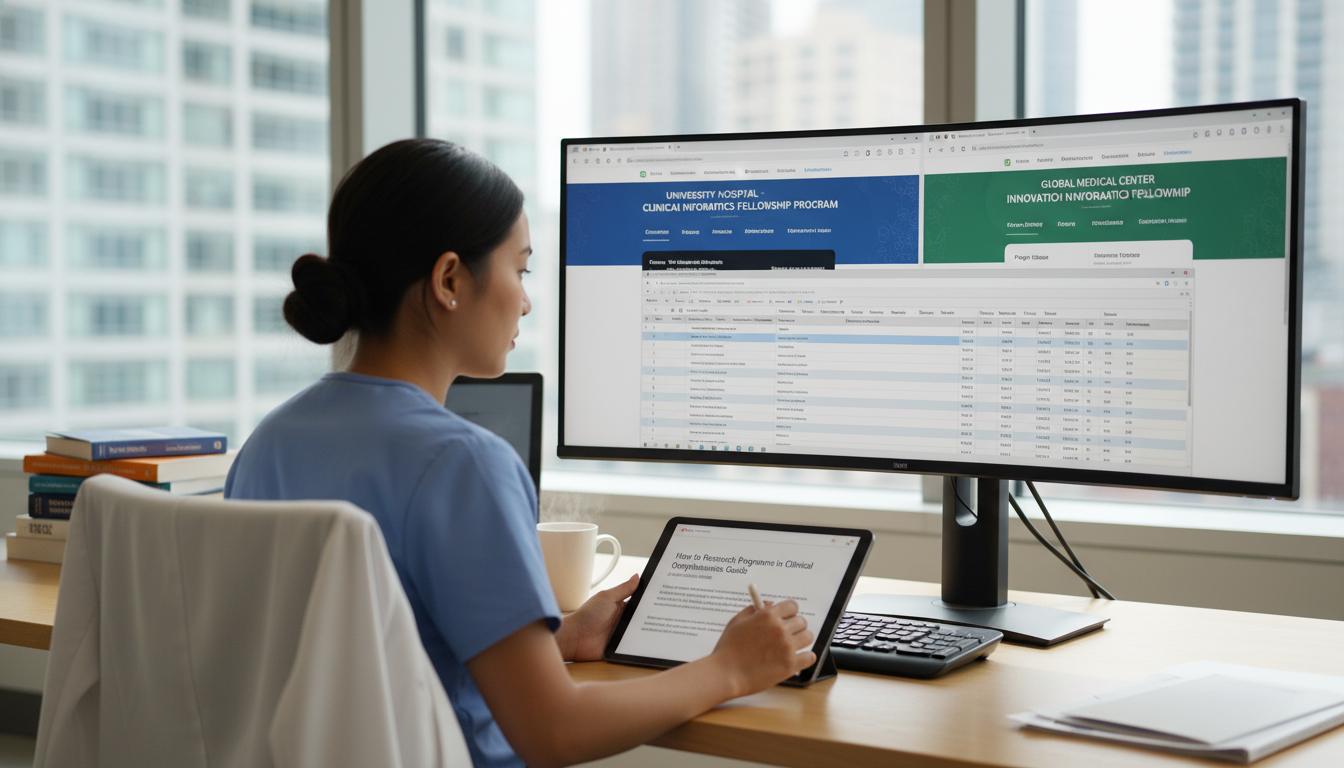
Create a master list with columns like:
- Program name and institution
- Location(s)
- Primary health system(s) and EHR(s) used
- Program leadership (PD, APD, core faculty)
- Website link
- Notes / first impressions
Extract Key Signals from Program Websites
Program websites vary widely in quality, but you can still learn a lot. Look specifically for:
Mission and focus areas
- Do they emphasize data science, implementation, clinical operations, or research?
- Do they mention population health, quality & safety, AI, or digital health?
Health IT infrastructure
- EHR platforms (Epic, Cerner, others)
- Data warehouse / analytics platforms (Clarity, Caboodle, EDW, SQL warehouses, FHIR infrastructure)
- Collaborations with data science or informatics departments
Curriculum and rotations
- How are rotations structured (block vs longitudinal)?
- Are there protected blocks for analytics, research, and QI?
- Is there a formal didactic curriculum (informatics seminars, AMIA 10×10, data science courses)?
Fellow projects and scholarly work
- Example QI or IT implementation projects
- Conference presentations, publications, AMIA abstracts
- Partnerships with departments like population health, radiology, pathology, or surgery
Career outcomes
- Where do graduates work now?
- Titles such as CMIO, associate CMIO, director of clinical informatics, faculty positions, or industry roles are strong signals.
Populate your spreadsheet with these data points to create a high‑level “map” of the landscape.
Leverage Social and Academic Footprints
Beyond official websites, look at:
PubMed and Google Scholar
- Search for the program director and core faculty
- Note recurring themes: EHR optimization, CDS, NLP, ML, population health, usability, etc.
- This helps you gauge research depth and alignment with your interests.
LinkedIn and institutional profiles
- Find current and former fellows
- Check positions they hold now, projects they list, and skills they highlight
- Look for trajectories (e.g., graduates moving into CMIO roles within the same system)
Conference programs (especially AMIA)
- Identify which programs frequently present at AMIA, HIMSS, or other informatics conferences
- Abstract titles can reveal the “flavor” of informatics at that institution
By the end of this phase, your long list may have 15–30 programs. The next step is to triage.
Step 3: Develop a Structured Program Research Strategy
To move from long list to manageable shortlist, you need a systematic approach. This is where evaluating residency programs and fellowships becomes an analytic exercise rather than guesswork.
Build a Comparison Framework
Create a scoring or rating sheet based on dimensions that matter most to you. For instance:
Clinical Environment & Health System
- Size and complexity of system
- Patient population and diversity
- EHR platform and maturity of health IT infrastructure
- Presence of multiple sites (academic, community, VA, safety‑net)
Informatics Training Content
- Breadth of rotations (governance, analytics, CDS, interoperability, innovation)
- Depth in your areas of interest (e.g., AI, UX, telehealth)
- Balance between leadership/operations and technical skills
- Formal didactic curriculum and degrees/certificates offered
Data & Analytics Ecosystem
- Access to data warehouses and self‑service analytics tools
- Support from analysts, data scientists, biostatisticians
- Opportunities to learn SQL, R, Python, or other tools
- Availability of real datasets for QI and research
Mentorship and Culture
- Accessibility of program leadership
- Diversity of faculty roles (CMIOs, clinical champions, data scientists, industry partners)
- Culture around innovation and change management
- Support for fellows’ ideas and projects
Career Outcomes and Networking
- Positions secured by recent graduates
- Ties to national informatics networks (AMIA, HIMSS committees, working groups)
- Alumni presence in roles you aspire to
Logistics and Personal Fit
- Location desirability and cost of living
- Compensation, benefits, and moonlighting opportunities
- Schedule, workload, and support for wellness
- Fit for your family, visa, or partner’s career
You don’t need to assign strict numeric scores, but relative ratings (e.g., 1–5) can highlight which programs deserve deeper investigation.
Example: Early Triage of Two Hypothetical Programs
Candidate goal: Become a CMIO with strong analytics literacy.
Program A (Academic)
- Strong: RCTs of CDS, several NIH‑funded faculty, PhD‑level data scientists, formal MS in Biomedical Informatics
- Weaker: Smaller clinical system, less leadership exposure, slower‑moving governance
- Overall: Excellent if research + analytics are top priorities; leadership experience may require seeking additional operational projects.
Program B (Large Integrated System)
- Strong: Multi‑hospital Epic environment, mature governance, multiple ongoing large‑scale QI projects, fellows sit on key committees
- Weaker: Less peer‑reviewed research, more “in‑the‑trenches” work, fewer publications
- Overall: Excellent for future CMIOs focused on operations and change management, with ample real‑world leadership exposure.
Depending on your goals, you might prioritize one over the other despite both being “excellent” on paper.
Step 4: Deep‑Dive Research Beyond the Website
Once you’ve narrowed to a shortlist (often 6–12 programs), it’s time for deeper, qualitative research.
Reach Out to Current and Recent Fellows
This is your most valuable information source. When possible, schedule brief video calls with 1–2 current or recent fellows from each program.
Ask targeted questions such as:
Training Experience
- What does a typical week look like? How is time divided between clinical, informatics, and education?
- How often do you work directly with the CMIO/associate CMIO?
- Do you get hands‑on experience making build decisions, working with analysts, or presenting to leadership?
Project Work
- What are your current major projects? How were they chosen?
- How much autonomy do fellows have in selecting and leading projects?
- Are there clear expectations for deliverables (e.g., implementation, dashboard, publication, protocol)?
Culture and Support
- How approachable are the program director and faculty?
- When things go wrong (projects stall, politics, EHR frustrations), how is that handled?
- How is work‑life balance? Are expectations realistic?
Career Preparation
- How has the program helped with networking (AMIA, committees, introductions)?
- Do alumni stay in the same system or move elsewhere?
- If you could redesign the fellowship for your career goals, what would you change?
Be respectful of their time; 20–30 minutes is often enough for a focused, candid conversation.
Talk to Faculty and Leadership (when appropriate)
If you have specific interests (e.g., AI in imaging, NLP for clinical notes, population health), consider emailing 1–2 faculty whose work aligns with those areas. Ask:
- Whether fellows can work on such projects
- How they see the health system’s priorities evolving
- What types of fellows thrive in their environment
These conversations may also inform your interview questions later.

Analyze Program Documents and Schedules
Some programs share rotation schedules, sample block diagrams, or policy manuals with applicants who ask. Reviewing these can clarify:
- Actual time allocation across rotations
- Required vs elective experiences
- On‑call duties and clinical obligations
- Academic vs operational blocks
Look for misalignment between website marketing language and actual schedules. For example, “strong analytics training” with no defined analytics rotation may mean you must self‑navigate to gain those skills.
Step 5: Evaluating Programs During Interview Season
Interview days are a critical part of how to research residency programs and fellowships. Treat them as structured field research, not just auditions.
Prepare Focused, Program‑Specific Questions
Use your prior research to craft questions that go beyond what’s online. Examples:
- “I saw that your fellows frequently sit on CDS and EHR governance committees. How much voting power or decision‑making influence do fellows have on those bodies?”
- “How do you balance project continuity with the 2‑year fellowship timeline? What happens to a project that outlives a fellow’s tenure?”
- “For fellows interested in data science, what specific tools and datasets are available, and how are analytic skills taught and supervised?”
- “How do you support fellows who want to pursue leadership roles like CMIO after graduation? Are there formal leadership development curricula?”
Have a standardized set of questions you ask at every interview; this helps with later comparison.
Observe Culture and Communication
During interviews and resident/fellow socials, pay attention to:
- How faculty talk about IT, clinicians, and administration (collaborative vs adversarial)
- Whether fellows seem empowered or overwhelmed
- The degree of transparency about challenges (e.g., upcoming EHR migration, budget constraints, staffing issues)
- How people speak about end users: do they show empathy and a user‑centered mindset?
Red flags might include:
- Vague answers about project ownership or resources
- Minimizing burnout or workload concerns
- Lack of clarity about how fellows are evaluated and supported
Clarify the “Hidden Curriculum”
Informatics involves politics, change management, and working within complex organizations. Ask:
- “Can you describe a recent informatics project that failed or stalled? What did fellows learn from it?”
- “How are conflicts between clinical services and IT handled, and what role do fellows play?”
- “What’s the informal expectation for email responsiveness and after‑hours work on informatics projects?”
These answers give insight into the hidden curriculum of leadership and organizational behavior you’ll encounter.
Step 6: Integrating Your Findings into a Final Rank List
After interviews, you’ll have a wealth of data. Turning it into a decision is the last, and sometimes hardest, step.
Revisit Your Original Goals and Constraints
Return to the self‑assessment you did in Step 1.
- Has anything changed about your career goals after talking to programs?
- Are certain experiences (e.g., heavy analytics, startup collaboration, AMIA‑focused research) now clearly more or less important?
- Which non‑negotiables (family, location, visa) eliminate some programs, regardless of quality?
Rewrite your priorities if needed, then apply them program by program.
Use a Structured Comparison Tool
Consider a simple framework:
Must‑Haves (binary)
- Does the program meet core requirements? (e.g., visa sponsorship, family needs, minimum analytics opportunity)
Weighted Preferences
- Rate programs 1–5 on your top 5–7 criteria (e.g., leadership exposure, analytics training, mentorship, culture, location).
Narrative Summary
For each program, write a 2–3 sentence “gut feeling” summary immediately after interview day. Example:
“Strong operations and governance exposure, outstanding CMIO mentorship, moderate analytics depth, heavy emphasis on system‑wide QI. Culture feels collaborative but pace is intense. Excellent fit for my CMIO goal despite less formal research.”
When rank list week arrives, your memory will be biased by recency and isolated anecdotes; these contemporaneous notes help anchor your decision.
Balance Head and Heart
You’re training to operate at the intersection of data and human systems. Make your decision the same way:
- Use your structured program research strategy to ensure you’re not overlooking critical factors.
- Also respect your sense of belonging, support, and psychological safety at each program. Fellows learn best where they feel both challenged and supported.
If you find yourself stuck between two programs, consider:
- Where you’d be happiest living for 2+ years
- Which alumni outcomes line up closest with your own ambitions
- Where you felt faculty genuinely understood and were excited by your goals
Frequently Asked Questions
1. How many clinical informatics fellowship programs should I apply to?
Most applicants apply to 8–15 programs, depending on competitiveness, geographic flexibility, and personal constraints. If your application is strong and you are flexible about location, you may be comfortable on the lower end. If you have specific geographic needs, consider applying more broadly to ensure enough interviews.
2. How do I tell if a program has strong health IT training in practice, not just on paper?
Look beyond marketing language. Signs of robust health IT training include:
- Dedicated rotations in EHR build, analytics, and governance
- Regular, scheduled interactions with CMIOs and operational leaders
- Access to enterprise data warehouses and analytic tools
- Specific, named examples of fellow‑led projects that changed workflows or policies
- Graduates moving into informatics leadership or advanced analytics roles
If these elements are vague or missing, the program may not deliver the depth of training you need.
3. I’m not very technical yet. Should I avoid programs with heavy analytics or data science?
Not necessarily. If your goal is leadership in informatics, you’ll benefit from comfort with data and analytics. Programs that teach SQL, R, Python, or similar tools can strengthen your ability to collaborate with analysts and data scientists. When researching programs, ask:
- How they onboard fellows with limited coding or analytics background
- Whether there’s a structured curriculum vs self‑directed learning
- How technical skills are integrated into real projects
Choose a program that meets you where you are but also pushes you toward your long‑term goals.
4. What’s the best single indicator that a clinical informatics fellowship is right for me?
There is no single perfect metric, but a strong composite signal is:
Recent graduates from the program are doing the kind of work you want, in roles you aspire to, and they speak positively about their training.
When your goals, alumni outcomes, and your own impressions of the program all align, you’re likely looking at an excellent fit.
Researching clinical informatics programs thoroughly takes time, but it’s an investment in the trajectory of your entire career. By combining structured data gathering with honest self‑reflection and thoughtful conversations, you can identify the fellowship that will best prepare you to lead at the frontiers of health IT and digital transformation.