
Understanding Your Priorities Before You Research
Before you dive into websites and spreadsheets, you need a clear sense of what you want. For an MD graduate targeting an emergency medicine residency, this step is crucial: EM programs vary widely in patient volume, department culture, and training style. Without defined priorities, everything can start to look the same.
Clarify your career goals
Ask yourself:
- Do you see yourself in academic EM, community practice, or a hybrid?
- Are you leaning toward a subspecialty fellowship (e.g., ultrasound, critical care, toxicology, EMS, pediatric EM, global health)?
- Do you anticipate working in:
- Urban, high-volume trauma centers?
- Suburban community EDs?
- Rural or resource-limited settings?
Your answers directly affect your program research strategy. For example:
If you want academic EM, prioritize programs with:
- Strong research output
- Opportunities for teaching and scholarly work
- NIH or foundation-funded faculty
- EM-specific conferences and journal clubs
If you plan to work in community EM, consider:
- Programs with community-affiliated sites
- Exposure to high-throughput EDs
- Autonomy in patient care and procedures
- Experience with community practice patterns and operations
Define your personal needs and constraints
Beyond career goals, clarify your real-world constraints and preferences:
- Geographic limitations (family, partner’s job, visa status)
- Cost of living and salary balance
- Lifestyle needs: outdoor activities, city vs suburban, climate
- Support system: proximity to family or friends
- Visa or citizenship considerations (if applicable to you)
Write these down as “must-haves” and “nice-to-haves.” For example:
- Must-have: EM residency in a state where my partner can easily find work.
- Must-have: 3-year EM program (or 4-year EM program) depending on your preference and long-term plans.
- Nice-to-have: Within one day’s drive of family.
- Nice-to-have: Strong ultrasound fellowship at the institution.
This written list will guide how you research residency programs and help you avoid getting swayed by superficial factors during the EM match process.
Building a Smart Program Research Strategy
A systematic, layered approach will help you move from hundreds of possibilities to a focused, balanced list.
Step 1: Start broad using official databases
Begin with trusted, centralized tools that provide basic program facts.
Key resources:
FREIDA (AMA Residency & Fellowship Database)
- Filter by: specialty (Emergency Medicine), state, program type (university, community, hybrid), and size.
- Review basic data: number of residents, program length, type of hospital, night float vs shift systems, etc.
ERAS / AAMC program search tools
- Confirm which programs participate in the allopathic medical school match.
- Check application requirements (USMLE Step scores, letters, etc.).
NRMP Program List
- Confirm participation in the EM match.
- Look at program codes and track types (categorical vs other EM pathways).
At this stage, aim to generate a long list of EM programs (often 40–80+ for EM, depending on competitiveness and your application strength).
Step 2: Use objective filters to narrow your list
Next, apply objective criteria that clearly matter to you:
- Location: States or regions where you’re willing (or unwilling) to live.
- Program length:
- 3-year EM programs: earlier earning potential, common for community-oriented careers.
- 4-year EM programs: additional training time; may offer more leadership, teaching, or subspecialty exposure.
- Hospital type & volume:
- Level I trauma center vs lower-level trauma designation
- Tertiary referral center vs community hospital
- Annual ED volume (high-volume > 60–80k visits/year vs smaller EDs)
- Visa status (if relevant): J-1 or H-1B sponsorship availability for international applicants or non–US citizens.
Make an initial cut based on obvious mismatches (e.g., wrong region, no EM residency, doesn’t sponsor your visa).
Step 3: Rank your priorities and create a comparison framework
To evaluate residency programs more deeply, you need a comparison system.
Create a spreadsheet with columns such as:
- Program name
- Location (city/state)
- Program length (3 vs 4 years)
- Trauma level / ED volume
- Academic vs community vs hybrid
- Fellowships available (US, CCM, tox, EMS, peds EM, global health, etc.)
- Shift structure (if available)
- Resident wellness initiatives
- Board pass rates (ABEM)
- Alumni outcomes (academic vs community, region)
- Call schedule / overnight shifts
- Research opportunities
- Notes on culture (based on interviews, word-of-mouth, online forums)
Assign priority levels:
- High priority: ED volume, trauma exposure, procedure volume, culture, supervision/autonomy, geographic fit
- Moderate priority: Research intensity, specific fellowships
- Low priority: Brand name alone, non-EM prestige, cosmetic aspects of websites
This framework will anchor your program research strategy and prevent you from making decisions based solely on one attractive feature (e.g., famous name or nice city).

Deep-Dive: How to Research Residency Programs Effectively
Once you have a manageable list, it’s time to take a deeper look at each potential emergency medicine residency. This is where many MD graduate residency applicants either excel—or get overwhelmed.
1. Dissect the program website (beyond the homepage)
Most programs follow a similar structure, but the quality and depth of information varies. Focus on:
A. Curriculum and learning structure
Look for:
- Rotations by year (ED months vs off-service months)
- Trauma rotations: duration and level of involvement
- ICU exposure (medical, surgical, neuro, cardiac)
- Pediatric EM exposure (dedicated pediatric ED vs general ED)
- EMS/prehospital experience (ride-alongs, medical direction exposure)
- Ultrasound curriculum (formal training, QA sessions, dedicated US rotations)
Ask yourself:
- Does this curriculum align with the type of EM practice I want?
- Is there balanced exposure to critical care, trauma, peds, and bread-and-butter EM?
- How early in training do residents take primary responsibility in the ED?
B. Clinical environment and patient mix
Identify:
- Number and type of ED sites (main academic, community affiliates, VA, county hospitals).
- Types of patients: urban underserved, suburban insured, rural transfer-heavy, etc.
- Trauma and acuity level: plus presence of:
- Stroke centers
- Cardiac catheterization labs
- Burn units
- Transplant centers
Programs with multiple ED sites often provide broader preparation, but also more commuting and orientation transitions. Consider your preferences.
C. Supervision, autonomy, and team structure
Try to understand:
- How residents are supervised (direct attending, senior resident plus attending, etc.)
- When residents start seeing high-acuity or trauma independently (with oversight)
- Role in procedures:
- Do EM residents consistently do airways, central lines, reductions, LPs, etc.?
- Are there competing learners (anesthesia, surgery, IM residents) who may share or dominate certain procedures?
Programs that explicitly highlight resident-led resuscitations with graduated autonomy can be strong for those who want to enter independent practice with confidence.
2. Examine resident life, wellness, and culture
Culture often matters as much as clinical strength in emergency medicine. High-volume EDs plus poorly supported wellness can lead to burnout.
Look for:
- Resident wellness initiatives (formal wellness curricula, mental health access, protected wellness days)
- Scheduling policies:
- Maximum consecutive shifts
- Shift lengths (8, 9, 10, 12 hours)
- Number of nights per month
- Weekend frequency
- Support resources:
- EM-specific social worker or case manager support
- Security presence in the ED
- Debriefing of critical or disturbing cases
Clues to a supportive culture:
- Candid resident-written FAQs or blog posts
- Evidence of social cohesion (retreats, photos that show residents genuinely together—not just staged)
- Explicit discussion of burnout and how the program addresses it
3. Study fellowship and career outcomes
If you are interested in a subspecialty, pay close attention to:
- In-house EM fellowships (ultrasound, critical care, EMS, toxicology, peds EM, admin/operations, global health)
- Where graduates match for fellowship (institution names, geographic diversity, fellowship competitiveness)
- Percentage of graduates pursuing fellowship vs direct practice
- Job placement patterns:
- Academic vs community vs hybrid positions
- Geographic spread (do grads stay local or disperse nationally?)
- Leadership roles (medical directors, fellowship directors, etc.)
Programs that regularly send graduates into high-quality fellowships or academic roles may indicate strong mentorship, networking, and scholarly support—valuable if you’re targeting academic EM or leadership.
4. Assess research and academic opportunities
For MD graduates from allopathic medical schools, research expectations vary. Emergency medicine generally values clinical and educational scholarship, but intensity differs by program.
Look for:
- Presence of EM-focused research faculty and ongoing projects
- Required scholarly activity (e.g., one project vs robust portfolio)
- Protected research time (especially in PGY-3 or PGY-4 years)
- Access to statistician, IRB support, or research coordinators
- Student/resident publications, presentations at SAEM, ACEP, AAEM, etc.
Ask yourself:
- Do I want a high-research environment, or basic exposure is enough?
- Will this program support my academic goals without overwhelming me?
5. Use multiple data sources—cautiously
Supplement official sites with additional perspectives:
- Program social media (Twitter/X, Instagram, YouTube)
Shows culture, day-to-day activities, conferences, wellness events, and resident voices. - Virtual open houses / info sessions
Allow direct questions to PDs, APDs, and residents. - EMRA (Emergency Medicine Residents’ Association) resources
Often include guides and program-relevant insights. - Residency forums and crowdsourced spreadsheets
Use sparingly; they offer anecdotal insight but can be skewed, outdated, or biased.
Your goal is to triangulate information: if resident wellness is consistently praised across multiple sources, that’s more convincing than one glowing post.
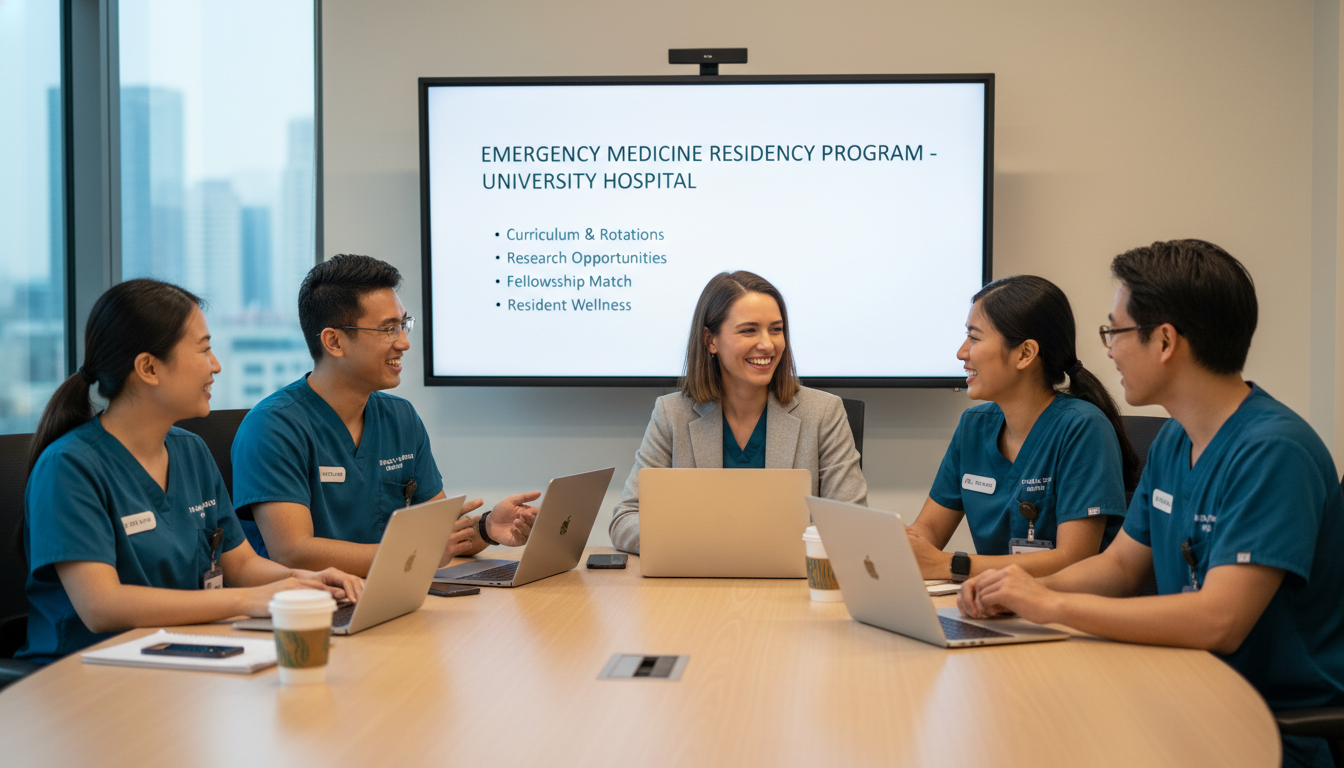
Evaluating Residency Programs: Making Meaningful Comparisons
With information gathered, the next challenge is evaluating residency programs in a structured, fair way.
Create a scoring or tiering system
To compare programs objectively, consider:
Assign weights based on your priorities. Example:
- Clinical training quality (30%)
- Location & lifestyle (25%)
- Culture & wellness (20%)
- Academic/fellowship opportunities (15%)
- Schedule & shift structure (10%)
Score each program on a 1–5 or 1–10 scale for each category, based on your research.
Add a “gut feeling” column, separate from objective scores; you’ll revisit this after interviews.
This doesn’t have to be rigid math, but it prevents you from overvaluing small differences (like brand reputation) at the expense of what actually matters for your training and life.
Key factors to prioritize in emergency medicine
When evaluating EM residency programs, pay particular attention to:
1. Clinical intensity and diversity
- Does the ED volume support high patient exposure?
- Are you seeing:
- High-acuity medical and surgical emergencies?
- Bread-and-butter EM cases?
- A broad mix of ages, comorbidities, and socioeconomic backgrounds?
An EM physician must be comfortable managing a wide range of presentations; your training environment should reflect that.
2. Procedural training
Strong EM programs ensure residents own key procedures, including:
- Airway management (intubation, difficult airway, use of adjuncts)
- Central and arterial lines
- Chest tubes and thoracostomies
- Procedural sedation
- Fracture and joint reductions
- Lumbar punctures, paracenteses, thoracenteses
- Ultrasound-guided procedures
If the ED is saturated with other procedural learners (e.g., anesthesia controlling most airways), ask: How does the program ensure EM residents hit competency benchmarks?
3. Autonomy with appropriate backup
Residents should progress toward managing critical patients largely independently, with attendings and senior residents available for guidance and supervision.
Signs of balanced autonomy:
- Senior residents run trauma and medical resuscitations
- Clear graduated responsibility described on the website or in conversations
- Faculty described as “hands-on when needed, hands-off when appropriate”
4. ED operations and flow
Well-run EDs teach you how to:
- Handle patient surges
- Navigate boarding and crowding
- Coordinate with consultants
- Manage throughput efficiently
Programs that expose you to ED leadership, QI, patient flow initiatives, and operations meetings can better prepare you for future leadership roles.
Use case examples: Applying your evaluation framework
Example 1: Academic-focused MD graduate
You want academic EM with ultrasound fellowship later.
- Program A:
- Large academic center, Level I trauma
- In-house ultrasound and EMS fellowships
- Multiple faculty with ultrasound publications
- Strong research infrastructure, mandatory scholarly project
- Program B:
- Solid community-based program, high volume
- Limited research output, no ultrasound fellowship
- Minimal scholarly expectations
You may rank Program A higher, even if it’s in a less desirable city, because it aligns with your long-term academic goals.
Example 2: Community-practice-oriented MD graduate
You plan to practice in a high-volume community ED immediately after training.
- Program C:
- Hybrid academic/community with very high ED volume
- Significant autonomy by PGY-2
- Graduates consistently go to community ED jobs
- Program D:
- Research-heavy university program, strong name recognition
- More subspecialty exposure but less high-throughput general EM experience
Program C may be the better fit for your specific career path, even if Program D is more widely recognized.
Integrating Your Research with EM Match Strategy
Researching programs isn’t just academic; it directly guides your EM match application approach.
Build a balanced application list
Using your evaluations, build a list that includes:
- Reach programs: Very competitive EM residencies, top-tier academic centers, or ideal locations.
- Target programs: Well-aligned with your profile and goals; realistic chance of interviews.
- Safety programs: Slightly less competitive or in less popular locations, but still strong for training.
For most MD graduates applying EM, this might mean:
- Total applications: often 30–45+ programs (varies with competitiveness and recent EM match trends).
- Mix of academic, community, and hybrid programs depending on your goals.
Adjust strategy based on your competitiveness
Evaluate your profile honestly:
- USMLE/COMLEX scores (if applicable)
- Clerkship grades and EM rotations
- SLOEs (Standardized Letters of Evaluation) strength
- Research and leadership
- Red flags (gaps, failures, professionalism issues)
If you’re a strong applicant, you can weigh your list more heavily toward high-priority locations and programs. If you have risk factors, broaden geographically and include more “safety” programs.
Use interview season to refine your data
Your pre-interview research is just Phase 1. Once interviews begin:
- Update your spreadsheet with:
- Resident and faculty impressions
- Clarified schedule details
- Culture markers (supportiveness, openness, approachability)
- Honest answers to your questions about autonomy, wellness, and graduates’ careers
- Adjust your rankings frequently; first impressions can change as you gather more data.
When it comes time to create your rank list, you’ll integrate:
- Pre-interview program research
- Actual interview experience
- Gut sense of fit
FAQs: Researching EM Residency Programs for MD Graduates
How early should I start researching emergency medicine residency programs?
Ideally, start 6–12 months before ERAS opens for your application cycle. Begin broad research (FREIDA, ERAS lists, general priorities) early in the year, then deepen your research after your EM rotations and SLOEs are underway. This timeline gives you space to learn how to research residency programs thoughtfully—without last-minute pressure.
How many EM programs should an MD graduate apply to?
It depends on your competitiveness and risk factors, but many MD graduates target 30–45 EM programs. Stronger applicants might apply to fewer; those with red flags or lower scores may need more geographic breadth. The key is to apply to a balanced mix of academic, hybrid, and community programs aligned with your goals, rather than only aiming at the most famous names.
How important is location compared to program quality?
Both matter, but the right balance is personal. For emergency medicine, your training quality—autonomy, procedures, clinical volume, and culture—will shape your skills for decades. That said, if you are deeply unhappy in a location (isolated from support systems, miserable climate, no partner job options), your performance and wellness can suffer. Most MD graduate residency applicants find a middle path: prioritize strong clinical training within a set of acceptable regions.
Should I trust online forums and anonymous program reviews?
Use them cautiously. Forums and crowd-sourced spreadsheets can flag issues or highlight strengths, but they’re often anecdotal, outdated, or biased by a small group of voices. Treat them as supplementary data, not your primary source. Always cross-check with official program information, direct conversations with residents, and your own impressions from interviews and open houses.
By approaching your EM residency program search with a clear sense of your priorities, a structured program research strategy, and a disciplined method for evaluating residency programs, you’ll be better prepared to build a realistic, high-yield application list—and ultimately to find the training environment where you can thrive as an emergency physician.