
Understanding the Role of a Preliminary Medicine Year
For an MD graduate planning a non–internal medicine specialty, a Preliminary Medicine year (prelim IM) is often the critical first step. Before you can effectively research programs, you need to be absolutely clear about what a preliminary medicine year is—and what it is not.
What is a Preliminary Medicine Year?
A Preliminary Medicine year is a one-year, non-categorical Internal Medicine position. You complete 12 months of internal medicine–focused training, then move on to your advanced (categorical) residency in specialties such as:
- Neurology
- Anesthesiology
- Radiology/IR
- PM&R
- Dermatology
- Ophthalmology
- Radiation Oncology
- Some advanced EM or other specialty tracks
Key features:
- Duration: 1 year (PGY-1 only)
- Goal: Provide solid clinical fundamentals, inpatient experience, and call responsibilities
- Outcome: You do not become board-eligible in Internal Medicine from a prelim IM alone
- Match structure: Typically, you match separately into a prelim year and an advanced program (some are linked, many are not)
For an MD graduate residency applicant from an allopathic medical school, prelim IM usually serves as the foundation that shapes your clinical habits, time management, and confidence. The quality and “fit” of this one year can significantly impact your transition into your advanced specialty.
Why Your Program Research Strategy Matters
Many MD graduates treat the prelim IM search as an afterthought compared with their advanced specialty applications. That’s a mistake.
A thoughtful, structured program research strategy for your preliminary year will help you:
- Avoid programs with unmanageable workloads or poor support
- Secure strong letters of recommendation to support your career
- Ensure your prelim year aligns with your advanced program’s expectations
- Minimize stress by choosing a program with a culture, geography, and schedule that work for your life
Your goal is not just to “find a prelim spot,” but to match into a prelim medicine program that sets you up for success in your ultimate specialty. That requires deliberate research—not just a quick skim of websites.
Step 1: Clarify Your Needs and Constraints Before You Research
Before you start clicking through FREIDA and program websites, define your personal priorities and constraints. This will make your search efficient and targeted.
A. Align With Your Advanced Specialty Program
The most important starting point: What does your advanced program expect or prefer from your prelim year?
Ask yourself and your advisors:
- Does my advanced specialty or target institution:
- Prefer university-based prelim IM vs community-based?
- Expect significant ICU exposure?
- Value academic research opportunities during prelim year?
- Care about specific EMR systems or patient populations?
Actionable advice:
- If you’ve already matched into an advanced program (or are applying concurrently), email the program coordinator or PD and ask:
- “Are there particular types of prelim medicine programs or experiences you strongly recommend (or discourage) for incoming residents in your specialty?”
- If you don’t have a specific program yet, ask your specialty mentors:
- “What kind of prelim medicine year best prepares residents for our specialty?”
Use these answers to prioritize where and how deeply you research prelim IM programs.
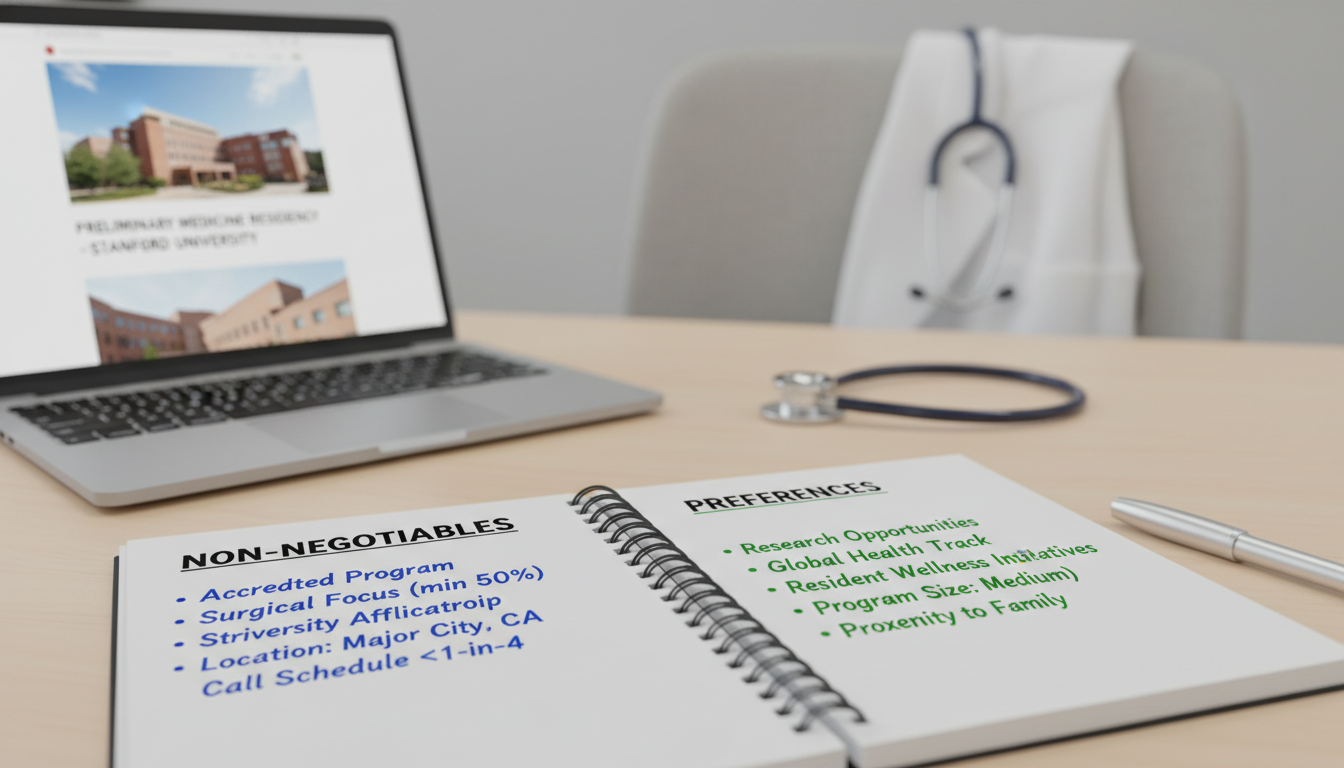
B. Non-Negotiables vs Preferences
Create a two-column list before you start program hunting:
Non-negotiables (must-haves):
- Geographic limitations (family, visa, spouse/partner, health)
- Visa sponsorship requirements (e.g., J-1 vs H-1B, if you’re an IMG with an MD or dual degree)
- Minimum salary / cost-of-living alignment
- Housing feasibility and commute constraints
- Shift patterns or night float expectations (for medical or parenting reasons)
Preferences (nice-to-have):
- Academic vs community hospital setting
- Specific patient demographics or pathology exposure
- Level of supervision vs autonomy you want
- Research or teaching opportunities
- Reputation or name recognition
Having this clearly documented before you start will prevent you from over-weighting shiny features (like a brand name) that don’t align with your real-life needs.
Step 2: Build a Target List Using Smart Tools and Filters
Once you know your constraints and aims, you can begin building a preliminary medicine program list in a strategic, structured way.
A. Start With FREIDA and NRMP Data
FREIDA (AMA) and NRMP data reports are essential starting points for MD graduate residency planning, especially in the allopathic medical school match system.
On FREIDA:
Filter by:
- Specialty: Internal Medicine – Preliminary
- Geographic region (if location-limited)
- Program type (university, community, university-affiliated)
Note for each potential program:
- Number of prelim positions vs categorical
- Hospital setting (tertiary care, community, county, VA)
- Program size (total residents)
- Any indication of typical resident career paths
Export or manually record programs into a spreadsheet with columns for:
- Program name
- City/State
- Prelim spots offered
- University vs community
- Contact email
- Website link
- Early impressions (e.g., “heavy ICU,” “research-heavy,” “small community hospital”)
NRMP Program Director Survey (and Charting Outcomes data):
Review for:
- How prelim IM PDs weigh USMLE/COMLEX scores, letters, class rank, etc.
- Typical applicant profiles that successfully match into prelim IM from allopathic schools
- Whether there are common disqualifiers or red flags
These data help you gauge where you’re realistically competitive and where you may be a stronger or weaker candidate.
B. Look for Programs Commonly Used by Your Specialty
A smart program research strategy is to identify where residents in your target specialty commonly do their prelim year.
How to research this:
- For neurology, anesthesiology, radiology, etc., go to their residency pages and view current residents’ CVs. Many list “Preliminary Internal Medicine – [Institution]” for PGY-1.
- Note recurring patterns:
- Are there certain prelim medicine programs that frequently send residents into your specialty?
- Are some prelim programs paired or informally linked with strong advanced programs?
Add these frequently appearing prelim programs to your spreadsheet with a note: “Common feeder for [specialty] at [institution].”
C. Ask Mentors and Recent Graduates
Your allopathic medical school network is one of your most powerful tools.
Ask:
- Recent MD graduates who matched into your specialty:
- “Where did you do your prelim IM year and would you recommend it?”
- “What should I know about the workload, culture, and support?”
- Internal Medicine faculty or chiefs:
- “Which prelim programs do your graduates consistently enjoy or struggle with?”
Capture these comments in your spreadsheet under a “Reputation/Word-of-mouth” column.
Step 3: Deep-Dive Into Program Websites (and What to Look For)
Once you’ve built a broad list, you’ll need to evaluate residency programs in detail. Program websites vary in quality, but there are key elements that matter a lot, especially for a one-year position.
A. Curriculum and Rotation Structure
For each prelim IM program, look carefully at:
Rotation breakdown:
- How many months of general inpatient medicine?
- How many ICU months (MICU, CCU)?
- Are there required electives? Which ones?
- Is there ED time? Night float?
Night call structure:
- Traditional overnight q4 vs night float vs shift-based
- Number of consecutive nights allowed
- Weekend call frequency
Questions to consider:
- Does this rotation mix align with how you learn best?
- Will you gain enough inpatient exposure to feel confident in your role as a PGY-2 in your advanced specialty?
- If you know your upcoming specialty is ICU-heavy (e.g., anesthesiology), do you have sufficient critical care exposure?
B. Resident Schedule and Workload Indicators
Many programs will include sample schedules or duty-hour descriptions. Look for:
- Explicit discussion of duty hour compliance
- Typical census per intern on floor and ICU rotations
- Whether they mention protected didactics and if attendance is respected
- Whether there is robust ancillary support (phlebotomy, IV team, transport, case management)
Red flags:
- Vague descriptions such as “busy training environment” without structure
- No mention of actual caps (patients per intern)
- Resident complaints about duty hours in online forums that the program ignores publicly
While being busy is part of intern year, unmanageable workloads can make your prelim year miserable and limit learning.
C. Program Culture and Education
Your prelim IM year should not be just service work. You want education and a supportive environment.
On the website, look for:
Description of educational philosophy (e.g., emphasis on bedside teaching vs lectures)
Frequency and type of conferences:
- Morning report
- Noon conference
- Grand rounds
- M&M, journal clubs
Mentorship or advising systems:
- Are prelims assigned advisors or mentors?
- Are prelim residents included in categorical resident wellness and educational activities?
As a prelim, you don’t want to be an afterthought. Programs that explicitly mention prelim residents in their materials and show them in photos or resident lists are often more inclusive.
D. Track Record and Outcomes for Prelim Residents
This is often overlooked. You want to know: What happens to prelim residents after they finish?
Look for:
- A list of recent prelim graduates and their next programs
- Mention of successful matches of prelims into strong advanced programs
- Testimonials or resident profiles that include prelim residents
If the website doesn’t highlight outcomes for prelims but focuses heavily on categoricals only, make a note to ask about this on interview day.

Step 4: Go Beyond Websites – Reputation, Fit, and Reality Testing
Even the best program website is a curated marketing tool. To truly understand how to research residency programs effectively, you must gather external, unfiltered information.
A. Use Objective and Semi-Objective Data Sources
Some additional tools:
Program reviews and rating sites (use with caution; look for consistent patterns rather than isolated comments)
Doximity residency navigator:
- Especially its alumni distribution and reputation indicators
- Not perfect, but offers a sense of name recognition and regional strengths
Hospital quality metrics:
- Large academic centers vs small community hospitals may have different patient volumes and acuity
- Programs in safety-net hospitals or VAs may offer rich clinical pathology but also higher service demands
Your goal is not to chase prestige, but to understand the clinical context in which you’ll train.
B. Reach Out to Current and Recent Residents
This is one of the most powerful parts of evaluating residency programs.
How to approach:
Find current or recent prelim residents via:
- Program’s resident roster
- Your med school alumni office
Send a concise, respectful email:
- Introduce yourself as an MD graduate from [school], interested in their prelim program
- Ask whether they’d be willing to talk briefly or answer a few questions over email
Key questions to ask:
- “Are prelim residents integrated with the categorical IM residents, or treated differently?”
- “How would you describe the workload—manageable, or overwhelming?”
- “Do you feel supported by faculty and leadership?”
- “Did you have time for board study, personal needs, or research (if desired)?”
- “Would you choose this same prelim program again?”
Listen to both content and tone. If multiple residents independently express the same concern, take it seriously.
C. Synthesize What You’re Learning
At this stage, update your spreadsheet or tracking document to reflect:
- Strengths of each program
- Concerns or red flags
- Alignment with your non-negotiables and preferences
- How well each program seems to prepare residents for your eventual specialty
You may assign each program a subjective “fit score” (e.g., 1–5) in categories like:
- Workload balance
- Education quality
- Culture/support
- Geographic/financial feasibility
- Alignment with advanced specialty
This allows you to compare programs systematically rather than relying on vague impressions.
Step 5: Strategically Organize and Prioritize Your Application List
Once you’ve researched broadly and deeply, you’ll need to turn your data into an application and ranking strategy.
A. Tier Your Prelim IM Programs
Create tiers based on both competitiveness and desirability:
Tier 1 – Ideal Fit / Reach:
- Highly desirable location or institution
- Excellent educational environment
- Heavier competition (e.g., large academic centers in big cities)
Tier 2 – Solid Fit / Realistic:
- Good clinical exposure and supportive culture
- Reasonable competitiveness for your profile
- Maybe less “name-brand,” but strong training
Tier 3 – Safety / Backup Options:
- Programs with higher fill rates via SOAP or less competitive profiles
- May have heavier workload or less prestige, but still acceptable training
- Ensure these are places you would genuinely be willing to train
Apply to a strategic mix of these tiers, depending on:
- Your board scores and academic record
- Strength of your letters and clinical performance
- Geographic flexibility
For most MD graduate residency applicants seeking a prelim IM spot, you’ll want a slightly larger number of applications than for your advanced specialty, simply because prelim spots can be competitive in certain regions.
B. Consider Combined or Linked Programs
Some advanced specialties offer:
- Linked preliminary + advanced positions (you match into both at the same institution)
- Strongly preferred partner prelim programs (e.g., neurology residents at X often do prelim IM at Y)
When possible:
- Prioritize prelim IM programs that are either linked to or strongly associated with your advanced specialty sites.
- This reduces logistical stress of switching institutions and often leads to better continuity of mentorship and systems knowledge.
C. Prepare Targeted Questions for Interviews
As you move into interview season, refine how you’ll evaluate residency programs in real time.
Questions to ask on interview day:
- “How are prelim residents incorporated into educational conferences and mentorship programs?”
- “What is the typical patient load for interns on general medicine and ICU rotations?”
- “How do you ensure prelim residents feel supported, given that they’re only here one year?”
- “Can you share where recent prelim graduates have gone after their year here?”
- “How does the program respond to feedback about workflow, duty hours, or wellness?”
Use the answers to calibrate (or correct) your initial understanding from website and external research.
Step 6: Common Pitfalls to Avoid in Prelim IM Program Research
Even thoughtful MD graduates can stumble into recurring mistakes in their program research strategy. Be intentional about avoiding these.
Pitfall 1: Treating the Prelim Year as “Just One Year”
Mindset trap: “It’s only 12 months; I can survive anything.”
Why this is dangerous:
- A toxic or chronically exhausted environment can burn you out before your advanced specialty even starts.
- Limited faculty engagement may mean weak letters and weaker professional development.
- Poor systems or heavy service demands limit actual learning and growth.
Your prelim year sets the tone for your residency career. Treat its selection with the same seriousness as your advanced program.
Pitfall 2: Over-Focusing on Prestige Over Fit
Yes, institutional reputation can matter. But for a one-year position:
- Educational quality, support, and workload outweigh name recognition.
- A slightly lesser-known program with strong teaching and humane scheduling may prepare you better than a hyper-competitive, understaffed major academic center.
Aim for a balance: strong training environment and a culture where you can thrive.
Pitfall 3: Ignoring the Experiences of Prelim Residents Specifically
Some programs are fantastic for categoricals but treat prelims as purely service positions.
Red flags:
- Website and materials barely mention prelims.
- Current residents report that prelims are excluded from retreats or advanced educational activities.
- No data on where prelims go after the year.
You want to be part of the resident community, not a temporary extra pair of hands.
Pitfall 4: Not Matching Your Program to Your Specialty’s Needs
Example: If you’re entering neurology or anesthesiology:
- Strong ICU exposure during prelim IM is usually a positive.
- Familiarity with rapid response systems, cross-cover management, and complex internal medicine patients is crucial.
If you’re going into a more outpatient or procedure-heavy specialty, your exact rotation mix might be less critical—but core inpatient competence is still key.
Discuss with your advanced specialty mentors what type of prelim IM environment will best set you up for success.
Putting It All Together: A Practical Workflow
Here’s a concise, step-by-step workflow you can follow:
Clarify goals and constraints (1–2 days):
- Non-negotiables, preferences, specialty-specific needs.
Build an initial list (3–5 days):
- Use FREIDA, NRMP data, and advanced specialty resident profiles.
- Create a master spreadsheet of prelim IM programs.
Website deep-dive (1–2 weeks, intermittent):
- Review curriculum, schedule, culture, prelim-specific descriptions.
- Score programs on fit categories.
External validation (2–3 weeks, overlapping):
- Contact current/recent prelim residents and mentors.
- Note patterns of praise or concern.
Tier and prioritize (1–3 days):
- Separate into reach, realistic, and backup tiers.
- Plan application numbers accordingly.
Prepare targeted questions and interview rubric:
- Decide what you will look for and ask on interview day.
- Update impressions after each interview.
Rank list construction:
- Weigh objective quality, personal fit, and logistical feasibility.
- Avoid placing any program on your rank list that you truly cannot imagine attending.
By approaching your prelim IM search in this structured way, you turn a potentially chaotic process into a deliberate, informed decision that supports your long-term career.
FAQs: Researching Preliminary Medicine Programs for MD Graduates
1. As an MD graduate from an allopathic medical school, do I need to worry about competitiveness for prelim IM?
Yes, to a degree. While many MD graduate residency applicants from U.S. allopathic schools successfully secure prelim IM positions, geography and program type matter:
- Highly desirable cities and major academic centers are competitive.
- Community or less urban programs may be more accessible.
Use NRMP and FREIDA data plus your school’s match history to gauge where you stand. Apply broadly if you are location-limited or if your academic profile has significant weaknesses.
2. How many preliminary medicine programs should I apply to?
This depends on:
- Your competitiveness (scores, grades, letters, professionalism record)
- Your geographic flexibility
- The number and competitiveness of advanced programs you’re applying to
In general, MD graduates often apply to a slightly larger number of prelim IM programs than advanced programs, especially in competitive specialties. Discuss specific numbers with your dean’s office or advisors, but planning a balanced list across tiers is essential.
3. Should I prioritize a prelim IM program at the same institution as my advanced specialty?
When possible, yes—it can be a major advantage:
- Easier transition between PGY-1 and PGY-2 (same EMR, hospital systems, culture)
- More continuity of mentorship and networking
- Less logistical stress of moving after a year
However, if the local prelim program is known for severe workload or poor support, a better-fit prelim program elsewhere can be the wiser choice. Weigh both institutional continuity and daily quality of life/training.
4. How do I tell if a prelim IM program will support me as “just a one-year resident”?
Look for:
- Website mentions of prelim-specific features (advising, integration into conferences, graduation outcomes)
- Explicit recognition of prelim residents in photos and resident lists
- Feedback from current or past prelims about inclusion in social/educational activities
- Responses on interview day when you ask, “How do you ensure prelim residents feel part of the residency community?”
Programs that answer these questions clearly and positively are more likely to treat prelims as valued team members rather than temporary labor.
By applying a deliberate, evidence-based approach to how you research residency programs—and focusing on the unique aspects of the preliminary medicine year—you can secure a position that not only fulfills the allopathic medical school match requirement, but truly prepares you for success in your advanced specialty.