Understanding the Landscape: Clinical Informatics and the US Citizen IMG
Clinical Informatics is a relatively new, fast‑evolving field that sits at the intersection of medicine, data, and technology. For a US citizen IMG (American studying abroad), this space offers real opportunity—but also unique challenges—when it comes to researching and selecting the right programs.
As of now, Clinical Informatics is:
- A subspecialty of multiple primary specialties (e.g., Internal Medicine, Pediatrics, Emergency Medicine, Pathology), and
- A field with non‑ACGME fellowships, health IT training programs, and industry‑adjacent roles.
For residency applicants, that means you’re often looking at two layers of decisions:
- Which core residency to pursue (e.g., IM, FM, EM, Path, Peds, Anesthesia), and
- Where and how you’ll be able to build toward a clinical informatics fellowship or equivalent health IT training afterward.
As a US citizen IMG, you face:
- Perception challenges at some academic programs
- Visa issues (less of a problem for you, but you may still be competing with visa‑requiring IMGs in “IMG‑friendly” places)
- Extra pressure to signal clear interest and readiness in a niche field like informatics
This article will walk you through a step‑by‑step program research strategy tailored specifically for an American studying abroad who is targeting Clinical Informatics–friendly residencies and, eventually, a clinical informatics fellowship or related health IT training.
We’ll cover how to:
- Clarify your informatics goals
- Identify residency programs that are genuinely informatics‑supportive
- Use a structured system for evaluating residency programs
- Combine official data with “hidden” information channels
- Create a realistic list of programs as a US citizen IMG
Step 1: Clarify Your Informatics Goals Before You Search
Before you Google a single program, you need a personal roadmap. Clinical Informatics is broad, and programs differ in how they support it. Your research will be far more efficient if you know exactly what you’re looking for.
1. Decide Your Likely Core Specialty
Clinical informatics fellowships currently require completion of an ACGME‑accredited primary residency (e.g., IM, Peds, EM, Pathology, etc.). Ask yourself:
- Which clinical specialty best fits your long‑term clinical identity?
- Which specialties are more IMG‑friendly and realistic for your profile?
- Where does informatics naturally integrate well? (e.g., IM and EM for hospital EHR optimization, Pathology for lab information systems, Peds for population health data, etc.)
For many US citizen IMGs, Internal Medicine or Family Medicine may be the most accessible entry path, but strong candidates may also match into EM, Peds, or Pathology at informatics‑heavy institutions.
2. Identify Your Informatics Interests
Clinical Informatics is not just “computers in medicine.” Programs will want to see specific interests. Consider which of these resonate:
- EHR optimization / clinical decision support
- Data analytics, quality improvement, and population health
- Telemedicine and digital health integration
- Clinical workflow redesign and change management
- Healthcare interoperability, standards (HL7, FHIR), or clinical data modeling
- AI/ML in clinical practice or predictive modeling
- Patient safety, human factors, and usability
Write a 2–3 sentence personal focus statement, for example:
“I’m an Internal Medicine–bound US citizen IMG interested in clinical decision support, data‑driven quality improvement, and EHR usability. I want a residency that will let me participate in hospital IT projects and prepare for a clinical informatics fellowship.”
This statement becomes your filter for how to research residency programs: everything you learn about a program, you’ll compare to this target.
3. Define Your Constraints and Priorities
As a US citizen IMG, you should be honest about your baseline competitiveness and logistical needs:
- USMLE scores / COMLEX (if applicable)
- Year of graduation and time since medical school
- US clinical experience (USCE) and any informatics‑relevant work (e.g., QA projects, EHR internships, data analysis)
- Geographic preferences (but be flexible—informatics opportunities are concentrated at certain institutions)
- Need for strong structured mentorship versus willingness to “build your own” informatics pathway at a smaller program
Create a short list of must‑haves and nice‑to‑haves. Example:
- Must‑have: Accepts IMGs, has an academic medical center or strong community program with EHR optimization/quality projects.
- Nice‑to‑have: Existing clinical informatics fellowship on site, or robust hospital IT department involving clinicians.
Step 2: Build a Target List Using Public Databases and Directories
Once your goals are clear, you can start systematic research. Avoid random searching; instead, treat this as a structured data project, just like a small informatics exercise.
1. Start with Core Residency Databases
For your base list, use:
- FREIDA (AMA Residency & Fellowship Database)
- ERAS / AAMC Residency Explorer (when available to you)
- NRMP’s “Results and Data” PDFs (for prior match statistics)
- Specialty-specific websites (e.g., ACP for IM, AAFP for FM, ACEP for EM, etc.)
Filter by:
- Specialty (e.g., Internal Medicine categorical, Family Medicine, Emergency Medicine, Pathology, Pediatrics)
- IMG‑friendliness:
- Programs that have historically taken IMGs
- Use FREIDA filters like “Accepts IMGs” if available
- Use Residency Explorer/other sources to see percentage of IMGs
- Program size and type (university, university‑affiliated community, community)
Export or manually record:
- Program name
- Location
- Program type (university / academic vs community)
- Minimum USMLE requirements (if posted)
- Percentage of IMGs (if available)
2. Layer in Informatics‑Relevant Signals
Next, you want to identify which of these core residencies sit in informatics‑rich environments.
Look for:
- Existing Clinical Informatics Fellowship at the same institution
- Affiliation with large academic medical centers known for Health IT
- EHR vendor relationships (Epic, Cerner, etc.) with strong optimization teams
- Medical schools or hospitals with a reputation for:
- Data science
- Population health
- Quality and safety programs
Sources:
- ACGME’s list of Clinical Informatics fellowships
- Program websites for phrases like “health informatics,” “clinical informatics,” “health information technology,” “digital health,” “data science”
- Major informatics organizations:
- AMIA (American Medical Informatics Association) – check membership and training program listings
- HIMSS – hospitals with HIMSS awards often have advanced IT infrastructures
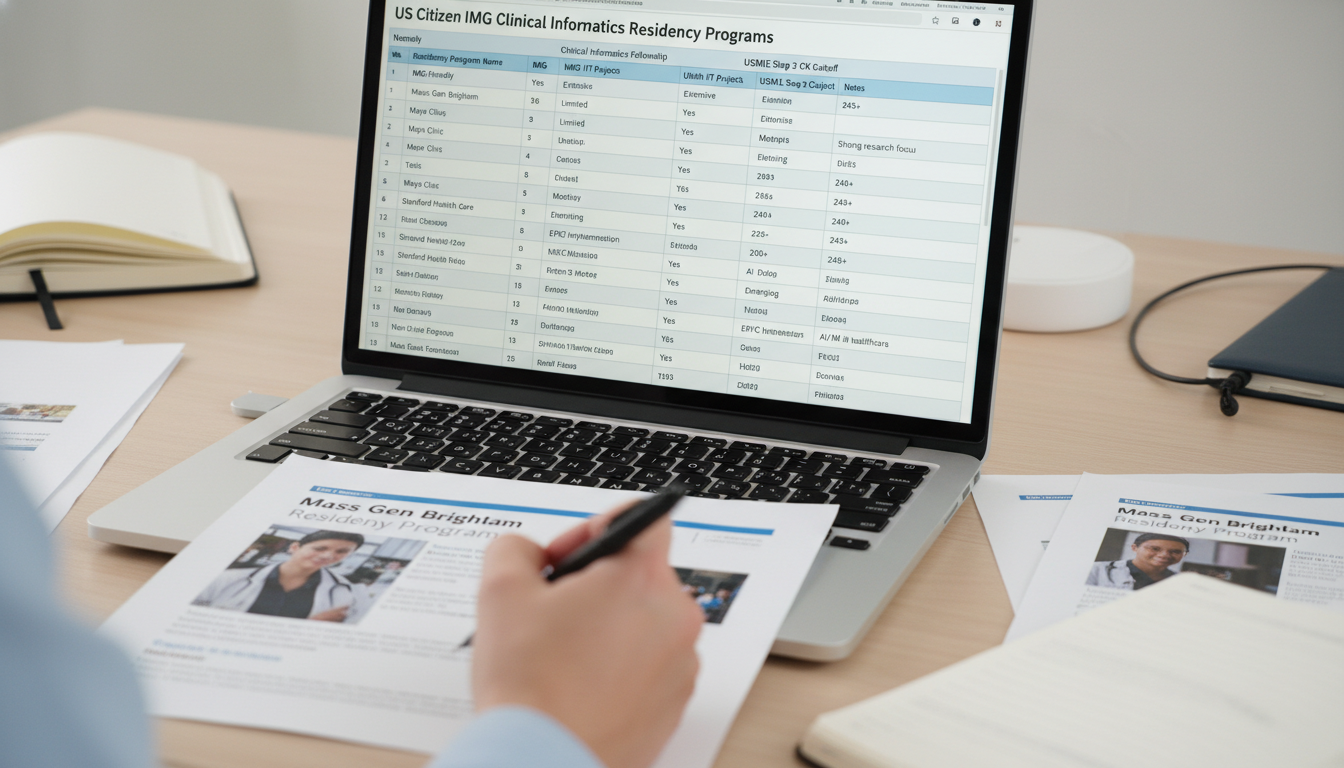
Create a column in your spreadsheet: “Informatics Flag (Y/N)” and another: “Type of Opportunities” (fellowship on-site, robust QI/data programs, EHR optimization teams, etc.).
3. Narrow by IMG Feasibility and Competitiveness
As a US citizen IMG, you should prioritize:
- Programs that explicitly list IMGs among current or past residents
- Programs without harsh graduation year limits (e.g., “within 3 years of graduation”) if that affects you
- Institutions that don’t state unrealistic score cutoffs you cannot meet
Add columns:
- “IMG Presence (High/Medium/Low)” – based on current resident bios
- “Score Cutoff/Expectation” – if inferred or stated
- “US Citizen IMG Friendly?” – your subjective yes/maybe/no based on data
Your goal: a shortlist of 40–80 programs (depending on your specialty and competitiveness) that are both potentially attainable and informatics‑supportive.
Step 3: Deep-Dive into Program Websites with an Informatics Lens
Once you have a filtered list, you’ll do qualitative research. This is where “how to research residency programs” shifts from basic eligibility to evaluating residency programs for true informatics value.
1. What to Look for on Program Websites
As you review each program’s site, scan for the following keywords and sections:
- Curriculum pages
- Look for rotations or electives in:
- Clinical Informatics
- Health Informatics
- Quality Improvement and Patient Safety
- Population Health
- Health IT, data analytics, or digital health
- Look for rotations or electives in:
- Faculty bios
- Any faculty with titles:
- Chief Medical Information Officer (CMIO)
- Associate CMIO, Medical Director of Informatics
- Director of Clinical Informatics
- VP for Health IT / Quality & Safety leader
- Faculty with degrees: MPH, MS in Informatics, MS in Data Science, or related
- Any faculty with titles:
- Scholarly activity / projects
- Recent QI or research projects involving:
- EHR interventions
- Predictive models
- Telehealth
- Data dashboards
- Recent QI or research projects involving:
- Program features
- Longitudinal QI curriculum
- Dedicated research time
- Required scholarly project with statistical or data support
As you find these, note:
- “Named Informatics Faculty Y/N”
- “EHR/QI/Digital Health Projects: Examples”
- “Formal Electives or Tracks in Informatics?”
The presence of structured offerings and named informatics faculty is far more important than vague mentions of “we use Epic.”
2. Cross-Check the Institution’s Broader Environment
Sometimes the residency page is sparse, but the institution is rich in health IT. Explore:
- The hospital system’s IT / Digital Health / Innovation Center web pages
- Medical school departments of Biomedical Informatics, Population Health, or Data Science
- News releases about:
- EHR upgrades or optimization initiatives
- AI tools or predictive risk scores
- Digital front door / telehealth expansions
If the institution is clearly investing in health IT, you can often create your own opportunities as a resident—provided they support resident involvement.
3. Evaluate Culture and Flexibility
A crucial aspect of evaluating residency programs is whether they will actually let you do informatics work as a trainee. Look for signals of a culture that values:
- Resident‑driven QI projects
- Participation in hospital committees (e.g., EHR steering committees, quality councils)
- Support for conference presentations (AMIA, HIMSS, specialty QI meetings)
Red flags:
- No mention of QI or research requirements
- Minimal resident involvement in projects beyond mandatory case reports
- No elective time or very rigid schedules
As an American studying abroad, you may need extra structural support to build your network; rigid, low‑support programs are less ideal if you are aiming for a competitive clinical informatics fellowship later.
Step 4: Use Data and Networking to Validate What You Find
Website content is a starting point—but may be outdated or incomplete. The next step in your program research strategy is using real people and real outcomes to refine your impressions.
1. Search for Alumni Paths and Informatics Outcomes
For each shortlisted program, try to find:
- Recent resident graduates who:
- Entered a clinical informatics fellowship
- Took roles in health IT, digital health startups, or analytics positions
- Completed advanced degrees (MPH, MS in Informatics, health data analytics) during or after residency
Sources:
- Program alumni pages
- LinkedIn searches (filter by institution + specialty + “clinical informatics” or “informatics”)
- AMIA membership or conference proceedings (if accessible)
If you find that multiple residents from a program have moved into informatics or health IT training, that’s extremely strong evidence the environment is supportive.
2. Contact Current Residents and Fellows Strategically
Reach out with short, respectful, targeted questions:
- Current residents at your target programs
- Clinical informatics fellows at the same or nearby institutions
- Faculty in informatics roles (CMIO, informatics fellowship directors)
When you do, be prepared with focused questions, such as:
- “How receptive is your program to resident involvement in hospital IT or QI projects?”
- “Do residents have any exposure to the clinical informatics team or CMIO?”
- “Have residents gone on to informatics fellowships or health IT roles after graduation?”
- “How easy is it to create an informatics‑related scholarly project?”
As a US citizen IMG, also ask (tactfully):
- “Do you have co‑residents who are US citizen IMGs or other IMGs? How supportive is the program of international graduates overall?”

3. Combine Quantitative and Qualitative Signals
For each program, synthesize:
- Hard data:
- IMG acceptance patterns
- Core residency match stats
- Presence of an onsite clinical informatics fellowship
- Soft data:
- Culture of support for resident projects
- Openness to non‑traditional or tech‑oriented career paths
- Visible alumni outcomes
Score or categorize each program as:
- Tier A (High Informatics Fit + Realistic Match Probability)
- Tier B (Moderate Informatics Fit or Slight Reach)
- Tier C (Backup programs with little informatics but better match odds)
Designing this tiered list is a core step in how to research residency programs efficiently and strategically.
Step 5: Align Your Application Strategy with Informatics Goals
Researching programs isn’t just about where to apply; it’s about how you present yourself to those programs.
1. Tailor Your Application Materials
For informatics‑friendly programs:
- Emphasize:
- Any past experience with EHRs, data analysis, coding, statistics, or IT systems
- QI projects that used data or impacted workflows
- Research involving databases, registries, or outcomes analysis
Examples you might highlight:
- Helped design a template in an EMR during a clerkship
- Worked on a database project during medical school (even if not labeled “informatics”)
- Participated in telemedicine initiatives or digital triage tools
Describe these in the language of Clinical Informatics:
“Improved documentation workflow,” “reduced alert fatigue,” “built automated data reports,” etc.
2. Build a Consistent Narrative
Programs want to see a coherent story, not random tech interest. For a US citizen IMG targeting informatics:
- Personal statement:
- Clarify why you chose medicine first, technology second—not the reverse.
- Show how clinical questions led you to data or systems thinking.
- CV and experiences:
- Group informatics‑relevant entries together (Research & QI, Health IT Experience, etc.).
- Letters of recommendation:
- Where possible, ask faculty who can speak to:
- Your analytical thinking
- Leadership in QI/IT projects
- Professionalism and communication with multidisciplinary teams (IT, nursing, admin)
- Where possible, ask faculty who can speak to:
3. Be Strategic When Signaling Interest
In emails to program coordinators, faculty, or residents:
- Reference specific informatics features of their program:
- “I’m particularly excited by your residents’ involvement in EHR optimization projects”
- “I noticed your institution has a clinical informatics fellowship and residents have collaborated on decision support tools”
This shows you did serious program research—not mass messaging.
Step 6: Evaluate Fit During Interviews and Rank List Creation
Your research doesn’t stop at submitting ERAS. Interview season is your chance to validate and refine your earlier evaluations.
1. Questions to Ask on Interview Day
To understand the real informatics culture, ask:
To program leadership or faculty:
- “How are residents involved in system‑level quality or IT initiatives?”
- “Is there opportunity to work with the CMIO or the clinical informatics team?”
- “Can residents pursue informatics or data‑driven projects as part of their scholarly requirements?”
- “Have any graduates gone on to a clinical informatics fellowship or health IT leadership roles?”
To residents:
- “Does the program support time for informatics‑related electives or research?”
- “Are there mentors who understand or work in clinical informatics?”
- “How is the program for someone with a non‑traditional, tech‑oriented career plan?”
- “As an IMG (or US citizen IMG), do you feel supported in building a unique academic path?”
2. Watch for Signs of Authentic Commitment vs Buzzwords
Positive signs:
- Specific examples of resident informatics projects
- Named mentors and structured pathways for informatics or QI
- Flexibility to arrange electives with IT, data science, or innovation teams
Caution signs:
- Vague answers like “We’re open to anything” without concrete examples
- Heavy emphasis on service work with little time for scholarly or systems‑level projects
- Outright confusion about what “clinical informatics” even is
3. Rank List Strategy for the US Citizen IMG
When you create your rank list:
- Weigh heavily:
- Training quality and board pass rates
- Supportive culture for IMGs
- Clear pathways into informatics (fellowships, mentors, projects)
- Be honest about risk:
- Don’t fill your top 10 only with hyper‑academic, super competitive programs if your metrics are mid‑range.
- Balance “informatics dream” programs with “solid but less informatics‑heavy” backups where you can still pursue informatics via electives, remote coursework (e.g., online informatics certificates), or later fellowships.
Your career in clinical informatics is a 10–20 year arc. The right residency will give you clinical strength, institutional exposure, and enough flexibility to build your informatics profile—even if it doesn’t scream “tech” on day one.
FAQs: US Citizen IMG Pathways to Clinical Informatics
1. As a US citizen IMG, do I need a residency at a place with a clinical informatics fellowship?
No, but it helps. An onsite clinical informatics fellowship creates:
- Direct exposure to informatics faculty and projects
- Easier networking and mentorship
- A clearer pipeline into the subspecialty
However, you can still reach informatics by:
- Doing residency at a solid, IMG‑friendly program
- Participating in QI, EHR, and data projects
- Attending informatics conferences (AMIA, HIMSS)
- Applying broadly to informatics fellowships later, leveraging your project work
Focus on high‑quality clinical training plus documented informatics activities, even at non‑fellowship institutions.
2. What if my target residency programs don’t mention “clinical informatics” specifically?
Look for proxy signals:
- Strong QI and patient safety infrastructure
- Dedicated EHR optimization or IT committees with physician involvement
- Population health or data analytics initiatives
- Affiliation with a university that has a department of biomedical informatics or public health
You can often carve out an informatics‑aligned path (projects, electives, mentorship) even in programs that don’t label it explicitly, as long as they’re open to scholarly innovation.
3. How many programs should I apply to as a US citizen IMG interested in informatics?
It depends on your specialty and competitiveness, but many US citizen IMGs applying to IM/FM/Path/Peds typically apply to 40–80 programs, sometimes more if scores or graduation year are limiting.
Within that:
- Aim for a solid subset (15–30) of programs with clear informatics potential
- Fill the rest with reliable IMGs‑friendly clinical programs where you can still build your profile via QI, data projects, and self‑directed learning in health IT training domains.
4. How early should I start researching residency programs for an informatics‑oriented career?
Ideally:
- 18–24 months before applying: clarify goals, explore informatics, start basic projects.
- 12 months before applying: build your structured spreadsheet, do deep dives into programs, contact mentors and informatics faculty.
- 6–9 months before applying: finalize your program list, tailor your personal statement and CV around your clinical informatics path, and plan elective choices (if still in school or doing USCE).
The earlier you start, the more deliberately you can build experiences that align with the environments you’re targeting.
By approaching program selection as a disciplined research project—exactly the skillset you’ll use in Clinical Informatics—you’ll not only choose better residency options, but also demonstrate to programs that you think like an informatician already: systematic, data‑driven, and focused on meaningful outcomes.