Understanding Your Path: DO Graduate, Clinical Informatics, and Program Types
For a DO graduate interested in Clinical Informatics, “how to research residency programs” is more complex than simply browsing a list of hospitals. You’re navigating:
- Your osteopathic background (DO vs MD considerations)
- The evolving field of Clinical Informatics
- Multiple possible training routes (residency, fellowship, and health IT–focused pathways)
Before diving into a step‑by‑step program research strategy, you need clarity on where Clinical Informatics fits into your training timeline and how the osteopathic residency match intersects with this specialty.
Clinical Informatics in the Training Pathway
Clinical Informatics (CI) is currently recognized as a subspecialty, not a standalone core residency. Most physicians enter Clinical Informatics through:
Primary residency (core specialty)
- Internal Medicine, Family Medicine, Pediatrics, Emergency Medicine, Pathology, Anesthesiology, etc.
- For DO graduates, this means participating in the main residency (NRMP) match for a primary specialty.
Clinical Informatics fellowship
- ACGME-accredited two-year fellowship after completion of an ACGME residency and board eligibility in a primary specialty.
- Focused on data, EHRs, analytics, quality improvement, and health IT training.
Alternative health IT training pathways
- Master’s programs (e.g., MS in Biomedical Informatics, Health Informatics)
- Health system–based informatics roles (e.g., physician champion, CMIO track)
- Industry roles in digital health, EHR vendors, or analytics
As a DO graduate aiming at Clinical Informatics, your program research splits into two linked tasks:
- Task 1: Research and select a primary residency that supports your informatics interests.
- Task 2: Identify and track Clinical Informatics fellowship and health IT training opportunities that align with your long-term goals.
DO Graduate Considerations in the Osteopathic Residency Match Era
Since the single accreditation system, DO graduates participate in the NRMP match alongside MD graduates. For a DO graduate residency search with an informatics focus, pay attention to:
Programs with a history of DO residents:
These programs are more likely to be familiar with COMLEX scores, OMM backgrounds, and different curricular pathways.Programs that accept COMLEX alone vs. require USMLE:
For highly competitive academic programs or informatics-heavy institutions, USMLE scores can still strengthen your file, especially for Clinical Informatics–focused environments.Institutional biases and culture:
Some institutions are truly DO-friendly with active DO faculty; others “accept” DOs but rarely match them. Your program research strategy should include verifying DO match history and speaking directly with current DO residents.
Understanding these dynamics early helps you filter, prioritize, and communicate confidently as you evaluate residency programs and later, Clinical Informatics fellowships.
Building a Program Research Strategy: Step-by-Step Framework
A scattered Google search isn’t enough for serious applicants. You need a deliberate, structured approach to researching both residency and Clinical Informatics fellowship options.
Here is a step-by-step program research strategy tailored to DO graduates interested in Clinical Informatics.
Step 1: Define Your Clinical Informatics Career Vision
Before you assess programs, clarify your goals. Ask yourself:
Do you want to be:
- A full-time clinical informatician (e.g., CMIO, Director of Clinical Informatics)?
- A clinician who uses informatics skills to improve care within your specialty?
- A bridge to industry, health systems, or digital health startups?
What types of roles excite you?
- Designing decision support tools
- Implementing and optimizing EHR workflows
- Leading quality improvement using data
- Working on clinical data science or AI projects
- Translating between IT teams and frontline clinicians
How technical do you want your career to be?
- Comfortable with concepts and leadership but not coding?
- Interested in learning SQL, Python, or data science tools?
Your answers will shape the kind of residency you pursue (e.g., IM vs EM vs FM vs Pathology) and the type of Clinical Informatics fellowship or health IT training environments that best fit you (academic, community, industry-oriented, or policy-focused).
Step 2: Map the Training Pathway That Fits Your Goals
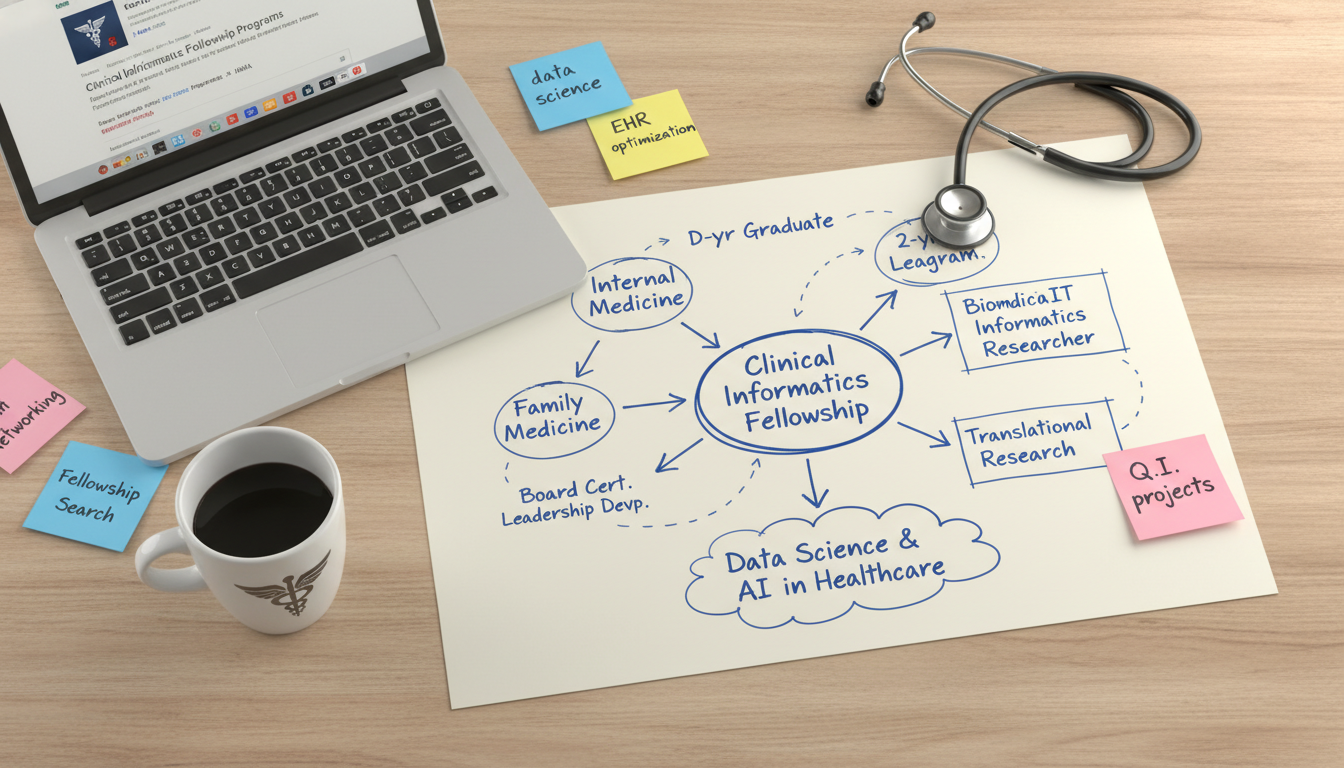
For a DO graduate residency track leading to Clinical Informatics, typical pathways include:
Pathway A: Strong Clinical Specialty → Academic CI Fellowship
- Example: DO completes Internal Medicine residency at a university hospital → Clinical Informatics fellowship at the same or another academic center → academic informatics leadership.
Pathway B: Community-Focused Specialty → CI + Operational Leadership
- Example: DO completes Family Medicine in a large integrated health system with robust EHR infrastructure → becomes physician champion → completes part-time CI fellowship or health IT training → moves into a system leadership role.
Pathway C: EM or Hospital-Based Specialty → Systems-Level Informatics Role
- Example: DO completes Emergency Medicine → CI fellowship with strong data analytics track → transitions into ED informatics leadership + quality and operations.
Use this to backwards-plan: identify Clinical Informatics fellowships or health IT training programs that interest you, then note which core specialties and residency programs feed into them.
How to Research Residency Programs with an Informatics Lens
Once your path is clear, you can start systematically evaluating residency programs. This involves understanding where to find information, how to interpret it, and what “informatics-friendly” really looks like.
1. Create a Structured Program Research Spreadsheet
Begin with a simple but comprehensive tracking tool (spreadsheet or Notion/Airtable board). Include columns for:
- Program name and specialty
- Location and healthcare system type (academic, community, hybrid)
- DO acceptance history (number of DOs in recent classes)
- COMLEX/USMLE requirements and score expectations
- EHR platform (Epic, Cerner, Meditech, etc.)
- Existing Clinical Informatics fellowship at the institution
- Health IT training opportunities:
- Data analytics projects
- Quality improvement (QI) infrastructure
- EHR optimization and clinical decision support initiatives
- Faculty with informatics/IT roles (CMIO, associate CMIOs, informatics faculty)
- Research support and publications in informatics or QI
- Culture markers:
- DO mentors
- Interdisciplinary collaboration
- Resident leadership opportunities
- Your level of interest (1–5)
- Questions to ask and notes from conversations
Treat this as your central tool for evaluating residency programs and to avoid missing critical details as the process progresses.
2. Use Official Directories Strategically
For a DO graduate residency search, start with authoritative directories:
FREIDA (AMA) – Filter by:
- Specialty, geographic region, and program size
- Programs that “accept DO” and have “DO residents”
- Academic vs community setting (academic centers often have more robust health IT infrastructure and formal informatics tracks)
ACGME Program Search – Check:
- Accreditation status and cycle length
- Sponsoring institution (often correlates with institutional IT and CI resources)
NRMP, specialty societies, and osteopathic specialty organizations – For match data and program lists.
Then, layer on a Clinical Informatics perspective:
- Look for institutions that:
- Have an accredited Clinical Informatics fellowship
- Are large health systems or academic centers known for Epic/Cerner optimization or digital innovation
- Are part of health systems with recognized health IT leadership (e.g., HIMSS Stage 7, known digital transformation awards)
3. Deep Dive into Program Websites with a CI Focus
When you open a residency website, read it like a clinician-informatician in training:
Curriculum pages
- Are there QI or data-driven care components?
- Is there structured time for electives (where you could choose informatics projects)?
- Are there tracks like “Leadership,” “Quality & Safety,” or “Healthcare Systems”?
Faculty bios
- Identify faculty with titles like:
- Chief Medical Information Officer (CMIO)
- Associate CMIO, Medical Director of Informatics
- Director of Quality Improvement / Patient Safety
- Biomedical/Clinical Informatics faculty
- Note any DO faculty in these roles—it can be especially encouraging for DO graduates.
- Identify faculty with titles like:
Research & scholarly activity
- Are residents publishing in clinical informatics, QI, outcomes research, or digital health?
- Are there cross-department collaborations with data science, IT, or public health schools?
Institutional pages
- Look beyond the residency site: explore the health system’s digital strategy, innovation centers, and health IT descriptions.
- Search for “[institution name] Clinical Informatics fellowship” even if it’s not linked from the residency page.
Capture all relevant information and links in your spreadsheet.
Evaluating How “Informatics-Friendly” a Residency Really Is
The phrase “good for Clinical Informatics” is vague. To make it actionable, break it into specific, observable features.
Feature 1: EHR and Data Infrastructure
For someone headed toward Clinical Informatics, the EHR is your primary “lab.” Ask:
- Which EHR system is used? (Epic and Cerner are common in informatics-heavy institutions.)
- How integrated is the EHR across the health system? (Single instance vs multiple unconnected systems)
- Are residents encouraged or allowed to participate in:
- EHR optimization committees
- Development or testing of clinical decision support tools
- User feedback and build prioritization processes
In interviews and emails, you can frame it like:
“As someone interested in Clinical Informatics, I’m curious how residents can get involved in EHR optimization, data-driven QI, or clinical decision support projects here.”
Feature 2: Direct Exposure to Informatics Leadership
A residency that truly aligns with a future Clinical Informatics fellowship will provide:
Regular engagement with:
- CMIO/ACMIOs
- IT / data analytics teams
- Quality & patient safety offices
Opportunities such as:
- Shadowing informatics leaders
- Joint IT-clinical meetings open to residents
- Decision-making committees where residents have voting or advisory roles
On websites and during your research, note if:
- Informatics leaders are visible and accessible
- There are structured informatics electives or rotations
- Residents have mentored CI or QI projects that lead to posters/publications
Feature 3: Research and Scholarly Culture
Residency isn’t only about clinical care; it’s also your springboard to fellowship applications.
For a future clinical informatics fellowship, strong applicants often have:
QI or informatics-focused projects involving:
- Order set redesigns
- CDS (clinical decision support) development
- Dashboard creation
- Workflow analyses and improvements
Presentations at:
- AMIA, HIMSS, ACP/AAFP/ACEP, or specialty meetings with informatics/QI tracks
- Institution-wide quality forums
Evaluate residency programs by:
- Number and type of resident projects in QI, data usage, and informatics
- Protected research time (if any) in the curriculum
- Availability of research mentors in informatics or health IT
Researching Clinical Informatics Fellowships and Health IT Training
Even while you’re focused on the osteopathic residency match, you can and should begin learning how to research Clinical Informatics fellowship programs and broader health IT training options.
Identifying Clinical Informatics Fellowship Programs
Use these strategies:
AMIA and ACGME listings
- ACGME’s Clinical Informatics subspecialty list shows accredited programs.
- AMIA (American Medical Informatics Association) often lists programs and networking opportunities.
Institutional searches
- Google: “[institution] clinical informatics fellowship DO” or “[health system] biomedical informatics fellowship.”
- Many fellowships are housed within departments of medicine, pediatrics, pathology, emergency medicine, or anesthesiology.
Program characteristics to record:
- Accepts DOs and board-eligible status requirements
- Preferred prior specialties (some are open to all; others favor certain fields)
- Type of projects (data science, EHR implementation, AI, population health)
- Industry partnerships (EHR vendors, digital health startups, pharma, or payers)
- Degree options (e.g., chance to earn an MS in Biomedical Informatics)
Even if you’re 3–5 years away from fellowship applications, this helps you select a residency that will prepare you for the kind of CI fellowship that fits your future.
Evaluating Fit: CI Fellowship Criteria for a DO Graduate
As you learn about CI fellowships, consider:
DO inclusivity
- Does the program list DOs among current or past fellows?
- Are they familiar with osteopathic training pathways and COMLEX?
Clinical flexibility
- Can fellows continue some clinical work in their primary specialty?
- How is call or clinical time integrated with informatics responsibilities?
Skill-building emphasis
- Technical depth (SQL, R, Python, FHIR, data pipelines)
- Human factors and change management
- Health policy, regulation, and ethics
- Leadership and project management
Matching this to your long-term goals makes your residency research much more strategic.
Health IT Training Beyond Formal CI Fellowship
A Clinical Informatics fellowship is powerful but not the only path. During and after residency, you can pursue:
Formal degrees:
- MS in Health Informatics or Biomedical Informatics
- MPH with informatics or epidemiology emphasis
- Certificates in data analytics, AI in healthcare, or population health
Short courses and certificates:
- AMIA 10x10 course
- Coursera/edX specializations in health informatics and data science (paired with real-world projects)
On-the-job training through your health system:
- Joining EHR optimization committees as a resident
- Serving as a “super-user” or physician champion for new tools
- Collaborating with IT on pilot projects, dashboards, or documentation optimization
While researching residency programs, look for environments that support these opportunities and explicitly value informatics-oriented residents.
Making Contact: Reaching Out and Asking the Right Questions
Passive research is only half the process. Strong applicants actively engage with programs and clarify how well the program matches their specific Clinical Informatics goals.
Who to Contact
- Program coordinator and program director (PD) – For overall program culture and DO-friendliness.
- Associate program directors in QI or systems-based practice – For CI-adjacent opportunities.
- CMIO / informatics faculty – For targeted questions about informatics experiences.
When you email, introduce your osteopathic background and informatics interest clearly and succinctly.
Example:
“I’m a DO graduate applying in Internal Medicine with a focused interest in Clinical Informatics. I’m particularly interested in how residents at your institution engage with EHR optimization, data-driven QI, or informatics projects.”
Key Questions to Ask During Outreach or Interviews
Use a consistent list to compare programs:
DO and COMLEX considerations
- “Do you have current or recent DO residents? How do COMLEX scores factor into your review?”
- “Are there DO faculty or mentors in leadership roles at your institution?”
Informatics exposure in residency
- “Are residents able to participate in health IT or Clinical Informatics–related projects or committees?”
- “Is there a pathway for residents to work with the CMIO team or data analytics group?”
Support for future CI fellowship applications
- “Have any recent graduates pursued Clinical Informatics fellowships or health IT leadership roles?”
- “How does the program support residents’ scholarly work in QI or informatics?”
Protected time and mentorship
- “Is there protected time for QI or data-driven projects?”
- “Who would likely be a mentor for an informatics-oriented resident?”
Document responses in your spreadsheet to directly compare programs on the dimensions that matter most for your CI career path.
Pulling It All Together: Making a Data-Driven Rank List
By the time you interview and are ready to submit your rank list, you should treat your own decision-making as an informatics exercise.
Weighing the Factors
Consider weighting core categories, for example:
Clinical training quality (30–40%)
- Volume and complexity of cases, supervision, board pass rates.
DO friendliness and culture (20–25%)
- Presence of DOs, equitable treatment, respect for osteopathic background.
Clinical Informatics and health IT opportunities (25–30%)
- EHR infrastructure, presence of CI fellowship, access to IT/QI leadership, informatics-related projects.
Lifestyle and personal fit (15–20%)
- Location, call schedule, wellness culture, support systems.
Give each program a score in each category and calculate a composite. This helps you avoid overemphasizing a single positive (great city, prestigious name) at the expense of long-term informatics alignment.
Example Comparison: Program A vs Program B
Program A
- Academic IM program, Epic EHR, on-site Clinical Informatics fellowship.
- Multiple CI faculty, residents present at AMIA.
- One DO per class, PD very supportive, but location is less desirable.
Program B
- Community IM program, Cerner EHR, no CI fellowship.
- Strong clinical training and DO-friendly culture.
- Limited structured informatics presence, but open to resident-led projects.
If your goal is a competitive Clinical Informatics fellowship, Program A may be more strategic despite location tradeoffs. Your structured evaluation helps you see that clearly.
FAQs: Researching Programs as a DO Graduate Heading into Clinical Informatics
1. As a DO graduate, do I need to take USMLE in addition to COMLEX to be competitive for Clinical Informatics–oriented residencies and fellowships?
Not strictly, but it often helps. Many DO-friendly programs accept COMLEX alone, especially in primary care. However, highly academic centers with strong Clinical Informatics fellowships may be more familiar with USMLE scores and prefer to see them when comparing applicants. If you already have USMLE scores or are early enough to take them, they can strengthen your application and broaden your options, particularly at institutions known for heavy health IT innovation.
2. How early in residency should I start preparing for a Clinical Informatics fellowship?
Start in your intern year by:
- Identifying informatics-minded mentors (CMIOs, QI leaders, data analytics collaborators).
- Joining at least one committee or project that touches EHR optimization, data-driven QI, or clinical workflows.
- Completing one or two small but well-executed projects that can lead to presentations or publications.
By PGY-2, you should be actively working on substantive projects and networking with CI faculty; by PGY-3, you’ll be ready to apply with a meaningful informatics portfolio.
3. What if the residency program I like doesn’t have a formal Clinical Informatics fellowship?
You can still build a strong informatics pathway by:
- Working with the institution’s IT and QI teams on real projects.
- Pursuing external training (online informatics courses, AMIA’s 10x10 course, or a part-time MS in Health Informatics later in residency or early career).
- Networking with Clinical Informatics fellowship directors at other institutions through conferences and virtual meetings.
Residency programs without CI fellowships can still produce excellent fellowship candidates if they support informatics-oriented resident initiatives.
4. How can I tell if a program is truly DO-friendly and not just “DO-accepting” on paper?
Look for concrete evidence:
- Number of current DO residents and recent DO graduates
- Presence of DO faculty in leadership positions
- Candid feedback from current DO residents you contact (off the record, if possible)
- Program responses to your questions about COMLEX and osteopathic training
If the program struggles to name DO residents or gives non-specific, lukewarm answers, consider that a signal and adjust your evaluation accordingly.
By approaching your search with a structured program research strategy, a clear understanding of how Clinical Informatics fits into your path, and a focus on both DO inclusivity and health IT training opportunities, you transform a confusing process into a data-driven decision. Your future in Clinical Informatics starts with where—and how—you choose to train now.