
Understanding the Landscape: What Makes Radiation Oncology Program Research Unique
Radiation oncology is a small, highly specialized field with fewer residency positions than many other specialties. As an MD graduate planning an allopathic medical school match in radiation oncology, you cannot afford a casual or last‑minute approach to researching programs. Your program research strategy needs to be structured, data‑driven, and honest about your competitiveness and goals.
Several factors make the rad onc match distinct:
- Small field, small numbers: Many programs accept only 1–3 residents per year. That amplifies the importance of program “fit” and targeted applications.
- Highly academic specialty: Even community‑focused programs usually involve meaningful research, clinical trials, and multidisciplinary collaboration.
- Rapidly evolving technology: Programs differ in the sophistication of their technology, range of techniques (IMRT, VMAT, SBRT, Proton, brachytherapy), and exposure to cutting‑edge modalities.
- Job market considerations: Geographic preferences, fellowship interests (e.g., brachytherapy, proton therapy), and academic vs. community career goals should influence how you evaluate residency programs.
Before you dive into specific program websites, clarify three things about yourself:
Career direction
- Academic vs. community vs. hybrid career
- Desire for heavy research vs. primarily clinical training
- Interest in specific niches (e.g., brachytherapy, pediatrics, proton therapy, CNS, GU, GI, thoracic)
Personal constraints and priorities
- Geographic ties (family, partner, visa issues)
- Tolerance for relocation and different cost‑of‑living environments
- Importance of climate, urban vs. suburban vs. rural settings
Objective competitiveness
- USMLE/COMLEX scores and clinical grades
- Research output (pubs, abstracts, poster presentations)
- Home institution reputation and rad onc mentorship
- Red flags (gaps, fails, career changes) that might affect your allopathic medical school match prospects
Having this self‑assessment in mind will guide how you interpret each program and help you build a realistic and strategic application list.
Step-by-Step Program Research Strategy for Radiation Oncology
Step 1: Build a Comprehensive Program List
Your first task is to identify all radiation oncology residency programs, then gradually narrow that list as you learn more.
Primary sources:
ERAS / AAMC and NRMP catalogs
- Official list of ACGME‑accredited radiation oncology programs
- Check program size, NRMP codes, and available tracks (categorical, advanced, integrated PGY‑1/PGY‑2 vs. separate prelim year)
FREIDA (AMA Residency & Fellowship Database)
- Filter by “Radiation Oncology”
- Note program size, visa policies, benefits, and rotation structure
ARAMP / ARRO and professional societies
- ARRO (Association of Residents in Radiation Oncology) often lists programs, trainee resources, and sometimes resident perspectives
- ASTRO and ACR might list training programs and clinical trial participation, giving clues about each department's academic activity
Create a basic spreadsheet with at least these columns:
- Program name
- Institution & city/state
- Program director & coordinator contact
- Number of residents per year
- Program type (academic tertiary center vs. hybrid vs. community‑based university affiliate)
- Preliminary year arrangement
- Website URL
- Application deadlines and specific requirements (e.g., minimum Step scores if stated)
- Notes column
This master list is your starting point; you will refine it as you evaluate residency programs in more detail.
Step 2: Use Program Websites Strategically
Program websites vary in quality and how up‑to‑date they are, but they’re still central to how to research residency programs.
Key elements to review:
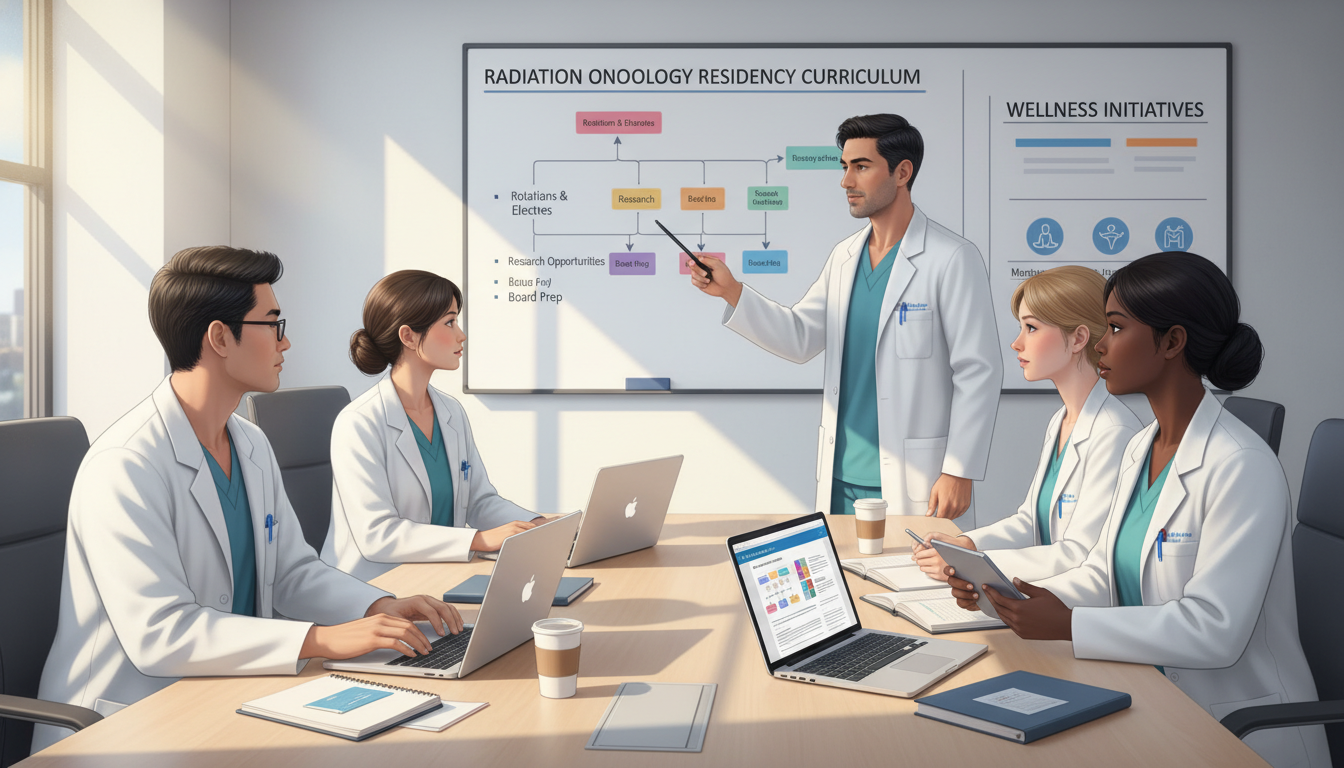
Curriculum and rotations
- How are rotations structured across disease sites (breast, CNS, GU, GI, head & neck, thoracic, pediatrics, lymphoma, GYN, etc.)?
- Is there dedicated time for:
- Brachytherapy
- Proton therapy (if applicable)
- Pediatrics (often with a partner institution)
- Outpatient vs. inpatient consult services
- How many months of electives or away rotations?
Resident complement and call structure
- Total residents in program; residents per year
- Call schedule: home call vs. in‑house, frequency, weekend coverage
- Night float vs. traditional call—especially relevant if the center has a large inpatient service
Research expectations and resources
- Protected research time (blocks, continuity time, or both)
- Required scholarly product (e.g., at least 1–2 manuscripts, presentations at ASTRO or national meetings)
- Access to biostatistics, clinical trials office, physicists, dosimetrists engaged in research
- Database or registry resources, like REDCap or departmental databases
Technology and treatment capabilities
- External beam: IMRT, VMAT, 3D‑CRT, SBRT/SRS, adaptive therapy
- Brachytherapy: HDR, LDR, GYN, prostate, interstitial techniques
- Proton therapy: On‑site vs. Off‑site rotations
- Image guidance: CBCT, MRI‑guided therapy
- Treatment planning systems: Eclipse, RayStation, Monaco, etc.
Educational structure
- Didactics: formal lecture series, disease‑site conferences, physics and radiobiology teaching
- Tumor boards and multidisciplinary clinics
- Mock orals, OSCEs, or formal board prep programs
- QA conferences, journal clubs, morbidity & mortality (M&M)
Program culture clues
- Photos and profiles of current residents and faculty
- Statements about diversity, wellness, mentorship
- Descriptions of social activities, retreats, resident committees
As you review each website, take structured notes in your spreadsheet. Use short bullets under each program to capture standout features (e.g., “Strong brachy exposure; proton affiliate; heavy peds; 6 months protected research”).
Step 3: Leverage Public Data and Match Statistics
For an MD graduate targeting radiation oncology residency, understanding the competition level and outcomes is central to your strategy.
NRMP and AAMC data
Review the latest NRMP “Charting Outcomes in the Match” for Radiation Oncology:
- Average Step scores for matched vs. unmatched US MD applicants
- Number of research experiences and publications
- Number of contiguous ranks in rad onc for matched applicants
Check the NRMP “Program Director Survey”:
- Relative importance of Step/COMLEX scores, research, audition rotations, letters, and class rank
- Whether PDs use Step cutoffs and how high they tend to be
Program-specific match outcomes
Many program websites (or APD presentations) will show:
- Where their graduates match for fellowships or first jobs (academic vs. private practice, geographic distribution)
- The proportion of graduates entering academia vs. community practice
- Research or leadership roles of alumni (e.g., faculty at major cancer centers, national committee memberships)
These data help you:
- Assess how “research‑heavy” and academic‑oriented a program is
- Align program outcomes with your own career goals
- Gauge program reputation and networking power in the field
Objective self‑comparison
Using NRMP statistics, honestly compare:
- Your Step 2 CK vs. typical matched applicants
- Your research portfolio (quality and quantity) vs. averages
- Your number of rad onc rotations and letters from radiation oncologists
Then categorize programs in your spreadsheet:
- Reach: programs where your stats are below or at the lower end of their usual range or with extremely competitive reputations
- Target: programs where you’re roughly aligned with typical matched profiles
- Safety (relative): less research‑intensive, possibly smaller or regional programs where your profile is stronger than average
You’ll use these categories when you build your final application list and for interview ranking.

Evaluating Residency Programs: What Really Matters in Rad Onc
You now have a broad list and basic information. The next step is evaluating residency programs in depth to decide where to apply and how to rank them.
1. Clinical Breadth and Case Volume
Radiation oncology is procedural and pattern‑recognition driven. You need broad exposure.
Key questions:
- Is there a balanced mix of disease sites?
- Are there high‑volume services (e.g., head & neck, lung, GYN, GU, CNS)?
- Are residents the primary physician for patients under attending supervision, or mainly observers?
Practical way to evaluate:
- Look at rotation descriptions:
- Do residents run their own clinics with pre‑attending review?
- Is contouring done by residents with attending modification, or does an advanced practice provider or attending do most of it?
- Ask current residents (during open houses or interview days):
- “How many new patients do you typically see per week on a busy service?”
- “How comfortable do you feel independently contouring standard sites by PGY‑4?”
2. Technical and Procedural Training
Your marketability after residency will depend partly on your comfort with advanced modalities.
For each program, check:
Brachytherapy
- Types: GYN (tandem & ovoid, tandem & ring), interstitial, prostate, breast, skin
- Case volume: small (occasional) vs. robust (weekly cases)
- Who performs the procedures: residents actively involved vs. mainly attendings/fellows
SRS/SBRT
- Frequency and spectrum (spine, lung, liver, brain, bone)
- Resident role in planning and on‑treatment decisions
Proton therapy
- On‑site center vs. rotation at external facility
- Number of months residents spend and their independent responsibilities
Special technologies
- MRI‑guided RT, adaptive RT, stereotactic body frame, motion management (4D‑CT, gating)
- Opportunities to participate in QI projects or research related to these technologies
Programs that provide hands‑on procedural exposure and expect residents to function as junior attendings by PGY‑4/5 will better prepare you for a wide range of practice settings.
3. Research Environment and Expectations
Because this field is closely tied to oncology research, understanding a program’s academic environment is essential for an MD graduate residency applicant.
Assess:
Formal expectations
- Minimum number of projects or publications
- Requirements to present at ASTRO or other national meetings
- Milestones for research progress
Available support
- Access to mentors across disease sites and disciplines (e.g., medical oncology, surgery, physics)
- Statistical and data management support
- Funding or departmental support for conference travel
Feasibility
- Ask: “Do most residents meet the research expectations without excessive stress?”
- Check resident CVs (often on program websites or LinkedIn/ResearchGate) to see actual productivity
If you aim for an academic career or competitive fellowship, prioritize programs with:
- Multiple NIH‑funded faculty
- Active clinical trial portfolios
- Strong translational or physics collaborations
If you’re more clinically oriented, look for a program where research is supported but not overwhelming, and where the culture values high‑quality clinical training.
4. Educational Structure and Exam Preparation
Quality of teaching can differ dramatically. Look for:
- Protected didactics time (and whether it’s truly protected)
- Structured curricula in:
- Clinical radiation oncology by site
- Radiation physics
- Radiobiology
- Imaging relevant to radiation oncology
- Board preparation:
- Mock oral boards, written exams, or in‑service review
- Passing rates on the ABR boards—ask about recent cohorts if not published
Signs of a strong educational culture:
- Faculty consistently attend teaching sessions
- Residents are supported (not punished) for attending didactics over clinical tasks
- There’s a clear calendar of lectures and conferences
5. Culture, Wellness, and Fit
In a small specialty, the rad onc match is highly relationship‑driven. Departmental culture can make or break your training experience.
Ways to evaluate:
Observe how residents interact with each other and faculty during open houses or interviews:
- Are residents candid and relaxed with each other?
- Do they feel comfortable voicing concerns?
Ask specific questions:
- “How does the program handle conflicts or problems with workload?”
- “Can you describe how feedback is given and received?”
- “What has the program changed in response to resident feedback in the last few years?”
Look for concrete wellness initiatives:
- Reasonable limits on call and holiday coverage
- Time and funding for conferences
- Parental leave policies and how they’re handled in practice
In a small field, any toxic or dysfunctional dynamics become very intense. Pay attention to red flags such as:
- Residents speaking only in vague, carefully worded phrases about program weaknesses
- Very recent or frequent turnover in program leadership
- Many unfilled positions in recent matches
Building and Using Your Personal Program Research System
Create a Scoring or Tiering System
To make your program research strategy systematic, design a simple 5–10 category scoring system and apply it consistently.
Example categories (scale 1–5):
- Clinical breadth & case volume
- Procedural/technical exposure
- Research environment & fit with your goals
- Educational structure & board preparation
- Culture/wellness and resident happiness
- Geographic fit and personal life
- Career outcomes (fellowships, jobs)
- Competitiveness relative to your profile
You might not need an exact numerical rank for every program, but forcing yourself to rate them will highlight which programs genuinely fit—beyond name recognition.
Prioritize Information from Current Trainees
Websites are curated; residents live the reality. Use:
- Virtual or in‑person open houses
- ARRO or other resident‑run panels
- Integrated sub‑internships or away rotations (if available and feasible)
Targeted questions you can ask residents:
- “What are the top 2 strengths and top 2 weaknesses of your program?”
- “If you could change one thing about your training, what would it be?”
- “How many attendings would you feel comfortable asking for a strong letter of recommendation?”
- “Do you feel prepared for independent practice, including brachy and SBRT?”
Organize their responses in your spreadsheet so they inform your final ranking.
Incorporate Away Rotations and Mentorship
If you do (or did) away rotations:
- Document what you learned about each department’s:
- Day‑to‑day workflow
- Attending teaching style
- Treatment planning culture
- Resident autonomy
Use your rotation experiences as deep, first‑hand data. Programs where you felt valued, engaged, and appropriately challenged might move higher on your list—even if they are not the most “famous” names.
Seek advice from:
- Your home institution’s radiation oncologists
- National mentors (e.g., through ASTRO or ARRO mentorship programs)
Ask them to:
- Review your preliminary list
- Comment on reputations that may not be obvious from online research
- Help calibrate your reach vs. target vs. safety distribution
Putting It All Together: From Research to Application and Rank List
Narrowing Your Application List
After collecting and organizing data:
Eliminate clear mismatches
- Programs with mandatory heavy research if you have no interest in academia
- Locations you would not accept under any circumstance
- Programs with major red flags (e.g., chronic under‑staffing, very low case volumes, known toxicity)
Balance breadth and realism
- Radiation oncology has historically had variability in competitiveness year to year.
- As an MD graduate residency applicant, consider:
- ~20–40 programs if you are broadly competitive, depending on your risk tolerance
- More if you have significant red flags or weaker metrics, but still focus on fit rather than pure volume
Stratify into tiers
- High‑priority (top interest + good fit)
- Mid‑priority (reasonable fit but partial compromises, e.g., geography or research expectations)
- Backup (you’d still be willing to attend, but not your ideal)
Using Research During Interviews
When you receive interview invitations, your prior program research becomes extremely useful:
Prepare program‑specific questions that show you’ve done your homework:
- “I saw that your department has an active SBRT lung program; how involved are residents in those cases?”
- “I read about your collaboration with medical physics for adaptive therapy—how can residents join those projects?”
Take detailed notes during interviews:
- Update your spreadsheet immediately after each interview with impressions, pros/cons, and any new data.
Re‑evaluate your tiers:
- Some programs will rise or fall significantly in your ranking once you’ve met the people and seen the culture.
Final Rank List Strategy
At the end of interview season, you’ll have both objective data and subjective impressions. For the rad onc match, lean on both:
Objective factors:
- Clinical volume and procedural skills you’ll acquire
- Board pass rates
- Fellowship/job outcomes
Subjective factors:
- How you felt interacting with residents and faculty
- How honestly your questions were answered
- How well the program seems to support people with your background and goals
Rank programs in the true order of your preference, assuming you met the basic threshold of having sufficient case volume and educational support at each program. The NRMP algorithm works best when you list programs in your genuine preference order rather than trying to “game” the system.
FAQs: Researching Radiation Oncology Residency Programs as an MD Graduate
1. How many radiation oncology programs should I apply to as an MD graduate?
The right number depends on your competitiveness and constraints, but many US MD graduates aiming for radiation oncology residency apply to roughly 20–40 programs. If you have weaker test scores, limited research, or geographic restrictions, consider more—but always prioritize quality and fit over sheer quantity. Use your program research strategy to balance reach, target, and safety programs.
2. How important is research when evaluating residency programs in rad onc?
Research is very important in most radiation oncology programs, but the intensity varies. For an MD graduate, aim for a program where research expectations align with your goals:
- If you want an academic career, prioritize programs with robust research infrastructure, multiple NIH‑funded faculty, and strong conference presence.
- If you’re more clinically focused, look for programs with reasonable, achievable research requirements and excellent clinical training.
Either way, confirm that residents can realistically meet expectations without chronic overwork.
3. Should I prioritize “big name” cancer centers when researching programs?
Prestige and name recognition can help with certain careers, especially highly academic ones, but they are not everything. Some smaller or less famous programs provide outstanding hands‑on training, more autonomy, and better culture. When evaluating residency programs, consider:
- Case volume and procedural exposure
- Educational quality and board pass rates
- Resident happiness and culture
- How well the program’s strengths match your interests (e.g., brachy, proton, specific disease sites)
A slightly less famous program where you thrive will serve you better than a top‑tier name where you feel unsupported or undertrained.
4. As an MD graduate from an allopathic medical school, how can I tell if a program is realistic for me?
Use a combination of data and mentorship:
- Compare your Step scores, research output, and clinical performance to NRMP “Charting Outcomes” data for radiation oncology.
- Review each program’s website and, if available, resident CVs to gauge typical profiles.
- Ask your home radiation oncology faculty or mentors to review your list; they often know nuances of individual programs and how they view applicants.
Categorize programs into reach/target/safety tiers and apply across all three—then refine based on interview outcomes and updated impressions.
By approaching the allopathic medical school match in radiation oncology with a structured, data‑driven, and introspective research process, you significantly improve your chances of matching into a program that not only trains you well, but also fits who you are and where you want your career to go.