
Nuclear medicine is a small, highly specialized field—excellent for image-guided diagnosis and targeted therapies, but also uniquely competitive due to the limited number of positions and programs. As a Caribbean IMG, strategic program research is not optional; it’s your foundation for a successful nuclear medicine match.
This guide will walk you step-by-step through how to research residency programs in nuclear medicine with a specific focus on the needs, challenges, and opportunities for Caribbean international medical graduates (IMGs). You’ll learn how to build a program research strategy, which factors matter most, how to read between the lines of program websites, and how to evaluate where you are most likely to both match and thrive.
Understanding the Nuclear Medicine Residency Landscape as a Caribbean IMG
Before you dive into specific programs, you need a clear picture of the training pathways, competitiveness, and IMG realities in nuclear medicine.
Training pathways into Nuclear Medicine
Nuclear medicine training in the U.S. can follow several routes (always verify current details with the ACGME, NRMP, and individual programs):
Categorical/Integrated Nuclear Medicine Programs
- 4–5 years including a preliminary clinical year plus nuclear medicine.
- Less common overall, but can be attractive if you want a more direct route.
Advanced Nuclear Medicine Residency (after another residency year)
- Typically 2–3 years following:
- One year of ACGME-accredited clinical training (transitional/prelim), or
- Sometimes another specialty (e.g., internal medicine, radiology), depending on program requirements.
- Many nuclear medicine positions are advanced (start at PGY-2 or PGY-3).
- Typically 2–3 years following:
Nuclear Radiology Fellowships (after Diagnostic Radiology)
- While not a “nuclear medicine residency,” some IMG candidates ultimately pursue nuclear radiology after completing diagnostic radiology, especially if they want blended skills.
For Caribbean IMGs, the most relevant are advanced nuclear medicine residencies and categorical programs that accept IMGs.
Why the applicant pool is unique
Nuclear medicine attracts:
- Candidates with strong physics and imaging interests
- Applicants with research experience, often in molecular imaging, oncology, or PET/CT
- A mix of US MDs, DOs, and IMGs—though IMGs must be especially strategic due to visa and filter issues.
The field is small, which means:
- Fewer total spots
- Programs know each other and often know their applicant pool well
- Your fit and narrative matter more than in "mega-specialties" with hundreds of programs
Caribbean IMG–specific considerations
As a Caribbean medical school graduate, you need to take into account:
- USMLE performance
Programs often use score filters. A strong score profile can offset some biases against Caribbean med schools. - Perception of Caribbean medical school training
Some programs have a track record of supporting SGU residency match or matches from other Caribbean schools; others do not consider Caribbean IMGs at all. - Visa requirements
If you need a J-1 or H-1B visa, this dramatically affects how you research programs.
Understanding these elements helps you set realistic expectations before you start cataloging potential programs.
Step 1: Clarify Your Goals and Applicant Profile
Before you look outward at programs, you must look inward and define who you are as an applicant and what you want from training.
Analyze your own profile
Create a short, honest summary of your current status:
- Medical school: Caribbean (name, clinical site quality, any honors or distinctions)
- USMLE/COMLEX:
- Step 1: Score, number of attempts
- Step 2 CK: Score, number of attempts
- Step 3 (if applicable)
- Clinical experience in the U.S.:
- Any radiology or nuclear medicine electives/sub-internships
- Observerships, research electives
- Research:
- Any imaging or oncology projects
- Abstracts, posters, publications (especially in nuclear medicine or related fields)
- Letters of recommendation:
- Do you have letters from nuclear medicine or radiology attendings in the U.S.?
- Visa status:
- Need J-1, prefer H-1B, or a green card/US citizen
This personal audit will guide how to evaluate residency programs:
- If you have solid scores and nuclear medicine research, you can aim for more academically oriented programs.
- If your scores are borderline but you have strong clinical performance and supportive mentors, you may favor IMG-friendly, smaller, or community-oriented programs.
Define your training and career goals
Ask yourself:
- Do you see yourself in academic medicine (research, teaching, tertiary care) or community practice?
- Are you primarily interested in:
- Oncologic imaging and PET/CT?
- Theragnostics (e.g., Lu-177, I-131 therapies)?
- Pediatric nuclear medicine?
- Do you want to pair nuclear medicine with future training in:
- Diagnostic radiology?
- Cardiology (for nuclear cardiology focus)?
- Oncology?
Your answers affect your program research strategy:
- Academic career → prioritize programs with strong research infrastructure and NIH-funded or industry-sponsored projects.
- Clinically focused career → prioritize high-volume PET/CT centers and strong clinical exposure.
Write down 3–5 non-negotiables (e.g., visa sponsorship, strong PET/CT volume, IMG track record) and 3–5 preferences (e.g., specific geographic region, academic vs community mix). You will use these as filters later.
Step 2: Build a Target List Using Structured Program Research
Now that you know your own profile and goals, it’s time to systematically discover and organize nuclear medicine programs.
Use official databases first
ACGME Program List (Nuclear Medicine)
- Visit the ACGME website and search the Nuclear Medicine specialty.
- Export or manually record:
- Program name
- Institution
- City/State
- Program ID
- Program type (categorical vs advanced)
- This ensures you are looking only at accredited programs, which is essential for board eligibility.
AMA FREIDA
- FREIDA often lists:
- Program size
- Visa policies (J-1/H-1B)
- Contact info
- Number of positions
- Use the filters:
- Specialty: Nuclear Medicine
- Accepts IMGs: Yes
- Visa accepted: J-1, H-1B (if applicable)
- Save or export your filtered list. This is your initial “wide net” list.
- FREIDA often lists:
NRMP and ERAS data
- Review specialty data from NRMP for nuclear medicine:
- Fill rates
- IMG match rates
- Check ERAS for which programs participate and if they have IMG or visa requirements listed.
- Review specialty data from NRMP for nuclear medicine:
Create a program tracking spreadsheet
To practice how to research residency programs effectively, do not rely on memory or random notes. Create a structured spreadsheet with columns such as:
- Program Name / Institution
- City, State
- Categorical or Advanced
- Positions per year
- US IMG-friendly? (Y/N/Unknown)
- Non-US IMG-friendly? (Y/N/Unknown)
- Visa Types Sponsored
- USMLE Cutoffs (if listed)
- Nuclear Medicine Faculty Interests (research areas)
- PET/CT Volume / Theranostics Program
- Past Residents (IMG? Caribbean?)
- Website Notes
- “Fit” Score (1–5)
- Priority (High/Medium/Low)
- Application Status (Planned, Submitted, Interview, Rejected, Waitlisted)
- Comments
This spreadsheet will become your central command center for evaluating residency programs.
Step 3: Deep-Dive Into Each Program’s Website and “Hidden” Signals
Once you have your wide list, you must refine it through qualitative research: program websites, faculty pages, publications, and alumni profiles.
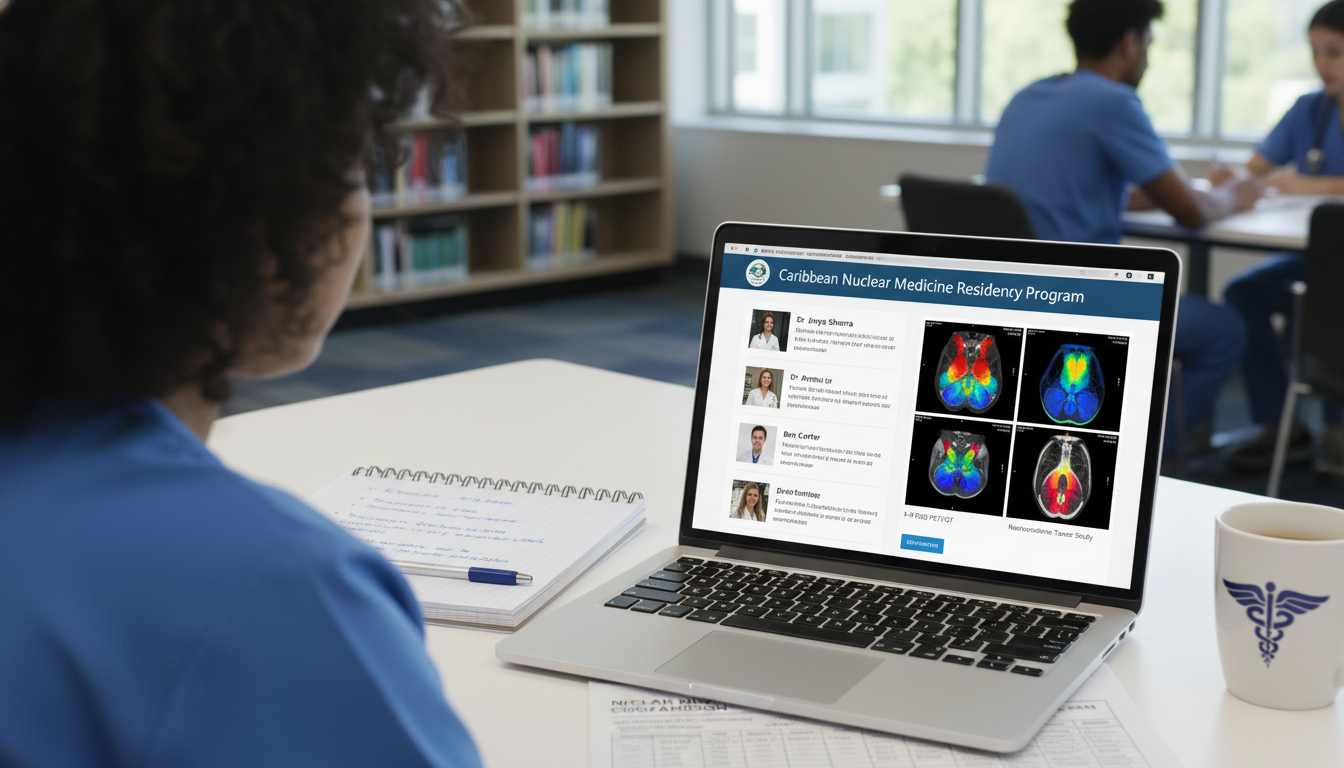
Examine the program’s structure and curriculum
On each program website, look for:
Program length and structure
- Is it a 2- or 3-year training program?
- Is there a built-in preliminary year or is it strictly advanced?
- Rotations: PET/CT, SPECT, cardiac nuclear, pediatric nuclear, therapies, research time.
Clinical volume and technology
- Does the hospital have:
- PET/CT scanners (how many?)
- SPECT/CT
- Theranostic services (Lu-177, Y-90, Ra-223, etc.)
- How many studies per year? High-volume centers give better hands-on experience.
- Does the hospital have:
Therapeutic nuclear medicine emphasis
- Programs heavily involved in radiopharmaceutical therapy may be particularly valuable for future practice and employability.
Record these details in your spreadsheet’s notes column.
Analyze faculty and research
Faculty and research can make a program more IMG-friendly and academically fertile:
- Check faculty profiles:
- Education path: Any IMGs among faculty?
- Research focus: Oncology, cardiology, molecular imaging, AI in imaging, dosimetry.
- Look at recent publications:
- PubMed search: “[Institution Name] nuclear medicine” or “[Key faculty name] PET/CT”
- High research output improves your learning environment and potential for publications.
Ask:
- Does the program support residents presenting at conferences (e.g., SNMMI)?
- Are there structured research blocks?
If your background includes research or you plan to build a strong research profile, prioritize programs with active labs and faculty mentors.
Look for IMG signals
As a Caribbean IMG, you must specifically assess:
- Current and recent residents:
- Many programs list resident bios and medical schools.
- Note if:
- There are Caribbean grads (e.g., St. George’s University, Ross, AUC, Saba).
- There are IMGs from other countries.
- Alumni outcomes:
- Where do graduates go? Academic centers, private practice, further radiology training?
Programs that have previously accepted Caribbean IMGs or other IMGs are more likely to understand your pathway and be open to your application.
This is where you may see indirect references to SGU residency match or other Caribbean medical school residency success stories through alumni lists; such patterns should raise the program’s “IMG-friendly” score in your spreadsheet.
Clarify visa and exam filters
Look for:
- Visa language:
- “We sponsor J-1 only”
- “We sponsor J-1 and H-1B”
- “We do not sponsor visas” (often excludes non–green card IMGs)
- USMLE requirements:
- Minimum Step scores, number of attempts allowed
- Graduation year cutoff (e.g., must have graduated within last 5 years)
If not clearly stated on the website, check FREIDA and, if needed, email the program coordinator with one concise question (e.g., “Do you consider applicants who require H-1B sponsorship?”).
Step 4: Evaluating Residency Programs: Objective and Subjective Criteria
You now have structured data. The next step is evaluating residency programs using a blend of objective and subjective factors.

Objective criteria for program comparison
IMG-friendliness
- Presence of IMGs among residents and faculty.
- History of Caribbean graduates in the program.
- Clear communication about visa support.
Clinical exposure
- PET/CT and therapy volume.
- Case diversity: oncology, cardiology, neurology, pediatric.
- Level of resident independence (do you report cases with attendings regularly?).
Academic environment
- Protected teaching conferences.
- Board pass rates (if posted).
- Opportunities to teach medical students and residents from other specialties.
Program size and call structure
- Smaller programs can mean more hands-on experience but fewer peers.
- Call responsibilities and support (e.g., is there in-house attending backup?).
Location and affiliated institutions
- Urban vs rural.
- Affiliated cancer centers or research institutions.
- Access to multi-disciplinary tumor boards.
Score each of these for every program (e.g., 1–5) to guide your nuclear medicine match decisions.
Subjective fit: The “feel” of a program
Even before interviews, you can gauge certain subjective aspects:
Website tone and depth
- Does the program highlight resident wellness, mentorship, or diversity and inclusion?
- Are residents pictured and quoted? Real stories suggest a more transparent culture.
Communication responsiveness
- If you email with a reasonable question, is the response polite and timely?
- Do they seem annoyed by IMG-focused questions or helpful?
Alignment with your narrative
- If you’re passionate about theranostics and the program barely mentions therapy, the fit may be weaker.
- If you have a research-heavy CV and the program has minimal academic activity, consider whether that mismatch will frustrate you.
Combine objective and subjective evaluations into a “Fit Score” (1–5 or 1–10) in your spreadsheet.
Step 5: Strategically Narrow Your List and Plan the Application
With all data collected and evaluated, you will refine your list into tiers and build a program research strategy aligned with nuclear medicine match realities for Caribbean IMGs.
Build realistic tiers
A common, balanced system:
Tier 1: Reach Programs
- Highly academic centers with strong research reputations.
- Limited history with Caribbean IMGs or stricter score cutoffs.
- You might still apply if your profile has standout strengths (research, publications).
Tier 2: Target Programs
- Solid clinical or mixed academic/clinical training.
- Known to accept IMGs, possibly including Caribbean grads.
- You meet or slightly exceed their listed minimum requirements.
Tier 3: Safety Programs
- Smaller or less research-heavy programs.
- Clearly IMG-friendly with robust visa support.
- You exceed their apparent minimum thresholds.
As a Caribbean IMG, do not over-concentrate only on reach programs. In a small specialty like nuclear medicine, having a robust Tier 2 and Tier 3 list is essential.
Determine how many programs to apply to
Exact numbers vary by cycle, but for a Caribbean IMG in nuclear medicine, it is generally safer to:
- Apply broadly across all three tiers.
- Prioritize:
- Programs that accept IMGs and sponsor your visa type.
- Programs with at least some track record with Caribbean or international grads.
The scarcity of positions means that a narrower list is usually risky, unless your profile is extremely strong and you have personalized connections.
Integrate mentorship and networking into your research
Your program research is more powerful if it’s connected to real people:
- Seek mentors in nuclear medicine or radiology:
- Faculty at your clinical rotation sites.
- SGU or other Caribbean alumni who matched into imaging specialties.
- Ask targeted questions:
- “Which nuclear medicine programs are known to be IMG-friendly?”
- “Do you know anyone at [Program X] I might reach out to for advice?”
Professional, polite networking can yield insider information that no website will provide and help you refine your rankings and application list.
Step 6: Tailoring Your Application Based on Program Research
Research is only useful if it guides how you present yourself to each program.
Customize your personal statement and experiences
Use your knowledge of the program when writing:
- Highlight overlapping interests:
- If Program A emphasizes theranostics, describe your interest in radionuclide therapy or experience in oncology or radiation oncology rotations.
- Mention specific program strengths:
- A line like “I am particularly drawn to your program’s strong PET/CT oncology service and active involvement in multidisciplinary tumor boards” shows you did your homework.
Never copy-paste exact program website language, but clearly reflect that your career goals align with their strengths.
Align your letters and experiences
If you know a program values:
- Research → Emphasize research mentors and include letters that speak to your investigative work.
- Clinical excellence → Highlight strong clinical rotations and letters from supervising attendings who saw you in patient care.
For Caribbean IMGs, strong letters from U.S.-based attendings in radiology or nuclear medicine are particularly influential and can counterbalance concerns about school pedigree.
Track and refine throughout the cycle
As interview invitations and rejections come in, update:
- Application Status in your spreadsheet.
- Patterns:
- If most rejections come from programs with strict score cutoffs, this confirms those filters are active.
- If you get interest from certain types of programs (e.g., strong community hospitals with active PET/CT labs), consider ranking similar programs higher.
Your program research strategy should be dynamic, not static.
FAQs: Program Research for Caribbean IMG in Nuclear Medicine
1. How can I tell if a nuclear medicine residency is truly IMG-friendly?
Look beyond a simple “Yes/No” on FREIDA. To assess whether a program is truly IMG-friendly:
- Check current and recent residents’ medical schools on the website.
- Look for Caribbean graduates or other foreign medical schools.
- Review faculty biographies for IMG backgrounds.
- Email the coordinator with a brief, polite question about whether they consider non–US citizen IMGs and which visas they sponsor.
- Ask mentors or alumni if they know IMGs in that program.
If multiple indicators suggest they have consistently trained IMGs, the program is more likely to seriously consider your application.
2. I’m from a Caribbean medical school with average scores. Should I still apply to nuclear medicine?
Yes, but with careful targeting. Being a Caribbean IMG with average scores makes nuclear medicine more challenging, but not impossible if you:
- Build strong U.S. clinical experience in radiology or nuclear medicine.
- Obtain excellent letters from imaging-related faculty.
- Focus on programs with clear IMG and visa support.
- Highlight any research, case reports, or conference presentations in imaging.
You may need a broader safety net, including prelim/transitional year applications or related specialties, but well-researched applications to IMG-friendly nuclear medicine programs can still lead to interviews.
3. How important is research for matching into nuclear medicine as a Caribbean IMG?
Research is not mandatory everywhere, but it can be a major advantage, especially for Caribbean IMGs:
- It demonstrates your commitment to the field.
- It helps you stand out against applicants from U.S. schools.
- It opens doors at academic programs and supports your long-term career goals.
If you lack nuclear medicine–specific research, consider:
- Oncology, radiology, radiation oncology, or internal medicine research with imaging components.
- Case reports or quality improvement projects during rotations.
When evaluating residency programs, give extra weight to those that welcome resident involvement in research and have mentors willing to work with motivated IMGs.
4. Should I focus on programs that already have Caribbean graduates, like those with a history of SGU residency matches?
Programs with a history of SGU residency match or matches from other Caribbean medical schools are especially encouraging for you:
- They already understand Caribbean training structures and transcripts.
- They have seen IMGs from your background succeed.
- Their selection committees are less likely to automatically screen out Caribbean applicants.
However, don’t restrict yourself only to those programs. Some institutions with no visible Caribbean alumni still train IMGs from other regions and may be open to strong Caribbean candidates. Use a combination of:
- Past Caribbean or IMG residents,
- Clear visa support,
- Responsive communication,
to determine whether a program belongs on your target list.
By approaching the Caribbean medical school residency journey into nuclear medicine with a structured, data-driven program research strategy—while paying close attention to IMG-specific filters, visa issues, and clinical and academic fit—you maximize your chances of a successful nuclear medicine match and set the foundation for a rewarding career in this evolving, high-impact specialty.