
Understanding the Unique Position of Caribbean IMGs in Pathology
Caribbean medical graduates occupy a distinctive place in the U.S. residency landscape. For pathology, this can be both a challenge and an opportunity—especially if you approach program research with a clear, methodical strategy.
As a Caribbean IMG, you are often competing with:
- U.S. allopathic and osteopathic graduates
- International graduates from schools with long-established reputations
- Applicants with strong research or U.S. connections
At the same time, pathology as a specialty:
- Is moderately competitive (less so than dermatology or orthopedic surgery, but not “easy”)
- Values strong exam performance and clinical reasoning
- Places high value on letters of recommendation from pathologists
- Rewards applicants who demonstrate genuine interest and understanding of the field
Your goal isn’t just to “get a spot.” Your goal is to:
- Identify programs where a Caribbean medical school residency match in pathology is realistic, and
- Prioritize programs where you are likely to thrive academically, professionally, and personally.
This article will walk you through a rigorous, step-by-step program research strategy tailored to a Caribbean IMG aiming for a pathology match, including how to evaluate residency programs, how to use data tools, and how to translate research into a smart application list.
Step 1: Clarify Your Profile Before You Research Programs
Before you look outward at programs, you need a clear, honest look inward.
1. Academic Metrics
Be precise about where you stand:
- USMLE Step 1: Pass / Fail (for newer takers) + raw score if available to you
- USMLE Step 2 CK: Numeric score and date taken
- Any prior attempts: Fails or repeats matter in pathology residency selection
- Medical school performance: Class rank, honors, remediation history
For a Caribbean IMG, a competitive pathology profile often includes:
- Solid Step 2 CK (often ≥230 improves your odds, though programs vary)
- No exam failures if possible
- Steady academic trend without repeated courses
If you have red flags (exam failures, gaps, professionalism issues), you’ll need to:
- Be more targeted in your program research
- Increase the total number of programs you apply to
- Emphasize other strengths (research, strong letters, U.S. experience)
2. Clinical and Pathology-Relevant Experiences
List out:
- Pathology electives (especially U.S.-based)
- Subinternships / observerships related to pathology or lab medicine
- Research: pathology, molecular diagnostics, oncology, or any lab-based project
- Presentations / posters / publications
Programs that do a lot of SGU residency match or other Caribbean medical school residency matches in pathology will often look for:
- Proof that you truly understand what pathology is like day-to-day
- Evidence of commitment: pathology electives, observerships, or virtual rotations
3. Personal Constraints and Preferences
Your research should also reflect your life realities:
- Geographic limits (family, visa issues, cost of travel)
- Need for J-1 or H-1B sponsorship
- Openness to community-based vs. big academic centers
- Comfort with colder climates vs. certain regions
Write these down before you start. They will shape where you focus and which programs you exclude early.
Step 2: Use Data to Build an Initial Pathology Program List
Your first goal is not to judge programs but to create a broad, data-driven long list. From there, you’ll refine.
1. Start with Official Databases
Use these core resources:
FREIDA (AMA Residency & Fellowship Database)
Search for:- Specialty: Pathology – Anatomic and Clinical (AP/CP)
- Filter by: IMG-friendliness (if available), state, visa sponsorship notes
NRMP Charting Outcomes / Program Reports
Review:- Trends for pathology match by US vs non-US IMG
- Typical Step scores of matched applicants (where available)
- Match rates for IMGs in pathology
ERAS / ACGME Program Listings
Confirm:- Program name, address, and accreditation status
- Program type (university, community, hybrid)
- Positions offered each year
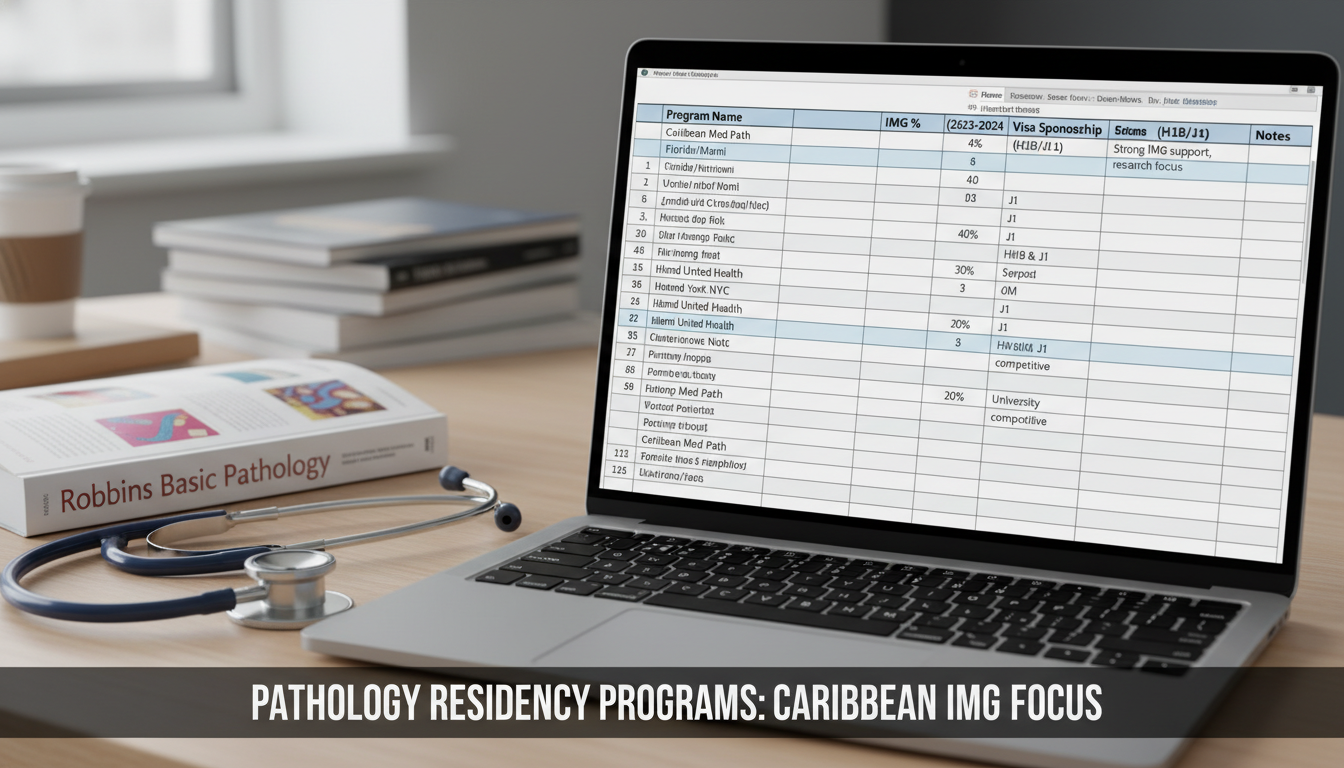
Create a spreadsheet with columns for:
- Program name
- State / city
- Program type (academic / community / hybrid)
- Positions per year
- Website link
- Visa sponsorship status
- Notes on IMG percentage, Caribbean presence, etc.
This structured approach gives you a backbone for your program research strategy.
2. Identify IMG-Friendly Pathology Programs
For a Caribbean IMG, your pathology match odds improve if you:
- Prioritize programs with a visible history of training IMGs
- Favor programs with former or current residents from Caribbean schools
You can identify IMG-friendliness by:
- Checking each program’s current resident roster
- Look at medical schools listed
- Note any Caribbean schools (SGU, AUC, Ross, Saba, etc.)
- Reading program FAQs for:
- “Do you accept IMG applicants?”
- “Minimum USMLE score requirements?”
- “Do you sponsor J-1 or H-1B visas?”
If you find programs with multiple residents from Caribbean medical schools, especially SGU or other large Caribbean schools, that’s a strong sign. These are the types of programs that contribute significantly to the SGU residency match and similar Caribbean medical school residency trends in pathology.
Step 3: Deep-Dive into Each Program: How to Evaluate Pathology Residencies
Once you have a long list, the next step is evaluating residency programs in enough depth to see if they are realistic and a good fit.
1. Analyze Historical Match Trends and Caribbean Presence
Look for:
- Residency websites that list alumni or current residents by medical school
- Social media (Twitter/X, Instagram, LinkedIn) pages highlighting residents or graduates
- Program newsletters or annual reports
Red flags for a Caribbean IMG:
- No IMGs in the program for many years
- Explicit statements like “we do not sponsor visas” or “U.S. graduates only”
Positive signs:
- Multiple IMGs in current or recent classes
- Mention of graduates from Caribbean medical schools
- Faculty or leadership who are IMGs themselves
If one of your goals is a future fellowship in subspecialties like hematopathology, cytopathology, or dermatopathology, check whether:
- Their alumni match into fellowships
- They list fellowship placements on their website
2. Evaluate the Pathology Training Environment
Pathology is a visually and cognitively demanding field; your training environment matters.
Key factors to evaluate:
- Volume and case variety
- Does the hospital handle a broad range of surgical pathology cases?
- Are there subspecialty services? (e.g., GI, GU, neuropathology)
- Grossing and autopsy expectations
- Reasonable balance of service vs. education
- Didactics and teaching structure
- Daily sign-out?
- Regular lectures, unknown slide sessions, tumor boards?
From a Caribbean IMG perspective, good programs often:
- Have a structured curriculum to solidify foundational pathology knowledge
- Provide clear support for residents adjusting to U.S. hospital systems
- Offer early guidance on abstract writing, posters, and boards preparation
3. Board Pass Rates and Resident Outcomes
Ask:
- What is the program’s American Board of Pathology (ABP) pass rate over the last 5–10 years?
- Do they openly share this on their website, or will they tell you if you email?
Programs that support a strong pathology match into fellowships will often show:
- Near-100% board pass rates
- Graduates going into reputable fellowships, academia, or solid community practice
If this information isn’t clearly available:
- You can politely email the program coordinator or ask during an open house
- Current or recent residents (via LinkedIn) may be willing to share their experience
4. Research and Academic Opportunities
Not all pathology residencies are heavy on research, but for a Caribbean IMG, research can help offset perceived disadvantages.
Evaluate:
- Are there ongoing research projects in:
- Surgical pathology
- Hematopathology
- Molecular pathology
- Cytopathology
- Are residents presenting at:
- USCAP
- CAP
- ASCP
- Local pathology societies
Look for:
- Faculty with well-known names or active PubMed profiles
- Mentions of “resident publications,” “case reports,” or “poster presentations”
If your CV already includes some pathology research, prioritize programs that:
- Have structured research mentorship
- Provide time and support for conference presentations
Step 4: Special Considerations for Caribbean IMGs: Visa, Support, and Culture
For a Caribbean IMG, non-academic factors are just as critical in your program research strategy.
1. Visa Sponsorship and Immigration Issues
Confirm:
- Does the program sponsor J-1 visas (most common)?
- Do they also sponsor H-1B? (some pathology programs do; many don’t)
- Are there any notes on:
- Maximum years since graduation
- Number of attempts allowed on USMLE
Where to find this:
- Program website, FAQ, or “For International Medical Graduates” section
- FREIDA notes or ERAS program details
- Email the program coordinator if unclear
If you are several years out from graduation or have a gap in training:
- Prioritize programs that state they are open to older graduates
- Or have a track record of taking non-traditional applicants
2. Academic and Personal Support Systems
As a Caribbean IMG, you may be:
- Far from home with limited family support
- Adjusting to new healthcare and cultural systems
- Managing the pressure to “prove yourself”
When evaluating residency programs, look for:
- Formal mentorship programs (assigned faculty mentor for each resident)
- Peer support (resident “big sibling” systems)
- Wellness or mental health resources for residents
- Structured orientation for new interns, especially IMGs
Signs of a supportive culture:
- Program uses inclusive language on their site
- Alumni speak positively about faculty support
- Resident photos and bios reflect diverse backgrounds
3. Location, Cost of Living, and Lifestyle
You must also realistically consider:
- Cost of living relative to resident salary
- Big cities may offer great training but higher rent
- Transportation:
- Is a car necessary?
- How long is the commute?
- Safety and community:
- Are there cultural or ethnic communities where you might feel at home?
- Are there religious or social groups you can connect with?
Residency is demanding. Choosing a location where you can build some social support is a practical survival strategy, not a luxury.

Step 5: Prioritizing Programs: From Long List to Smart Application List
Once you’ve collected detailed information, you need a system to prioritize.
1. Scoring System for Evaluating Residency Programs
Create a basic scoring framework (example out of 5 points per factor):
IMG-Friendliness (0–5)
- 5: Multiple current Caribbean IMGs; explicit supportive language
- 3: Some IMGs, but few from Caribbean schools
- 0–1: No IMGs, or unclear/negative language
Academic Quality (0–5)
- Board pass rates, case volume, fellowships, didactics
Research / Career Development (0–5)
- Structured support, conference attendance, mentorship
Location & Lifestyle Fit (0–5)
- Geography, cost of living, climate, nearby community
Visa / Eligibility (0–5)
- Full points if they sponsor your needed visa and accept older grads/IMGs
Total each program’s score and categorize:
- High Priority (e.g., 18–25 points)
- Medium Priority (12–17 points)
- Low Priority (<12 points)
This makes your program research strategy systematic rather than emotional.
2. Balancing Reach, Target, and Safety Programs
For a Caribbean IMG in pathology, a typical distribution might look like:
Reach programs (20–30%)
- Strong academic centers with moderate IMG presence
- Higher average board scores or heavily research-oriented
Target programs (40–50%)
- Academic or community programs with clear IMG representation
- Requirements match your score range and background
Safety programs (20–30%)
- Community or hybrid programs that are clearly IMG-friendly
- May be in less popular locations but with solid training
The exact numbers depend on:
- Your Step 2 CK score
- Any red flags
- Your level of U.S. clinical experience and letters of recommendation
Remember: “Safety” does not mean “low quality.” Many smaller or community-linked pathology residencies offer excellent training and strong fellowship placements.
Step 6: Using Networking and First-Hand Insights to Refine Your List
Online data is necessary but not sufficient. You can significantly improve your pathology match strategy by adding human insights.
1. Leverage Your Caribbean School Network
If you’re from a large Caribbean school like SGU, AUC, Ross, or Saba:
- Request detailed match lists specifically filtered by:
- Pathology residency
- U.S. region or program
- See which programs frequently appear as SGU residency match or other Caribbean matches in pathology
Then:
- Reach out (via email/LinkedIn) to recent pathology graduates from your school
- Ask targeted questions:
- How IMG-friendly is your program really?
- How supportive are attendings?
- What are the strengths and weaknesses of training there?
Graduates who matched into pathology are often very willing to help current students from their alma mater.
2. Attend Virtual Open Houses and Webinars
Many pathology programs now:
- Host virtual open houses before ERAS
- Offer Q&A sessions with PDs and residents
- Present program overviews, case discussions, and fellowship achievements
Use these wisely:
- Come with 2–3 specific questions about:
- IMGs and support systems
- Pathology education structure
- Visa policies or board prep resources
Avoid generic or easily searchable questions—demonstrate you’ve already done baseline research.
3. Connect with Pathology Organizations
Professional organizations sometimes run sessions focused on:
- Pathology residency application strategies
- IMG-specific concerns
Follow and engage with:
- CAP (College of American Pathologists)
- USCAP
- ASCP
These can provide:
- Exposure to faculty across multiple programs
- Networking opportunities
- Insight into which programs are particularly active and academically engaged
Putting It All Together: Example Program Research Workflow
Here’s what a practical week of organized program research could look like for a Caribbean IMG in pathology:
Day 1–2: Build the Long List
- Use FREIDA + ACGME to list all AP/CP pathology programs
- Create spreadsheet with basic info (location, program type, website)
Day 3–4: IMG-Friendliness and Visa Scan
- Visit each program website:
- Note visa sponsorship (J-1, H-1B)
- Scan current residents for IMGs and Caribbean grads
- Assign preliminary “IMG-friendliness” scores
Day 5–6: Academic and Research Evaluation
- For each promising program:
- Review didactic structure, case volume, fellowship opportunities
- Try to find board pass rates and alumni outcomes
- Add “academic quality” and “research” scores
Day 7: Personal Fit and Prioritization
- Add “location/lifestyle” scores
- Mark reach/target/safety categories
- Narrow list to:
- Core group of high-priority programs
- Backup set of medium and safety programs
Repeat and update this list as:
- You attend open houses
- You talk to alumni or residents
- You get more clarity on your own preferences (e.g., academic vs. community, geographic focus)
Common Mistakes Caribbean IMGs Make When Researching Pathology Programs
To sharpen your strategy, avoid these pitfalls:
Relying only on “IMG-friendly lists” from random forums
- These may be outdated or biased
- Always verify with current residents and official websites
Underestimating the importance of program culture
- Even an IMG-friendly program may not be a good personal fit
- Burnout and lack of support can derail a residency
Applying only to top-tier academic centers
- This is risky if your scores or CV are not exceptionally strong
- Balance some prestigious programs with realistic targets
Ignoring geographical realities
- If you cannot move to a rural Midwestern town, don’t pretend you can
- But be flexible if your main goal is to secure a solid pathology match
Not using their Caribbean school’s alumni network fully
- Caribbean schools often have extensive networks in pathology and other specialties
- Not reaching out means missing inside information about many programs
Final Thoughts: Your Research is Part of Your Strategy, Not Just a Pre-Application Task
Program research isn’t just a box to check before submitting ERAS.
Done properly, it will:
- Help you decide how many programs to apply to in pathology
- Clarify where a Caribbean medical school residency match is genuinely realistic
- Guide which programs you should target for emails, open houses, and networking
- Make your interviews stronger, because you’ll know what matters to that program
As a Caribbean IMG, you are not just trying to “get into any pathology residency.” You are trying to:
- Enter an environment that will train you well
- Provide support as you navigate a new system
- Position you for fellowships, board certification, and a long career in pathology
Treat program research as seriously as your exam preparation. The investment of time up front will pay off in a more focused, effective, and ultimately successful pathology match strategy.
FAQ: Researching Pathology Programs as a Caribbean IMG
1. How many pathology programs should a Caribbean IMG apply to?
It depends on your profile, but many Caribbean IMGs targeting pathology apply to 40–70 programs:
- Fewer (30–40) if:
- Step 2 CK is strong
- No red flags
- Solid U.S. pathology experience and letters
- More (60–80) if:
- Lower scores, exam attempts, or graduation gaps
- Limited U.S. experience
- Visa complexities
Use your research to prioritize and avoid wasting applications on clearly non-IMG-friendly programs.
2. How important is it to find programs with existing Caribbean IMGs?
It’s not strictly required, but it’s very helpful. Programs that have already taken Caribbean graduates:
- Know the quality and structure of Caribbean medical education
- Are more likely to feel comfortable ranking you
- Often have residents who can advocate for IMGs and understand your challenges
However, if a program has strong IMG representation (even from non-Caribbean schools), that can also be a positive sign.
3. Can a Caribbean IMG match into competitive pathology fellowships later?
Yes. Many Caribbean IMGs go on to:
- Hematopathology
- Cytopathology
- Surgical subspecialty fellowships
- Molecular or transfusion medicine
What matters most is:
- The quality of your residency training
- Your board performance
- Your research output and networking during residency
During program research, pay careful attention to fellowship placements and alumni outcomes.
4. How can I tell if a pathology residency is “too competitive” for my profile?
Signals that a program may be a reach:
- Almost all residents are from U.S. MD schools, with very few IMGs
- Program is at a top-tier academic center with heavy research focus
- Website mentions high minimum board scores (e.g., Step 2 ≥240)
- No visible Caribbean IMGs, despite many residents
You can still include some reach programs on your list, but ensure:
- You have enough target and safety programs
- Your overall application volume reflects your true competitiveness