
Understanding the Landscape: Preliminary Surgery for Non‑US Citizen IMGs
For a non-US citizen IMG interested in a preliminary surgery year, researching residency programs is not just about where you can get in—it’s about where you can realistically thrive, meet visa requirements, and use the year strategically. Because prelim spots are often used as “service years” and may not always lead to categorical positions, your program research strategy must be precise and intentional.
This article will walk you through how to research residency programs in preliminary general surgery as a foreign national medical graduate, including:
- How prelim surgery positions differ from categorical ones
- Where and how to gather accurate program information
- How to interpret data on interview likelihood and ranking tendencies
- Which filters matter most for a non-US citizen IMG (especially visas)
- How to evaluate and compare programs to build a realistic, high-yield list
The focus is on US programs and assumes you are applying via ERAS/NRMP.
Step 1: Clarify Your Goals for a Preliminary Surgery Year
Before you start looking up programs, you must know why you’re doing a preliminary surgery residency. Your research will be different depending on your goals.
Common Goals of Non-US Citizen IMGs in Prelim Surgery
Bridge to Categorical General Surgery
- Aim: Use the prelim year to prove yourself and later secure a categorical surgery position (in the same or another program).
- Research focus:
- Programs that frequently convert prelims to categorical spots.
- Strong surgical training, OR exposure, and mentorship.
- PD and faculty reputation for supporting prelims.
Pathway to Another Specialty
- Aim: Use a prelim surgery year while reapplying or pivoting to:
- Anesthesiology
- Radiology
- PM&R
- Emergency medicine (less common from prelim surgery, but possible)
- Research focus:
- Programs within larger institutions that also have the specialty you’re targeting.
- Research and networking opportunities across departments.
- Aim: Use a prelim surgery year while reapplying or pivoting to:
US Clinical Experience & Credentials
- Aim: Strengthen CV with US residency experience, letters, and possibly research for later applications (surgery or non-surgical).
- Research focus:
- Programs that support non-US citizen IMGs with:
- Robust teaching
- Mentorship and LORs
- Visa stability
- Academic or research connections
- Programs that support non-US citizen IMGs with:
Backup to Categorical Applications
- Aim: You’re applying to categorical surgery and/or another specialty but also using prelim surgery as a safety net.
- Research focus:
- Wide net of prelim programs where you meet minimum requirements.
- Ensuring prelim locations won’t trap you geographically if you reapply elsewhere.
Write down your primary and secondary goals. You will refer back to them when evaluating residency programs and making your rank list.
Step 2: Understand the Types of Preliminary Surgery Programs
Not all prelim surgery residencies function the same way. As a foreign national medical graduate, understanding these differences helps you focus your research and avoid misaligned programs.
A. Traditional Preliminary Surgery (Non-Designated)
- Purpose: Often for applicants who want to go into general surgery but didn’t match categorical.
- Typical structure: 1-year program; heavy service and call schedule.
- Key question: Do they ever promote prelims into categorical positions?
- Important for non-US citizen IMGs:
- Is the institution IMG-friendly?
- Will they sponsor J-1 or H-1B visas for prelims (not just categoricals)?
B. Designated Preliminary Positions
- Typically reserved for applicants entering a categorical position in another specialty that requires a surgery intern year (e.g., interventional radiology, urology, some integrated programs).
- As a non-US citizen IMG without a linked categorical spot, you are usually not eligible for these roles.
- When looking at FREIDA/ERAS, focus primarily on non-designated preliminary positions unless explicitly informed otherwise by the program.
C. Academic vs Community vs Hybrid Programs
Understanding setting will guide your program research strategy:
Academic/University-based
- Large tertiary care centers, medical schools, research.
- Pros: More subspecialties, research options, exposure to complex cases.
- Cons: Frequently more competitive; may prioritize US grads; visas policies may be stricter.
Community-Based, University-Affiliated
- Strong teaching focus but smaller systems; some affiliation with a university.
- Pros: Often more IMG-friendly, good operative exposure.
- Cons: Research options may be limited; fewer categorical upgrade opportunities in-house.
Pure Community Programs
- Independent hospitals, often teaching-focused but not strongly academic.
- Pros: Often more open to non-US citizen IMGs, more hands-on early.
- Cons: Lower name recognition; fewer in-house options to switch to categorical.

Step 3: Core Tools and Data Sources for Program Research
To learn how to research residency programs properly, you need to know where to look and what each source provides. Combine data from several tools for a full picture.
1. FREIDA (AMA Residency & Fellowship Database)
What it is: A comprehensive directory of residency programs.
How to use it for prelim surgery:
- Filter by:
- Specialty: Surgery – General
- Program Type: Preliminary
- Accepts International Medical Graduates
- Visa sponsorship: J-1 / H-1B (if filter available or indicated in descriptions)
- Collect:
- Program size (number of prelim and categorical residents)
- Setting (community, academic, mixed)
- Contact info and website links
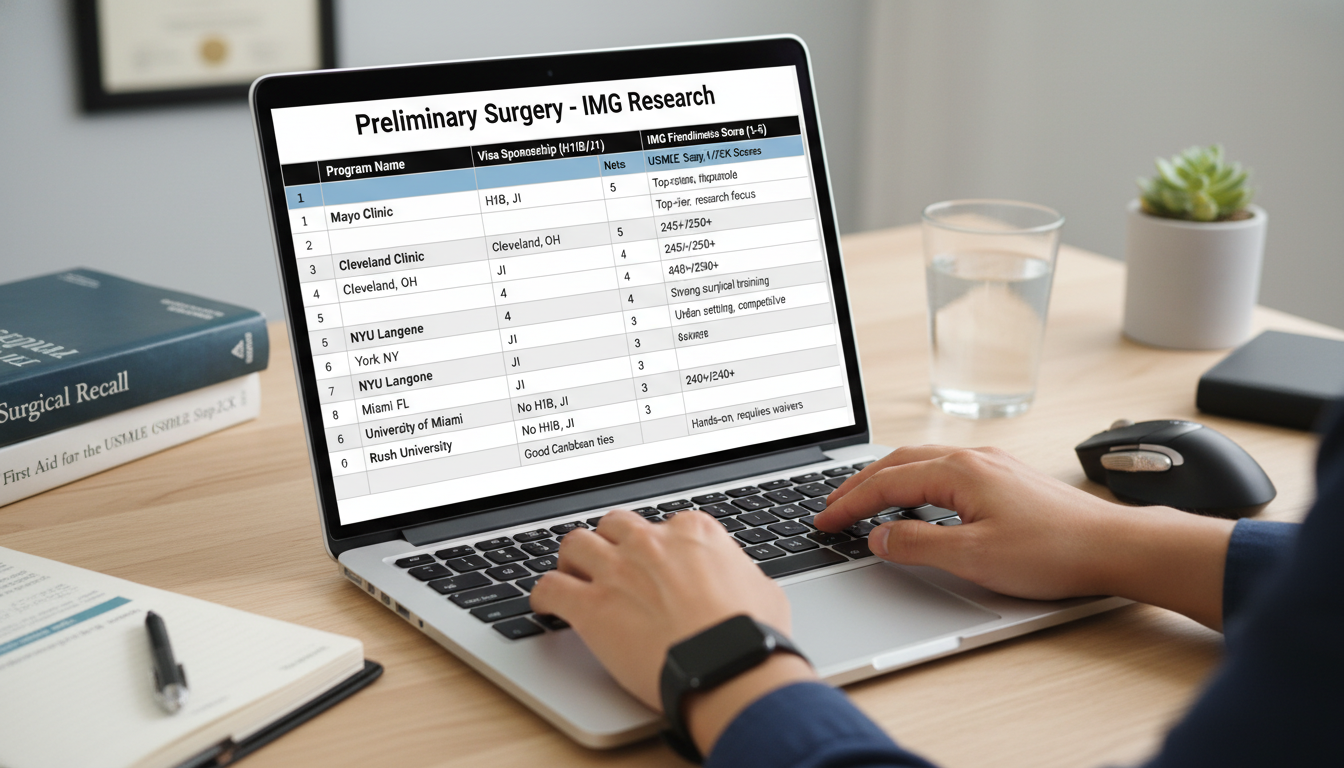
Action tip: Create a spreadsheet and list:
- Program name
- Location
- Visas offered
- Number of prelim spots
- Notes from website/emails
This becomes your master program list.
2. Program Websites
Program websites are critical for evaluating residency programs because they often contain information that FREIDA and ERAS do not.
Look for:
- Preliminary track description
- Is it clearly described or barely mentioned?
- Do they acknowledge prelim residents as part of their team?
- Eligibility and IMG policy
- USMLE score minimums
- Year of graduation cutoffs
- Need for US clinical experience
- Explicit IMG-friendly statements
- Visa information
- Whether they sponsor J-1 only or H-1B as well
- Any restrictions specific to prelim residents
- Resident roster
- Are there current or past non-US citizen IMG residents?
- Any prelims who have moved into categorical spots?
- Educational structure
- Didactics, simulation training, skills labs
- Rotations and call schedule for PGY-1
- Outcomes
- Where do graduates go after the prelim year?
- Do they list success stories?
If the site is vague, assume you will need to email the program to clarify.
3. ERAS Program Listings
When ERAS opens, program-level details become visible:
- Program Requirements Tab
- Minimum USMLE Step scores.
- Maximum attempts allowed.
- Required documents (US LORs, MSPE, etc.).
- Citizenship/Visa Tab
- Confirm whether the program accepts non-US citizen IMGs.
- Specific visa types accepted for the preliminary surgery residency, not just for categorical tracks.
Action tip: Cross-check ERAS info with the website and FREIDA. If conflicting, email the coordinator to clarify. Visa policy inconsistencies are common.
4. NRMP and AAMC Data
While you can’t access program-specific NRMP rank lists, you can look up:
- Specialty-specific IMG match rates (general surgery vs prelim surgery).
- Program-level characteristics like size, fill rates in previous years.
These data inform how competitive the field is and whether non-US citizen IMG applicants have historically matched in prelim spots.
5. Resident and Applicant Forums (Use with Caution)
Places like:
- Reddit r/medicalschool / r/IMGreddit
- Student Doctor Network (SDN)
- Specialty-specific Facebook or WhatsApp groups
These may provide qualitative insights:
- Workload and culture (malignant vs supportive).
- How prelims are treated vs categoricals.
- Success in obtaining categorical positions afterward.
Treat all anecdotal information as supporting, not decisive. Programs can change leadership, culture, and policies quickly.
Step 4: Key Filters for Non‑US Citizen IMGs in Prelim Surgery
Once you’ve gathered basic program data, you need to narrow down the list. This is where a thoughtful program research strategy saves time and money.
Filter 1: Visa Sponsorship (Non-Negotiable)
As a foreign national medical graduate, visa policy is the first filter. Do not invest in applications where you are categorically ineligible.
- J-1 Visa
- Most common and widely offered.
- Good option if you are flexible about the 2-year home-country return rule or plan to obtain a waiver later.
- H-1B Visa
- Less commonly offered, more complex.
- Typically requires:
- Passing USMLE Step 3 before starting residency.
- Institutional support and legal resources.
Best practice:
- Label each program: “J-1 only,” “J-1 & H-1B,” or “No visa / Unclear.”
- If unclear, email:
- Ask specifically: “Do you sponsor J-1 and/or H-1B visas for preliminary surgery residents?”
- Distinguish prelim from categorical in your question.
If a program only sponsors visas for categorical spots, it is much less useful as a prelim destination for a non-US citizen IMG.
Filter 2: IMG-Friendliness
Some programs consistently welcome IMGs; others do not.
What to look for:
- Current residents from:
- Non-US medical schools
- Diverse countries and regions
- Program or departmental statements:
- “We welcome applications from international medical graduates.”
- No harsh restrictive policies:
- “US graduates only” or “No IMGs accepted” clearly exclude you.
Check if IMGs are present specifically in surgery or only in other departments. A hospital may train IMGs in internal medicine but not in surgical fields.
Filter 3: Minimum USMLE Scores and Attempts
Prelim positions may be slightly more flexible than categorical, but many surgery programs still set high bars.
- Look for:
- Stated minimum Step 1/Step 2 CK scores (if any).
- Restrictions on attempts (e.g., no failures allowed).
- If not stated:
- Check forums or talk to prior applicants.
- Email the program for general guidance if you’re borderline.
Be honest when filtering:
- If your scores are far below typical matched applicants, prioritize more IMG-friendly, community-based prelim programs.
Filter 4: Graduation Year and US Clinical Experience
Programs commonly require:
- Graduation within 5–7 years.
- Evidence of recent clinical activity.
As a non-US citizen IMG, recent US clinical experience (observerships, externships, or prior training) significantly boosts your chances.
When researching:
- Check program eligibility:
- Maximum YOG allowed.
- Required type/duration of USCE.
- If you’re an older graduate, place extra emphasis on programs clearly open to older IMGs.
Step 5: Deeper Evaluation: Training Quality, Culture, and Outcomes
Once you narrow to programs where you’re eligible, the next step in evaluating residency programs is to assess which ones will support your long-term goals.
A. Training Experience and Operative Exposure
Even in a preliminary surgery year, the depth of your experience matters.
Look for:
- Case volume and type for PGY-1s:
- Are prelims allowed in the OR regularly?
- Or are they mainly managing floor work and consults?
- Didactic Structure:
- Weekly M&M conferences, grand rounds, skills labs.
- Access to simulation and laparoscopy training.
- Distribution of Rotations:
- How many months are spent on:
- General surgery
- ICU
- Surgical subspecialties (trauma, vascular, colorectal)
- Off-service rotations
- How many months are spent on:
Action tip: During interviews or through emails, ask directly:
- “How do prelim residents participate in the OR?”
- “Are there differences in rotation assignments for prelim vs categorical interns?”
B. Culture and Treatment of Preliminary Residents
For a non-US citizen IMG, whether the environment is supportive or exploitative can make or break your year.
Look for:
- Recognition of prelims on the website:
- Are prelim residents listed and photographed alongside categorical residents?
- Role of prelims in the team:
- Do they attend teaching sessions equally?
- Are they included in wellness initiatives and mentorship programs?
- Historical reputation:
- Reports from alumni or forums about:
- Excessive work hours
- Lack of supervision
- Discriminatory behavior toward IMGs or visa holders
- Reports from alumni or forums about:
If possible, proactively reach out to current or recent prelims, particularly IMGs, for an honest opinion.
C. Pathways to Categorical Positions and Fellowship
If your goal is to ultimately obtain a categorical position:
- Ask programs:
- “In the last 3–5 years, how many prelims have obtained categorical surgery positions here or elsewhere?”
- “Do categorical PGY-2–3 positions ever open up mid-year?”
- Red flags:
- Programs that have never converted a prelim to categorical.
- Programs that refuse to answer questions about outcomes.
If you plan to switch specialties, ask:
- “Do your prelims often match into other specialties after their year here?”
- “Are there structured advising resources for prelims reapplying?”
D. Institutional Resources and Networking
Large academic centers may offer:
- Research opportunities
- Connections to other departments (anesthesia, radiology, etc.)
- Career development sessions
Smaller community programs may provide:
- Closer faculty contact
- More operative independence
Decide which environment best aligns with your career aspirations.
Step 6: Building and Prioritizing Your Program List
Now that you have data, you need to build an organized, realistic list. This is the heart of an effective program research strategy.
Step 6.1: Create a Structured Spreadsheet
Include columns for:
- Program name, state, city
- Academic/community/hybrid
- Visa type(s) supported
- IMG presence (Y/N; approximate %)
- USMLE minimums / your relative fit
- Number of prelim positions
- Conversion history (prelim → categorical)
- Teaching quality indicators
- Personal notes (e.g., “close to relatives,” “strong trauma exposure”)
Color-code or score each category (e.g., 1–5) to help you visually compare.
Step 6.2: Categorize Programs by Competitiveness & Fit
Classify programs into:
High Reach
- Top-tier academic centers, big-name institutions.
- May or may not be IMG-friendly; competitive scores expected.
Moderate / Target
- Solid training, mixed academic/community environments.
- Historically take IMGs, including non-US citizens.
Safety / High-Yield
- Smaller programs, often community-based and IMG-friendly.
- Strong visa track record, realistic score expectations.
As a non-US citizen IMG applying to prelim surgery residency, you should have a significant portion of programs in the target and safety categories.
Step 7: Strategic Communication with Programs
Well-planned communication can refine your list and sometimes improve your chances.
A. When and How to Email Programs
Appropriate reasons to email:
- Clarify visa sponsorship for prelim residents.
- Confirm eligibility (e.g., YOG cutoffs, score policies).
- Express genuine interest with specific reasons.
Tips:
- Keep emails concise and professional.
- Use a clear subject line:
“Prospective Preliminary Surgery Applicant – Visa Sponsorship Question” - Avoid generic statements like “Your program is my top choice” unless it is absolutely true and specific.
B. Questions Worth Asking (Before Applying)
Sample questions tailored to a non-US citizen IMG:
- “Does your program sponsor J-1 and/or H-1B visas for preliminary surgery residents?”
- “Do preliminary residents participate fully in didactics and operative cases?”
- “In recent years, have prelims from your program secured categorical surgery positions or matched into other specialties?”
Programs that respond clearly and respectfully are more likely to be supportive training environments.
Step 8: Using Interviews to Validate Your Research
If your research was solid, your interview invitations will naturally reinforce your program list. Use each interview to verify what you’ve learned.
A. Questions to Ask During Interviews
To PDs/Faculty:
- “How does the program support preliminary residents in their long-term career goals?”
- “Could you describe the typical operative exposure for a prelim intern?”
- “What proportion of your recent prelims have moved into categorical roles or other specialties?”
To Current Residents (especially IMGs and prelims):
- “How are prelims integrated into the team?”
- “Do you feel the program is supportive of non-US citizen IMGs?”
- “How would you describe the work-life balance and culture for interns?”
B. Observe for Red Flags
- Vague or evasive answers about prelim outcomes.
- Comments implying prelims are mostly “service-only.”
- Negative or dismissive attitudes toward IMGs or visa-related concerns.
If your interview experience contradicts your prior research, update your rankings accordingly.
Step 9: Adapting Strategy Based on Applicant Profile
A strong program research strategy is personalized. Consider these profiles:
Scenario 1: High Scores, Recent Graduate, Some USCE
You can:
- Apply broadly, including academic prelim programs.
- Aim for institutions with strong research and potential for categorical conversion.
- Use the prelim year to build an exceptional portfolio for categorical surgery.
Scenario 2: Moderate Scores, Older Graduation Year, Limited USCE
You may:
- Focus on IMG-friendly community or hybrid programs.
- Target places that clearly emphasize teaching and operative exposure.
- Consider programs in regions known to welcome IMGs (Midwest, some East Coast and Southern community hospitals).
Scenario 3: Pivoting to Another Specialty
If your true interest is anesthesia, radiology, etc.:
- Ensure the hospital system has those departments and residency programs.
- Choose prelim surgery programs that will:
- Support you with letters.
- Allow time (even minimally) to network with your future specialty.
- Ask explicitly how they support prelims who are reapplying to other specialties.
Final Checklist: Putting Your Research into Action
Before you finalize your program list for a preliminary surgery residency as a non-US citizen IMG, confirm you have:
Verified Visa Sponsorship
- Clear J-1 or H-1B information specifically for prelims.
Confirmed Eligibility
- Graduation year, scores, attempts, and required USCE.
Checked IMG-Friendliness
- Presence of IMGs in the program and institutional culture.
Evaluated Training Quality
- Operative exposure, didactics, and faculty engagement.
Investigated Prelim Outcomes
- Historical pathway to categorical and other specialties.
Organized Programs by Tier
- Balanced number of reach, target, and safety programs.
Collected Qualitative Impressions
- From emails, forums, and, when possible, conversations with current or former residents.
The better you prepare and research now, the more efficiently you can apply and the more likely you are to find a prelim surgery program that supports your long-term career as a surgeon—or in another specialty—despite the additional constraints of being a non-US citizen IMG.
FAQs: Researching Prelim Surgery Programs as a Non‑US Citizen IMG
1. How many prelim surgery programs should a non-US citizen IMG apply to?
There is no universal number, but many non-US citizen IMGs aiming for a prelim surgery year apply widely—often 30–60+ programs, depending on their profile and budget. If your scores are lower or your YOG is older, you may need to apply to more programs, particularly those known to be IMG-friendly. Focus on quality research first; don’t just apply randomly.
2. Is it realistic to convert a preliminary surgery spot into a categorical position as a foreign national medical graduate?
It is possible but not guaranteed. Some programs regularly convert prelims into categorical positions when spots open; others almost never do. As a foreign national medical graduate, visa issues may add complexity (for example, if categorical positions favor H-1B and your prelim is on J-1). During research and interviews, ask explicitly about the program’s track record of prelim-to-categorical transitions and whether visa status has been a limiting factor.
3. Should I prioritize visa sponsorship or training quality when choosing programs?
You must meet both, but visa sponsorship is foundational. Without a viable visa option, you cannot train there. Among programs that fit your visa needs (J-1 or H-1B), then prioritize training quality, culture, and outcomes. Build your list only from programs where visas are confirmed and then stratify by the strength of clinical experience and career support.
4. How can I tell if a prelim surgery program is IMG-friendly if the website doesn’t say?
Look for indirect indicators:
- Resident lists showing graduates from non-US medical schools.
- Names that clearly suggest international backgrounds.
- Program participation in international medical graduate outreach or observerships.
If the site is unclear, email the coordinator and ask whether they currently or recently have had non-US citizen IMG residents in surgery. You can also search LinkedIn for “Preliminary Surgery Resident” plus the program name to see resident backgrounds. Combining these approaches gives a more accurate sense of whether a program is IMG-friendly even when it’s not explicitly stated.