
Understanding the Unique Challenges for Non‑US Citizen IMGs in Psychiatry
Non-US citizen IMGs face a distinct set of barriers when planning for a psychiatry residency in the United States. Before you dive into specific program lists or application strategies, you need to understand what makes your situation different—and how that shapes how to research residency programs strategically.
Key differences you must account for:
Citizenship and visa status
As a foreign national medical graduate, you must ensure programs are willing and able to sponsor or support your visa (typically J-1 or H-1B). Many strong programs are simply not options if they cannot sponsor your visa type.IMG friendliness
Some psychiatry residency programs have long, positive histories of training IMGs; others rarely or never take IMGs. Your chances of a successful psych match are far higher when you target programs that routinely interview and rank non-US citizen IMGs.US clinical exposure requirements
Many psychiatry programs want “US clinical experience” (USCE) such as observerships, externships, or electives—sometimes specifically in psychiatry. You need to research which programs require this and how much.Step scores and attempt limits
A number of programs have explicit cutoffs or preferences for USMLE scores and number of attempts—often stricter for IMGs.
Because your time, money, and application slots are limited, you can’t afford a random or superficial approach. You need a disciplined program research strategy that considers both your unique constraints and your long-term goals in psychiatry.
This article will walk you step-by-step through how to research residency programs in psychiatry as a non-US citizen IMG—from defining your priorities, to building and refining your list, to reading between the lines on program websites and data.
Step 1: Define Your Priorities and Constraints Before You Start Searching
Before you click on a single program website, take 30–60 minutes to clarify your own situation and priorities. This will prevent you from becoming overwhelmed or chasing programs that were never realistic options.
1. Clarify Your Visa Situation
As a non-US citizen IMG, visa sponsorship is a non-negotiable filter.
Common scenarios:
You are eligible and willing to pursue a J‑1 visa (through ECFMG)
- Most IMG-friendly psychiatry programs accept or prefer J‑1
- Research whether the state where the program is located has friendly J‑1 waiver opportunities if you plan to stay in the US after training
You are specifically seeking H‑1B visa sponsorship
- Fewer psychiatry programs sponsor H‑1B for residency
- Programs may have higher USMLE requirements for H‑1B
- You must have passed all USMLE Steps required for full licensure in that state before starting residency
You are open to both J‑1 and H‑1B
- You can keep more options open but must track which programs offer which visas
Turn this into a filter:
- “I will only apply to programs that explicitly sponsor J‑1.”
- “I will apply only to programs that offer H‑1B OR to those that have historically converted J‑1 to H‑1B for fellowship.”
2. Analyze Your Application Profile Honestly
Key components you must evaluate:
USMLE scores and attempts
- Step 1 (if scored) and Step 2 CK
- Number of attempts on each exam
- Compare your scores with average psychiatry match data for IMGs
Year of graduation (YOG)
- Many programs prefer applicants who graduated within 3–5 years
- But some IMG-friendly programs accept older graduates, especially if they have ongoing clinical work or research
US clinical experience (particularly in psychiatry)
- Observerships, externships, electives
- Experience in mental health, community psychiatry, addictions, child psychiatry, etc.
Research and publications
- Not always mandatory in psychiatry, but helpful for academic-oriented programs
- Useful if you’re targeting university or research-focused residencies
English language fluency and communication skills
- Critical for psychiatry, where interviewing and therapeutic relationships are central
- May be evaluated through personal statement, interviews, and letters of recommendation
Write down a brief “profile summary” for yourself:
Example:
Non-US citizen IMG, YOG 2020, Step 1: 225 (1st attempt), Step 2 CK: 238 (1st attempt), 3 months USCE in psychiatry, strong LORs from US psychiatrists, no research, open to J‑1.
You will use this summary as you weigh where you are competitive.
3. Define Your Professional and Personal Priorities
Not all psychiatry programs are alike. Think about what matters for your career goals and life circumstances:
Professional priorities:
- Academic vs. community-based program
- Interest in sub-specialties: child & adolescent, addiction, forensic, consultation-liaison, geriatric, etc.
- Desire for strong psychotherapy training vs. biologic/neuromodulation emphasis
- Interest in research or academic careers
- Desire for robust exposure to diverse populations (urban vs. rural)
Personal/lifestyle priorities:
- Geographic region (e.g., East Coast vs. Midwest vs. West Coast)
- Preference for large city, medium-sized city, or smaller community
- Cost of living and safety
- Proximity to relatives, friends, or specific cultural communities
- Climate and transportation
Turn these into a few clear guiding statements:
- “I prefer medium-to-large city programs with diverse patient populations.”
- “I want strong psychotherapy training and faculty mentorship in child psychiatry.”
- “I must be in a state that accepts J‑1 and has some J‑1 waiver opportunities.”
With these in place, you’re ready to move into systematic program research.
Step 2: Build an Initial List Using Public Databases and Tools
This step is about casting a wide but targeted net. Use structured resources to form your “raw list” of psychiatry residency programs.
1. Start with FREIDA and ACGME Data
The AMA FREIDA database and ACGME information are foundational tools to start learning how to research residency programs efficiently.
On FREIDA (freida.ama-assn.org):
Filter by:
- Specialty: Psychiatry
- Program type: ACGME-accredited
- US state or region (if you have preferences)
When viewing each program:
- Note program size (number of residents)
- Check if they list visa types accepted
- J‑1, H‑1B, or “No visa sponsorship”
- If FREIDA data seem outdated, verify on the program website
- Look for the number of IMGs currently training
On the ACGME site:
- Confirm accreditation status and any citations
- Look at resident complement (how many residents per year)
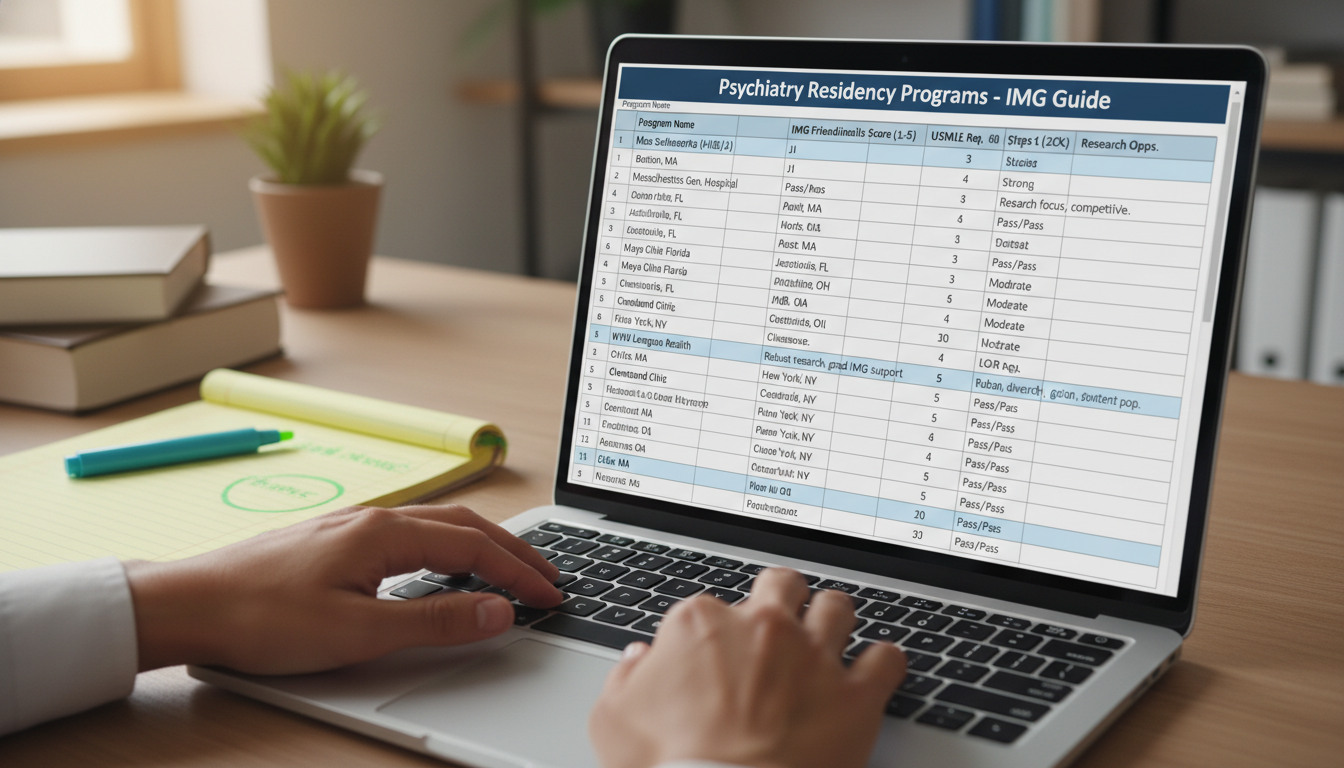
Create a spreadsheet with columns such as:
- Program name
- Location (city, state)
- Visa sponsorship (J‑1, H‑1B, both, none, unclear)
- IMG percentage / presence
- Program type (university, community, hybrid)
- Notes / initial impressions
This is your initial framework for program research strategy.
2. Use NRMP and Match Data to Identify IMG-Friendly Psychiatry Programs
The NRMP (National Resident Matching Program) publishes data every year on the psychiatry match, including the proportion of positions filled by IMGs.
While they don’t list programs by name, they help you understand where you are competitive:
- Psychiatry has become more competitive in recent years, but it remains accessible for strong IMGs.
- Analyze:
- Percentage of positions filled by non-US citizen IMGs
- USMLE score distributions for matched vs. unmatched IMGs (from NRMP’s “Charting Outcomes in the Match”)
Use this to judge how ambitious your program list should be. If your scores are close to or above the average of matched IMGs, you can include more competitive programs. If below, you’ll focus more on historically IMG-friendly programs.
3. Leverage IMG-Focused Lists and Word-of-Mouth Wisely
Many IMGs look at:
- Online spreadsheets (e.g., crowdsourced lists of “IMG-friendly” programs)
- Forums and social media groups
- Blogs and YouTube channels devoted to the psych match
Use these as supplementary tools, not your primary source of truth.
When you see a program labeled “IMG-friendly”:
- Check how many IMGs are actually in the current roster
- Confirm visa sponsorship from the official website
- Consider recency—data from 7–10 years ago may not reflect current policies
Make notes like:
- “Heard IMG-friendly on forums; confirm by checking current residents.”
- “Reported H‑1B sponsorship for strong candidates; verify on website or by email.”
Step 3: Deep-Dive Into Individual Program Websites
Once you have a preliminary list (e.g., 60–100 programs), your next task is evaluating residency programs in detail, starting with their official websites. This is where many IMGs fall behind—they skim quickly instead of systematically extracting useful information.
1. Confirm Visa and IMG Policies
On each program’s site, usually under Eligibility, International Medical Graduates, or Application Information, look for:
Visa sponsorship
- Do they explicitly support J‑1? H‑1B? Both?
- Any stated restrictions? (e.g., “We do not sponsor H‑1B visas.”)
IMG eligibility
- Do they explicitly welcome IMGs, or is there no mention?
- Are there additional requirements for IMGs (e.g., ECFMG certification at time of application vs. at time of ranking)?
USMLE / COMLEX requirements
- Minimum Step 1 / Step 2 CK scores (if listed)
- Maximum number of attempts
- Whether Step 3 is required/preferred for H‑1B
Treat any clearly stated exclusion criteria as a hard filter. For example:
- “We only consider applicants who have passed all USMLE exams on the first attempt.”
- “Applicants must have graduated within the last 5 years.”
If you do not meet strict criteria, the probability of an interview is extremely low; consider removing or downgrading that program on your list.
2. Analyze Current Residents: Who Do They Actually Train?
Looking at the current residents page is one of the most powerful ways to evaluate psychiatry residency programs as a foreign national medical graduate.
Check:
- Medical schools listed
- How many residents are IMGs?
- Are there non-US citizen IMGs (often indicated by foreign medical schools)?
- Patterns by PGY year
- If older classes had IMGs but recent ones have none, the program may be shifting away from IMGs.
- Diversity
- Are residents from a variety of countries and backgrounds?
- This may indicate a supportive environment for international physicians.
Add notes to your spreadsheet:
- “~50% IMGs, many non-US citizens.”
- “Only 1 IMG in last 4 years—likely not very IMG-friendly.”
- “Several graduates from my region/country—possible networking opportunity.”
3. Evaluate Curriculum and Clinical Exposure
For psychiatry, training content matters significantly. Consider:
- Range of clinical sites
- Academic hospital, VA, community mental health centers, forensic settings, addiction treatment facilities, child psychiatry clinics
- Psychotherapy training
- Formal curriculum in CBT, psychodynamic therapy, family therapy, group therapy
- Availability of individual supervision
- Subspecialty exposure
- Rotations in addiction, forensics, consult-liaison, geriatric, child and adolescent, emergency psychiatry
- Didactics and teaching structure
- Weekly didactic day protected from clinical duties?
- Board review sessions?
These details help you decide if the program will support your career goals—for example, if you want to become a child psychiatrist or work in academic psychiatry.
4. Look at Resident Outcomes
To gauge the quality and direction of the program:
- Check where graduates go:
- Fellowships (subspecialty training)
- Academic positions
- Community practice
A program that places graduates into good fellowships or faculty roles indicates strong preparation and mentoring—a plus if you want an academic career.

Step 4: Building a Structured Program Research Strategy
Now that you’ve collected a significant amount of data, you need to organize and refine it into a plan that will maximize your chances in the psych match.
1. Categorize Programs by Competitiveness and Fit
Using your spreadsheet, categorize programs into tiers based on your profile and the information you gathered:
Reach programs
- University or highly sought-after programs
- High USMLE expectations, limited IMG spots, or preference for US grads
- You meet some but not all “ideal” criteria
Target programs (core of your list)
- Historically IMG-friendly
- Your scores and profile are close to or above their typical resident profile
- Visa sponsorship is clear and matches your needs
Safety programs
- Strong IMG representation, relatively lower average scores, community-based or less competitive location
- You exceed many of their minimum criteria
As a non-US citizen IMG in psychiatry, a common distribution might be:
- 20–30% reach programs
- 50–60% target programs
- 20–30% safety programs
The exact numbers will depend on your budget and competitiveness.
2. Consider Geographic and Visa Strategy Together
Integrate your geographic preferences with visa realities:
- Some states have many J‑1 waiver opportunities and are historically friendlier to IMGs (e.g., parts of the Midwest, certain Southern states).
- Large coastal cities may be more competitive but still worth including if you have strong reasons (family, research interests, etc.).
Examples of strategic thinking:
- “I will apply broadly to J‑1-friendly programs in the Midwest and South, where psychiatry positions are plentiful and IMG representation is strong.”
- “I will include some West Coast university programs as reaches because of my research background, but most of my list will be community/university-affiliated programs with many IMGs.”
3. Track Communication and Updates
Your spreadsheet should also include columns for:
- Date you reviewed the website
- Whether you emailed the program with questions (e.g., about H‑1B)
- Any responses received
- Notes from virtual open houses, webinars, or social media
Keeping this organized makes it easier when writing tailored emails, personal statements, or preparing for interviews.
Step 5: Going Beyond Websites – Direct Contact, Networking, and Hidden Signals
To truly excel at evaluating residency programs, you must go beyond what’s written on the official page.
1. Attend Open Houses and Virtual Info Sessions
Many psychiatry programs host:
- Virtual open houses
- Q&A sessions with program directors and residents
- Webinars about their curriculum or diversity initiatives
As a non-US citizen IMG, these are extremely valuable because:
- You can ask about IMG and visa policies directly.
- You can sense the culture—are they welcoming to questions? Do they show enthusiasm for diversity?
- You might meet current residents from your region or with similar backgrounds.
Take structured notes:
- “Program director explicitly said they welcome non-US citizen IMGs and sponsor J‑1.”
- “Residents mentioned multiple H‑1B visas in recent years.”
- “Atmosphere seems supportive; emphasis on psychotherapy training.”
2. Use Networking Strategically
Networking does not guarantee anything, but it can help you:
- Verify unofficial information (e.g., whether a program truly accepts H‑1B)
- Understand how IMGs are supported
- Learn what the program values in applicants
Possible networking channels:
- Alumni from your medical school currently in US psychiatry programs
- Supervisors from your USCE rotations
- IMGs from your country/region in psychiatry via professional associations or social platforms
- Mental health conferences or academic meetings
When you approach someone:
- Be respectful, concise, and specific.
- Do not directly ask for “help to get an interview.”
- Instead, ask about:
- Their experience as an IMG
- How they perceive their program’s support for IMGs
- Any advice they have for evaluating programs like theirs
3. Read Between the Lines
Some signals about program friendliness and culture are subtle:
Positive signs:
- Website explicitly welcomes IMGs and outlines support systems
- Several residents from diverse international schools
- Clear descriptions of supervision, wellness initiatives, and mentoring
- Transparent information about visa sponsorship
Caution signs:
- No mention of IMGs anywhere, plus a resident roster with only US MD/DO graduates
- Website not updated for years—unclear if policies are current
- Vague or inconsistent statements about visas (“may consider” without examples)
- Reputation among IMGs for poor support or communication (verify from multiple sources)
Use these observations to adjust where you invest your application budget.
Step 6: Finalizing and Using Your Program List Strategically
With all your data organized, it’s time to turn your research into a concrete application plan.
1. Decide How Many Programs to Apply To
For a non-US citizen IMG in psychiatry, a typical range is:
- 40–80 programs, depending on:
- Competitiveness of your profile
- Budget constraints
- Breadth of your geographic flexibility
You might lean toward the higher end if:
- You have lower USMLE scores
- You lack US clinical experience
- You have an older YOG
2. Tailor Your Application Materials to Your Research
Your personal statement, program-specific paragraphs, and emails should reflect genuine understanding of each program. Because you’ve done detailed research, you can:
- Mention specific aspects of their curriculum or patient population that appeal to you.
- Align your experience (e.g., work with underserved populations or addiction) with their mission.
- Highlight that you understand the nature of psychiatry training in their environment (academic vs community, urban vs rural).
3. Use Your Research During Interviews and Ranking
Your preparation pays off again at interview and ranking time:
- Ask insightful questions based on your prior investigation (e.g., clarification about supervision, call structure, psychotherapy training).
- Evaluate whether the culture you perceived online matches your interview experience.
- Use your structured notes to create a rational rank list, prioritizing:
- IMG and visa support
- Educational quality
- Personal and career fit
This transforms your effort in how to research residency programs into a powerful tool for a successful psych match.
Frequently Asked Questions (FAQ)
1. How many psychiatry programs should a non-US citizen IMG apply to?
Most non-US citizen IMGs with average profiles apply to 40–80 psychiatry programs. If your USMLE scores and clinical experience are strong and you have recent graduation, you may safely aim for the lower end of that range. If your profile is less competitive (lower scores, multiple attempts, older YOG, minimal USCE), consider the higher end while making sure most of your choices are genuinely IMG-friendly.
2. How important is it that a program has current non-US citizen IMG residents?
It is very important. The presence of current non-US citizen IMGs in a program strongly suggests:
- They actively sponsor visas
- They are comfortable evaluating and supporting foreign national medical graduates
- They may have institutional experience with ECFMG and immigration processes
A complete absence of IMGs, especially over several PGY years, is usually a red flag.
3. Should I avoid programs that do not list minimum USMLE scores?
Not necessarily. Many programs choose not to publish specific score cutoffs, but still consider IMGs with a range of scores. Instead of assuming the worst, look at:
- The profiles of current residents (e.g., presence of IMGs from a variety of schools)
- Whether they explicitly welcome IMGs
- Any indirect hints from alumni or networking contacts
If your scores are significantly below typical matched IMG ranges, you should still apply more heavily to programs known to be open to lower scores.
4. Is research experience necessary for psychiatry residency as an IMG?
Not strictly necessary, especially for community or hybrid programs. Many psychiatry programs welcome IMGs without research, as long as they show:
- Strong clinical interest in psychiatry
- Good communication skills
- Commitment to mental health care
However, research experience (especially in psychiatry, neuroscience, or psychology) can make you more competitive for academic or university-based programs. When researching programs, note whether they emphasize research and how many residents pursue scholarly projects; then decide if this aligns with your background and goals.
By following this structured, evidence-based approach to how to research residency programs, you can shift from feeling overwhelmed to strategically confident. As a non-US citizen IMG targeting psychiatry, your careful program research strategy—focused on visa sponsorship, IMG support, and authentic educational fit—will be one of the most powerful determinants of your success in the psych match.