
Understanding the EM-IM Combined Path as a Non-US Citizen IMG
Emergency Medicine–Internal Medicine (EM IM combined) programs are five-year residencies that train you in both emergency medicine and internal medicine, usually leading to dual board eligibility. For a non-US citizen IMG or foreign national medical graduate, this path can be deeply rewarding—but significantly more competitive and logistically complex than applying to a single specialty.
Before you start learning how to research residency programs, you need to understand the specific challenges and realities you’re working with:
- Small number of programs: EM-IM combined residencies are offered by a relatively small group of academic centers, usually large tertiary or quaternary care hospitals.
- Limited positions: Each program often has only 2–4 EM-IM spots per year.
- Higher competitiveness: You’re effectively competing with applicants who could match in categorical Emergency Medicine or Internal Medicine alone.
- Visa sensitivity: Many EM-heavy programs are less likely to sponsor visas compared with Internal Medicine–only programs.
For a non-US citizen IMG, program research strategy is not optional—it’s the core of your application success. You cannot afford to apply blindly. Every program on your list should be there for a reason: they consider IMGs, can handle your visa needs, and match your training interests.
In this article, we’ll walk step-by-step through how to research residency programs in Emergency Medicine-Internal Medicine specifically for non-US citizen IMGs, and how to convert that research into a realistic, strategic rank list.
Step 1: Clarify Your Own Profile and Priorities First
Before opening FREIDA or program websites, you must be clear about who you are as an applicant and what you want from training. This helps you focus your efforts and avoid wasting time.
A. Map Your Applicant Profile
Create a one-page snapshot of your current standing:
- USMLE/COMLEX scores
- Step 1 (pass/fail but still relevant if you failed or had multiple attempts)
- Step 2 CK score and any attempts
- Step 3 (if taken—can be a big plus for visa-sensitive programs)
- Graduation year
- Many EM-heavy programs prefer recent graduates (≤ 3–5 years since graduation).
- Visa needs
- J-1 only? J-1 or H-1B? Already in the US on a dependent or other visa?
- Clinical experience
- US clinical experience (USCE): electives, sub-internships, EM/IM rotations.
- Emergency medicine exposure vs internal medicine exposure.
- Research and scholarly work
- EM or IM-related projects, QI projects, publications, poster presentations.
- English proficiency & communication
- US letters of recommendation commenting on communication skills are crucial for EM.
- Red flags
- exam failures, gaps in CV, disciplinary issues.
This honest self-assessment will guide which programs are realistic and how you present your story.
B. Define What You Want from an EM-IM Program
Ask yourself:
Balance of EM vs IM:
- Do you want a program more oriented toward critical care, ED leadership, or hospital medicine?
- Are you planning fellowship (e.g., critical care, cardiology, ultrasound, toxicology)?
Setting:
- Urban, high-volume trauma center vs community-oriented academic center.
- Patient population (underserved, diverse, high acuity).
Geography and lifestyle:
- Regions where you have family or support.
- States with more job opportunities or favorable licensing for IMGs.
Visa and long-term plans:
- Do you need a program that reliably sponsors J-1 or H-1B?
- Long-term goal: academic vs community practice, or planning a waiver job (e.g., J-1 waiver in underserved area).
Write these down; they become your filter when evaluating residency programs.
Step 2: Build an Initial Target List of EM-IM Programs
You can’t research what you don’t first identify. For EM-IM combined programs, your list is naturally smaller, but you still need a systematic approach.
A. Use Official Databases (FREIDA, NRMP, ACGME)
Start with:
- AMA FREIDA
- Filter by specialty: “Emergency Medicine–Internal Medicine” or combined programs.
- Note program size, location, and whether they list IMG percentages.
- NRMP/ERAS lists
- Check the ERAS Participating Specialties and Programs list for the current cycle.
- ACGME program search
- Confirm accreditation status and current program director names.
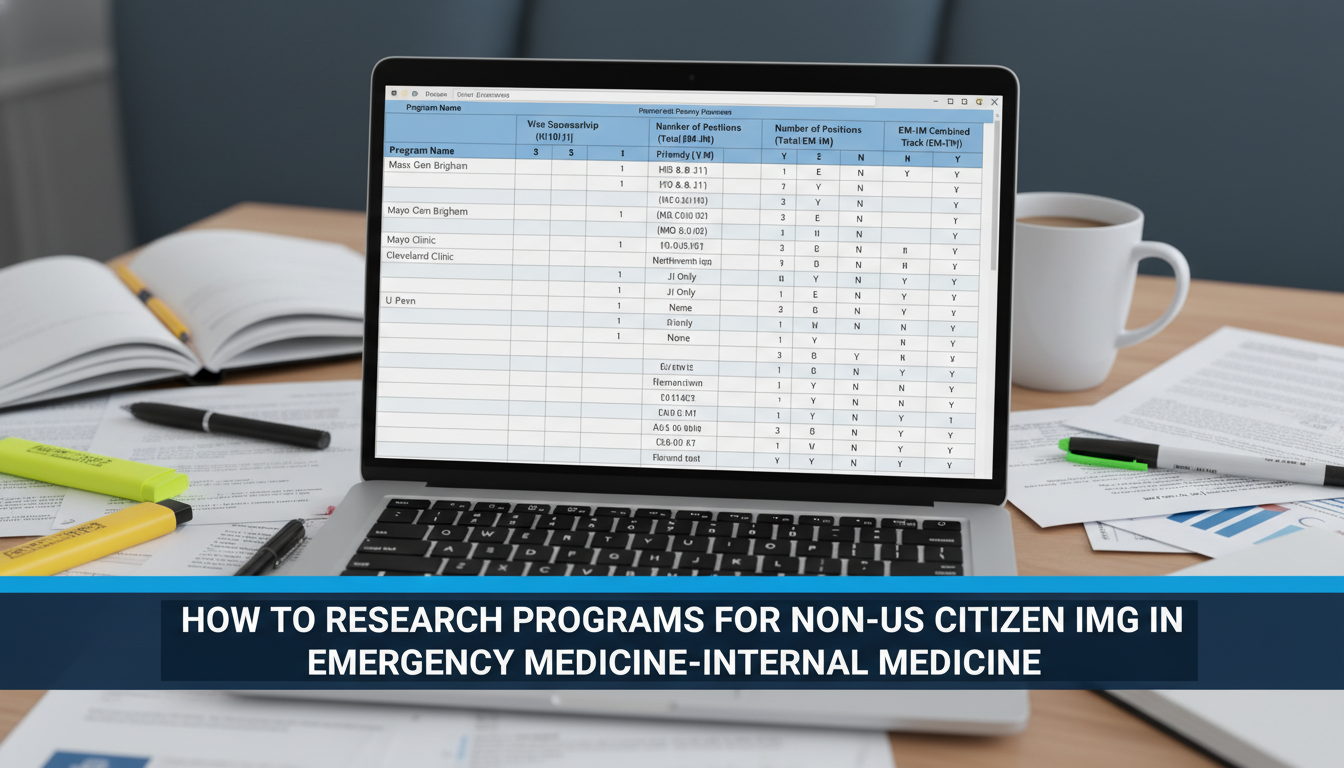
Create a spreadsheet with columns such as:
- Program name
- City/State
- Program type (university, university-affiliated, community-based)
- Number of EM-IM positions per year
- Estimated IMG-friendliness (we’ll refine this)
- Visa policy (stated/unknown)
- Website URL
- Application deadline / interview season notes
Aim for a complete list of all EM-IM programs first—typically this might be 10–20 programs depending on the year. You may later add:
- Several categorical EM programs
- Several categorical IM programs
if you want a broader match strategy.
B. Cross-check with Specialty Societies and Program Websites
Many combined programs are affiliated with:
- SAEM (Society for Academic Emergency Medicine)
- ACEP (American College of Emergency Physicians)
- ACP (American College of Physicians)
Some EM-IM tracks are described on:
- The main EM department page.
- The Internal Medicine department page.
- A dedicated EM-IM link.
Always visit the official program site; databases can be outdated. Confirm:
- EM-IM track still exists.
- Number of residents in each cohort.
- Recent graduates and their paths.
Step 3: Evaluate IMG-Friendliness and Visa Policies
For a non-US citizen IMG or foreign national medical graduate, visa policy and IMG track record are the two biggest filters.
A. Understand Common Visa Types
J-1 Visa (ECFMG-sponsored)
- Most common for IMGs.
- Many academic EM-IM programs accept J-1.
- Requires you to return home for 2 years afterwards unless you get a waiver.
H-1B Visa (Institution-sponsored)
- More restrictive in EM because of exam requirements (often Step 3) and hospital policies.
- Some institutions simply don’t offer H-1B to residents.
- If you must have H-1B, your list will be significantly smaller.
As you research, categorize programs:
- “J-1 only”
- “J-1 or H-1B”
- “No visa sponsorship”
- “Unclear – must verify”
B. How to Find Visa Information
Program Website
- Look for “For Applicants,” “FAQ,” or “International Medical Graduates” sections.
- Keywords: “visa,” “J-1,” “H-1B,” “IMG.”
- Some sites state clearly: “We sponsor J-1 visas only; we do not sponsor H-1B.”
Institutional GME Office
- Many institutions have a Graduate Medical Education (GME) website with visa policies.
- If GME says “No H-1B for any residency,” then all programs at that institution follow that rule.
Emailing the Program Coordinator
- Keep it short and professional:
- Introduce yourself (non-US citizen IMG).
- Ask directly: “Does your EM-IM program sponsor J-1 and/or H-1B visas?”
Example email:
Dear [Coordinator Name],
I am an international medical graduate and a non-US citizen interested in your Emergency Medicine–Internal Medicine combined residency track. Could you please confirm whether your program is able to sponsor J-1 and/or H-1B visas for residents?
Thank you for your time.
Sincerely,
[Your Name], MD- Keep it short and professional:
Record the response immediately in your spreadsheet.
C. Assessing Whether a Program is IMG-Friendly
Visa sponsorship is necessary but not enough. You also need to know if they actually interview and match IMGs.
Strategies:
Program Website “Current Residents” Page
- Look at names, medical schools, and countries.
- If multiple residents trained outside the US/Canada, that’s a positive sign.
- If you see EM-IM residents from international schools, note that as “IMG-friendly track record.”
Past Resident Lists and Alumni
- Some sites list alumni and where they attended medical school.
- Look for non-US schools; that signals a history of working with IMGs.
NRMP “Charting Outcomes,” Program Fill Data
- While not program-specific, it shows IMG match patterns in EM and IM.
- EM-IM being niche means you must extrapolate cautiously, but it gives context.
Forums and Crowdsourced Resources
- Use cautiously: Reddit, Student Doctor Network (SDN), Facebook IMG groups.
- Look for:
- “Interview and match experiences as a non-US citizen IMG at [Program].”
- “Does [Program] interview IMGs for EM-IM?”
Always verify with official sources; online posts can be outdated or biased.
In your spreadsheet, you might rate IMG-friendliness as:
- 3 = Strong history of IMGs/clear support
- 2 = Some IMGs or unclear but not negative
- 1 = Rare/no IMGs; likely difficult
Aim to keep the majority of your list in the 2–3 range, especially if you’re an older grad, have visa needs, or any red flags.
Step 4: Analyze Training Quality and Fit in EM-IM Combined Programs
Once you have filtered by visa and IMG-friendliness, you must evaluate training quality and personal fit. EM-IM combined programs vary widely in focus and culture.
A. Understand the Structure of EM-IM Training
Key structural questions:
- How are the 5 years organized?
- Alternating EM and IM months, or blocks of each?
- Which department is “home base”?
- Some EM-IM residents feel more integrated into EM, others into IM.
- Board eligibility:
- Confirm they are ACGME-accredited for EM-IM and you’ll be board-eligible for both specialties.
Look on the website for:
- A sample 5-year rotation schedule.
- Descriptions of EM and IM training sites.
- Orientation or “boot camp” experiences for EM.
B. Evaluate Emergency Medicine Training
Consider:
- Type of ED:
- Level 1 trauma center? Community ED? County vs private?
- Patient volume and acuity:
- Many EM-IM residents seek high-acuity environments with critical care exposure.
- Procedural opportunities:
- Intubations, central lines, chest tubes, ultrasound.
- Supervision and autonomy:
- Do upper-level residents run trauma/resuscitation bays?
- Academic culture:
- Conference schedule, simulation labs, ultrasound curriculum.
For each program, note specific EM highlights:
- “High trauma volume, county ED with strong ultrasound training.”
- “More internal medicine focus; EM volume moderate.”
C. Evaluate Internal Medicine Training
Look at:
- Breadth of subspecialties:
- Are there established fellowships (cardiology, pulmonary/critical care, nephrology, ID)?
- Inpatient vs outpatient balance:
- As EM-IM, you may prefer strong inpatient/ICU training.
- Critical care exposure:
- MICU, CCU, Neuro ICU, Surgical ICU months.
- Continuity clinic structure:
- Single clinic vs multiple sites; support for primary care if you’re interested.
For IM, also consider:
- Research opportunities
- Mentorship and career development
- Fellowship match record for EM-IM graduates
D. Combined Program Culture and Identity
EM-IM residents sometimes risk feeling “split” between two departments. When evaluating residency programs, look for:
- Dedicated EM-IM leadership:
- An EM-IM program director or associate director is a strong sign.
- EM-IM resident cohort size:
- Are there residents in all 5 years? Are you the only one in your class?
- Unique EM-IM curriculum:
- Combined conferences?
- Pathways in critical care, administration, global health?
Red flags:
- Program website barely mentions EM-IM.
- No current EM-IM residents listed.
- Outdated information or unclear leadership.
These may indicate a low-priority track or one at risk of future changes.

Step 5: Use a Systematic Program Research Strategy
Having data is not the same as using it well. Here’s a structured, step-by-step process to compare and prioritize programs.
A. Build a Comparative Scoring Sheet
In your spreadsheet, create scoring columns such as:
- Visa compatibility (0–3)
- IMG-friendliness (0–3)
- EM training strength (0–3)
- IM training strength (0–3)
- EM-IM identity & support (0–3)
- Geographic preference (0–2)
- Research/academic opportunities (0–2)
- Overall “gut fit” score (0–2)
You don’t need perfect objectivity—your aim is consistency. After researching, give each program a total score. This helps you:
- Identify top-tier targets.
- See which low-score programs might still stay as “backup” options.
- Avoid overemphasizing prestige while ignoring visa or IMG reality.
B. Deep Dive Into Priority Programs
For your top 8–10 EM-IM programs, do a more detailed review:
- Read:
- Their entire website, including resident bios.
- Their EM and IM categorical pages.
- Watch:
- Any virtual open houses or Q&A sessions posted on YouTube.
- Explore:
- LinkedIn profiles of recent graduates (where they came from and where they went next).
- PubMed or institutional pages to see resident involvement in research.
Write a short narrative summary of each top program:
- Why it might fit you.
- Any concerns (e.g., no H-1B, few IMGs, heavy night float, etc.).
C. Contact Programs Strategically (When Appropriate)
You can reach out to:
- Program coordinators: For factual information (visas, application requirements).
- Current or former EM-IM residents: For culture and day-to-day reality.
When contacting residents or alumni (via LinkedIn or institutional email):
- Introduce yourself briefly.
- Mention you’re a non-US citizen IMG interested in EM-IM.
- Ask 2–3 specific questions, such as:
- “How well supported do EM-IM residents feel between both departments?”
- “Have there been non-US citizen IMGs in EM-IM at your institution?”
- “How would you describe the ED workload and acuity?”
Be respectful of their time; not everyone will respond, but even a few conversations can significantly refine your view.
Step 6: Align Your Application Strategy with Your Research
Once you’ve completed your program research, use it to shape both your application list and the way you present yourself.
A. Calibrate the Number and Mix of Programs
Because EM-IM combined programs are limited, many applicants—especially non-US citizen IMGs—build a mixed application strategy:
Core EM-IM applications
- All programs where you meet basic criteria and visa requirements.
- Prioritize those with reasonable IMG-friendliness.
Categorical Emergency Medicine programs
- Especially at institutions with EM-IM tracks: sometimes being a strong EM applicant with interest in IM can still be advantageous.
- Consider EM programs known to match IMGs and sponsor visas.
Categorical Internal Medicine programs
- Academic IM programs with strong ED and ICU exposure.
- Safety net if EM-IM or EM alone proves too competitive.
The specific numbers depend on your profile, but many non-US citizen IMGs applying to EM-IM will apply to:
- All available EM-IM programs that are visa-compatible, plus
- 10–20 EM programs and/or 10–20 IM programs as additional options.
B. Tailor Your Personal Statement and CV to EM-IM
Use your research to write more targeted materials:
Personal Statement:
- Explicitly mention why EM-IM combined fits your career goals (e.g., critical care, complex systems of care, ED-hospital interface).
- Refer to specific features of EM-IM training that attract you (continuity, high-acuity EM, inpatient medicine).
- If you have a geographic or institutional interest based on your program research, you can subtly highlight these themes.
CV and Experiences:
- Emphasize:
- EM rotations, IM rotations, ICU exposure.
- Experiences where you managed acutely ill patients longitudinally.
- Quality improvement, systems-based projects, or ED-IM collaboration experiences.
- Emphasize:
C. Prepare to Discuss Your Program Research During Interviews
Program directors appreciate applicants who understand:
- What EM-IM training truly entails.
- Specific strengths of their institution.
Use your research to craft thoughtful questions:
- “I noticed your EM-IM residents do extra ICU time compared to categorical EM. How has that shaped graduates’ careers?”
- “I see several EM-IM alumni in critical care fellowships. What kind of mentorship is available to support that path?”
For a non-US citizen IMG, also be prepared to discuss:
- How your background and experiences will contribute to a diverse, high-acuity learning environment.
- Your understanding of visa limitations and long-term US career planning, without making it the main focus.
Frequently Asked Questions (FAQ)
1. As a non-US citizen IMG, is applying to EM-IM combined programs realistic?
It can be realistic, but it is highly competitive. EM-IM programs are few, positions are limited, and many institutions are cautious about visas. Your chances are best if:
- You have strong Step 2 CK scores (and Step 3 if possible).
- You have meaningful US clinical experience in EM and IM.
- You target programs that clearly accept IMGs and sponsor visas.
- You also apply to a broader set of EM and/or IM programs as part of a balanced strategy.
Your program research strategy should focus on identifying where candidates like you have historically matched rather than only aiming for the highest-prestige names.
2. How can I quickly check if a program sponsored non-US citizen IMGs before?
There is no single official database, but you can:
- Check the current residents and alumni pages for international medical schools.
- Look at institutional GME policies for J-1/H-1B sponsorship.
- Review LinkedIn or alumni profiles for graduates from non-US schools.
- Search forums or social media for “IMG at [Program Name].”
If you identify even one or two EM-IM residents from outside the US, this suggests an openness to foreign national medical graduates, especially if they are non-US citizens.
3. Should I email programs to ask if they consider non-US citizen IMGs for EM-IM?
Yes—as long as your emails are concise and professional. It is appropriate to ask:
- Whether they sponsor J-1 and/or H-1B visas.
- Whether there are additional requirements for IMGs (e.g., US clinical experience, graduation year limits).
Avoid repeatedly emailing the same program or asking questions that are clearly answered on their website. Your goal is to clarify eligibility, not to lobby for special treatment.
4. If I can’t match into EM-IM, is matching into EM or IM alone a good alternative?
For many non-US citizen IMGs, yes. Both paths can still lead to:
- Emergency Medicine only:
- Focused acute care career, opportunities in ultrasound, administration, toxicology, etc.
- Internal Medicine only:
- Strong base for future fellowships (e.g., critical care, cardiology, pulmonary/CC, hospital medicine).
- Some IM physicians work in ED settings in certain systems, although not always equivalent to EM training.
Your program research should therefore include EM and IM categorical programs that share similar strengths to EM-IM (strong ICU, high-acuity ED, academic environment). This preserves your ability to train in high-level acute and inpatient care even without dual certification.
By approaching EM-IM combined residency with a methodical, data-driven research process, you transform a seemingly opaque and competitive pathway into a set of clear, actionable steps. For a non-US citizen IMG, careful evaluating of residency programs, understanding visa realities, and targeting IMG-friendly institutions will dramatically increase your chances of building the career in Emergency Medicine–Internal Medicine that you envision.