
Understanding Geographic Flexibility as a US Citizen IMG
For a US citizen IMG or American studying abroad, geographic flexibility is one of the most powerful levers you have for matching successfully—especially into IMG friendly residency programs. While many US MD and DO seniors can prioritize city, family location, or lifestyle first, US citizen IMGs often need to invert that logic: go where the opportunities are most realistic, then optimize within that space.
At its core, geographic flexibility means three things:
- Willingness to consider multiple states and regions rather than a narrow target area
- Openness to a mix of urban, suburban, and community settings, not just big-name academic centers
- Strategic use of geographic preference residency tools (ERAS, NRMP, signaling, and letters) to show programs you are serious about coming—and staying—there
Used well, this approach can dramatically expand your access to international graduate programs in the US that are historically IMG friendly, while still protecting what matters to you (family, visa needs, long-term goals, or future fellowship plans).
This article will walk you through:
- How geography actually influences IMG match chances
- Regional patterns in IMG friendly residency programs
- How to build a smart regional preference strategy
- Practical application tactics showing location commitment
- How to balance flexibility with personal priorities
Throughout, the focus is on what specifically matters for a US citizen IMG, which is often very different from non-US IMGs or US MD/DO seniors.
How Geography Shapes Residency Chances for US Citizen IMGs
Geography isn’t just “where you want to live.” It affects:
- Number of available IMG friendly positions in your specialty
- Competition intensity (how many US MD/DOs apply there)
- Program familiarity with international graduate programs
- Perception of your commitment to that area
1. IMGs Cluster in Certain Regions
If you look at NRMP and ACGME data, you’ll notice clear geographic patterns:
- Some states and hospital systems have long traditions of training IMGs
- Others are dominated by large academic centers that favor US MD/DOs
Historically, many IMG friendly residency programs cluster in:
- Northeast (e.g., New York, New Jersey, Pennsylvania)
- Midwest (e.g., Michigan, Ohio, Illinois)
- Parts of the South (e.g., Florida, Texas, some Carolinas)
- Selected areas in the Mid-Atlantic and inland West
This doesn’t mean you can’t match elsewhere, but your odds improve in regions where programs:
- Already have multiple IMGs on their rosters
- Are used to evaluating transcripts, MSPEs, and exams from international schools
- See IMGs as an essential part of their workforce and long-term staffing
2. As a US Citizen IMG, You Have One Key Advantage
Unlike non-US IMGs, you don’t need visa sponsorship. That:
- Removes a major barrier for many community and smaller programs
- Makes you more attractive to IMG friendly programs that don’t handle H-1B or J-1 visas
- Allows you to apply more broadly without worrying about “visa sponsorship” filters
Geographic flexibility + no visa requirement is a strong combination. A program in a less popular city may see you as an ideal candidate: willing to come, likely to stay, and no legal complexity.
3. Geographic Flexibility Improves Match Probability
In competitive specialties or for applicants with:
- Lower USMLE/COMLEX scores
- Fewer US clinical experiences
- Gaps in training or career transitions
…widening your geographic preference residency options is often more impactful than adding one more research project or elective.
Programs in highly desirable locations (coastal big cities, trendy metro areas) receive:
- More applications
- More US MD/DO interest
- Higher Step scores on average
By contrast, programs in smaller cities, rural regions, and less well-known areas often:
- Have more IMG residents
- Receive fewer total applications
- Are more open to holistic review if you show genuine interest and commitment
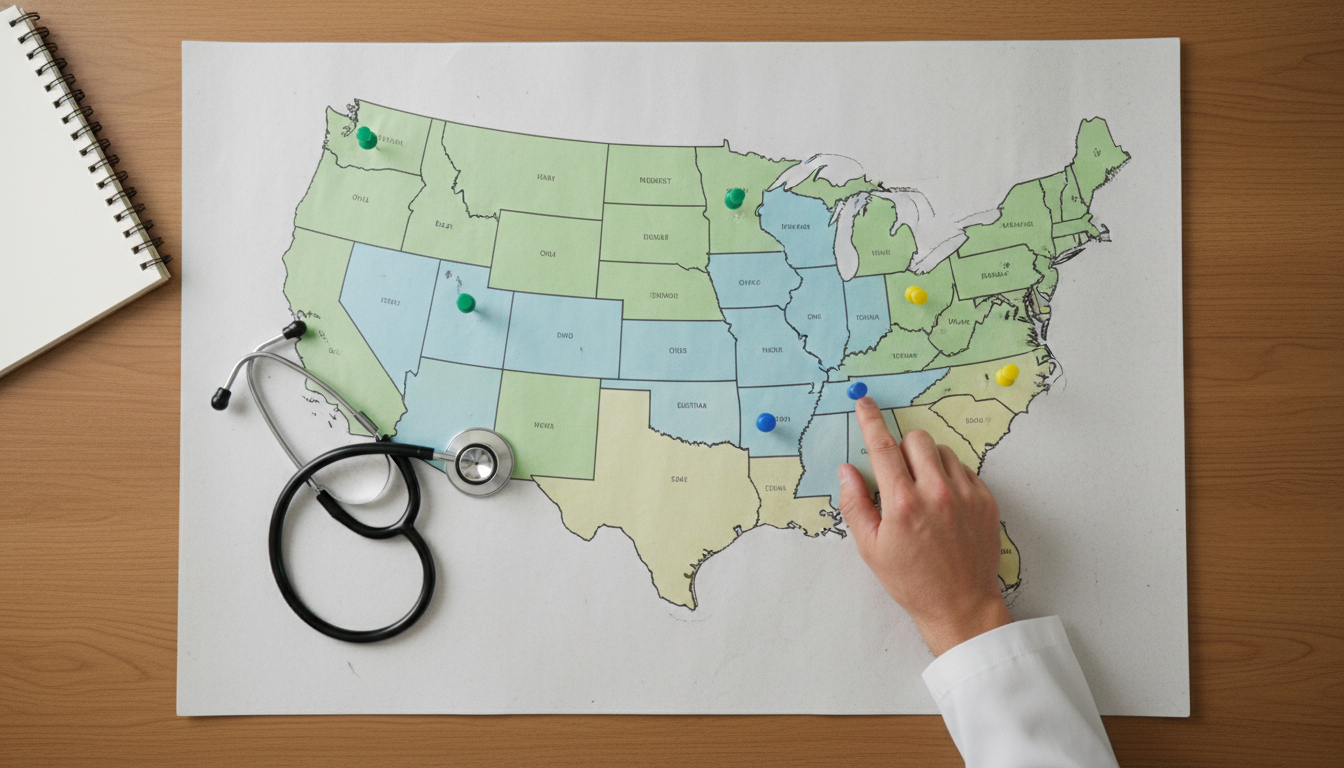
Regional Patterns: Where IMG-Friendly Residency Programs Cluster
To develop a smart regional preference strategy, think in regions, not just individual cities. Below is a high-level guide from an IMG perspective; always cross-check with current NRMP and FREIDA/ERAS data because patterns shift over time.
1. Northeast Corridor
States commonly considered IMG friendly:
- New York, New Jersey, Pennsylvania, Connecticut, some parts of Massachusetts
Why it’s important:
- High density of hospitals and graduate medical education programs
- Many long-established international graduate programs
- Urban and community hospitals that historically rely on IMGs
Pros for US citizen IMGs:
- Many internal medicine, family medicine, pediatrics, and preliminary surgery positions
- Programs are used to evaluating US citizen IMG and non-US IMG applicants
- Multiple tiers of programs (large academic centers, affiliates, and community hospitals)
Potential downsides:
- Cost of living can be high in major cities
- Some areas are intensely competitive (e.g., Boston-area university hospitals, top Manhattan centers)
Best use case:
US citizen IMGs willing to live in medium-to-large cities, with strong geographic flexibility within the region (e.g., not just NYC, but also upstate NY or New Jersey suburbs).
2. Midwest and Great Lakes
IMG friendly states often include:
- Michigan, Ohio, Illinois, Indiana, Wisconsin, Missouri; sometimes Minnesota and Iowa
Why this region stands out:
- Many community and university-affiliated hospitals
- Significant IMG presence across internal medicine, family medicine, psychiatry, pediatrics, and transitional/preliminary years
- Often more affordable cost of living
Pros for US citizen IMGs:
- Many programs open to IMGs and appreciative of long-term commitment
- Less competition from US MD/DOs compared to coastal hotspots
- Good balance of urban, suburban, and smaller-city environments
Challenges:
- Some locations may be less attractive lifestyle-wise for applicants who strongly prefer big coastal cities
- Winters can be harsh—this genuinely matters for long-term lifestyle fit
Best use case:
Applicants who can prioritize location flexibility match over city prestige and are open to mid-size cities and suburban communities for robust training and good match odds.
3. South and Southeast
States with notable IMG presence (varies by specialty and year):
- Florida, Texas, Georgia, the Carolinas, Virginia, parts of Tennessee and Alabama
Key considerations:
- High variability: some states and programs are very IMG friendly; others are not
- Texas is unique due to a separate application system (Texas STAR/TSMP), but includes several IMG friendly programs in certain specialties
Pros:
- Rapid population growth → demand for physicians
- Mix of academic, community, and hybrid programs
- Some regions actively recruit IMGs to serve growing communities
Potential downsides:
- Certain programs are very competitive and heavily sought by US MD/DO graduates
- Some states may have fewer total programs compared with the Northeast or Midwest
Best use case:
US citizen IMGs who want warmer climates, are open to secondary cities and suburban environments, and are willing to learn each state’s application nuances (particularly Texas).
4. West and Mountain States
States with some IMG presence:
- California (very competitive), Nevada, Arizona, Colorado, Utah, New Mexico, Oregon, Washington
Reality check:
- Total number of residency positions is lower compared with the East and Midwest
- Many West Coast programs are highly competitive and have a strong pipeline of US MD/DO applicants
Pros:
- Attractive lifestyle and climate
- Some community hospitals or newer programs may be more open to US citizen IMGs
Challenges:
- Significantly fewer IMG friendly residency spots proportionally, especially in California’s large academic programs
- Risk of over-focusing on these states and under-applying elsewhere
Best use case:
Use the West as part of a diversified regional strategy, not your only region—unless you have a very strong specific connection (family, medical school rotations, or prior residence) and an otherwise very competitive application.
Building a Geographic Preference Strategy That Works
Your goal is to combine data, self-knowledge, and flexibility into a coherent plan. Think of it as designing three layers: Core Region(s), Acceptable Region(s), and Stretch Region(s).
Step 1: Define Your Non-Negotiables
Before looking at any map, clarify what truly matters:
- Do you need to be within a certain driving distance of family (e.g., aging parents, partner, children)?
- Do you have health needs requiring specific regional resources?
- Are there legal or logistical limits (e.g., partner’s job market, child custody arrangements)?
Write down your true constraints—not preferences. Many applicants mix these up and artificially narrow themselves.
Step 2: Identify Core and Acceptable Regions
Create a structure like this:
- Core Regions (High priority + high flexibility within them)
- Example: “Northeast and Midwest within 2–6 hours of my parents”
- Acceptable Regions (Open, but not first choice)
- Example: “South and Mid-Atlantic, especially urban or suburban areas”
- Stretch Regions (Lifestyle-pull or long-shot interest)
- Example: “West Coast and Mountain states for a few targeted, realistic programs”
For each region, consider:
- How IMG friendly is it, generally, in my chosen specialty?
- How many programs realistically accept US citizen IMG applicants?
- Am I willing to live there for at least 3–7 years if I end up loving the program?
Step 3: Use Data to Verify IMG Friendliness
Don’t guess. Use:
- FREIDA/ERAS listings: Check if programs report taking IMGs
- Program websites and current resident rosters:
- Do you see IMGs? US citizen IMG? American studying abroad?
- NRMP Charting Outcomes and specialty-specific match reports (when available)
Look for patterns:
- Programs in mid-size cities with a history of international graduate programs
- Community-based or hybrid academic-community hospitals
- Programs whose residents list Caribbean, European, or Asian medical schools
Step 4: Align Application Volume With Geography
Once you know your core and acceptable regions, distribute your applications with intentional weighting. For a typical US citizen IMG in an IMG friendly specialty (e.g., internal medicine, family medicine, psych, pediatrics):
- 50–60% of applications: Core regions (e.g., Northeast + Midwest)
- 25–35% of applications: Acceptable regions (e.g., South + Mid-Atlantic)
- 10–15% of applications: Stretch regions (e.g., selected West Coast/Mountain programs)
This distribution balances realism with opportunity and lifestyle hopes, while keeping your location flexibility match strategy front-and-center.

Showing Real Geographic Commitment to Programs
Many programs worry IMGs will leave quickly unless they have a true reason to stay. Your job is to make your regional preference strategy clear and believable.
1. Signal Local Ties Whenever Possible
“Local ties” can include:
- Grew up there or nearby
- Family in the region (even if not the same city)
- College or previous work in the area
- Completed US clinical rotations or observerships there
- Long-term partner, spouse, or children located nearby
Make this explicit in:
- Your personal statement (tailored versions for certain regions)
- The “geographic preference” or “program-specific” supplemental questions in ERAS
- Email communications when appropriate (brief, professional, honest)
Example snippet for a personal statement tailored to a Midwest program:
“Although I attended medical school in the Caribbean, my family has lived in Ohio for over 15 years, and I completed my undergraduate studies in Michigan. Throughout medical school I returned to the region regularly and completed clinical rotations in Cleveland and Detroit. I am committed to building my career in the Midwest, where I hope to practice long term and remain close to my family support system.”
2. Use ERAS Geographic and Program Signaling Wisely
Some specialties now include geographic preference and program signaling tools. For a US citizen IMG:
- Use signals to reinforce your core regions, not just the “fanciest” programs
- Don’t waste signals on places you’re only mildly interested in because they are popular
- Align your signals with the regions you’ve already decided are core or acceptable
If there is a formal mechanism to indicate “no regional preference,” “specific division,” or “broader region”, think strategically:
- If you have strong ties to one region, state that clearly
- If you truly are open nationwide, that can be an advantage—especially for IMG friendly residency programs in less popular states
3. Tailor Your Experiences and Narrative
For each region, think: “Why would a program director believe I will thrive and stay here?”
Ways to demonstrate this:
- Mention regional health issues or populations you are genuinely interested in (e.g., rural medicine in the Midwest, immigrant health in the Northeast, border health in the South)
- Reference electives, projects, or research that align with that region’s needs
- If you speak a relevant language (e.g., Spanish in parts of Texas or Florida), highlight how this directly contributes to patient care
4. Communicate Smartly Without Overdoing It
You do not need to send dozens of “interest” emails, but you can:
- Send brief, targeted messages to a limited number of programs that are:
- In your core regions
- Strongly aligned with your background or interests
- Use that message to highlight:
- Your US citizen IMG status (no visa needed)
- Specific local ties or long-term plans in that area
- A concise reason that program is a good fit for your training goals
Keep it professional, concise, and focused on mutual fit, not desperation.
Balancing Flexibility With Personal and Career Goals
Geographic flexibility doesn’t mean ignoring your own life. It means prioritizing wisely.
1. Think in Phases: Training vs. Long-Term Life
Residency is typically 3–7 years. Many physicians:
- Train in one region
- Move later for fellowship or attending positions
Ask yourself:
- “Can I handle 3–4 years in a less-than-perfect city if it gives me solid training and a successful match?”
- “Would I rather slightly compromise on city preference now to open up more future options?”
For a US citizen IMG, entering a strong international graduate program—even in a less glamorous city—can significantly improve:
- Future fellowship chances
- Employment opportunities across the country
- Your ability to eventually return to your dream city as an attending
2. Avoid the “Big Coastal City Only” Trap
A common pattern among American studying abroad (especially Caribbean grads):
- Applying heavily to New York City, Miami, Los Angeles, and a few large city programs
- Under-applying to IMG friendly residency options in the Midwest or secondary cities
- Ending up unmatched despite decent credentials
To protect yourself:
- Ensure your application list reflects true geographic flexibility
- For every high-profile city you apply to, offset it with multiple programs in more IMG-friendly regions
- Remember: your job now is to match, not to optimize lifestyle in year 1
3. Involve Family or Partners Early
If you have a partner, spouse, or children:
- Discuss geographic flexibility openly before application season
- Identify mutually acceptable regions rather than specific cities
- Consider where both of your careers or needs can be reasonably supported
Clear communication early prevents last-minute stress that restricts your options.
4. Protect Your Well-Being
Being open geographically doesn’t mean ignoring reality:
- If certain climates or regions would be genuinely harmful to your mental or physical health, respect that boundary
- If you have strong cultural or community needs, factor in where you can realistically find that support
- Look for regions with at least some components you’ll enjoy—nature, food, community, or affordable travel back home
Frequently Asked Questions (FAQ)
1. As a US citizen IMG, should I apply nationwide or focus on a few regions?
Apply broadly but strategically. Most US citizen IMGs benefit from:
- Strong focus on 2–3 core regions known to be IMG friendly (often Northeast + Midwest + one other)
- Additional applications in acceptable regions that align with your personal and career goals
- A limited number of stretch region applications in highly desirable or competitive areas
Nationwide is fine if you can genuinely move anywhere, but prioritize depth (multiple programs per region) over scattering single applications across dozens of states.
2. Do programs care if I say I’m “open to any location”?
Yes—and no. Program directors care more about whether you are:
- Genuinely likely to come if matched
- Likely to stay for the full training period
- Realistic about the location and its demands
Saying “I’m open to any location” is only helpful if your application behavior matches that statement (broad distribution, no contradictory messaging). Combine broad openness with specific, credible reasons for programs in your main target regions.
3. How can I prove I’m serious about a region if I have no family there?
You can still build a strong case:
- Do rotations, electives, or observerships in that region
- Learn about and reference local health systems or community needs
- Highlight why the training environment, not just the city, fits your goals
- Mention long-term career plans that align with the region (e.g., interest in rural primary care in the Midwest or border health in Texas)
Programs primarily want to know you’ve thought about what it means to live and work there, not that you happened to be born nearby.
4. Is it harder to match in competitive specialties as a geographically flexible US citizen IMG?
In competitive specialties (e.g., dermatology, radiology, certain surgical fields), geography matters even more:
- Many competitive programs are concentrated in major academic centers with lower IMG intake
- Even with geographic flexibility, match rates for IMGs remain low in some specialties
If you’re set on a competitive specialty:
- Strongly consider a parallel plan in a more IMG friendly field or track
- Use geographic flexibility to maximize your chances in that backup path
- Talk early with mentors familiar with US citizen IMG outcomes in that specialty
Being open to multiple regions helps, but it doesn’t fully overcome specialty-level competitiveness—be honest with your numbers and context.
Geographic flexibility, when used deliberately, turns your status as a US citizen IMG into a real strategic advantage. By understanding where IMG friendly residency programs cluster, using a thoughtful regional preference strategy, and clearly signaling your willingness to train and build a life in those areas, you substantially increase your odds of a successful and satisfying match.