
Understanding the Landscape: Medical Genetics and the US Citizen IMG Perspective
Medical genetics is a small, specialized field with a unique residency structure and relatively few training programs. As a US citizen IMG or an American studying abroad, you’re navigating two layers of complexity at once:
- A niche specialty with limited positions and highly variable program structures.
- The realities of matching as an IMG in the United States.
Before you can build a strong program research strategy, you need a clear picture of:
- How medical genetics training is structured
- Where medical genetics fits into the match
- What it means for a US citizen IMG specifically
How Medical Genetics Residency Is Structured
Most US medical genetics training pathways fall into these categories:
Combined Programs
- Pediatrics–Medical Genetics (5 years)
- Internal Medicine–Medical Genetics (5 years)
- Less commonly, other combined pathways (e.g., MFM–Genetics in certain academic centers)
Categorical Medical Genetics & Genomics (2 years)
- Requires completion of another primary residency (e.g., pediatrics, internal medicine, OB/GYN) before starting.
- Often entered after completing a categorical residency OR via an integrated match pathway.
Fellowship-like Training
- Some genetics training is pursued after board certification in another specialty, especially pediatrics or internal medicine.
- May be ACGME-accredited medical genetics & genomics programs or focused subspecialty genetics training (e.g., biochemical genetics).
For residency application purposes, most applicants at your stage will focus on:
- Combined pediatrics–genetics or internal medicine–genetics programs, or
- Programs that recruit into medical genetics following a preliminary or categorical residency.
Understanding which pathway you want informs how to research residency programs and which filters to use.
Why the US Citizen IMG Status Matters
As a US citizen IMG (or American studying abroad), you have some advantages over non–US citizen IMGs:
- You do not need visa sponsorship (no J-1 or H-1B issues), which can make programs more open to interviewing you.
- You may have greater geographic flexibility to rotate, network, and attend conferences in the US.
However, you still face IMG-related challenges:
- Many programs favor graduates of US allopathic schools.
- Some programs explicitly “rarely or never consider” IMGs.
- Your school’s recognition, USMLE scores, clinical experience in the US, and letters of recommendation carry significant weight.
Your program research strategy must factor in both:
- the small size and specialization of medical genetics, and
- IMG policies and historical receptivity.
Step 1: Clarify Your Own Profile and Priorities
Effective program research starts with you, not with program lists. Before you dive into databases and spreadsheets, spend time defining:
- Your qualifications
- Your goals
- Your constraints
Evaluate Your Academic and Clinical Profile
Key elements to assess:
USMLE/COMLEX scores
- Are your Step scores at, above, or below the averages for matched genetics or combined programs?
- If Step 1 is Pass/Fail, how strong are your Step 2 CK (and potentially Step 3) scores relative to your peers?
Medical school and training background
- Is your international school well-known and recognized by many US programs?
- Did you complete US clinical rotations (ideally in academic centers or genetics-related fields like pediatrics, IM, neurology, or OB/GYN)?
Genetics exposure and experience
- Electives or sub-internships in genetics or related fields
- Research in genomics, rare disease, or inherited disorders
- Case reports or quality improvement projects involving genetic conditions
- Participation in genetics interest groups or conferences (e.g., ACMG, ASHG)
Letters of recommendation
- Do you have US-based letters?
- Any from medical geneticists or genetics-adjacent subspecialists?
Being honest about your profile helps you:
- Decide how broadly to apply
- Decide which programs are realistic reaches vs. safer options
- Identify gaps you may address with additional experiences or strong explanation in your application
Define Personal and Professional Priorities
When evaluating residency programs, consider:
Geographic preferences
- Are there regions you must stay in (e.g., family, partner, financial reasons)?
- Are you open to less competitive geographic areas if it improves your chances?
Program size and environment
- Do you prefer a large academic center with multiple genetics faculty and subspecialty clinics, or a smaller program where you’ll be one of few genetics trainees?
Career goals
- Clinician-educator? Physician-scientist? Community genetics provider?
- Interest in subspecialties: biochemical genetics, cancer genetics, reproductive genetics, neurogenetics, pharmacogenomics, etc.
Lifestyle and well-being
- Cost of living, call structure, schedule flexibility, support for wellness
Write these down. They will become your framework for evaluating residency programs and deciding where to focus your energy.
Step 2: Build a Comprehensive Program List for Medical Genetics
Once you’re clear on your priorities and profile, the next step is to map the landscape of available programs and then filter strategically.
Core Resources for Initial Program Identification
Use a combination of these to build your master list:
AMA FREIDA Online
- Search by specialty: “Medical Genetics and Genomics,” “Pediatrics–Medical Genetics,” “Internal Medicine–Medical Genetics.”
- Filter by:
- Program type (combined/categorical)
- Program size
- State/region
- Note: FREIDA often lists whether programs accept IMGs and provides basic program descriptions and contact info.
ACGME Accredited Programs List
- Go to the ACGME website and search accredited programs in:
- Medical Genetics and Genomics
- Combined Pediatrics–Medical Genetics
- Combined Internal Medicine–Medical Genetics
- This ensures your list is current and includes newly accredited programs.
- Go to the ACGME website and search accredited programs in:
NRMP and ERAS
- Check NRMP’s list of participating programs and their match codes.
- Review ERAS Participating Specialties and Programs list for the application cycle you’re targeting.
Professional Organizations
- American College of Medical Genetics and Genomics (ACMG): Often lists training programs and resources for trainees.
- American Society of Human Genetics (ASHG): May highlight training pathways and institutions involved in genetics.
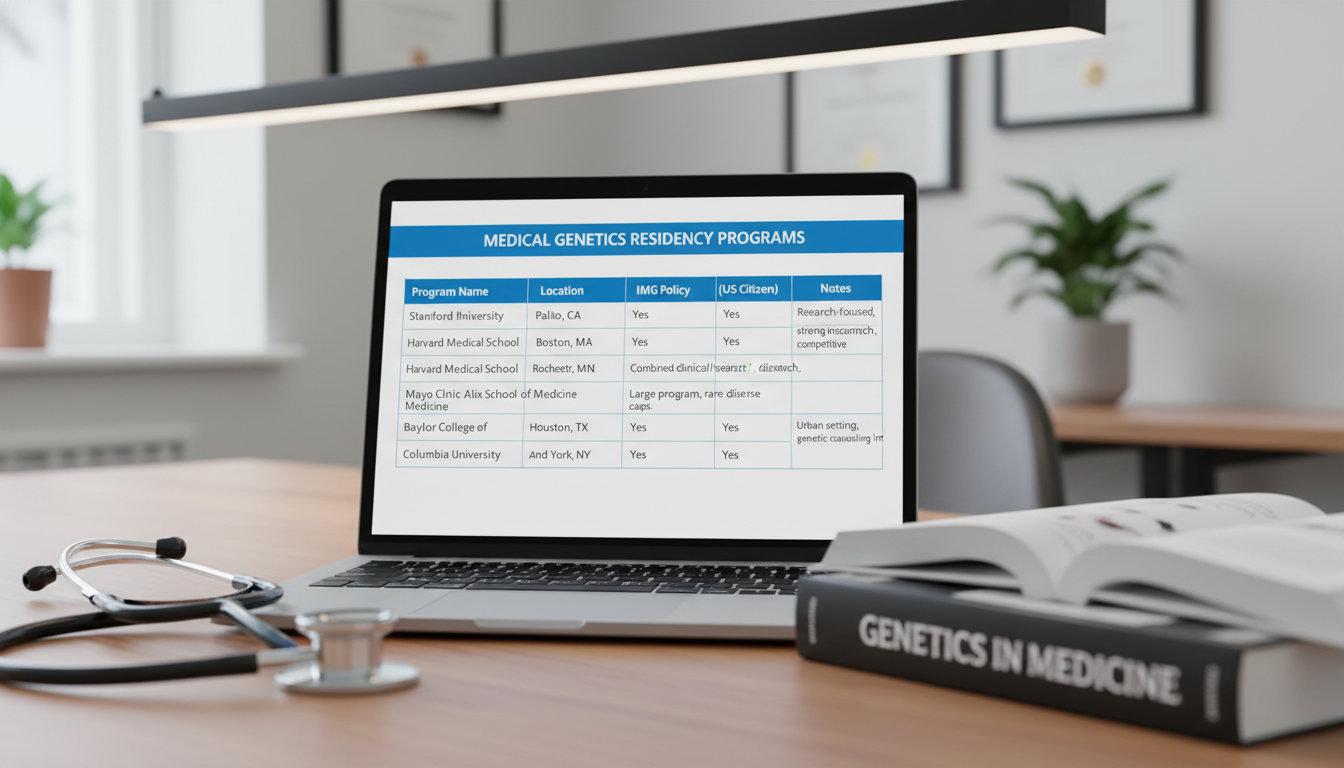
Put all programs in a master spreadsheet with columns for:
- Institution, city, state
- Program name (e.g., Pediatrics–Genetics, IM–Genetics, standalone Genetics)
- Program director and contact info
- Website URL
- ERAS/NRMP codes
- Program size (number of residents per year)
- Preliminary notes: region, university vs. community, IMG-friendliness signals (to be filled later)
This is the foundation of your program research strategy.
Step 3: How to Research Residency Programs in Depth
Once you have a master list, the next phase is deep research into each program. This is where you learn about:
- Program structure and training emphasis
- Academic and research opportunities
- IMG-friendliness and match outcomes
- Culture and support environment
Core Sources of Program Information
Program Websites
- Start with the official website for each institution’s genetics or combined program.
- Look for:
- Rotation structure: How are genetics and core disciplines integrated over time?
- Clinic types: Metabolic, cancer genetics, prenatal, adult genetics, neurogenetics, cardiogenetics, etc.
- Faculty profiles: Number of board-certified geneticists, areas of expertise, research interests.
- Research opportunities: Ongoing projects, labs, protected research time, T32 or institutional research tracks.
- Fellowship options: Biochemical genetics, clinical molecular genetics, cytogenetics, etc.
FREIDA and Other Directories
- Note:
- IMG acceptance patterns
- Number of positions, US graduates vs. international graduates
- Work hours, benefits, salary (when listed)
- Note:
Program Social Media and Online Presence
- Twitter/X, Instagram, and institutional YouTube channels
- Virtual open house recordings
- Resident/fellow spotlights
- Posts about resident achievements, wellness activities, community engagement
Conference Participation and Academic Profile
- Search program names with “ACMG abstract,” “ASHG abstract,” or “genetics case conference.”
- Look for faculty and trainees presenting at national meetings—this reflects academic vibrancy.
Word of Mouth and Networking
- Talk to:
- Genetics faculty at any US sites where you have rotated
- Residents or fellows you meet at conferences
- Your school’s alumni who matched in genetics or at specific institutions
- Ask targeted questions about culture, support, and how they perceive IMG applicants.
- Talk to:
Evaluating Residency Programs: Key Domains for Genetics and IMGs
To systematically compare programs, score each one in several domains. Create columns in your spreadsheet to rate:
IMG Friendliness
- Do they list “visa sponsorship” but also highlight previous IMGs?
- Are there current or past IMGs among their residents, fellows, or faculty?
- Do they explicitly state: “We consider IMGs” or “We sponsor J-1 and H-1B visas” (even if you don’t need it, that’s a marker of openness)?
- Check program rosters and alumni lists for non-US medical schools.
Structure and Training Environment
- How is the combined training (e.g., peds–genetics) scheduled? Is it:
- 2–3 years pediatrics followed by 2–3 years genetics?
- Or interwoven block structure?
- What is the patient mix?
- Strong pediatrics focus vs. broad age range?
- Access to complex cases (metabolic disorders, rare syndromes, undiagnosed disease programs)?
- Do they have in-house genetic laboratories, next-generation sequencing, or robust molecular diagnostics?
- How is the combined training (e.g., peds–genetics) scheduled? Is it:
Academic and Research Opportunities
- Presence of NIH funding or research centers (e.g., cancer centers, rare disease centers).
- Opportunities to:
- Conduct clinical or translational research
- Publish and present at ACMG/ASHG
- Pursue advanced degrees (MPH, MS in genetics, clinical investigation training programs)
Support and Culture
- How do residents describe mentorship and supervision?
- Is there formal support for wellness, mental health, and career development?
- Are there dedicated advisors for IMG issues (credentialing, adjustment to the US system, etc.)?
Geographic and Lifestyle Factors
- Cost of living, transportation, climate
- Proximity to family or support networks
- Safety, diversity, and inclusivity in the city and institution
By assigning each domain a simple rating (e.g., 1–5) and adding qualitative notes, you create a powerful decision-making tool tailored to you as a US citizen IMG interested in medical genetics.
Step 4: Use Data and Match Information Strategically
Because medical genetics is a small specialty, each genetics match result can significantly influence your application decisions. Use data to refine your program list.
Analyze NRMP and Specialty-Specific Data
NRMP “Charting Outcomes in the Match”
- Look for:
- Average scores and application characteristics for matched applicants in genetics and combined programs (when available; sometimes aggregate data is limited because of small numbers).
- Compare:
- U.S. MD vs. U.S. DO vs. IMGs
- Your own metrics vs. published benchmarks
- Look for:
Program Fill Rates and Applicant Type
- Some combined or small genetics programs may struggle to fill all spots and may be more open to strong IMGs.
- Look at:
- NRMP Program Results by Specialty and State
- Whether programs frequently fill all positions or sometimes underfill.
Residency Explorer or Similar Tools (if available)
- While these tools may not be genetics-specific, they can offer insight into:
- Program competitiveness
- Historical patterns with IMGs
- While these tools may not be genetics-specific, they can offer insight into:
Reading Between the Lines: Signals for US Citizen IMG Applicants
When programs do not explicitly state their IMG stance, you can infer:
Positive signs:
- Diversity of medical schools in past and current residents
- International research collaborations
- Mentions of J-1/H-1B sponsorship
- Alumni practicing in diverse geographical and practice settings
Caution flags:
- Website language that emphasizes “we primarily consider US allopathic graduates”
- No evidence of any IMG residents/fellows/faculty over several years
- Very small program with strong pipeline from their own medical school only
As a US citizen IMG, you’re less constrained by visa issues but still affected by these patterns. Use them to determine how heavily you invest energy in certain programs (e.g., more effort into your top realistic options, fewer resources into long shots).
Step 5: Direct Outreach and Clarifying IMG Policies
After you’ve done your background research, targeted outreach can clarify ambiguous programs and demonstrate professionalism and genuine interest.
When and How to Contact Programs
Timing:
- Late spring to late summer before applications open is reasonable.
- Avoid sending emails immediately around ERAS opening week or interview season; program coordinators are overwhelmed then.
Who to contact:
- Program coordinator (first point of contact)
- Program director (for targeted, high-yield questions)
- Current residents or genetics fellows (for culture-related questions)
What to ask:
Keep emails concise and specific. Examples tailored to your situation as a US citizen IMG:
Clarifying IMG consideration:
- “I am a US citizen who completed medical school abroad. Does your program typically consider US citizen IMG applicants, and are there specific criteria you look for (e.g., US clinical experience, graduation year)?”
Clarifying structure:
- “Could you clarify how your pediatrics–medical genetics combined program structures the integration of genetics training across the 5 years?”
Asking about mentorship/research:
- “As someone interested in adult genetics and cancer predisposition syndromes, what opportunities do residents have to work with faculty in these areas?”
Avoid purely generic questions that can be answered by the website; that signals you haven’t done your homework.
How Direct Outreach Helps Your Program Research Strategy
- Provides real-time, up-to-date information about:
- Changes in structure or leadership
- New educational tracks or research initiatives
- Evolving stance on IMGs or US citizen IMGs
- Builds your understanding of program culture:
- Responsiveness and tone of replies
- Willingness to support applicants with nontraditional paths
Document all email responses in your program spreadsheet. Over time, this will become a valuable reference when you decide where to apply and later how to create your rank list.

Step 6: Prioritizing and Finalizing Your Program List
By this point, you should have:
- A master list of medical genetics and combined programs
- Detailed notes on structure, research, culture, and IMG-friendliness
- Clarification from some programs via email or networking
Now refine your list into tiers that align with your risk tolerance, goals, and competitiveness.
Creating Tiers for Your Application Strategy
For a US citizen IMG in medical genetics, a typical tiered approach might look like:
Tier 1 – High-Priority / “Best Fit” Programs
- Strong alignment with your interests (e.g., rare disease, cancer genetics, reproductive genetics).
- Unambiguous openness to IMGs.
- Good geographic and lifestyle fit.
- Reasonable competitiveness relative to your profile.
Tier 2 – Solid / Moderately Competitive Options
- Less perfect fit but still strong training programs.
- Some historical or inferred openness to IMGs.
- Maybe slightly above your metrics but not unrealistic.
Tier 3 – Reach Programs
- Highly prestigious institutions or programs with minimal IMG representation.
- Very strong academic profiles.
- Apply if you have some notable strengths (outstanding research, strong letters, etc.).
Tier 4 – Safety/Backup Pathways
- Programs that may be less competitive or in less sought-after locations.
- Alternative pathways (e.g., pediatrics or internal medicine programs with strong genetics departments where you can later subspecialize).
Balancing Combined vs. Categorical Pathways
Depending on your stage and background:
If you have not yet completed a primary residency:
- Prioritize combined pediatrics–genetics or IM–genetics residencies.
- Include some categorical pediatrics or internal medicine programs at institutions with strong genetics divisions as a fallback.
If you are already in or finishing another residency:
- Focus on 2-year medical genetics & genomics programs.
- Evaluate how they integrate with your base specialty.
For each program you plan to apply to, ensure you have:
- A clear understanding of how genetics training is structured
- A rationale for why the program fits your goals
- Notes that will help you write tailored personal statements or answer “Why this program?” during interviews
Practical Example: Applying the Strategy as a US Citizen IMG
Imagine you are an American studying abroad at a Caribbean school with:
- Step 1: Pass
- Step 2 CK: 240
- 2 months of US clinical electives (one in pediatrics, one in internal medicine)
- A genetics research project with a US collaborator and a submitted case report
Here’s how you might apply the above steps:
Self-assessment
- Solid but not stellar scores.
- Good early genetics exposure and some US clinical experience.
- Need programs that are open to IMGs and value research.
Building the list
- From FREIDA, ACGME, and ACMG, identify all US medical genetics & combined programs.
- Filter out those that explicitly do not consider IMGs.
- Highlight programs that list US citizen IMGs or J-1/H-1B sponsorships.
Deep research
- For each program, review:
- Integration of genetics with peds/IM
- Presence of metabolic or cancer genetics clinics
- Research output in areas you find interesting
- Note any signs of IMGs in the resident list or alumni.
- For each program, review:
Contacting programs
- Write concise emails to 5–10 key programs where IMG policies are unclear but the fit looks excellent.
- Ask whether they consider US citizen IMGs and if US clinical rotations are required or strongly preferred.
Tiers and decisions
- You might aim for:
- 4–6 Tier 1 programs (clear IMG-friendly, strong genetics profile)
- 5–8 Tier 2 programs (moderately competitive, decent fit)
- 3–4 Tier 3 programs (top-tier but more of a stretch)
- 3–5 backup categorical peds/IM programs with strong genetics divisions
- You might aim for:
This approach leverages a targeted program research strategy that recognizes both your strengths and the realities of the genetics match.
Frequently Asked Questions (FAQ)
1. As a US citizen IMG, do I have a realistic chance of matching into medical genetics?
Yes, but your chances depend on:
- Your USMLE scores and overall academic profile
- Strength of your US clinical experience and letters
- The number and diversity of programs you apply to
- How well you target programs that are known or likely to be IMG-friendly
Because medical genetics is a smaller, more specialized field, some programs are more open to applicants with nontraditional paths, especially if you show clear commitment to genetics and can contribute academically.
2. How can I tell if a program is IMG-friendly if it doesn’t state it explicitly?
Look for indirect indicators:
- Current or past residents/fellows with international medical school backgrounds
- Faculty who trained abroad or maintain international collaborations
- Explicit mention of visa sponsorship (even if you don’t need it, it shows openness)
- No language discouraging IMGs on their website or FREIDA page
If in doubt, send a polite, concise email to the program coordinator asking whether the program typically considers US citizen IMG applicants.
3. Should I prioritize combined pediatrics–genetics vs. internal medicine–genetics as an IMG?
This depends on your interests:
- If you enjoy working primarily with children and rare congenital/metabolic disorders, pediatrics–genetics may be ideal.
- If you prefer adult medicine, cancer predisposition syndromes, cardiogenetics, and multi-age-range practice, internal medicine–genetics may fit better.
In terms of competitiveness and IMG friendliness, it varies by institution, not strictly by pathway. Focus on the match between your interests and the program’s patient population and faculty expertise, then research each program individually.
4. How many medical genetics programs should I apply to as a US citizen IMG?
Numbers vary, but for a relatively small specialty like genetics, many US citizen IMGs apply broadly. A reasonable starting range might be:
- 10–20 genetics or combined genetics programs, depending on your competitiveness and budget, plus
- Several backup categorical pediatrics or internal medicine programs that could serve as a stepping stone to genetics training later.
Use your tiered evaluation system to decide how widely to apply, prioritizing programs where your profile is a good fit and where IMG friendliness is clear or likely.
By approaching program research systematically—clarifying your priorities, building a comprehensive list, deeply evaluating each program, and strategically reaching out—you can significantly improve your odds of finding and matching into a medical genetics residency that truly fits your goals as a US citizen IMG.