
Understanding the Landscape: Medicine-Psychiatry and the US Citizen IMG
Medicine-Psychiatry (often called Med-Psych) is a small, highly specialized niche. For an American studying abroad (US citizen IMG), researching these residency programs thoughtfully is absolutely essential. With only a limited number of medicine psychiatry combined programs in the United States, a strong program research strategy can be the difference between a realistic, well-targeted rank list and a disappointing Match outcome.
As a US citizen IMG, you bring unique strengths—life experience, adaptability, and often broad clinical exposure—but also face specific challenges: variable perceptions of international medical schools, possible gaps in home program advocacy, and less direct access to US networking. Thorough research of residency programs helps you:
- Identify which Med-Psych programs seriously consider IMGs
- Understand how each program balances internal medicine and psychiatry
- Evaluate residency programs for fit, training quality, and visa/credential nuances
- Strategically prioritize where to visit, email, or do away rotations
This guide will walk you step-by-step through how to research residency programs in Medicine-Psychiatry as a US citizen IMG, how to interpret what you find, and how to turn that information into a smart application and ranking strategy.
Step 1: Know the Med-Psych Landscape and Your Own Profile
Before you dive into websites and databases, you need two things clear in your mind:
- What Med-Psych training actually looks like
- A realistic snapshot of your own candidacy as a US citizen IMG
What Is a Medicine-Psychiatry Combined Residency?
Medicine psychiatry combined programs are integrated five-year residencies leading to eligibility for both Internal Medicine and Psychiatry board certification. Key elements usually include:
- 2–3 years equivalent of internal medicine rotations
- 2–3 years equivalent of psychiatry rotations
- Longitudinal experiences in integrated or collaborative care models
- Exposure to medically complex psychiatric patients and psychiatrically complex medical patients
- Variable amounts of research, electives, and subspecialty experiences
Because these programs are small (often 2–4 residents per year, sometimes fewer), each slot is precious. Programs tend to know their applicants well and often prefer candidates with clear, well-articulated interest in Med-Psych rather than “I’ll just see how it goes.”
Honest Self-Assessment as a US Citizen IMG
Your program research strategy should be rooted in a realistic understanding of your profile, including:
- USMLE/COMLEX performance
- Step 1: Pass/fail is the new standard, but any prior numerical score still matters.
- Step 2 CK: This is often heavily weighted for IMGs.
- Clinical experience in the U.S.
- Number and quality of US clinical experiences (USCE): electives, sub-internships, observerships.
- Any internal medicine, psychiatry, or Med-Psych oriented rotations in the U.S.
- Research and scholarly activity
- Any work in integrated care, psychosomatic medicine, primary care psychiatry, or related fields.
- Letters of recommendation
- Presence of strong US letters (especially from internal medicine, psychiatry, or a Med-Psych faculty member).
- Red flags or unique circumstances
- Gaps in training, exam failures, late switch to medicine psychiatry combined, etc.
Write out a simple one-page profile for yourself. This will help you quickly compare your background against program patterns as you research, especially regarding IMG-friendliness and competitiveness.
Step 2: Build a Target List of Medicine-Psychiatry Programs
Next, you need a master list of programs before you can start evaluating residency programs in detail.
Where to Find Med-Psych Programs
Use multiple sources so you’re not missing anything:
- ACGME / ERAS / NRMP databases
- Search by specialty for “Internal Medicine/Psychiatry” or “Combined Medicine-Psychiatry”
- Confirm that programs are still active and accepting applicants this cycle.
- Individual program or institutional websites
- Some combined programs are housed within large academic centers with multiple other tracks.
- Specialty organizations
- Look for Med-Psych or combined training sections within ACP, APA, or Academy of Psychosomatic Medicine/Consultation-Liaison Psychiatry.
- Word of mouth and mentoring
- US-based mentors and faculty may know of new programs or those that are particularly IMG-friendly.
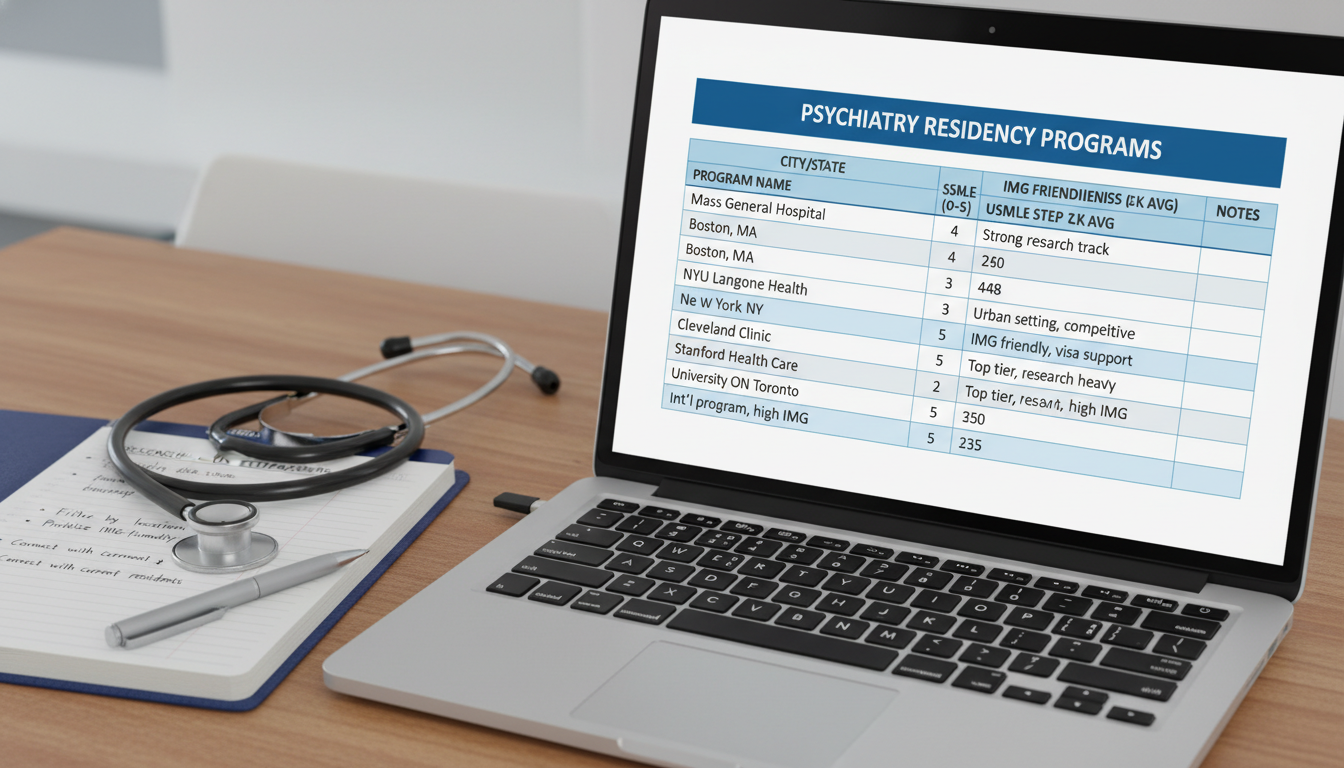
Create a spreadsheet with columns such as:
- Program name and institution
- City and state
- Number of residents per year
- Total program size
- NRMP code(s)
- Program website URL
- Contact email
- Notes on IMG acceptance, Step 2 requirements, USMLE cutoff (if any), and combined curriculum features
This becomes your master program research tool.
Step 3: How to Research Residency Programs Systematically
Now that you have your list, the heart of your task is learning how to research residency programs deeply and consistently. This means going beyond “location and name” to really understand how each medicine psychiatry combined program might fit your goals as a US citizen IMG.
Use a Structured Program Research Strategy
A practical approach is to assign yourself a consistent checklist you apply to every program. For each Med-Psych program you research, answer:
- Does the program accept and match IMGs—especially US citizen IMGs?
- What is the strength and balance of medicine vs psychiatry training?
- What is the program’s culture, mission, and patient population?
- How do graduates use their dual training?
- What are the logistical issues: visas, Step score expectations, start dates, etc.?
Having this standard set of questions allows you to compare programs side-by-side without being swayed only by name or location.
Where to Look and What to Look For
1. Program Websites
The program’s own site should be your primary information source.
Focus on:
- Program description / overview
- Look for clear statements about mission: integrated care, underserved populations, academic careers, primary care psychiatry, etc.
- Curriculum and rotation schedules
- How many months of internal medicine vs psychiatry?
- Are there combined rotations (e.g., C-L psychiatry, integrated primary care clinics, psych-oncology, addiction medicine)?
- Are there protected research or elective blocks?
- Current residents and alumni
- Do they list current residents’ medical schools? Any international schools?
- Are alumni profiles visible, showing their careers (academic, community, fellowship-trained, leadership roles)?
- Faculty
- Any notable Med-Psych or psychosomatic leaders?
- Faculty with dual appointments in both departments?
- Diversity, equity, and inclusion statements
- May give insight into openness to non-traditional paths, including IMGs.
As a US citizen IMG, the alumni and current resident lists are particularly useful: if your type of medical school or background appears there, that program may be a better cultural and logistical fit.
2. FREIDA and Other Databases
Use tools like AMA FREIDA and similar directories to:
- Check program size, accreditation status, and fellowship opportunities
- Look for IMG percentage, visa sponsorship, and historical data (if available)
- Filter for location, size, or academic vs community emphasis
For a US citizen IMG, visa sponsorship is less critical than for non-US IMGs—but programs that sponsor visas tend to have more infrastructure and experience with international graduates in general, which can be an indirect indicator of openness to IMGs.
3. NRMP and ERAS Data
Historical NRMP data (when available) can provide:
- How many positions are offered yearly
- Whether the Medicine-Psychiatry track fills completely
- Match trends in combined programs
While these data won’t specify IMG match rates by program, they can hint at competitiveness and stability.
Example: Applying the Strategy to a Hypothetical Program
Suppose you find “University X Medicine-Psychiatry Residency.”
From the website you note:
- Curriculum: 26 months Internal Medicine, 26 months Psychiatry, 8 months integrated/combined
- Alumni: Several graduates in C-L psychiatry, addiction medicine, and primary care leadership
- Residents: One current Med-Psych resident is an IMG from a Caribbean school
- Mission: Strong emphasis on underserved, high-acuity inpatient medicine and inpatient psychiatry with integrated behavioral health in primary care
- IMG Info: Website states: “We welcome applications from qualified international medical graduates; US clinical experience preferred; J-1 visas sponsored”
As a US citizen IMG with US clinical experience and strong interest in high-acuity, underserved care, you’d mark this program as high potential fit, both in terms of training model and openness to IMGs.
Step 4: Evaluating Residency Programs for Fit as a US Citizen IMG
Once you gather data, the key step is interpretation—how to evaluate residency programs for you. This goes beyond name recognition or prestige.
Core Dimensions of Fit for Med-Psych
1. Training Balance and Clinical Strength
Ask:
- Is the internal medicine component strong in inpatient wards, ICU, and continuity clinic?
- Is the psychiatry side robust in acute, chronic, and subspecialty care (C-L, addiction, forensics, child, integrated care)?
- Are there genuinely integrated experiences, not just two separate residencies stitched together?
US citizen IMGs sometimes worry that they need the “biggest name” to overcome their IMG status. In reality, a program with clear structure, strong mentorship, and robust dual training can be more valuable for your career than brand alone.
2. Academic, Community, or Hybrid Culture
- Academic-heavy programs
- May value research, publications, and academic potential.
- Good if you’re interested in fellowships, faculty positions, or health services research.
- Community-based programs
- Often emphasize service, high patient volume, and clinical autonomy.
- Sometimes more flexible in considering IMGs, particularly US citizen IMGs who can start without visa issues.
- Hybrid programs
- Combine academic tertiary care with community or VA settings.
Align the culture with your personality and goals. For example, if you’re a US citizen IMG with several publications in psych-oncology, an academic Med-Psych program with strong C-L services makes sense.
3. IMG-Friendliness and Support
Look for:
- Presence of current or recent IMGs in the Med-Psych track or associated Internal Medicine/Psychiatry programs
- Clear statements on international graduates on the program website
- Explicit requirements (USMLE cutoffs, time since graduation limits, minimum USCE)
- Advising and mentorship structures—do they support non-traditional pathways?
A program that has never taken an IMG into Med-Psych is not automatically off the table, but you should temper your expectations and maybe treat it as a “reach” application.
4. Location, Lifestyle, and Personal Priorities
Because there are so few Med-Psych programs, you might need to be geographically flexible. Still, consider:
- Cost of living and salary
- Proximity to support systems (family, friends, religious communities)
- Urban vs rural vs mid-sized city preferences
- Spousal/partner career considerations
Fit includes your ability to thrive personally. Burnout risk is real in combined training; you want an environment where your life outside the hospital is sustainable.

Step 5: Gathering Insider Information Beyond Websites
Public information only goes so far. For a complete picture of how to research residency programs, especially small, niche ones like Med-Psych, you need insider perspectives.
Use Networking Strategically
As a US citizen IMG, your home institution may not have Med-Psych programs, but you can still build connections:
- US-based mentors from your electives or sub-internships
- Ask if they know any Med-Psych faculty or alumni.
- Request introductions by email.
- Professional organizations and conferences
- APA, ACP, and various integrated care or psychosomatic conferences often include Med-Psych faculty and residents.
- Many now have virtual or hybrid options.
- Online communities
- Specialty interest groups (formal or informal), including Med-Psych or combined training groups
- Be professional, respectful, and concise when reaching out.
When you meet Med-Psych residents or faculty, ask targeted, respectful questions, for example:
- “What do you think your program does especially well for combined trainees?”
- “How would you describe the culture—more internist, more psychiatrist, or truly blended?”
- “Have you worked with US citizen IMGs? How supported did they feel?”
Contacting Programs Directly
For small specialties, a well-crafted email can be appropriate and helpful. Consider reaching out when:
- Program websites are unclear about IMG policies
- You have a specific, focused question about the curriculum or combined experiences
- You will be in town and hope to attend a virtual open house or Q&A session
Keep your message:
- Brief (1–2 short paragraphs)
- Specific (“I am a US citizen IMG from [school] with strong interest in Med-Psych, and I had a question about…”)
- Professional (include CV if requested, not as an unsolicited attachment)
This step is especially valuable for an American studying abroad, since you may lack a “home program” to advocate for you. Thoughtful contact can also show genuine interest, which matters in small programs.
Virtual Open Houses and Social Media
Most programs now host:
- Virtual open houses (often recorded)
- Q&A sessions with residents
- Instagram/Twitter accounts highlighting resident life
Use these to observe:
- How residents talk about wellness, support, and workload
- How faculty describe expectations and culture
- Whether there are current IMG residents and how they are represented
Document your impressions in your spreadsheet, focusing on specific observations rather than vague feelings.
Step 6: Prioritizing and Refining Your Application List
After weeks of research, you might have 8–15 Med-Psych programs on your radar (or possibly all existing programs, given the small number). Now you need to classify them and align your application strategy.
Categorize Programs: Reach, Target, and Safety
Although there are no true “safety” programs in a niche specialty, you can roughly stratify:
- Reach programs
- Highly selective academic centers
- Very small intake (1–2 residents/year)
- Unclear or low IMG representation
- Target programs
- Match reasonably well with your USMLE scores and experiences
- Have or recently had IMGs in the program or institution
- Curriculum aligns with your interests (e.g., integrated primary care psychiatry, addiction, C-L)
- Safety-like programs
- More historically open to IMGs
- Slightly less competitive location or brand name
- Strong match to your interests and background
As a US citizen IMG, you should apply broadly across these categories, especially because the number of medicine psychiatry combined programs is limited.
Integrating Your Med-Psych and Categorical Applications
Many dual applicants apply to:
- Med-Psych programs
- Categorical Internal Medicine programs
- Categorical Psychiatry programs
Your program research strategy should therefore also cover the categorical counterparts at the same institutions. Ask:
- If you don’t match Med-Psych, would you still want to train in that institution in internal medicine or psychiatry?
- Are there pathways to integrate your interests in psychosomatic medicine, primary care psychiatry, or collaborative care from a categorical base?
Doing this homework in advance helps you design a rational application distribution and write coherent personal statements.
Using Your Research for Personal Statements and Interviews
The details you gathered during evaluating residency programs will directly enrich your applications:
- In personal statements, reference specific program features (e.g., “your longitudinal integrated primary care-psychiatry clinic” or “your strong emphasis on medically complex psychiatric inpatients”).
- In interviews, ask informed questions that show you understand the structure of medicine psychiatry combined training at that specific site.
- Show awareness of the program’s mission and articulate how your path as a US citizen IMG uniquely fits that environment.
Programs notice who has done their homework.
Frequently Asked Questions (FAQ)
1. As a US citizen IMG, am I at a big disadvantage for Medicine-Psychiatry?
You face some extra hurdles, but it’s not insurmountable. Many medicine psychiatry combined programs primarily recruit from US MD schools, yet several have accepted IMGs, including US citizens who studied abroad. Strong Step 2 CK performance, robust US clinical experience, targeted letters of recommendation, and a clear, well-documented interest in integrated medicine-psychiatry can all offset the IMG label. Thoughtful, systematic program research also lets you prioritize those programs with a track record of supporting IMGs.
2. How can I tell if a Med-Psych program is truly IMG-friendly?
Look for concrete indicators:
- Current or recent IMGs among residents in Med-Psych and the categorical IM and psychiatry programs
- Explicit welcome statements to international graduates on the website
- Clear description of minimum USMLE scores, recency of graduation, and USCE requirements
- Availability of program staff to answer your questions respectfully
- Willingness to sponsor visas (even though you may not need one as a US citizen IMG, this often indicates institutional familiarity with non-US schools)
No single sign is definitive, but several of these together suggest IMG-friendliness.
3. How many Med-Psych programs should I apply to as a US citizen IMG?
Because the number of medicine psychiatry combined programs is small, most serious applicants apply to nearly all programs for which they are even somewhat competitive. As a US citizen IMG, it’s usually wise to:
- Apply broadly to Med-Psych programs
- Add a reasonable number of categorical Internal Medicine and Psychiatry programs that match your profile and interests
- Use your research to stratify programs into reach/target/safety-like and adjust the total number accordingly
Your exact number will depend on finances and time, but in a niche specialty, casting a wide yet targeted net is generally advisable.
4. What if my school has no Med-Psych mentors or exposure?
This is common for an American studying abroad. You can compensate by:
- Seeking out integrated or psychosomatic experiences in US rotations during your clinical years
- Asking your internal medicine or psychiatry attendings (in the US) if they know Med-Psych faculty and can introduce you
- Attending virtual Med-Psych or consultation-liaison psychiatry sessions at national meetings (APA, ACP, etc.)
- Contacting Med-Psych programs professionally with specific questions
- Engaging in scholarly or QI projects related to integrated care, medically complex psychiatric patients, or behavioral health in primary care
Document these efforts and integrate them into your personal statement and CV; programs recognize initiative, especially from applicants without direct access to combined training at their home institutions.
By approaching your search with a deliberate program research strategy—collecting structured information, evaluating residency programs across multiple dimensions of fit, and leveraging networking wisely—you can transform the challenge of being a US citizen IMG into a focused, compelling application to Medicine-Psychiatry residencies.