
Understanding the Unique Landscape of Pediatrics–Psychiatry for US Citizen IMGs
Pediatrics–Psychiatry–Child & Adolescent Psychiatry (often called “triple board”) is a small, specialized training pathway that prepares you to be board-eligible in three fields: Pediatrics, General Psychiatry, and Child & Adolescent Psychiatry. For a US citizen IMG (American studying abroad), researching these programs is fundamentally different from researching large-core specialties like Internal Medicine or categorical Pediatrics.
You are navigating three layers at once:
- Combined training structure – 5-year triple board programs plus related categorical pediatrics or psychiatry tracks
- Small number of programs – only a limited set of accredited peds psych residency programs
- IMG-specific considerations – visa policies (for classmates), US clinical experience expectations, and perceptions of international schools
Because of this, your program research strategy must be more intentional, data-driven, and personalized than a typical applicant’s. You cannot “apply everywhere” without thought; you must understand where your profile truly fits, how each program uses IMGs, and how to present your background as a strength rather than a liability.
This article walks you step-by-step through how to research residency programs in Pediatrics–Psychiatry as a US citizen IMG, with a focus on:
- Finding and organizing program information
- Evaluating residency programs using the right criteria
- Understanding competitiveness and IMG-friendliness
- Tailoring your strategy to your unique background and career goals
Step 1: Clarify Your Goals and Constraints Before You Start Searching
Before you open FREIDA or Google anything, get clear on what you want. This will keep you from drowning in information and help you avoid chasing programs that don’t actually fit.
1. Define Your Career Vision in Peds–Psych
Ask yourself:
- Do you want triple board training (Pediatrics–Psychiatry–Child & Adolescent Psychiatry in 5 years)?
- Or would you consider:
- Categorical Pediatrics with a later child psychiatry fellowship?
- Categorical Psychiatry with child & adolescent psychiatry fellowship?
- A combined or integrated program with significant child psych exposure but not triple board?
Clarifying this helps you focus on:
- Triple board programs (main focus for “peds psych residency”)
- Versus backup categorical pediatrics or psychiatry programs for a safer match strategy
2. Identify Non-Negotiables and Flexibles
Write down a short list in two columns: non-negotiable vs. flexible.
Examples of non-negotiable criteria:
- Must sponsor or at least accept IMGs (for your co-applicants or spouse)
- Geographic limits (e.g., must be within a few hours of family)
- Minimum level of child and adolescent psychiatry exposure
Examples of flexible criteria:
- Program size (small triple board cohorts are the norm)
- Exact city type (mid-sized city vs major metro)
- Academic vs community orientation
As a US citizen IMG, you have one major advantage: you do not need visa sponsorship. This removes a big barrier that many non–US citizens face. However, you may still be perceived similarly to other IMGs in terms of training background, so you must still carefully research how each program views IMGs and international schools.
Being clear about your goals and constraints will shape every later step of evaluating residency programs.
Step 2: Build a Complete List of Pediatrics–Psychiatry and Related Programs
Once you know what you’re aiming for, systematically identify programs of interest.
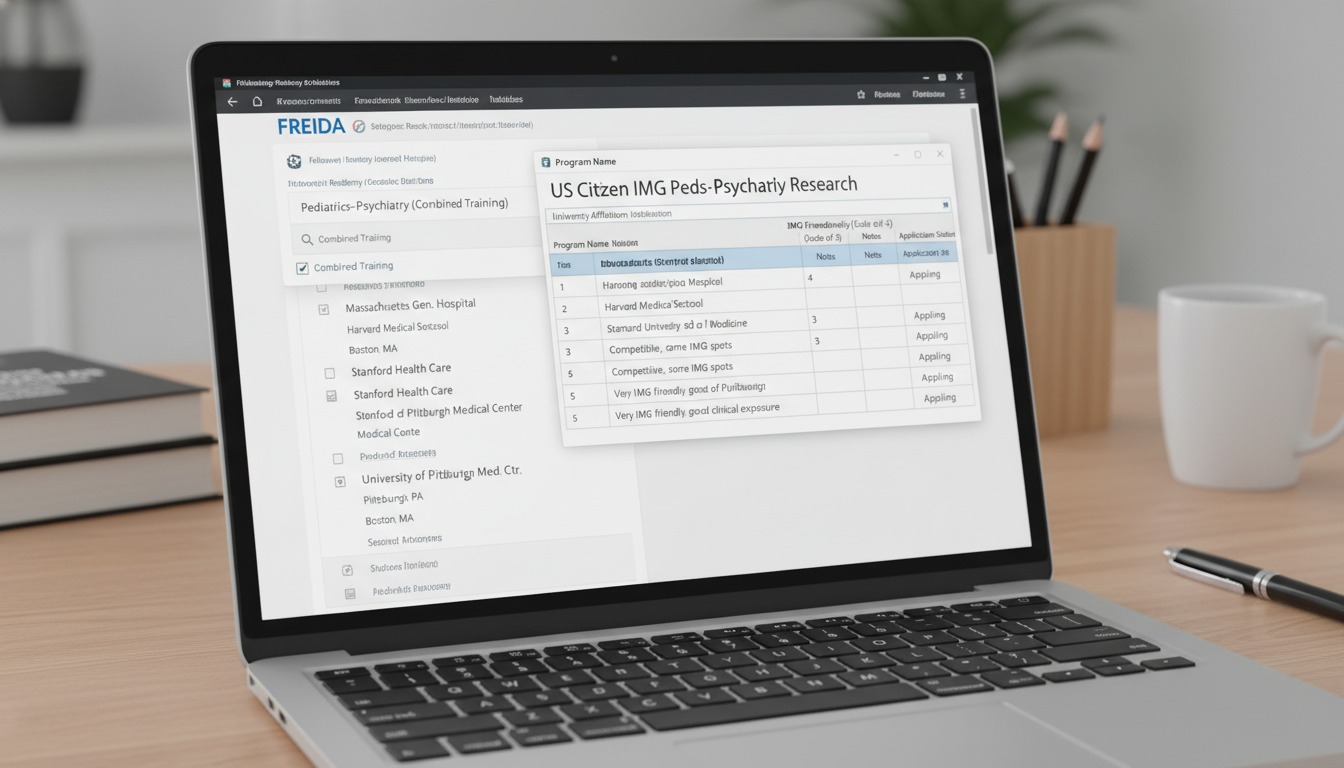
1. Start with Official Sources: ACGME + FREIDA
Use two primary tools:
ACGME Program Search
- Search for accredited “Pediatrics-Psychiatry-Child and Adolescent Psychiatry” programs
- Note each institution, program ID, and number of positions
AMA FREIDA Online
- Search under Pediatrics, Psychiatry, and combined specialties
- Filter for:
- Program type: combined / triple board
- Program size and positions
- IMG % (if available)
- For each program, open the detailed profile and record:
- Contact info
- Program length and structure
- Any notes on IMGs or visas
This gives you a master list of true triple board programs and associated categorical Pediatrics and Psychiatry programs at the same institutions.
2. Augment with Specialty Society and Program Websites
Next, cross-check with:
- American Academy of Pediatrics (AAP) – sections on combined training or child & adolescent mental health
- American Academy of Child and Adolescent Psychiatry (AACAP) – may list triple board programs or combined tracks
- Institutional websites – some programs have better information on their own pages than on FREIDA
On each program’s website, specifically look for:
- Detailed rotation schedules for all 5 years
- Descriptions of how pediatrics and psychiatry training are integrated
- Mentions of:
- Triple board graduates and their current careers
- Research opportunities in developmental, behavioral, or child psychiatry
- Child advocacy, integrated care, or global health
3. Create a Structured Spreadsheet
From the start, use a spreadsheet to organize your program research strategy. Include at least these columns:
- Program name and institution
- City/state and region
- Program type: Triple board / categorical Peds / categorical Psych
- Positions per year
- IMG percentage (if known)
- Explicit mention of IMGs on website? (Yes/No)
- US clinical experience required? (Yes/No/Unclear)
- Board score preferences (if any)
- Research or special strengths (e.g., autism, trauma, integrated care)
- Personal “fit” rating (1–5)
- Notes (e.g., attended their virtual open house, alumni trajectory, etc.)
This single tool will become the backbone of your program research strategy and later help you make final decisions on where to apply and how many programs you need.
Step 3: Understand Competitiveness and IMG-Friendliness for Peds–Psych
As an American studying abroad, you need to be brutally honest about where you are competitive and where your IMG status might be a barrier.
1. Use NRMP and Specialty Data Strategically
Pull data from:
- NRMP “Charting Outcomes in the Match” (for Pediatrics, Psychiatry, and if available, combined programs)
- NRMP Program Director Survey – pay close attention to:
- Which factors PDs rank as most important for selecting applicants
- Differences between Pediatrics and Psychiatry program directors
- Their stated attitudes toward IMGs
Key data points to note for your spreadsheet:
- USMLE Step 1 and Step 2 CK means, medians, and quartiles for matched IMGs
- Match rates of US citizen IMGs into Pediatrics and Psychiatry
- For triple board (or small subspecialty tracks), look at:
- Overall fill rates
- Whether positions are often filled by home or categorical residents
Even if triple board data are limited, you can extrapolate from:
- Pediatrics competitiveness (often more open to IMGs)
- Psychiatry competitiveness (increasing but still moderate)
- Very small program sizes (1–3 residents/year) → higher variability and more importance on perceived “fit”
2. Evaluate IMG-Friendliness Program by Program
Because triple board is small, there won’t be a clean “IMG-friendly ranking” anywhere. You must infer it.
Clues a program may be more IMG-friendly:
- Past or current residents with IMG backgrounds featured in their website or social media
- FREIDA or program website states: “We welcome applications from international medical graduates”
- No strict requirement for US MD/DO degree
- No explicit requirement for USMLE attempts “first try only” (if applicable to you)
Clues a program may be less IMG-friendly:
- States “We only consider applications from LCME- or AOA-accredited US/Canadian schools”
- Very strong affiliation with top-10 US med schools with highly competitive applicant pools
- Historic patterns (via talking to advisors or alumni) that they rarely rank IMGs
As a US citizen IMG, you aren’t blocked by visa issues—but you may still be affected by these institutional biases and expectations.
Step 4: Deep Dive into Each Program’s Structure, Culture, and Fit
Once you’ve mapped the universe of triple board and related programs, shift from “Do I qualify?” to “Would I thrive here?” This is where evaluating residency programs becomes highly nuanced.
1. Analyze Training Structure and Curriculum
For each peds psych residency or triple board program, examine:
Year-by-year schedule
- How many months of pediatrics vs. psychiatry vs. child & adolescent psychiatry?
- Are blocks integrated (e.g., consult-liaison pediatrics psychiatry) or mostly separated?
Child psychiatry focus
- How early do you get exposure to child and adolescent psychiatry?
- Are there rotations in:
- Inpatient child units
- Pediatric consultation-liaison
- Outpatient developmental and behavioral clinics
- School-based mental health programs?
Continuity clinics
- Are there longitudinal pediatric continuity clinics throughout all 5 years?
- Is there a child psychiatry continuity clinic?
Integrated experiences
- Any unique clinics or models that combine pediatrics and mental health (e.g., primary care behavioral health, integrated pediatric mental health clinics)?
As a US citizen IMG, consider how these elements align with your background:
- If your school had limited psychiatry exposure, a program that starts with strong pediatric foundation may be supportive.
- If you completed electives in child and adolescent psychiatry, integrated or early psych experiences may help you leverage those strengths.
2. Evaluate Academic and Research Opportunities
Many US citizen IMGs applying to peds–psych have:
- Interest in child development, neurodevelopmental disorders, or trauma
- Experience in global health or child advocacy
- Research experiences abroad that they hope to continue in the US
When evaluating residency programs:
- Look for research tracks or scholarly project requirements
- Review faculty interests:
- Autism spectrum disorder
- ADHD and learning disorders
- Early childhood mental health
- Trauma-informed care
- Integrated primary care–behavioral health
- Note whether:
- Residents present at national meetings (AAP, AACAP)
- There are formal mentorship programs
- Triple board residents have protected research time
If you have prior research, determine whether the program has mentors who share your interests. This is especially important in a small field where faculty relationships are central.
3. Assess Culture, Mentorship, and Support
Culture is hard to quantify, but you can identify patterns:
Resident well-being and workload
- Do residents talk about burnout or balance?
- Are there wellness initiatives?
- How do they handle cross-cover between pediatrics and psychiatry?
Attitudes toward diversity and nontraditional paths
- Do residents’ bios include nontraditional backgrounds (e.g., second careers, IMGs, public health degrees)?
- Does the program highlight diversity, equity, and inclusion?
- Are there explicit statements about valuing varied life experiences?
Mentorship structure
- Does the program assign mentors early on?
- Are there dedicated faculty champions for triple board residents?
As a US citizen IMG, prioritize programs that:
- Show clear support for residents from varied educational backgrounds
- Have structures that would help you bridge any gaps from your international curriculum (e.g., US systems training, documentation, quality improvement frameworks)
4. Look at Alumni Outcomes
Triple board graduates can pursue many paths:
- Academic medicine in pediatrics, psychiatry, or child & adolescent psychiatry
- Leadership in integrated behavioral health
- Hospital-based consult services
- Community mental health and pediatric primary care
On each program website, try to find:
- A list of where recent graduates went (fellowships vs immediate practice)
- Examples of alumni practicing in combined or integrative roles
- Whether triple board alumni stay connected to the program (suggesting good support and satisfaction)
If information is sparse, ask about this explicitly during virtual open houses or away rotations.
Step 5: Use Direct Contact and Networking to Fill in the Gaps
Online information only goes so far—especially for a small, niche pathway like peds psych residency. Strategic outreach can clarify your questions and show programs that you are a thoughtful, serious applicant.

1. Attend Virtual Open Houses and Information Sessions
Most programs now host:
- Virtual open houses for peds, psych, or triple board tracks
- Q&A panels with current residents
- Subspecialty interest sessions, especially for child and adolescent psychiatry
When attending:
- Prepare 3–4 thoughtful questions that show you’ve already researched the program (e.g., “I noticed you integrate pediatric continuity clinic throughout all 5 years; how do triple board residents experience this differently from categorical pediatrics residents?”)
- Ask specifically, as a US citizen IMG:
- How they support residents from non–US schools in adapting to US healthcare systems
- Whether there are other IMGs or US citizen IMGs in the program or institution
Take notes and add them directly into your spreadsheet.
2. Reach Out to Current or Former Residents
If you find email addresses or LinkedIn profiles of current or former triple board residents:
- Send a concise, respectful message:
- Introduce yourself briefly (US citizen IMG at X school, interest in combined pediatrics–psychiatry, planned graduation year)
- Mention something specific you appreciate about their program or career path
- Ask 2–3 focused questions (e.g., “What surprised you most about the balance between pediatrics and psychiatry training?”)
Do not ask them to “evaluate your chances.” Instead, ask about:
- What type of applicant seems to thrive there
- How supportive the environment is for people transitioning from international schools
- How they chose between triple board and categorical pathways
3. Leverage Your Home and Elective Networks
Even as an American studying abroad, you may have US connections:
- US clinical electives / observerships in pediatrics or psychiatry
- Faculty mentors who trained in or know about triple board programs
- Alumni from your international school who matched into pediatrics or psychiatry
Ask mentors:
- Which programs are known to value international experiences?
- Whether they know any faculty at your target triple board programs
- Whether they would be willing to reach out or write tailored letters of recommendation if you demonstrate clear interest
Step 6: Refine Your List and Build a Realistic Application Strategy
By this stage, your spreadsheet should be detailed, and you should have a good sense of where you might fit. Now translate this into a concrete strategy.
1. Categorize Programs by Reach, Target, and Safety
Group your programs into:
- Reach – highly prestigious or very small programs, where your metrics or background are at or below their usual range
- Target – programs whose resident profiles and published data align well with your scores, experiences, and interests
- Safety – more IMG-friendly, slightly larger programs, or categorical pediatrics/psychiatry backups
For a US citizen IMG in a niche field:
- Expect that all true triple board programs are at least “target” or “reach.”
You may not have any realistic “safety” options within triple board alone because of small numbers. - Build safety into:
- Categorical Pediatrics programs (often IMG-friendlier)
- Categorical Psychiatry programs with strong child and adolescent exposure
2. Check for Coherence with Your Personal Story
Look down your refined list and ask:
- Do these programs align with a coherent story about who I am and what I want?
- Example: “US citizen IMG passionate about early childhood mental health and integrated care, with research in developmental disorders.”
- Can you explain convincingly why triple board rather than just pediatrics or psychiatry?
- For each program, can you name:
- 1–2 specific features that attract you
- 1–2 ways you could contribute to their mission and community?
If not, either gather more information or reconsider whether that program belongs on your final list.
3. Plan How You Will Signal Interest
With a small number of triple board programs, demonstrating informed interest matters.
Options include:
- Attending program-specific sessions and mentioning them in your personal statement or interviews
- Doing US rotations at the same institution (often very helpful if feasible)
- Writing a brief, tailored “why this program” paragraph you can adapt for each institution’s supplemental applications or emails
Make sure your communication is:
- Specific (references actual curriculum, integrated clinics, or faculty interests)
- Sincere (don’t copy-paste generic praise)
- Professional and not excessive (do not send repeated “check-in” emails)
FAQs: Researching Pediatrics–Psychiatry Programs as a US Citizen IMG
1. As a US citizen IMG, do I need to worry about visa issues when researching triple board programs?
You personally do not need visa sponsorship, which is a major advantage. However, some programs use “US grads only” language that still applies to US citizen IMGs. When evaluating residency programs, you must still look carefully at whether they consider international schools, how many IMGs they have taken historically, and whether they explicitly welcome IMGs. Visa policy may matter if you have a spouse or friends applying with non–US citizenship.
2. How can I stand out to peds psych residency programs despite being an American studying abroad?
Stand out by aligning your application tightly with combined pediatrics–psychiatry themes: child development, behavioral health, advocacy, and integrated care. Seek US clinical experience in pediatrics and psychiatry (especially child and adolescent psychiatry), participate in relevant research or quality improvement, and show clear, well-researched reasons for preferring triple board over categorical paths. Strong letters from US supervisors who can speak to your clinical skills in both pediatrics and psychiatry are particularly valuable.
3. Are there enough triple board programs for me to rely only on them for the Match?
Because the number of triple board positions is small nationwide, it is risky for almost any applicant—especially a US citizen IMG—to apply only to peds psych residency or triple board programs. A safer program research strategy is to apply to all triple board programs where you’re a reasonable fit, plus a broader set of categorical Pediatrics and/or Psychiatry programs that offer strong child and adolescent experiences.
4. What are the best resources for how to research residency programs in this niche field?
Combine general tools (FREIDA, ACGME, NRMP data) with specialty-specific and program-level resources: AAP and AACAP websites, individual triple board program pages, virtual open houses, and direct communication with current residents. Your own spreadsheet and notes will be the most powerful tools for synthesizing all this information into a clear, realistic plan tailored to your goals as a US citizen IMG interested in Pediatrics–Psychiatry.