
Understanding Your Unique Position as a US Citizen IMG in OB GYN
As a US citizen IMG (often an American studying abroad), you sit in a very specific niche in the obstetrics & gynecology (OB GYN) residency landscape. You are competing with:
- US MD seniors
- US DO seniors
- Non‑US citizen IMGs
- Prior‑year graduates and reapplicants
In OB GYN—a moderately competitive specialty—the way you research and target programs can make the difference between matching and going unmatched. You cannot afford a scattershot approach.
Your program research strategy should help you:
- Identify programs that actually interview and rank US citizen IMGs.
- Prioritize places where your application is reasonably competitive.
- Align with your career goals (academic vs community, fellowship interests, etc.).
- Generate tailored, high‑quality applications instead of generic, mass‑sent ones.
The rest of this guide walks you step‑by‑step through how to research residency programs in OB GYN specifically as a US citizen IMG, including tools, databases, concrete filters, and ways to interpret the information you find.
Step 1: Clarify Your Priorities and “Non‑Negotiables”
Before you open FREIDA or ERAS, define what “right program” means for you. This is the foundation of any effective program research strategy.
A. Academic and Career Priorities
Ask yourself:
- Do you want an academic career (research, teaching, fellowship) or are you drawn to community‑based practice?
- Are you interested in specific fellowships (MFM, REI, Gyn Onc, FPMRS, MIGS, Complex Family Planning)?
- How important is research during residency?
- Do you want robust surgical exposure or a more balanced medical‑surgical curriculum?
If you are planning on a competitive fellowship, you may lean toward:
- University‑based or university‑affiliated programs
- Programs with in‑house fellowships
- Strong research infrastructure, protected time, and publications
If your goal is general OB GYN practice:
- Community or hybrid programs may provide higher case volumes and more hands‑on autonomy earlier.
B. Personal and Lifestyle Priorities
Define your non‑negotiables:
- Geography: Regions you will or will not consider (family, partner’s job, visa for spouse, cost of living, climate).
- Program size: Small (2–3 residents/year) vs large (6–10 residents/year).
- Work environment: Collegial culture, wellness support, call schedule.
- Patient population: Underserved, urban, suburban, rural, high‑risk, diverse.
Write your priorities down in a document or spreadsheet. You will use these criteria later when evaluating residency programs.
Step 2: Gather Your Own Data to Define Competitiveness
To research programs effectively, you first need an honest picture of your own profile. This lets you target places where a US citizen IMG can realistically be competitive.
A. Core Metrics to Consider
- USMLE/COMLEX scores
- Step 2 CK is now the primary numerical filter.
- If you took Step 1 when it was scored, that still matters.
- Attempts and gaps (failed exams, repeated years, time since graduation).
- Clinical experience in the US (USCE)—especially OB GYN rotations, sub‑internships, or electives.
- Letters of recommendation in OB GYN, ideally from US faculty.
- Research and publications, especially women’s health or OB GYN‑related.
- Medical school background (Caribbean vs European vs other; known vs lesser‑known schools).
- Citizenship status (you do not need visa sponsorship, a major advantage over non‑US citizen IMGs).
B. Categorize Yourself
Rough self‑assessment (not official cutoffs, just practical ranges):
Strong IMG candidate for OB GYN
- Step 2 CK ≥ 240 (or top quartile for your cohort)
- No failures, no significant gaps
- 2–3 strong US OB GYN letters
- US rotations in OB GYN
- Some research, preferably related
Moderate IMG candidate
- Step 2 CK ~225–239
- No more than one failure or minor red flag
- 1–2 solid US OB GYN letters
- Limited but real OB GYN USCE
- Some non‑OB GYN research or quality improvement (QI)
High‑risk IMG candidate
- Step 2 CK <225 or multiple exam attempts
- Multiple gaps or repeated years
- Minimal USCE; letters mostly from non‑US faculty
- Little or no research
Your category helps you calibrate how broad your program list must be and how to interpret program filters (e.g., minimum scores, “no IMGs”).
Step 3: Use Databases and Tools to Build an Initial Program List
Now you can begin structured program research. Think of this as building a master list that you will later narrow and prioritize.
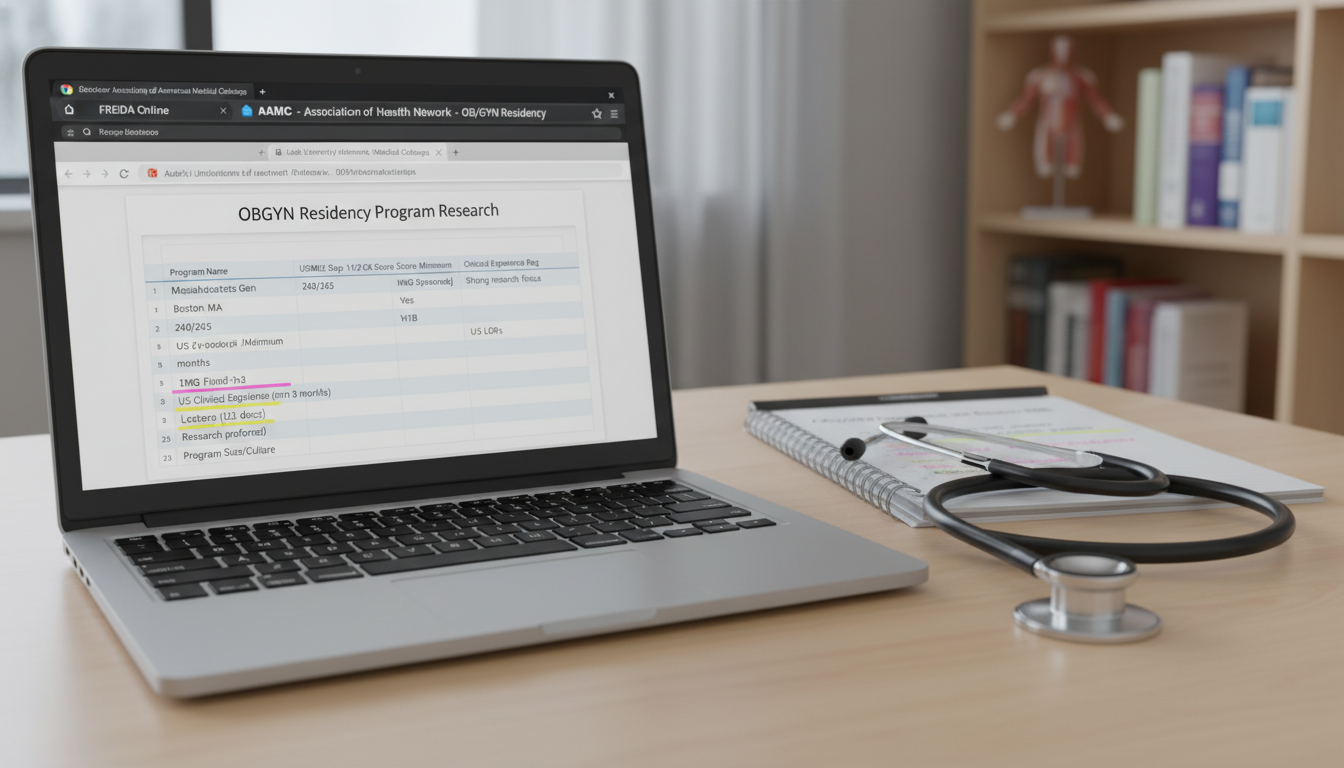
A. Start with ACGME and FREIDA
ACGME Program List
- Go to the ACGME website and search for accredited OB GYN programs.
- Export or copy the list of all active programs.
FREIDA (AMA Residency and Fellowship Database)
- Filter for: Specialty = Obstetrics and Gynecology; Location = United States.
- For each program, note:
- Program type (university, university‑affiliated, community).
- Program size (number of residents per year).
- Whether they sponsor visas—even though you do not need sponsorship, this can be a proxy for IMG friendliness.
- Any stated USMLE minimums or IMG policies.
B. Use Program Websites and ERAS Residency Directory
Once you have a basic list, visit:
Program websites
- Look for: “Current Residents,” “Application Information,” “Diversity & Inclusion,” “Curriculum,” and “Research.”
- Download any PDF handbooks if available.
ERAS Residency Explorer (if available in your cycle)
- Provides data on how applicants with profiles similar to yours fared at particular programs.
- Key for US citizen IMG applicants trying to gauge realistic options.
C. Third‑Party and Crowd‑Sourced Tools (Use Critically)
- NRMP Charting Outcomes in the Match (prior years)
- Check OB GYN tables for IMG match rates, scores, and characteristics.
- Student Doctor Network (SDN) threads / Reddit / specialty forums
- Search terms:
- “US citizen IMG OB GYN”
- “OB GYN residency IMG friendly”
- “American studying abroad OB GYN match list”
- Treat anecdotes as signals, not absolute facts.
- Search terms:
At this stage, don’t over‑filter. Aim to create a master list of perhaps 150–200 OB GYN programs, depending on your competitiveness, that you will later refine.
Step 4: Identify IMG-Friendly Programs—Specifically for US Citizen IMGs
Not all IMG‑friendly programs are equal. You need to distinguish:
- Programs that do not consider any IMGs
- Programs that accept some IMGs, but mostly non‑US citizen
- Programs that regularly match US citizen IMGs
A. Analyze Current Resident Rosters
This is one of the most powerful tools in evaluating residency programs for IMG friendliness:
- Open the program’s “Current Residents” page.
- For each PGY level, note:
- Medical school and country.
- Any Caribbean or international schools (e.g., St. George’s, AUC, SABA, Ross, European schools).
- Patterns to look for:
- At least 1–2 IMGs per class = more IMG‑friendly.
- All US MD/DO over many years = likely not IMG‑friendly.
- A mix that includes US citizen IMGs (often from Caribbean schools) = higher yield for you.
Keep a column in your spreadsheet labeled “IMG Presence” with categories like:
- “Multiple IMGs every year”
- “Occasional IMG”
- “No visible IMGs in last 4+ years”
B. Check Program Statements on IMGs and Exams
On the “Application Requirements” page, specifically look for:
- “We accept applications from IMGs” or “We require ECFMG certification.”
- Minimum USMLE Step 2 scores or average ranges.
- Requirements for:
- US clinical experience
- Time since graduation (often ≤5 years)
- Maximum number of attempts
Red flags for IMGs:
- “We accept only US graduates”
- “We do not sponsor visas” combined with no IMGs on roster suggests very low IMG intake.
- Very high minimum scores (e.g., “We only review applications with Step 2 ≥ 245”) if you are below that mark.
Remember: as a US citizen IMG, not needing visa sponsorship removes one barrier, but you still must clear the program’s internal IMG criteria.
C. Use Match Outcome Data Where Available
Some programs publish:
- Annual match lists for their own medical school or affiliated schools.
- Resident biographies mentioning “originally from New York, completed medical school in [foreign school].”
Search strategically:
- Google:
"[Program Name] OB GYN residents international medical graduate" - Google Images: sometimes pulls up residents’ bios faster than the site menus.
Your goal is to tag each program in your list:
- Likely IMG‑friendly
- Possible IMG‑friendly
- Low IMG intake
Step 5: Evaluate Clinical Training and Program Quality
Once you’ve filtered for programs that might consider you, the next layer is evaluating residency programs for training quality and alignment with your goals.

A. Clinical Volume and Case Mix
You want robust experience in:
- Obstetrics: high‑risk pregnancies, VBAC, operative vaginal deliveries, cesarean sections.
- Gynecologic surgery: abdominal, vaginal, laparoscopic, and robotic.
- Family planning, ambulatory gynecology, benign gyn, and early pregnancy loss care.
Review program websites and ACGME case logs (if provided):
- Ask: Do they mention exceeding minimum ACGME case requirements?
- Is there a Level I trauma center or high‑risk OB center?
- Are there subspecialty services on site (MFM, Gyn Onc, REI)?
B. Faculty and Fellowship Opportunities
For those interested in academic careers or fellowships:
- Does the program have in‑house fellowships?
- Programs with MFM, Gyn Onc, REI, FPMRS, MIGS, Complex Family Planning often have stronger academic output.
- Are faculty actively publishing?
- Are there structured resident research projects, scholarly days, or required presentations?
Even community programs can have strong fellowship placement; research their recent graduates’ destinations.
C. Resident Support, Culture, and Wellness
This can be harder to quantify, but try to infer:
- Is there resident turnover (many residents leaving or switching)?
- Do residents seem engaged and positive in photos and bios, or absent from the website?
- Look for mentions of:
- Protected didactic time
- Wellness initiatives
- Mentorship programs
- Diversity and equity commitments
Social media (program Instagram, Twitter/X, LinkedIn) can reveal a lot about culture and values.
Step 6: Build a Structured Program Research Strategy and Spreadsheet
To avoid getting overwhelmed, convert your findings into a structured tool—usually a spreadsheet.
A. Core Columns to Include
At minimum, consider:
- Program Name / Institution
- City / State / Region
- Type (University / University‑affiliated / Community)
- IMG Presence (e.g., “2–3 IMGs per class,” “None recently”)
- Visa Sponsorship (J‑1/H‑1B/None) – still informative even as US citizen IMG
- Step 2 Minimum / Average (if provided)
- Time Since Graduation Limit
- USCE Required? (Y/N; specify OB GYN USCE if needed)
- Fellowship(s) Available
- Case Volume (notes: “high‑risk OB center,” “robotics strong”)
- Resident Culture Notes
- Research Opportunities (Y/N, strong/weak)
- Geographic Fit (Y/N, or 1–5 rating)
- Personal Notes / Pros / Cons
- Priority Level (High / Medium / Low)
B. Color Code or Tier Programs
When evaluating residency programs, stratify them for application planning:
Tier 1 – Aspirational
- More competitive than your profile but not impossible.
- Apply if you have specific interest, ties, or extra strengths (research, networking).
Tier 2 – Realistic / Target
- Your stats and profile align with or slightly exceed program norms.
- Strong IMG presence or clear acceptance of US citizen IMGs.
Tier 3 – Safety / Broad Net
- Lower average scores, high IMG acceptance.
- Perhaps less prestigious but solid training.
The distribution of how many programs you list in each tier varies by your competitiveness. Many US citizen IMGs in OB GYN may aim for:
- ~10–20 Tier 1
- ~25–40 Tier 2
- ~20–40 Tier 3
(Exact numbers depend heavily on your profile and budget.)
Step 7: Leverage Networking and Hidden Information
Some of the most Useful information never appears on a website. As a US citizen IMG, you need to actively seek it out.
A. Use Alumni and School Connections
As an American studying abroad, check:
- Does your school have a match list showing prior OB GYN matches?
- Are there alumni who matched OB GYN in the US? Reach out via email or LinkedIn. Ask:
- Which programs interviewed you as an IMG?
- Any programs you’d strongly recommend or avoid?
- What did you learn about how to research residency programs that you wish you knew earlier?
Alumni can also:
- Forward your CV to their PD or faculty.
- Give honest feedback on your program list.
B. Attend Virtual Open Houses and Info Sessions
Since COVID, many OB GYN programs host virtual open houses:
- Follow program social media for announcements.
- During sessions, pay attention to:
- How they discuss IMGs and diversity.
- Resident attitudes and body language.
- Opportunities for questions about research, fellowships, and culture.
Ask targeted, informed questions that show you researched them already:
- “I saw on your website that you rotate at [Hospital X]. How early do residents start as primary surgeons there?”
- “I noticed several graduates went into MFM. Can you comment on the kind of research exposure residents get?”
C. Build Relationships with US Faculty Mentors
During US rotations or observerships:
- Ask attending physicians or program coordinators if they can help you identify programs open to IMGs.
- Faculty may know PDs at other programs and can give off‑the‑record insights like:
- “That program almost never takes IMGs.”
- “This community program is very supportive and has matched multiple Caribbean grads.”
Networking shouldn’t be transactional; approach it with genuine curiosity and professionalism.
Step 8: Align Your Application Strategy with Your Research
Researching programs is only helpful if it directly shapes how you apply and present yourself.
A. Tailor Your Personal Statement and Experience Descriptions
Use what you’ve learned to:
- Highlight experiences that match the program’s strengths (e.g., underserved care, high‑risk OB, family planning, global health).
- Mention regional ties or specific reasons you’re drawn to that program type or city.
- For academic programs, emphasize research and scholarly curiosity.
- For community programs, emphasize hands‑on experience, teamwork, and service.
B. Write Thoughtful, Program‑Specific Emails (When Appropriate)
Especially for mid‑tier or smaller programs you’re genuinely interested in:
- Briefly introduce yourself, mention that you are a US citizen IMG, and highlight one or two key fit points based on your research.
- Do not mass‑spam; only write where you have something specific and authentic to say.
Example (condensed):
“I’m a US citizen IMG completing my medical education at [School]. After researching your OB GYN residency, I was particularly drawn to your strong exposure to high‑risk obstetrics and the opportunity to work with underserved populations in [City]. I’ve completed US clinical rotations in OB GYN with strong evaluations and am especially interested in continuing to serve similar patient populations…”
C. Continually Refine Your List
As you gather more data:
- Remove programs that clearly do not consider IMGs.
- Add new programs recommended by mentors or alumni.
- Adjust tiers based on updated insights (e.g., a “dream” program turns out to be more IMG‑friendly than expected).
Your program research strategy should be dynamic, not static.
Step 9: Common Pitfalls US Citizen IMGs Should Avoid
When learning how to research residency programs in OB GYN, many US citizen IMGs fall into predictable traps.
A. Overvaluing Reputation, Undervaluing Fit
- Applying heavily to “big name” university programs that almost never take IMGs, while neglecting solid community or hybrid programs that might actually rank you highly.
- Remember: you need one residency; prestige matters less than solid training and match success.
B. Ignoring Program Filters
- Applying where minimum Step 2 thresholds, time‑since‑graduation limits, or “no IMGs” policies clearly exclude you.
- Aim for strategic breadth, not blind volume.
C. Underestimating the Power of USCE and OB GYN‑Specific Experience
- OB GYN programs want to know you can function in US clinical settings and truly understand the specialty.
- Use your program research to identify where prior rotations, letters, and experiences are most valued.
D. Not Differentiating Between Non‑US and US Citizen IMG Experiences
- Program statistics often lump all IMGs together. As a US citizen IMG, you avoid visa concerns, which can make some programs more open to you even if they appear less favorable for non‑US IMGs.
- When in doubt, ask PDs or coordinators whether US citizenship affects their considerations of IMG applications.
Putting It All Together: A Sample Workflow
Here’s how an American studying abroad targeting OB GYN residency might structure their program research over 4–6 weeks:
Week 1–2
- Clarify priorities and non‑negotiables.
- Self‑assess competitiveness.
- Download ACGME list; generate a FREIDA‑based master list (~150–200 programs).
Week 2–3
- Visit each program website:
- Tag IMG friendliness using resident rosters and application pages.
- Note exam cutoffs, time‑since‑graduation rules, visa policies.
- Log fellowship offerings, research, and case volume notes.
- Build and refine your spreadsheet.
Week 3–4
- Attend virtual open houses, talk with alumni, consult US mentors.
- Re‑tier programs into aspirational/realistic/safety.
- Narrow to a final list that balances competitiveness and budget.
Week 4–6
- Tailor personal statements and program‑specific messages.
- Double‑check each program’s requirements (USMLE/COMLEX, SLOEs, letters, ECFMG status).
- Submit a targeted, well‑researched set of applications.
By following this structured approach to how to research residency programs, you significantly increase the odds that your OB GYN residency application lands in programs where you are not just eligible, but genuinely competitive and aligned.
FAQs: Program Research for US Citizen IMGs in OB GYN
1. How many OB GYN programs should a US citizen IMG apply to?
There is no single correct number, but many US citizen IMGs aiming for OB GYN apply to 50–80 programs, sometimes more if they have red flags or lower scores. Use your research to:
- Focus on programs with clear IMG friendliness.
- Avoid programs that explicitly exclude IMGs or where no IMGs are present.
- Balance aspirational, realistic, and safety programs.
Quality research often lets you apply to fewer but better‑targeted programs.
2. Are community OB GYN programs worse than university programs?
Not necessarily. Many community and university‑affiliated programs:
- Offer excellent surgical volume and autonomy.
- Have strong fellowship placement records.
- Are more willing to consider US citizen IMGs.
University programs may offer more research and academic opportunities, but a well‑chosen community program can provide outstanding training and career outcomes.
3. How can I tell if a program will seriously consider a US citizen IMG?
Look for a combination of:
- Current or recent IMGs among residents (especially US citizen IMGs or Caribbean grads).
- Clear website language that accepts IMGs and does not impose impossible score thresholds.
- History of visa sponsorship (even though you do not need it, it indicates willingness to deal with IMG issues).
- Positive feedback from alumni, US mentors, or residents you contact.
When in doubt, you can send a brief, professional email to the program coordinator asking if US citizen IMG applications are reviewed on the same basis as US graduates.
4. What if my scores are on the lower side for OB GYN—should I still apply?
Many US citizen IMGs with modest scores still match into OB GYN by:
- Applying broadly but strategically to IMG‑friendly and mid‑tier programs.
- Strengthening their profile with strong US OB GYN rotations, excellent letters, and evidence of commitment to women’s health.
- Avoiding wasting applications on programs with clear score cutoffs above their range.
Your program research strategy should be honest about your numbers, but not defeatist. Focus on programs whose residents’ profiles more closely resemble your own and where US citizen IMGs have matched in the past.
With methodical, data‑driven research, you can turn the challenge of being a US citizen IMG into a focused advantage—targeting OB GYN residency programs where your background, skills, and goals truly fit.