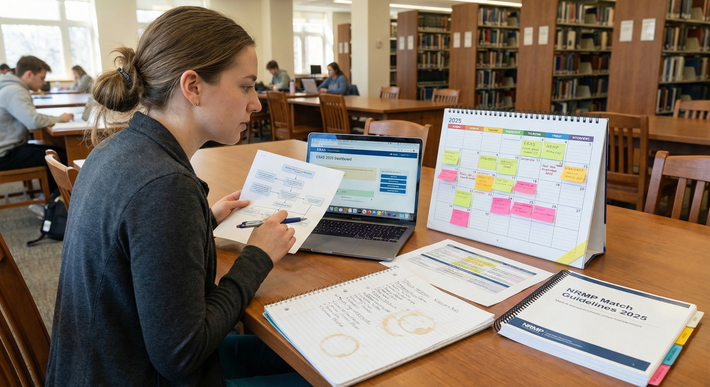
Every application season, medical students waste dozens of hours agonizing over whether "baking sourdough" sounds more human than "fly fishing."
The residency prep industry has created a lucrative narrative: your hobbies are your secret weapon. MedEd influencers promise that a quirky interest in artisanal coffee roasting will magically make a program director overlook a mediocre clinical grade or a bland letter of recommendation. It is a comforting myth. It sells coaching packages.
It is also complete nonsense.
When you look at actual selection committee behavior, the "Hobby Cult" falls apart. Hobbies are not a secret back-door strategy to bypass low scores. They are not a paint job designed to mask structural defects in your candidacy. At best, they are a fine polish applied to an already solid deck. At worst, when written with desperate hyperbole or generic filler, they expose an applicant lacking self-awareness.
Let's look at what the data actually shows about how Program Directors (PDs) evaluate the ERAS hobbies section, and how you should actually use this space.
This article is for educational purposes only. It is not financial advice, not legal advice, and not tax advice. Figures vary by individual circumstances, consult a qualified professional before acting.
The Myth: Hobbies Are Your 'Secret Weapon'
Many applicants believe a unique hobby will "wow" a program director into offering an interview invitation. I have watched candidates spend weeks perfecting a paragraph about their passion for road cycling while treating their sub-internship performance like an afterthought.
That is an absolute failure of strategy.
The National Resident Matching Program (NRMP) conducts a comprehensive survey of Program Directors every two years. They ask directors to rank the importance of dozens of application factors on a 1-5 scale. Year after year, the results are identical.
In the 2022 NRMP Program Director Survey, "Hobbies/Interests" ranked near the absolute bottom of selection criteria for extending interview invitations, landing at #19 out of 20 factors evaluated. It scored a meager 2.1 out of 5 in overall importance.
Compare that to the metrics PDs actually care about: clinical clerkship grades, Step 2 CK scores, specialty-specific letters of recommendation, and MSPE comments. Those consistently score between 4.0 and 4.8.
The reality is stark: no program director in the country opens an application, ignores a 215 Step 2 score or a failed rotation, and says, "Yeah, but look here, they play the ukulele. Get them on the phone."
If you are relying on a hobby to save your application, you have already lost. Hobbies do not get you through the initial screening filter. They do not earn you interview invites at competitive academic centers. They exist in a completely different tier of evaluation.
When Hobbies Actually Help: The Data on 'Tiebreakers'
So, do hobbies matter at all? Yes. But only under specific, conditional circumstances.
PDs use hobbies as a tiebreaker. When a committee is staring at two applicants with nearly identical metrics, same Step scores, similar clerkship evaluations, equally strong letters, the discussion shifts. Now, they want to know who will fit better into the call room at 2:00 AM. Who is a functioning human being outside the clinic?
A 2021 study published in the Journal of Graduate Medical Education analyzed candidate attributes that influenced interview invitations and post-interview rankings. The researchers found that candidates who documented "unique, long-term, and leadership-related hobbies" saw a statistically significant boost in post-interview ranking compared to candidates with generic interest entries.
Notice the descriptors: unique, long-term, and leadership-related.
Not "hiking." Not "watching Netflix." Not "spending time with friends."
A well-documented hobby signals three specific traits to an experienced committee:
- Grit and Discipline: Mastering an instrument, training for enduros, or maintaining a long-term artistic craft proves you can stick with something demanding over years, not weeks.
- Stress Management: Medical training is brutal. PDs want proof that you have functional, healthy coping mechanisms to avoid burnout.
- Conversational Value: Interventions during residency interviews often stall. A genuine, interesting hobby gives an interviewer an easy, non-stressful topic to break the ice and assess your interpersonal communication.
If your hobby entry does not accomplish at least one of these three things, it is taking up valuable white space for nothing.
The Art of Writing Hobbies: Evidence-Based Strategies
Writing generic hobbies is worse than useless; it projects a lack of effort. I have read hundreds of ERAS applications that list the classic holy trinity of generic filler: "Reading, traveling, trying new restaurants."
That entry tells me nothing. Everyone likes food. Most people enjoy traveling. Reading is standard literacy. You have wasted a character count to inform the selection committee that you are a standard human baseline.
If you are going to include hobbies, execute them with precision.
1. Ditch the Noun Lists; Use Narrative Context
Specific details convert a boring claim into verifiable reality. Provide metrics, achievements, or concrete context.
Bad: "Running and fitness."
Good: "Competitive marathon runner (3:45 PR). Completed three city marathons while managing third-year clinical rotations."
Bad: "Baking."
Good: "Sourdough baker. Cultivated and maintained a wild yeast starter for four years; bake weekly loaves for my clinical team."
Bad: "Music."
Good: "Classical pianist. Taught weekly lessons to low-income middle school students throughout medical school."
2. Focus on Transferable Qualities
Selection committees look for signals of leadership, altruism, intellectual curiosity, or team mechanics.
If you code open-source software in your spare time, that signals technical self-reliance. If you coach youth soccer, that signals communication and leadership. If you build furniture, that signals manual dexterity and spatial patience, a massive plus for surgical specialties.
3. Avoid Red Flags and Insincerity
I have seen candidates fabricate interests to sound intellectual. It always backfires.
If you write that you love reading 19th-century Russian literature, you had better be prepared to discuss The Brothers Karamazov in detail when an interviewer who majored in Slavic studies spots it on your file. I watched an applicant crash and burn because he claimed an interest in jazz drumming but could not name a single Miles Davis album when asked by an interviewer who played bass.
Beyond fabrication, avoid hobbies that raise operational red flags. Extreme, high-risk sports (e.g., solo free-solo climbing, backcountry wingsuiting) can subtly raise concerns about judgment or physical unavailability due to injury. Hobbies that sound like full-time jobs (e.g., "Founder and active CEO of an active e-commerce brand") will make PDs wonder if your residency commitment will play second fiddle to your side hustle.
The Bottom Line: Hobbies Are Polish, Not Paint
Let's cut through the noise. Your ERAS hobbies section will not fix a weak application. It will not rescue poor board scores, repair a toxic letter of recommendation, or cover up a failed clerkship.
Residence selection remains an overwhelmingly objective, performance-driven metric system. Focus your energy where the high yield actually lives:
- Maximizing your Step 2 CK score.
- Securing honors in core specialty rotations.
- Obtaining punchy, glowing letters of recommendation from recognized academic faculty.
- Producing meaningful, specialty-relevant research.
Hobbies come fifth. They are a final flourish.
If you have authentic, long-term interests that demonstrate resilience, creativity, or team leadership, describe them with concrete detail and concise framing. Give the interviewer a reason to smile and a comfortable topic for conversation.
If you don't? Keep it brief, keep it honest, and let your actual medical accomplishments do the heavy lifting.
Key Takeaways
- Hobbies are secondary metrics: NRMP data ranks hobbies near the very bottom (#19 out of 20) of program director selection criteria for interview invites.
- They serve as tiebreakers: A compelling hobby entry only matters when choosing between candidates with otherwise identical academic and clinical metrics.
- Specificity is mandatory: Replace generic lists ("reading, traveling") with concrete details, achievements, and timeframes.
- Authenticity beats exaggeration: Never fabricate an interest. Interviewers routinely test applicant hobbies during conversations, and insincerity is an instant red flag.