
The way most applicants list hobbies on a residency CV is lazy and wasteful.
You can do much better. And you should—because programs are using your “Hobbies and Interests” section as a tiebreaker, a risk filter, and a conversation starter. If yours is just a random list of activities, you are leaving value on the table.
This is a playbook for turning hobbies into strategic CV assets that actually help you match.
Step 1: Understand What Program Directors Actually Want From Hobbies
Program directors are not reading your hobbies for fun. They are screening for specific things:
Evidence you are a functional human being
- Do you have a life outside medicine?
- Can you manage stress without imploding?
Signals of desirable traits
- Grit, consistency, teamwork, leadership, creativity.
- Commitment vs. “I did this twice and put it on my CV.”
Conversation hooks
- Something they can ask you about to see you relax and talk like yourself.
- Shared interests (running, classical piano, Brazilian jiu-jitsu, baking, etc.).
-
- Extreme risk hobbies with no reflection on safety or judgment.
- Activities that suggest poor professionalism, time management, or boundaries.
So your job is to translate hobbies into:
- Traits
- Skills
- Outcomes
- Stories
Not just to “fill space” at the bottom of the CV.
Step 2: Audit Your Current Hobbies Ruthlessly
Grab your current CV (or a blank sheet if you never wrote this section). Make a quick list of everything you actually do with some consistency.
Then add structure:
- For each hobby, write:
- How long you have done it
- How often (per week/month)
- Any objective benchmarks (races, performances, certifications, competitions, contributions, leadership roles)
Examples:
- “Running” → “Half marathons, 3x/week running, 5 years, 3 organized races”
- “Photography” → “Portrait photography, 6 years, small paid shoots, Instagram portfolio, basic Lightroom editing”
- “Chess” → “Local club, weekly matches, chess.com rapid rating ~1650”
Now we do a quick triage.
Put each hobby into one of three piles:
Keep and Highlight
- Long-term, consistent (≥1–2 years).
- Clear depth or progression.
- Obvious transferable traits (discipline, teamwork, leadership).
Keep but Reframe
- Genuine but casual hobbies.
- Can be framed as balance, creativity, curiosity.
Drop
- You barely do it.
- You cannot answer follow-up questions.
- It will sound fake or inflated.
- It is too controversial or high-risk without clear contextualization (example: extreme political activism, base-jumping without any safety framing).
Be harsh. If you would be nervous getting grilled about it during an interview, it does not belong on your CV.
Step 3: Map Each Hobby to Residency-Relevant Traits
Here is the core move: stop thinking “what do I like?” and start thinking “what does this show about me as a resident?”
Use a simple mapping tool. For each hobby, ask:
- What does this show about:
- My discipline and consistency?
- My teamwork and collaboration?
- My leadership or initiative?
- My ability to handle stress and protect my mental health?
- My communication and teaching?
- My cultural humility and openness?
| Hobby/Interest | Residency-Relevant Trait |
|---|---|
| Long-distance running | Grit, consistency, stress control |
| Team sports (soccer, etc.) | Teamwork, communication, resilience |
| Choir/orchestra | Collaboration, long-term commitment |
| Baking/cooking | Precision, planning, sharing |
| Language learning | Curiosity, cultural awareness |
| Coding/app building | Problem-solving, initiative |
Concrete examples:
Distance running
- Traits: discipline, goal-setting, resilience, stress management.
- Interview framing: “I like events that require long preparation and structured training plans, similar to boards studying or tackling complex rotations.”
Playing violin in a community orchestra
- Traits: teamwork, long-term practice, ability to handle performance pressure.
- Interview framing: “I have to show up prepared because other people depend on me, which parallels my approach to call and team responsibilities.”
Leading a campus board game club
- Traits: leadership, organization, social skills, teaching rules/strategies.
- Interview framing: “I learned to create inclusive spaces for different personalities, which carries over to working with diverse teams on the wards.”
If a hobby cannot be tied to at least one or two of these categories, it is probably not worth precious CV real estate.
Step 4: Convert Hobbies Into Strong, Specific CV Entries
Random list: “Hobbies: reading, travel, fitness, cooking.”
Strong, targeted list:
- “Distance running – Completed 3 half marathons; run 3–4 times per week as primary outlet for stress and goal-setting.”
- “Home cooking and recipe development – Focus on Mediterranean and Korean dishes; host monthly dinners for friends and colleagues.”
- “Science fiction and narrative non-fiction – 20+ books per year; interested in stories about technology and ethics in medicine.”
The fix is simple: move from labels to mini-narratives.
Use this three-part structure for each hobby bullet:
- Type of activity
- Scope or depth
- Angle that links to residency-relevant trait or outcome
Examples:
- “Classical piano – 12 years; play weekly and perform occasionally at small community events, which keeps me disciplined and grounded outside clinical work.”
- “Recreational soccer – Weekly co-ed league; value the teamwork and communication required to play well with rotating lineups.”
- “Photography – Portrait and street photography for 5 years; maintain a small online portfolio and have completed several paid shoots.”
Notice:
- No exaggeration.
- No fluff verbs like “passionate.”
- Concrete details that any interviewer could ask about.
Step 5: Align Hobbies With Specialty and Program Culture—Without Being Fake
You do not need to have “neurosurgery hobbies” to match neurosurgery. But you should be aware of how your interests sound to a given specialty and program.
Ask:
- Does this hobby underline a trait that is especially valued in my specialty?
- Does it resonate with this program’s culture (e.g., wellness-focused, research-heavy, community-oriented)?
A few patterns I have seen:
Surgical specialties
- Like: endurance sports, activities demanding fine motor skills (instruments, drawing, crafts), high-pressure performance (music, competitive sports).
- Example framing: “Distance running has taught me how to be comfortable with long, mentally challenging efforts—similar to long OR days.”
Psychiatry
- Like: creative pursuits, narrative writing, interest in people and stories, meditation/yoga, language learning, volunteer counseling.
- Example framing: “Writing short fiction helps me think deeply about people’s inner experiences and motivations.”
Internal medicine / pediatrics
- Like: Teaching-related hobbies, organized service, anything suggesting patience and communication.
- Example framing: “I mentor high school students in math and science, and I enjoy taking complex topics and breaking them down clearly.”
Emergency medicine
- Like: Team sports, fast-paced hobbies, prehospital volunteering, anything that suggests comfort with chaos but with judgment.
- Caveat: If you list high-risk hobbies (rock climbing, racing), be ready to emphasize safety and risk assessment.
You do not invent hobbies to fit the specialty. You select and frame real interests to highlight what that specialty values.
Step 6: Build a Coherent “Personal Brand” From Your Interests
You do not want 10 totally unrelated, shallow hobbies. You want a small cluster of interests that together tell a coherent story about you as a person.
Target: 3–6 well-developed hobbies/interests on your CV.
Ask yourself:
- What are the 2–3 themes that emerge from my interests?
- Endurance & discipline?
- Creativity & communication?
- Community & mentorship?
- Curiosity & building things?
Tie them together in your mind. That way, when you get the classic interview question, “What do you do for fun?” you can give an answer that feels organized rather than random.
Example cluster:
- Distance running
- Cooking for friends
- Teaching assistant for physiology
Underlying theme: discipline + community + teaching. Easy to talk about as a coherent “this is who I am.”
Another cluster:
- Photography
- Graphic design for student groups
- Writing reflective essays
Theme: visual storytelling + reflection. Great for psychiatry, peds, primary care, even radiology (pattern recognition, visual detail, etc.) if framed right.
Step 7: Prepare Bulletproof Interview Stories Around Your Hobbies
Listing strong hobbies is only step one. Step two is not freezing when someone asks, “Tell me more about that.”
You want:
- 2–4 short, vivid stories that show growth, challenge, or insight from your hobbies.
- Each story should connect (even loosely) to a residency-relevant skill or mindset.
Use a simplified STAR structure:
- Situation – Context in one sentence.
- Task – What you were trying to do.
- Action – What you actually did.
- Result/Reflection – What changed and what you took from it.
Example (distance running):
- Situation: “In my second year, I signed up for a half marathon during a heavy exam block.”
- Task: “I was determined to train consistently without letting it hurt my grades.”
- Action: “I built a 12-week plan, blocked early morning runs, and learned to adjust training intensity when exams were close.”
- Result/Reflection: “I finished the race and learned how much structure helps me manage competing demands—exactly how I now organize board study around busy rotations.”
Notice how that story effortlessly answers:
- “How do you handle stress?”
- “How do you balance personal life and work?”
- “Tell me about a time you set a long-term goal.”
Build similar stories for 2–3 key hobbies. Practice them out loud. Not memorized, but familiar.
Step 8: Avoid Common Landmines That Make You Look Worse, Not Better
I have seen hobbies sink interviews. Not because the hobby was bad, but because the applicant handled it badly.
Avoid these:
Over-inflation
- Claiming “competitive” or “advanced” status you do not have.
- Saying “fluent” in a language when your fluency is Duolingo-level.
Test: If the interviewer is an actual expert in that hobby, can you hold a reasonable conversation? If not, lower the claim.
Copy-paste generic lists
- “Travel, reading, music.”
- This reads as “I did not try” or “I have no inner life.”
Fix: Be specific. “Backpacking in national parks,” “historical biographies,” “live jazz,” etc.
Potentially polarizing content
- Heavy political activism, controversial causes, religious proselytizing as a “hobby.”
You can include them if they are central to your identity, but be very deliberate and ready to discuss with tact. If you cannot do that, leave them off.
High-risk activities with no risk framing
- Free solo climbing, street racing, high-altitude mountaineering.
You can keep them, but add a line that highlights planning, training, and risk assessment. Programs do not want to lose residents to reckless accidents.
Too many passive consumption hobbies
- If every hobby is “watching Netflix, browsing Reddit, scrolling Twitter,” it suggests low initiative.
You can mention film or specific shows if you engage thoughtfully (e.g., “classic cinema, film analysis podcasts”), but balance with at least a few active pursuits.
Step 9: Format the Hobbies Section Strategically on Your CV
Structurally, you have options. But keep it clean.
Placement
For residency CVs, usually:
- Near the bottom, after education, work, research, and leadership.
- Labeled clearly: “Interests and Hobbies” or “Personal Interests”.
Formatting
Use:
- 3–6 bullet points
- Each bullet: 1–2 sentences max
- Mix of active, social, and reflective interests if that matches you
Example layout:
Personal Interests
- Distance running – Completed three half marathons; run 3–4 times per week as a way to maintain discipline and manage stress.
- Community cooking – Prepare Mediterranean-inspired meals and host monthly dinners for classmates; enjoy bringing people together around food.
- Science fiction and medical ethics – Read ~20 books per year focusing on technology, AI, and ethics in medicine; discuss in a small reading group.
- Acoustic guitar – Play fingerstyle guitar and occasionally perform at small student events.
Notice: each line offers:
- A clear picture of what you do
- A hook for conversation
- A subtle trait (discipline, community, curiosity, comfort performing)
Step 10: Track and Update Your Hobbies Like Any Other CV Section
Most people treat hobbies as static. They should not be.
Keep a simple log during M3/M4:
- New races, events, performances
- New roles (organizing a league, leading a group, teaching beginners)
- Any measurable progression (certifications, ratings, consistent practice streaks)
That lets you:
- Update your CV annually with real progression.
- Add a brief line in your personal statement or interview: “Over the past year, I took my photography more seriously and started doing occasional portrait sessions.”
If you want to be systematic, use a simple tracker:
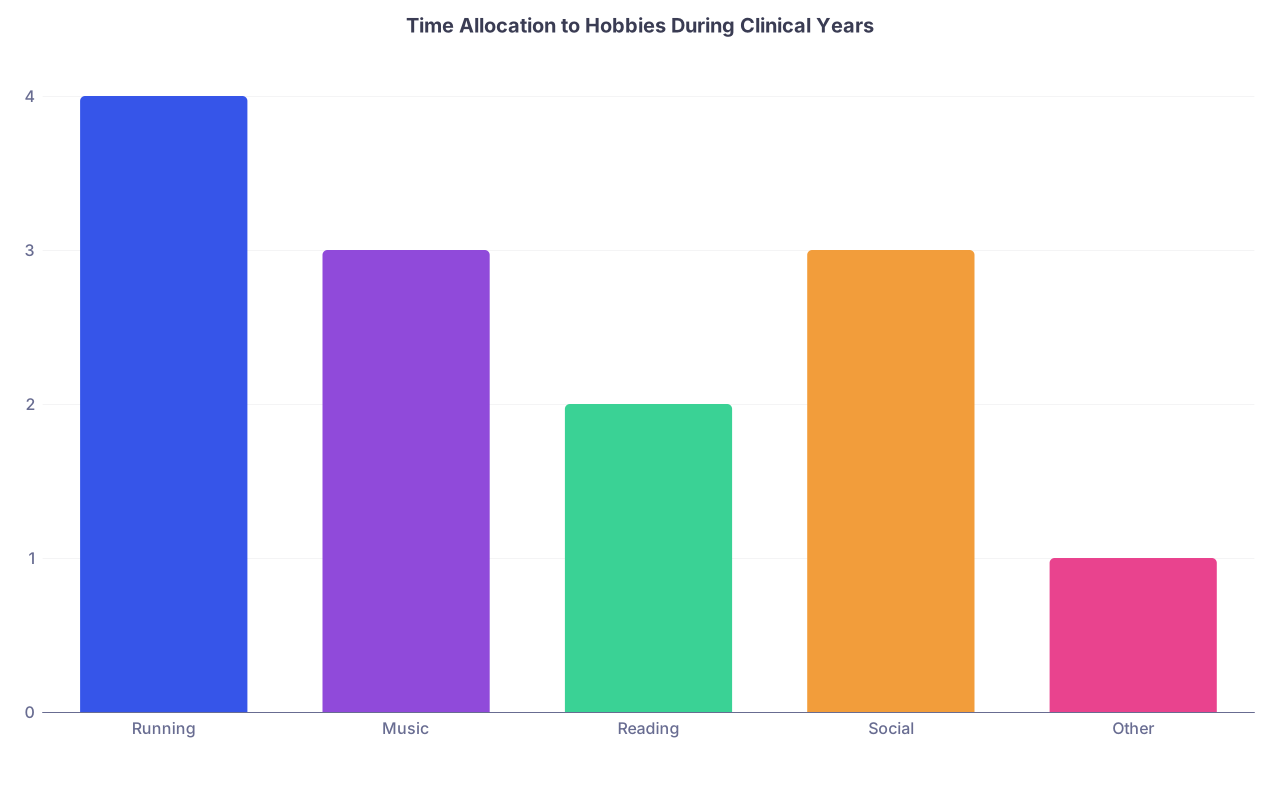
| Category | Value |
|---|---|
| Running | 4 |
| Music | 3 |
| Reading | 2 |
| Social | 3 |
| Other | 1 |
This kind of awareness helps you:
- Avoid burnout.
- Answer questions like “How do you maintain balance?” with real numbers rather than hand-waving.
Example Transformations: Bad vs Strong Hobby Sections
Let us fix a few common patterns.
Example 1: Generic and Vague
Before:
- Hobbies: reading, music, travel.
After:
- Contemporary fiction and biographies – Aim to read 2–3 books per month; particularly interested in stories about resilience and leadership.
- Piano – Played since childhood; practice weekly and occasionally play at small gatherings with friends.
- Budget travel – Plan and organize trips with friends focusing on local food and history; enjoy navigating new environments and cultures.
Now you sound like an actual person rather than a residency algorithm.
Example 2: Overinflated and Risky
Before:
- Extreme sports (cliff diving, base jumping)
- Fluent in Spanish
- Competitive gaming
Reality: you went cliff diving twice on vacation, completed 3 years of high school Spanish, and play online games with friends.
After (honest and better):
- Recreational outdoor activities – Enjoy hiking and occasional supervised cliff jumping during group trips, with an emphasis on safety and preparation.
- Spanish language learning – Can hold basic conversations; continuing to improve using language exchange apps and podcasts.
- Cooperative online gaming – Play strategy-based games weekly with a regular group of friends; value the teamwork and communication required.
You removed the bravado, kept the core, and stopped flagging yourself as someone with poor judgment.
Example 3: Specialty-Aligned Framing
Applicant to psychiatry:
Before:
- Journaling, yoga, podcasts.
After:
- Reflective journaling – Daily 10–15 minute practice for the last 3 years; helps me process experiences and understand my own reactions.
- Yoga and mindfulness – Attend classes 2–3 times per week; use structured breathing and meditation to manage stress and maintain focus.
- Psychology and mental health podcasts – Regularly listen to clinician-hosted shows exploring patient stories, therapeutic approaches, and system-level issues.
Same activities. Different, much stronger position for psychiatry.
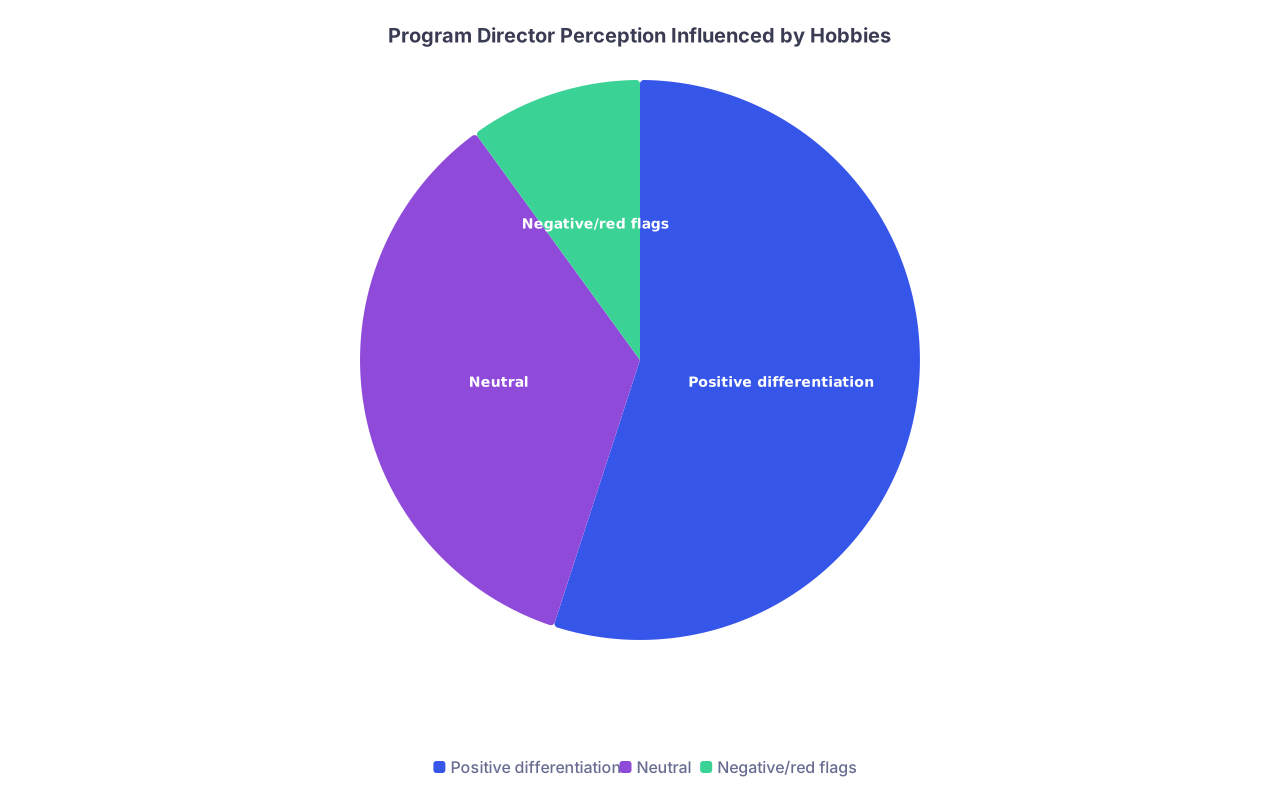
Visual: How Hobbies Affect Program Perception
| Category | Value |
|---|---|
| Positive differentiation | 55 |
| Neutral | 35 |
| Negative/red flags | 10 |
In my experience and from survey data, about half of the time, hobbies help you stand out positively. About a third of the time, they change nothing. Around 10 percent of the time, they hurt you—usually due to poor framing or obvious exaggeration. Your job is to live in that first category.
Turn This Into a 60-Minute Fix-It Session
If you want a concrete protocol, here is exactly what to do in one hour.

| Step | Description |
|---|---|
| Step 1 | Start 60 min timer |
| Step 2 | Brain dump all hobbies |
| Step 3 | Classify keep reframe drop |
| Step 4 | Map each kept hobby to traits |
| Step 5 | Write 3 to 6 strong bullets |
| Step 6 | Check for honesty and depth |
| Step 7 | Create 2 to 3 interview stories |
| Step 8 | Update CV and ERAS |
10 minutes – Brain dump
- List every activity you actually do or did in the last 3–5 years.
10 minutes – Triage
- Mark K (keep), R (reframe), or D (drop).
15 minutes – Trait mapping
- For each K/R, write 2–3 traits it demonstrates.
15 minutes – Bullet writing
- Turn the best 3–6 into 1–2 sentence bullets with:
- Type
- Scope
- Trait/context
- Turn the best 3–6 into 1–2 sentence bullets with:
10 minutes – Story prep
- Jot quick STAR outlines for 2–3 hobbies.
- Practice saying each story out loud once.
You will walk out with:
- A significantly better hobbies section.
- Ready-made interview answers.
- A cleaner, more coherent personal brand.
Quick Comparison: Weak vs Strong CV Hobbies
| Type | Weak Entry | Strong Entry Example |
|---|---|---|
| Generic | Reading | Contemporary fiction and non-fiction, 20+ books/year on resilience and medicine |
| Vague sport | Sports | Recreational soccer – weekly co-ed league; value teamwork and communication |
| Passive | Watching movies | Classic cinema – explore film history and analysis through curated lists and podcasts |
| Inflated | Fluent in French | Intermediate French – able to hold conversations; continuing to study weekly |
| Risky | Extreme sports | Supervised outdoor activities – enjoy hiking and occasional guided climbing, with focus on safety |
FAQs
1. Should I list hobbies that are very common (like reading or running), or will that make me look boring?
Yes, you should list them if they are genuinely important to you and you can show depth. Common hobbies are not a problem; shallow descriptions are. “Reading” is bland. “Contemporary fiction and biographies, 2–3 books/month, currently focused on narratives about resilience in healthcare” is specific and interviewable. Programs are not trying to be impressed by uniqueness; they want to know who you are and how you maintain balance.
2. What if I genuinely do not have time for hobbies during medical school? Should I fake something?
Do not fake. Instead, expand your definition of “hobby” to include what you actually do for restoration or interest—even if it is modest. That might be short daily walks, simple home workouts, cooking on weekends, a small online community, or a podcast you follow regularly. The key is honest, consistent engagement and a clear reason why it matters to you. If your life has been 100 percent medicine with nothing else, that itself is a signal of poor sustainability.
3. Can I use the same hobbies and interests section for all specialties and programs?
You can keep the core the same, but you should be willing to lightly tailor emphasis. For ERAS, your CV is mostly fixed, but in interviews and personal statements you can highlight certain hobbies more than others depending on the specialty culture. For example, for psychiatry you might lean into reflective and narrative hobbies; for surgical fields you might talk more about endurance or fine-motor activities. You do not change who you are. You selectively foreground what best aligns with that program’s values.
Key takeaways:
- Treat hobbies as strategic evidence of your traits, not filler.
- Be specific, honest, and prepared with a few real stories.
- Aim for a coherent cluster of 3–6 interests that match who you are and how you will function as a resident.