
The average ERAS CV is a bland, bloated list. That is a problem. Programs do not rank lists. They rank people who get things done.
You fix that by turning your CV from generic to surgical. Every line doing a job. Nothing extra. Nothing vague.
Here is exactly how to do that.
Step 0 – Understand What Your ERAS CV Actually Has To Do
You are not “documenting your history.” You are running a filtered sales pitch through a very rigid template.
Your CV has 3 jobs:
Pass the 20‑second skim test.
PDs and faculty scan:- Education
- Exams
- Major roles
- First 1–2 bullets under each recent activity
If nothing stands out, you are forgettable before they even read your personal statement.
Make you easy to advocate for in a committee room.
Someone will say one of these:- “She rebuilt our school’s free clinic operations.”
- “He has 4 first‑author pubs in cardiology, including one RCT.”
- “She led the resident wellness curriculum and actually measured outcomes.”
Your CV must hand them those lines in plain English.
Align you with your target specialty.
Your experiences need to quietly say:- “This person already lives in our world.”
- “They understand the patients, the workflow, the team.”
- “Low risk. High yield.”
If your current ERAS CV reads like a random pile of activities, you have a structure problem, not a competence problem.
We will fix that step by step.
Step 1 – Baseline Audit: Strip It Down Before You Build It Up
Print your current CV or open it side by side.
You are going to do a ruthless pass.
1.1 Use the 3‑Color Highlighter Test
Grab 3 colors (or use comments):
- Green – Strong, specific, clearly impactful entries
- Yellow – Potentially decent, but vague or undersold
- Red – Generic, fluff, or irrelevant
Mark every activity description. Be brutally honest.
Examples:
- “Volunteered in free clinic” → Red
- “Medical student, internal medicine rotation” → Red (that belongs in education, not activities)
- “Led a team of 6 to redesign clinic intake, reducing average wait time by 18 minutes” → Green
- “Co‑authored abstract on heart failure readmissions; presented at regional conference” → Green
- “Shadowed orthopedic surgeon” → Red for almost everyone except maybe first‑ or second‑year med student with no other clinical; even then, likely yellow.
Rule: You are allowed very few reds. Anything red must either:
- Be deleted
- Or turned into a credible yellow/green with better description and framing
Step 2 – Build a Specialty‑Specific Target Profile
Before you revise a single line, you need to know what “specific” should look like for your exact specialty.
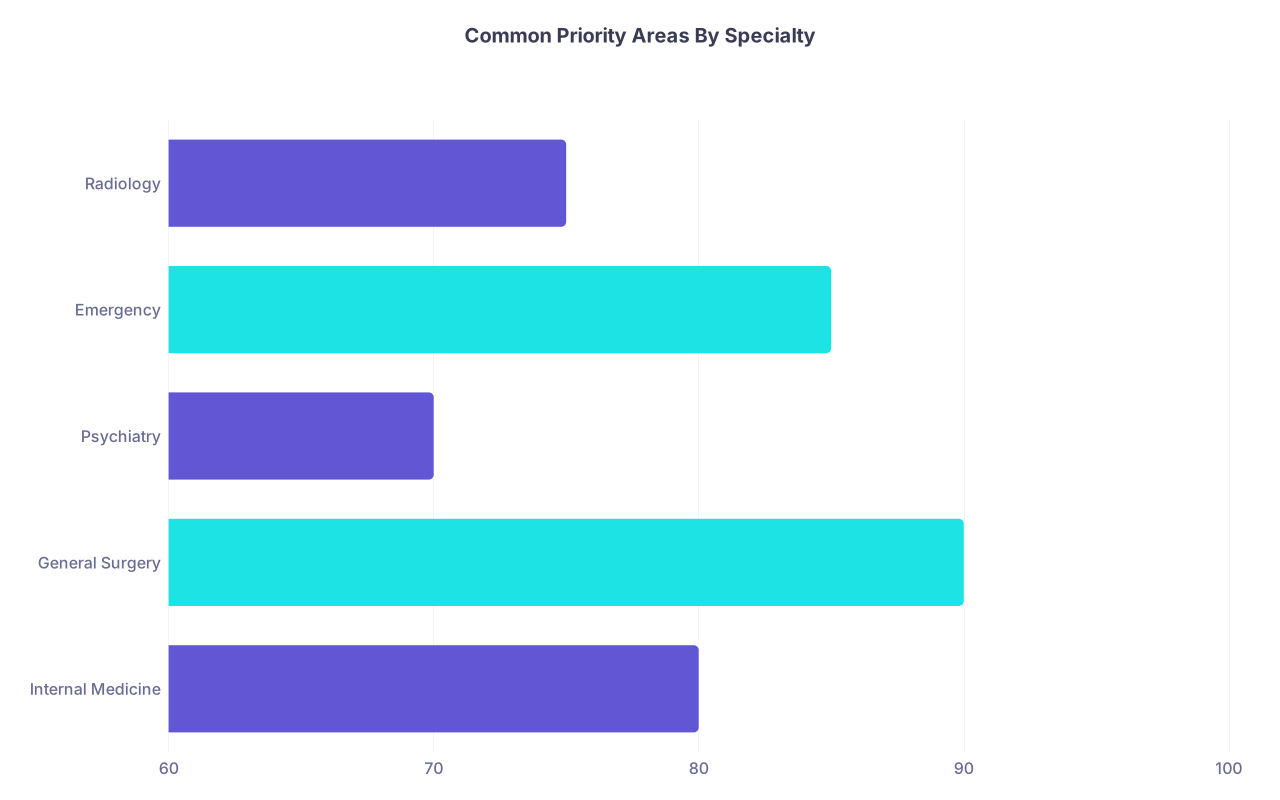
| Category | Value |
|---|---|
| Internal Medicine | 80 |
| General Surgery | 90 |
| Psychiatry | 70 |
| Emergency | 85 |
| Radiology | 75 |
(Think of the numbers loosely as “emphasis on demonstrable responsibility/ownership,” but the key is the priority focus.)
2.1 Identify 3–4 Priority Themes For Your Specialty
Examples:
Internal Medicine
- Longitudinal patient care
- Complex decision‑making / multi‑morbid patients
- Teaching / mentorship
- Clinical research / QI
General Surgery
- Ownership of tasks and follow‑through
- Procedural comfort and OR exposure
- Team leadership under pressure
- Systems improvement (OR efficiency, call coverage, pre‑op / post‑op pathways)
Psychiatry
- Communication and rapport building
- Longitudinal relationships
- Vulnerable populations, mental health advocacy
- Research in psych, neuro, or related fields
Now take a sheet of paper and write:
“If I were a PD in [specialty], I would want to see…”
List 6–8 things. Concrete. For example, for EM:
- Comfort in high‑acuity settings
- Fast‑paced team experience
- Evidence of shift work resilience
- Procedures exposure / interest
- Systems thinking (triage, throughput, handoffs)
This is your target profile. You will revise your CV toward this.
Step 3 – Rewrite Every Bullet Using a 3‑Part Formula
ERAS fields are ugly. You cannot fix the platform, but you can make your content sharp.
Stop writing “duties.” Start writing outcomes.
Use this formula for each bullet:
Action verb + scope + specific outcome or metric (or what changed)
You will not hit all three every time, but that is the standard.
3.1 Examples: Generic vs Specific

Clinical volunteering
- Generic: “Volunteered at student‑run free clinic.”
- Specific: “Coordinated intake and follow‑up for ~20 uninsured patients per month at student‑run free clinic, ensuring lab results and referrals were completed within 2 weeks.”
Research
- Generic: “Assisted with cardiology research project.”
- Specific: “Abstracted clinical data from 320 heart failure admissions, contributed to multivariable analysis of readmission predictors; co‑authored abstract accepted to ACC regional meeting.”
Leadership
- Generic: “President of Internal Medicine Interest Group.”
- Specific: “Led Internal Medicine Interest Group of 45 members; organized 6 faculty panels and 3 skills workshops, increasing average event attendance by 60% over prior year.”
3.2 Where To Find Outcomes If You “Do Not Have Numbers”
You almost always do. You just never tracked them.
Think about:
- Volume: “X patients per shift,” “Y students per session”
- Frequency: “Weekly/Monthly over 2 years”
- Change: “cut delays,” “increased attendance,” “reduced errors,” “improved response times”
- Reach: “clinic of 1,500 patients,” “class of 160 students,” “hospital with 800 beds”
If you truly cannot measure, describe concrete responsibilities:
- “Primary student responsible for daily progress notes and order proposals on a 6–8 patient panel during MICU rotation.”
Not perfect, but miles better than “completed MICU rotation.”
Step 4 – Choose and Polish Your Anchor Experiences
You probably have 3–5 experiences that actually matter. Those become your anchors.
Everything else is supporting evidence.
4.1 Identify Anchor Categories
Most strong ERAS CVs have at least one anchor in 2–3 of these:
- Major longitudinal clinical role
- Substantial leadership / curriculum / program role
- Research with clear outputs (pubs, presentations)
- Serious community or advocacy work
- Teaching / mentoring with structure
Pick your anchors. If you are still not sure, ask:
“If my interview time was cut to 15 minutes, which 3 experiences would I absolutely want to be asked about?”
Those are your anchors.
4.2 Expand Anchor Entries Strategically
For anchors, you want:
- 2–4 high‑quality bullets
- Progressive responsibility across time
- Metrics or clearly visible impact
Example – Anchor for Internal Medicine applicant:
“Student Director, Student‑Run Free Clinic – 2021–2023”
- Led clinic operations for weekly primary care sessions serving ~35 uninsured patients per evening.
- Implemented redesigned follow‑up tracking protocol, reducing missed lab reviews from ~25% to <5% over 6 months.
- Recruited and scheduled 50+ student volunteers and 12 attending physicians per quarter; developed orientation curriculum emphasizing chronic disease management and motivational interviewing.
- Collaborated with hospital IT to build an EHR‑based reminder system, improving documentation of blood pressure control metrics.
This tells a PD in 20 seconds: patient volume, ownership, systems thinking, and outcomes. That is anchor material.
Step 5 – Apply a “Relevance Filter” For Your Specialty
Now you start deleting or compressing.
5.1 Use the 10‑Second Relevance Question
For each entry, ask:
“If I were a PD in [specialty], would this entry genuinely increase my confidence this person will thrive here?”
If the answer is:
- Strong yes → Keep and strengthen
- Weak maybe → Compress (fewer bullets, less real estate)
- No → Delete or move to “Hobbies/Interests” if it is a cool personal hook
Example:
Applying to Psychiatry:
- “Undergraduate varsity soccer captain” → Maybe 1 short bullet in “Extracurriculars” (teamwork, leadership)
- “Peer mental health counselor during college” → Strong yes, expand and keep high on the CV
Applying to Radiology:
- “Organized campus‑wide art show with 200+ attendees” → 1 bullet max, mainly as a human color note
- “3‑year imaging research with 2 first‑author pubs” → Anchor
Step 6 – Standardize Format So Your Strengths Pop Instantly
Sloppy formatting makes you look less careful. PDs notice.
| Aspect | Weak CV Style | Strong CV Style |
|---|---|---|
| Bullet length | 1–2 long, rambling sentences | 1 concise, focused line each |
| Verbs | Helped, assisted, worked | Led, implemented, analyzed, built |
| Metrics | Rare or absent | Present in most anchor bullets |
| Order | Chronological only | Recent + specialty‑relevant first |
| Jargon | Heavy, undefined | Minimal, clearly understandable |
6.1 Enforce a Simple Bullet Style
- Start with strong verbs: led, implemented, designed, analyzed, coordinated, created, managed, taught, developed.
- Avoid weak openers: helped, participated, involved in, responsible for.
- One line if possible; 2 lines max on ERAS. Past tense unless ongoing.
Example cleanup:
- Weak: “Helped with teaching junior medical students in physical exam.”
- Strong: “Taught weekly bedside physical exam sessions for 6 second‑year students; created case‑based handouts used by 3 faculty preceptors.”
6.2 Order Within Sections: Relevance > Chronology (When Allowed)
ERAS locks some ordering, but when you can:
- Put most relevant experiences near the top of each section.
- Keep older but important anchors above recent fluff.
Step 7 – Tailor Research, Leadership, and Volunteering By Specialty
You do not have to change your life path. You do have to change your framing.
7.1 Research Reframing
For each project, make these explicit:
- Population / disease focus
- Your role (idea, data, stats, writing)
- Output (poster, publication, talk, QI implementation)
Example – Same project, different emphasis:
Applying to Cardiology‑heavy IM:
“Analyzed 280 STEMI cases to identify delays in door‑to‑balloon times; findings presented at regional cardiology conference and informed ED triage protocol changes.”Applying to EM:
“Reviewed STEMI activations in ED to identify triage and transfer delays; collaborated with EM faculty to propose revised activation criteria and transport pathways.”
Same work. Different angle.
7.2 Leadership Reframing
Translate titles to responsibilities. PDs do not care that you were “co‑chair” of something trivial.
- Instead of: “Co‑chair, Wellness Committee”
- Try: “Co‑led resident wellness committee; piloted schedule‑flex initiative that reduced last‑minute shift swaps by ~30% over 4 months.”
Tie leadership to something that smells like residency: schedules, coverage, conflict resolution, teaching.
7.3 Volunteering and Community Work
Do not bury your best human evidence in generic language.
Examples:
- Weak: “Volunteered at homeless shelter weekly.”
- Strong (Psych): “Led weekly reflective listening groups at urban shelter for 8–12 residents; collaborated with social workers to connect participants to mental health clinics.”
- Strong (IM): “Provided blood pressure checks and chronic disease education at weekly shelter clinic; coordinated follow‑up with local FQHC for ~15 new patients per month.”
Step 8 – Fix The “Hobbies and Interests” Section So It Works For You
Most people either treat this as a joke or overshare. Both are errors.
You want 3–5 concrete, specific items that can spark conversation and show some depth.
Bad list:
- Traveling, reading, running, music
Better:
- Trail ultramarathons up to 50k; currently training for my first 50‑mile race
- Home coffee roasting and espresso; built a small tasting group among classmates
- Historical fiction focused on World War II resistance movements
Notice:
- Specific
- Measurable (distance, focus area)
- Easy for interviewers to ask about
Your hobbies will not get you ranked #1. But they can prevent you from blending into the wall.
Step 9 – Run the 3‑Level Review: Peer, Senior, and Specialty
You are not done until you have outside eyes.

| Step | Description |
|---|---|
| Step 1 | Draft Revised CV |
| Step 2 | Peer Review |
| Step 3 | Senior Resident or Fellow Review |
| Step 4 | Faculty or Program Specific Review |
| Step 5 | Final Edits and Proofread |
9.1 Peer Review (Med Student / Co‑Resident)
Ask one direct question:
“After reading this for 5 minutes, what 3 things would you remember about me?”
If they cannot answer, your anchors are not clear enough.
9.2 Senior or Recent Graduate Review
Preferably in your specialty. Ask:
- “Which bullets feel like fluff?”
- “Where am I underselling myself?”
- “If you were my interviewer, what would you ask me about?”
They will catch both overstatement and underselling.
9.3 Specialty‑Specific Check
If you have access to a faculty mentor or chief resident in that field, send them only:
- Your anchors
- Your research
- Your most relevant clinical or leadership work
Ask:
“Does this look like a strong applicant for [specialty] at your program level?”
If they hesitate, listen.
Step 10 – Run A Final “Red Flag” Pass
Before you upload anything to ERAS, fix these common self‑inflicted wounds:
10.1 Inconsistency and Exaggeration
Program directors do not mind “impressive.” They hate “unreliable.”
Red flags:
- Claiming “led” something where you were one of 10 people at a table
- Inflated time commitments (e.g., 20 hrs/week of research throughout M3 with full‑time rotations)
- Metrics that sound fake (“reduced errors by 95%” without context)
If you cannot defend it in an interview without sweating, cut it or tone it down.
10.2 Typos, Grammar, and Awkward English
You are applying for a profession that lives on written documentation. Sloppy writing says, “This intern will write terrible notes.”
Do one slow pass just for:
- Spelling
- Punctuation consistency (periods at end of bullets? Pick a rule and stick with it)
- Verb tense (past vs present)
10.3 Misalignment With Personal Statement
Your CV and personal statement should reinforce each other, not contradict.
Quick check:
- If your personal statement is all about “passion for underserved medicine,” your CV better show more than one half‑day free clinic.
- If you claim deep interest in research, you should have at least one project with you playing a real role.
Sample Before‑And‑After ERAS Entry Transformations
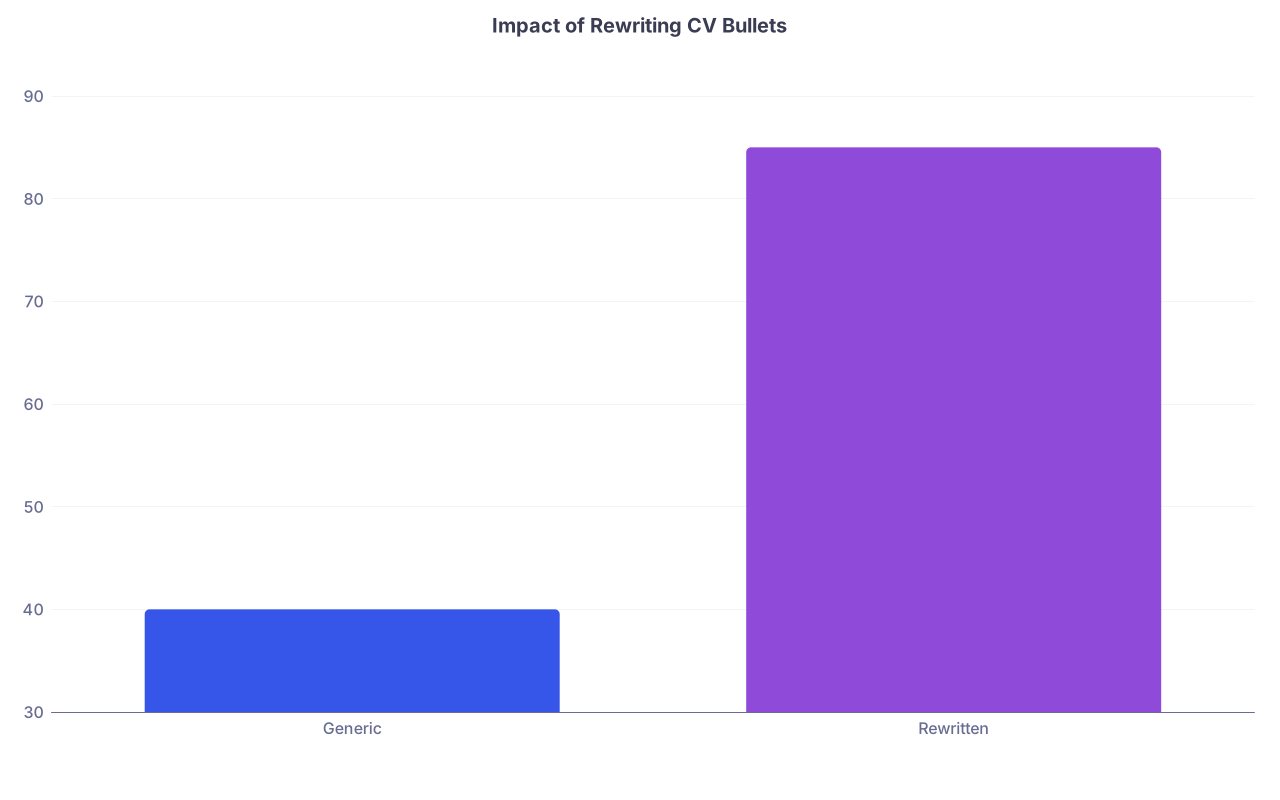
| Category | Value |
|---|---|
| Generic | 40 |
| Rewritten | 85 |
(Think of this as the perceived “strength” of entries on a 100‑point scale. Yes, it is arbitrary, but the gap is real.)
Example 1 – Research
Before:
“Research assistant in oncology lab. Helped with experiments and data collection. Worked on project about chemotherapy side effects. Presented poster at conference.”
After (for IM/Onc focused applicant):
“Research Assistant, Oncology Outcomes Lab – 2021–2023”
- Collected and curated chemotherapy toxicity data from 410 breast cancer patients, focusing on treatment‑limiting adverse events.
- Collaborated with biostatistician to develop multivariable regression model predicting early dose reductions.
- First author on poster presented at ASCO regional meeting; manuscript in revision for submission to JCO Oncology Practice.
Example 2 – Leadership
Before:
“Tutored first‑year medical students in anatomy and physiology. Helped them study and prepared review sessions. They gave positive feedback.”
After (for Surgery/Anatomy heavy interest):
“Peer Tutor, Anatomy and Physiology – 2020–2022”
- Led weekly 2‑hour small‑group review sessions for 6–8 first‑year students in gross anatomy and physiology.
- Created dissection checklists and concept maps that were later adopted by course faculty and shared with entire class of 160.
- Average student exam scores improved from class mean −6% pre‑tutoring to +4% above mean after 4 sessions.
No change in actual work. Massive change in how a PD perceives it.
Quick Specialty‑Targeted Checklist
Use this as a fast final pass. If you are applying in:

Internal Medicine
You should have:
- At least one longitudinal clinical or community role with chronic disease focus
- Some evidence of teaching or mentorship
- Research, QI, or scholarly work (not mandatory at all programs, but a plus)
- Anchor bullets that show thoughtfulness, detail‑orientation, and follow‑through
General Surgery
You should have:
- Concrete exposure to OR or procedural work (do not oversell, but show interest)
- Leadership or responsibility in high‑pressure or logistics‑heavy settings
- Clear examples of resilience, ownership, and team contribution
- Measurable impact in QI, workflow, or teaching (even outside surgery — still valuable)
Psychiatry
You should have:
- Experiences with vulnerable populations, counseling, or sustained relationship‑based work
- Bullets emphasizing communication, patience, and insight
- If research‑oriented: projects in psych/mental health/behavioral fields, with your role clear
- A hobbies section that shows you as a reflective, grounded human, not a robot
Emergency Medicine
You should have:
- Experiences in acute care, fast‑paced environments, or crisis situations
- Team‑based roles with shift work, nights, or variable workload
- Procedure exposure if available (simulation counts if framed honestly)
- Evidence of systems thinking: triage, throughput, handoffs, protocol work
Radiology
You should have:
- Exposure to imaging (research, electives, shadowing with some substantive role)
- Research with data, imaging, or technology is a big plus
- Bullets that highlight pattern recognition, attention to detail, and comfort with complexity
- Anchor experiences that show you can handle independent, focused work
What You Should Do Today
Open your ERAS CV and:
- Highlight your top 3–5 anchors in bold within your own working copy.
- Take one of them and rewrite every bullet using the Action + Scope + Outcome formula.
- Delete or compress two obviously generic entries.
Not tomorrow. Today. One anchor rewritten and two pieces of fluff gone.
That small change will do more for your ERAS than another hour of passively “tweaking” sentences.