
It is late August. You are staring at your ERAS CV preview and it looks like a Craigslist “free stuff” section.
- One-off free clinic from M1.
- A health fair you barely remember.
- Three tutoring gigs, all with different names.
- A soup kitchen.
- Two “leadership positions” that were really just GroupMe admin roles.
You are about to apply for residency and you have this sinking feeling: none of this hangs together. It feels random. Disconnected. Almost like you just chased whatever signup sheet came across your email.
Here is the good news: most applicants are in exactly the same mess. The difference is whether you leave it as chaos or you turn it into a clear, intentional story.
That is what we are going to fix.
Step 1: Stop Thinking “Activities List,” Start Thinking “Through-Lines”
The CV problem starts with the wrong mental model. You are thinking “list of everything I did” instead of “two or three core stories I am selling.”
Residency programs do not care that you did 23 separate volunteer activities. They care about:
- What patterns those activities reveal about you
- Whether those patterns fit their specialty and program culture
- Whether your story is believable and consistent across CV, personal statement, and interview
So your first job is not to edit entries. It is to find the through-lines.
1.1 Dump everything out, then cluster
Open a blank document or grab a stack of sticky notes. List every “random” volunteering and side thing you have:
- Free clinics
- Screening events
- Peer tutoring or TA work
- Community org volunteering
- Religious/community service
- Campus clubs, leadership, committees
- Advocacy, phone banking, health policy stuff
- Camp counselor, mentorship, youth activities
Now cluster. You are looking for themes, not titles.
Common themes that show up again and again:
- Teaching / mentorship
- Underserved / vulnerable populations
- Quality improvement / systems thinking
- Leadership / organizing
- Longitudinal service with one population
- Global health / cross-cultural work
- Mental health / crisis support
- Advocacy / policy / community organizing
Put each activity under one or two themes. Do not overthink it. Your goal is to see patterns, not write perfect labels.

| Step | Description |
|---|---|
| Step 1 | All Activities Dump |
| Step 2 | Cluster by Theme |
| Step 3 | Identify 2 to 3 Core Themes |
| Step 4 | Reframe CV Entries |
| Step 5 | Align PS and Letters |
| Step 6 | Practice Interview Narrative |
Step 2: Pick 2–3 Core Themes That Fit Your Target Specialty
You are not writing a memoir. You are building a marketing package for a specific specialty.
If you are applying to Internal Medicine, the “I love operations for the student gym” theme is less useful than your longitudinal free clinic involvement. For Psychiatry, your crisis hotline and mentoring at-risk youth matter more than the three days you helped with flu shots.
2.1 Map your themes to specialty values
Use this as a rough guide:
| Theme | Strong Fit For… |
|---|---|
| Teaching / mentorship | IM, Pediatrics, Neurology, Psychiatry |
| Underserved care | FM, IM, EM, Peds, OB/GYN, Psych |
| Systems / QI / operations | IM, Anesthesia, EM, Surgery |
| Advocacy / policy | FM, IM, Peds, Psych, Med-Peds |
| Longitudinal relationships | FM, IM, Peds, Psych |
| Crisis / acute response | EM, Surgery, Anesthesia, Psych |
If you are dual-applying, you still need one primary narrative. You can adjust emphasis slightly between specialties, but do not try to be three different people.
Your target: choose 2–3 core themes that:
- Appear multiple times across your activities
- Align with your chosen specialty
- You can talk about for 10+ minutes without sounding rehearsed
Examples:
- “Longitudinal commitment to underserved communities” + “teaching and mentorship”
- “Systems improvement and leadership” + “acute care and crisis response”
- “Child and adolescent advocacy” + “mental health support” (for peds/psych)
Write those down. These are now the spine of your CV story.
Step 3: Rewrite “Random” Entries Around Those Themes
Now we get tactical. You are going to rewrite your ERAS entries so they signal the themes you just picked, instead of reading like isolated curiosities.
3.1 The three-part bullet formula
For each meaningful activity, drive to this structure:
- Context – what this was, who it served, frequency
- Role / actions – what you actually did (verbs, not fluff)
- Growth / link to theme – one line that ties it to skills, values, or longitudinal commitment
Bad entry (typical ERAS):
Volunteered at student-run clinic. Helped see patients and take vitals.
Rewritten for “underserved care + systems thinking”:
Student volunteer, Community Care Free Clinic
Weekly student-run clinic serving uninsured adults. Collected histories and vitals, coordinated follow-up calls, and helped develop a simple tracking sheet that reduced missed follow-ups for abnormal labs.
See the difference. It is no longer a box checked. It is part of a story.
Another example.
Bad:
Volunteered at church youth group on weekends.
Rewritten for “mentorship + working with adolescents” (Psych/Peds narrative):
Youth mentor, Grace Community Youth Program
Mentored middle and high school students weekly in a faith-based youth group. Led small-group discussions, helped de-escalate peer conflicts, and collaborated with staff to connect struggling teens to school counselors.
Now it clearly supports a “working with adolescents / mental health interest” theme.
3.2 Group related micro-activities into “umbrella” entries
The single biggest mistake I see: eight separate entries that are all basically “health fairs” or “blood pressure screenings.”
Collapse them.
Instead of:
- Health Fair – M1 Fall
- BP Screening – Church Event
- Smoking Cessation Table – Community Day
- Vaccine Drive – Hospital Event
Create one:
Community health outreach volunteer
2019–2023
Participated in 10+ community events (BP screenings, vaccine drives, smoking cessation outreach) in partnership with [Hospital] and local community organizations. Focused on engaging uninsured and underinsured adults, counseling on chronic disease risk, and connecting interested patients with primary care resources.
You have just:
- Saved CV space
- Created a sense of longitudinal involvement
- Turned scatter into a coherent line item that screams “community health commitment”
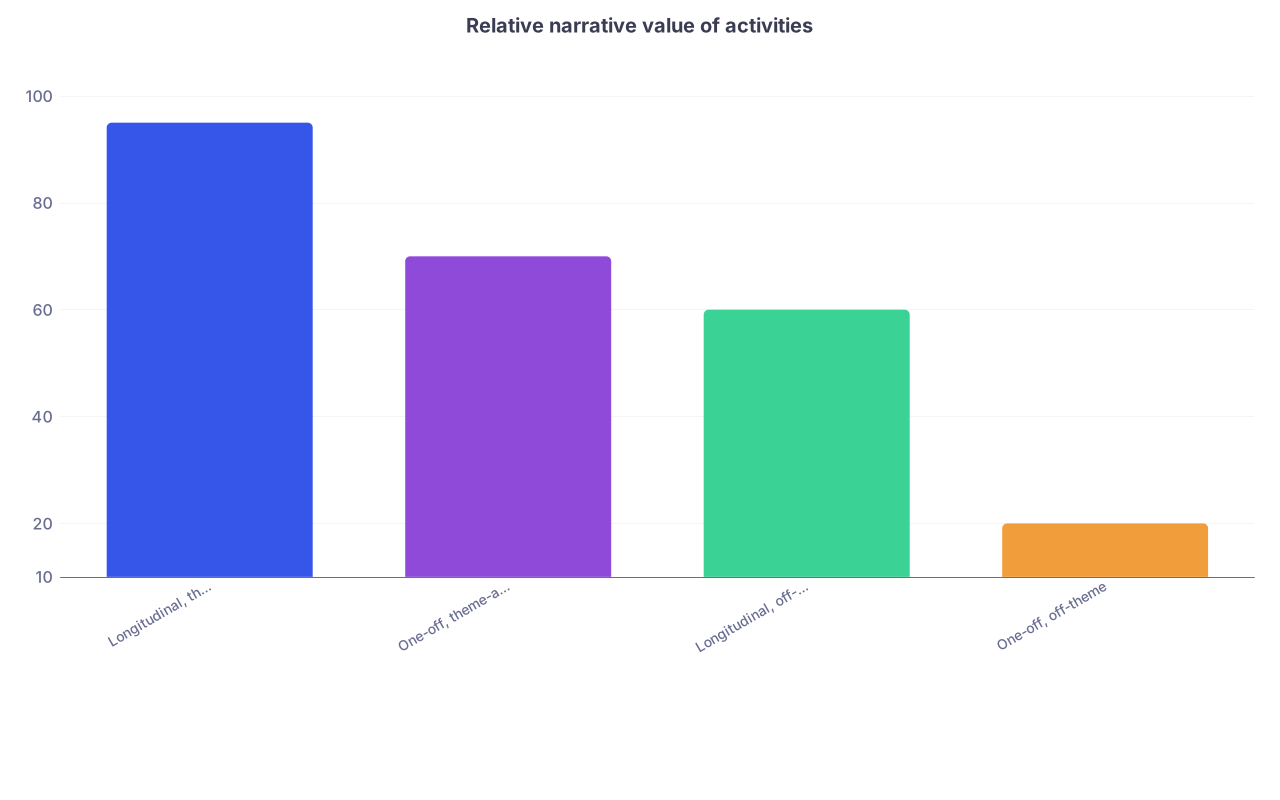
3.3 Rank entries by strategic value, not chronology
On ERAS, you control which entries are “most meaningful” and how you order experiences in sections.
Do not bury your strongest narrative-supporting entries under random one-offs just because of timing. Prioritize:
- Activities that hit your chosen themes hard
- Activities that are longitudinal (months/years, not a single Saturday)
- Activities where you had increasing responsibility
An M3–M4 role as clinic coordinator for a free clinic should sit well above an M1 health fair, even if the fair technically came first.
| Category | Value |
|---|---|
| Longitudinal, theme-aligned | 95 |
| One-off, theme-aligned | 70 |
| Longitudinal, off-theme | 60 |
| One-off, off-theme | 20 |
Step 4: Build a Clear Before–During–After Arc for Each Major Activity
Coherence does not just come from themes. It comes from trajectory. Programs want to see you moving from passive participant to active contributor to someone who reflects critically.
For 3–5 of your biggest activities, you want a mini-arc:
- Before: why you started
- During: what you did and how your role evolved
- After: what you learned, changed, or built
You will not write this explicitly in the CV, but it will shape the way you phrase entries and it becomes perfect interview fodder.
Example: Free clinic, IM applicant, themes: underserved care + teaching.
Before
Started M1 as a volunteer because you wanted patient contact and had an interest in disparities after undergrad research on access to care.
During
By M3 you were precepting M1s on basic H&P, helping standardize the intake templates, and noticed a pattern of missed follow-ups in diabetic patients.
After
You proposed and helped implement a simple follow-up protocol (phone calls + text reminders via a free platform), tracked it over six months, and saw follow-up rates increase. Realized you care about combining direct patient care with small systems tweaks that actually move outcomes.
Now rewrite your CV entry with that in mind:
Clinic volunteer and student coordinator, Community Care Free Clinic
2019–2023
Started as an M1 volunteer at a student-run clinic serving uninsured adults, focusing on histories, vitals, and basic counseling. As an M3, transitioned to student coordinator, orienting new volunteers, working with faculty to streamline intake templates, and leading a small initiative to improve follow-up for patients with uncontrolled diabetes through structured reminder calls and text messages.
This reads like a person following a thread, not like “I did some shifts and later had a title.”
Step 5: Align Your CV Story With Your Personal Statement and Letters
You cannot have your CV screaming “underserved primary care” and your personal statement rambling about bench research in ion channels. That is how you look scattered.
5.1 Use your themes as the backbone of your personal statement
You already did the hard work. You picked 2–3 themes and rewrote your CV.
Your personal statement should:
- Open with a specific moment from one of your key theme-supporting activities
- Use 2–3 body paragraphs to walk through how those themes show up across multiple experiences
- End by tying those themes to what you want from that specialty and (if relevant) that type of program
If your themes are “teaching + underserved care,” then your PS should probably highlight:
- Mentoring preclinical students
- Free clinic or community outreach
- Maybe a leadership role in a group that serves those populations
5.2 Choose letter writers who can reinforce those themes
If you are selling yourself as the “teacher–clinician who cares about underserved populations,” your ideal letter writers:
- Attending from a community or safety-net rotation
- Faculty advisor from the free clinic
- Course director or attending who saw you teach or mentor juniors
When you ask for letters, be blunt. Something like:
“I am applying to Internal Medicine with a focus on underserved primary care and teaching. If you feel comfortable, I would be grateful if you could comment on X, Y, and Z examples that reflect those interests.”
Most attendings appreciate that level of clarity. And yes, many will mostly write what you signal.

Step 6: Fix the Truly Random Stuff: Keep, Reframe, or Cut
You probably still have some weird outliers:
- Two weeks volunteering at a music festival medical tent
- One night of phone banking for a ballot initiative
- A single disaster relief deployment in another state
- Volunteering at an animal shelter
What do you do with these?
6.1 Keep and reframe if you can tie it to a theme
Example: EM applicant, themes: acute care + team-based crisis response.
- Music festival tent becomes: early exposure to triage, crowd medicine, working with EMS.
- Disaster relief: high-yield. Keep. Make it a central narrative piece.
- Phone banking for Medicaid expansion: great for advocacy / policy angle.
Be specific in the description to hit the theme.
6.2 Demote to “Other” or cut completely if it muddies the water
If:
- It was truly one-off AND
- You cannot honestly tie it to your core themes AND
- You already have enough meaningful entries
Then drop it or relegate it to a brief “Other volunteering” catch-all with one line.
This is not about hiding anything. It is about not diluting your story with noise.
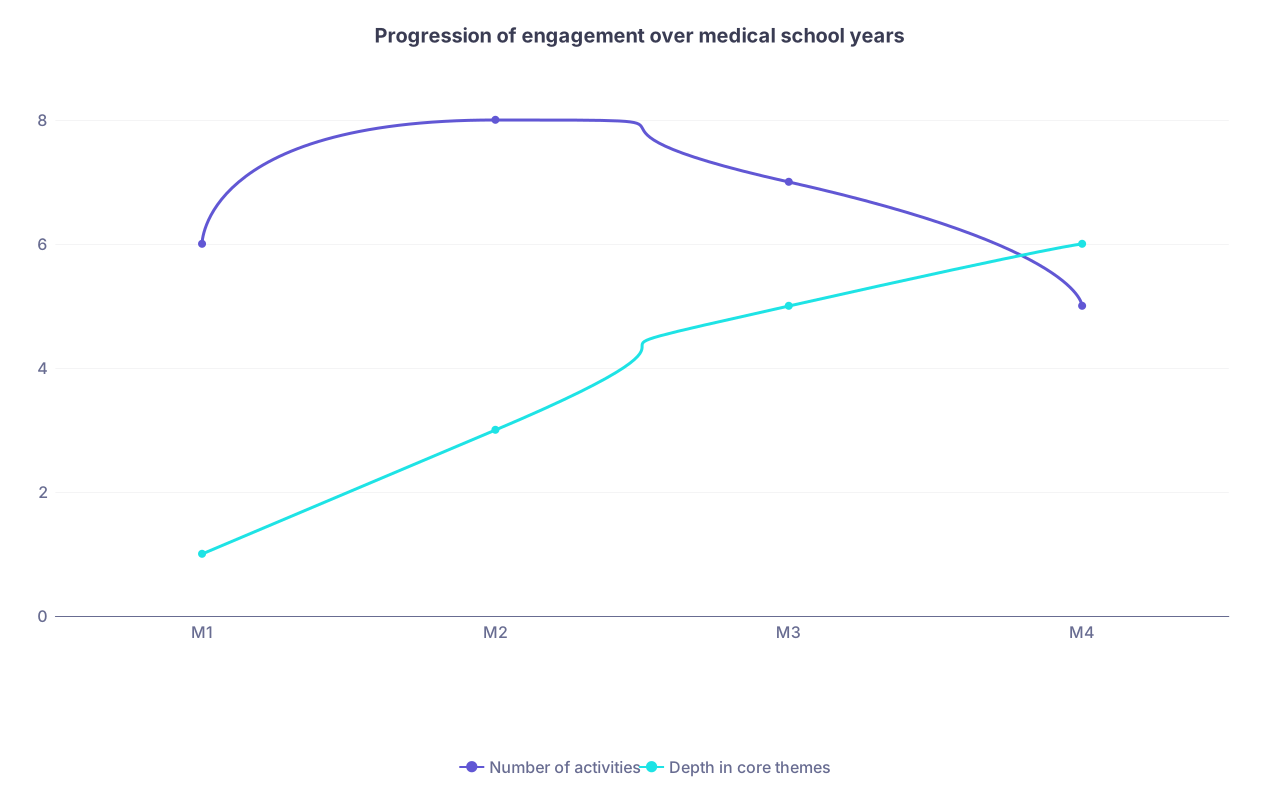
Step 7: Show Progression Over Time, Not Just a Pile of Stuff
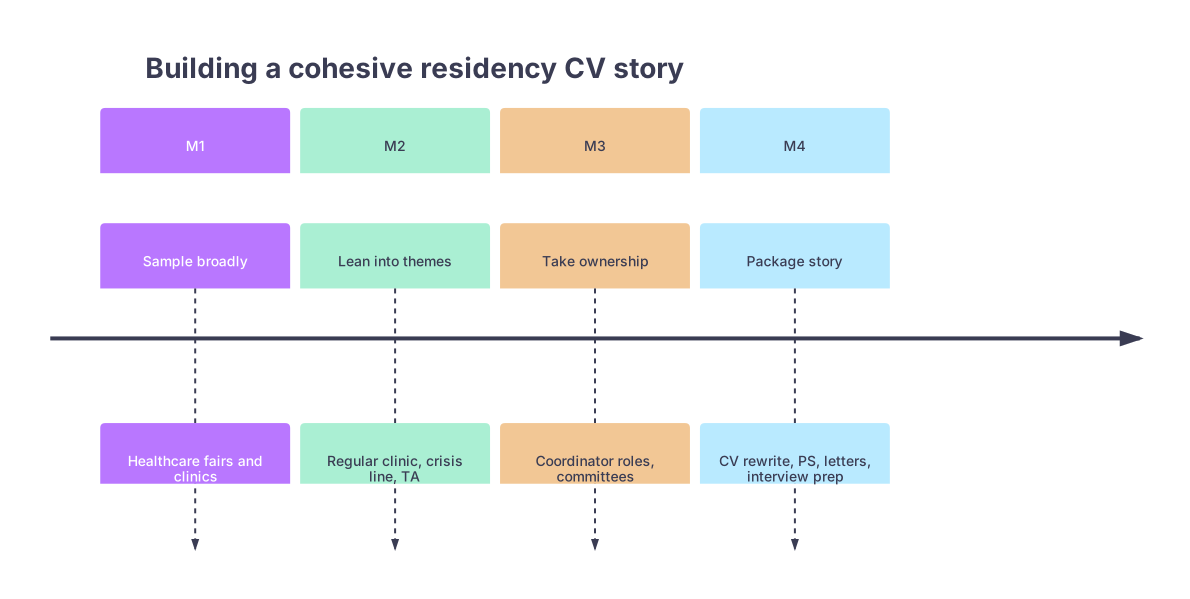
Programs like trajectories:
- M1: basic participant
- M2: more regular involvement
- M3–M4: leadership / initiative / depth
Use your dates and descriptions to make this obvious.
7.1 Use multi-year date ranges when possible
Instead of:
- Volunteer – 3 months M1
- Volunteer – 4 months M2
- Coordinator – 6 months M3
Combine:
Community Care Free Clinic – Volunteer then student coordinator
2019–2023
Then describe the progression in the bullet.
7.2 Explicitly mark role escalation
Phrase things like:
- “Initially participated as… later transitioned to…”
- “Started as… then took on…”
- “Moved from individual volunteering to organizing…”
This signals growth. Programs are selecting people they will invest in for 3–7 years. Growth trajectory matters as much as raw hours.
| Category | Number of activities | Depth in core themes |
|---|---|---|
| M1 | 6 | 1 |
| M2 | 8 | 3 |
| M3 | 7 | 5 |
| M4 | 5 | 6 |
Step 8: Stress-Test Your Story: The “So What?” and “Why This?” Tests
I have seen many decent-looking CVs crumble in interviews because the story is fragile. You want to stress-test it yourself first.
8.1 The “So what?” test for each major activity
Pick your top 5 entries. For each one, answer out loud:
- What did you actually do?
- What did you learn about yourself or medicine?
- How does this connect to the type of physician you want to be?
If your answer is some version of “I helped people” and you stall, you have not thought deeply enough. You need sharper, more specific connections.
Example for community tutoring (Peds/FM applicant):
- Did: Weekly one-on-one reading tutoring for early elementary students.
- Learned: How small, consistent interventions over months trump heroic one-off efforts; how to communicate complex concepts in simple language.
- Connection: That is exactly how you see primary care and preventive pediatrics—longitudinal, incremental, communication-heavy work.
You do not need to say it this neatly in the interview. But you need it in your head.
8.2 The “Why this specialty?” consistency check
Look at your full CV.
If I redact your intended specialty from your application, and all I can see is:
- Your activities
- Their descriptions
- Your personal statement content
Would a reasonable PD guess the right specialty?
If you are applying to Psychiatry and half your CV screams ortho (surgical interest groups, sports medicine shadowing, anatomy TA, Ortho sub-I, research in joint replacement), then tossing in one crisis line shift and saying “I realized I love talking to patients” will feel thin.
You do not have to look “pre-ordained,” but your specialty choice should look like the natural extension of who you have been for four years.
If it does not, you have two options:
- Reframe your existing experiences in ways that authentically support your new story
- Add a brief but well-thought-out explanation in your personal statement about a late but real pivot

Step 9: Concrete Example – From Messy to Cohesive
Let me walk you through a quick “before–after” with a fictional applicant.
9.1 Raw list (Psych applicant)
- Soup kitchen volunteering, college and M1
- Crisis text line, M2–M4
- Sunday school teacher, college
- Domestic violence shelter hotline, M3
- Anatomy TA, M2
- Free clinic, one semester M1
- Mental health awareness week planning committee, M3
- Research on sleep and depression, M3–M4
This looks scattered at first glance.
9.2 Themes we can extract
- Mental health / crisis support (crisis line, DV hotline, research, awareness week)
- Working with vulnerable populations (soup kitchen, DV shelter, free clinic)
- Teaching / working with youth (Sunday school, TA)
For Psychiatry, a great narrative is:
- Longstanding interest in people on the margins
- Specifically drawn to mental health and crisis points
- Enjoy teaching and psychoeducation
9.3 How to restructure
Group some entries:
Mental health crisis support volunteer
2021–2024
Volunteer crisis counselor with the national Crisis Text Line (M2–M4), responding to acute mental health crises via text and helping de-escalate situations and connect texters with local resources. Also served one semester on the domestic violence shelter hotline, supporting callers in immediate safety planning and referral to legal and counseling services.
Community service with vulnerable populations
2017–2022
Volunteered at a local soup kitchen throughout college and M1, assisting with meal prep, serving, and informal support for guests, many of whom were experiencing homelessness or severe mental illness. Participated in a student-run free clinic for one semester, focusing on histories and connecting patients with social services.
Teaching and youth mentorship
2016–2020
Taught elementary-age Sunday school weekly during college, planning lessons and supporting children with behavioral and attention difficulties. Served as an anatomy TA in M2, leading review sessions and adapting teaching approaches for classmates with different learning needs.
Research in sleep and depression
2022–2024
Assisted with a longitudinal study examining sleep disturbance and depressive symptoms in young adults, including recruitment, data collection, and contributing to a conference poster on associations between smartphone use and sleep quality.
You can see how this now tells one coherent story: this person repeatedly gravitates to vulnerable groups, especially with mental health needs, in crisis and over time, and likes teaching and explaining.
Now the personal statement can open with a crisis text line vignette and naturally tie in the rest.
Step 10: Final Polish – Make It Read Like One Person, Not A Committee
Last steps to pull this together:
Consistent language
Use similar verbs and phrasing around your themes:- Teaching: “mentored,” “facilitated,” “led small-group sessions,” “oriented new volunteers”
- Systems/QI: “streamlined,” “developed,” “implemented,” “tracked outcomes”
- Underserved: “uninsured,” “Medicaid population,” “safety-net,” “resource-limited settings”
Avoid generic fluff
Phrases like “developed leadership skills” or “improved communication” with no concrete action behind them are dead weight. Show, do not declare.Keep the weird but human bits
One or two slightly off-theme but genuine items (e.g., running club organizer, music performance) are fine. They make you memorable. Just do not let them swamp your core narrative.Read it aloud in order
Pretend you are a PD skimming from top to bottom. Ask:- What 2–3 adjectives come to mind about this person?
- Would I remember them in an hour?
- Do they look like someone who will fit our residents and patients?
If your adjectives are “all over the place,” you are not done yet. If they are along the lines of “longitudinal, community-oriented, teacher,” you are in good shape.
| Period | Event |
|---|---|
| M1 - Sample broadly | Healthcare fairs and clinics |
| M2 - Lean into themes | Regular clinic, crisis line, TA |
| M3 - Take ownership | Coordinator roles, committees |
| M4 - Package story | CV rewrite, PS, letters, interview prep |
FAQs
1. I really did just chase random volunteering early on. How do I avoid looking fake when I “re-theme” everything now?
Be honest about the exploration. You do not need to pretend you had a master plan from M1. It is fine to say (in interviews or PS) that you sampled widely, but certain types of work consistently felt more meaningful, and you leaned into those in M3–M4. The key is that your recent activities and depth line up with the story you are telling. Do not oversell the early scatter as something it was not.
2. How many volunteering entries is “enough” for residency?
There is no magic number. Program directors care more about depth and continuity than raw count. A candidate with 3–4 robust, multi-year, theme-coherent experiences will be more compelling than one with 15 one-off events. If you have at least 2–3 activities that show real commitment and responsibility, and you can talk about them well, you are not “behind.”
3. Should I list non-clinical volunteering that has nothing to do with medicine?
Yes, selectively. If an activity shows real commitment, leadership, or a side of you that matters (e.g., long-term coaching, serious music involvement, significant community role), keep it. Just do not let unrelated activities dominate, and do not pretend they are clinical. A few strong non-clinical entries can make you more three-dimensional while your main narrative still comes from medically relevant work.
4. My specialty choice changed late. My early volunteering points to another specialty. What now?
Do a blunt audit. Identify which experiences genuinely support the new specialty’s values (communication, continuity, procedures, acute care, etc.). Reframe those entries around transferable skills and insights. Then, in your personal statement, briefly own the late pivot: explain what you learned from the earlier path, what changed, and why the new specialty actually fits better. Programs are less bothered by a late change than by a story that tries to pretend the old interests never existed.
Key points to walk away with:
- Stop listing. Start theming. Your CV should revolve around 2–3 coherent, specialty-aligned through-lines.
- Rewrite and regroup your “random” volunteering so it shows depth, progression, and a believable trajectory.
- Make your CV, personal statement, and letters all tell the same story — so when a PD finishes reading, they know exactly who you are becoming as a physician.