
The average residency CV line is useless. Not bad. Not wrong. Just weak, vague, and forgettable.
You are not competing against the worst CVs. You are competing against hundreds of people who all “assisted,” “participated,” and “helped with” the exact same things. If your bullets sound like theirs, you lose.
Let me show you how to fix that.
This is not theory. This is the exact process I have used with students who went from “generic applicant” to “this person clearly gets things done” on paper.
Step 1: Understand What Makes a Residency Bullet High-Impact
Before you start rewriting, you need a target. A strong residency CV bullet does three things:
- Shows you did something specific
- Shows scale or outcome
- Signals skills that programs actually care about
If a bullet does not clearly answer at least two of these three, it is dead weight.
Here is the mental checklist I use when I look at any bullet:
- Can I see what you actually did?
- Can I estimate how big / complex / frequent it was?
- Can I infer what kind of intern or resident you will be?
If the answer is “kind of” or “not really,” it needs to be rewritten.
| Aspect | Weak Bullet | Strong Bullet |
|---|---|---|
| Action | Vague verb | Clear, concrete verb |
| Detail | Generic | Specific, contextual |
| Numbers | None | Uses counts, %, or frequency |
| Outcome | Missing | Shows result or impact |
| Skills | Implicit | Clearly signals residency-relevant skills |
The 4-Part Bullet Formula That Actually Works
Forget the “action verb + blah blah” advice. Use this instead:
Action verb + What you did + How much / how often + Result or purpose
You will not hit all four pieces in every bullet, but you should hit at least three.
Example structure:
- “Led [what] for [who] resulting in [impact]”
- “Developed [tool/process] used by [number/type] to [outcome]”
- “Managed [volume/type of patients/tasks] per [time] while [key responsibility]”
Keep that in your head. You will use it repeatedly.
Step 2: Identify and Kill Your Worst Offenders
Open your CV. Mark every bullet that uses one of these verbs as its main action:
- Helped
- Assisted
- Participated in
- Involved in
- Responsible for
- Worked on
- Shadowed (this one is particularly useless if left alone)
These are red flags. The verbs themselves are not always the problem, but 90% of the time they hide vague, low-impact content.
Take one section at a time: clinical experience, research, leadership, teaching, volunteering.
For each section:
- Highlight weak bullets.
- Choose 1–2 per section to fix first.
- Apply the rewrite protocol below.
You will not fix everything in one pass. That is fine. You are building the muscle.
Step 3: The Rewrite Protocol (Step-by-Step)
Here is the exact process I use to turn a bad bullet into a strong one.
Step 3.1: Start With the Weak Bullet
Example (real style, anonymized):
- “Assisted in patient care on internal medicine rotation”
This tells me nothing. Could be anyone. Could be anything.
Step 3.2: Ask 5 Specific Questions
For each weak bullet, answer these (even roughly):
- What exactly did you do with your own hands or mind?
- Who did you interact with (patients, nurses, attendings, families)?
- How often or how many (per day, per week, total)?
- What changed because you did it (saved time, improved flow, taught someone, caught errors)?
- What skill would a PD see here (ownership, efficiency, communication, teaching, organization)?
Let’s answer those for the example:
- Exact tasks: prerounding, presenting, writing notes, placing orders (under supervision), calling consults.
- Interactions: daily with 6–8 patients, nursing staff, residents, and attendings.
- Volume: followed 4–6 patients daily; on a 4-week rotation.
- Impact: consistently had notes and presentations ready before rounds, helped streamline rounds.
- Skill: reliability, clinical reasoning, communication in team.
Step 3.3: Pull Out the Best Angle
You are not trying to cram everything into one bullet. Choose one focus:
- Ownership of patient list
- Communication with team
- Efficiency / organization
- Clinical reasoning / presentations
Let us pick “ownership and efficiency.”
Step 3.4: Rewrite Using the 4-Part Formula
Weak:
- “Assisted in patient care on internal medicine rotation”
Stronger options:
“Managed daily care for 4–6 internal medicine patients per week, preparing preround notes and presentations consistently before team rounds.”
“Pre-rounded and presented on a panel of 4–6 internal medicine patients daily, ensuring complete notes and updated plans before attending rounds for 4-week rotation.”
See the difference? Same rotation. No exaggeration. Just clarity and scale.
Step 4: Common Weak Bullets & How to Fix Them
Let us walk through the usual junk I see and how to convert it.
4.1: Clinical Experience Bullets
Weak:
- “Assisted in surgeries”
- “Participated in patient care on pediatrics rotation”
- “Helped with ED patients”
Rewrites:
“First-assisted on 10+ general surgery cases (laparoscopic cholecystectomies, hernia repairs), handling retraction, suction, and basic suturing under attending supervision.”
“Followed 5–7 pediatric inpatients daily, performing focused histories and exams, presenting on rounds, and documenting progress notes reviewed by senior residents.”
“Evaluated 8–12 emergency department patients per shift with supervising resident, performing focused H&P, generating differential diagnoses, and proposing initial management plans.”
Notice: numbers, tasks, and level of responsibility are crystal clear.
4.2: Research Bullets
Research bullets are usually a disaster. They all sound like this:
Weak:
- “Assisted in cardiology research project”
- “Participated in data collection and analysis”
- “Worked on manuscript about diabetes”
You need to show what you owned.
Rewrites:
“Abstracted clinical data from 350+ charts for cardiology outcomes study using REDCap, focusing on arrhythmia incidence following ablation.”
“Cleaned and analyzed dataset of 220 patients with Python and SPSS, generating multivariable logistic regression models for predictors of 30-day readmission.”
“Co-authored retrospective study on glycemic control in hospitalized patients; drafted methods section and created 4 figures for manuscript submitted to Journal of Hospital Medicine.”
You are aiming for: tools used, sample size, your slice of the project, and status (submitted, accepted, presented).
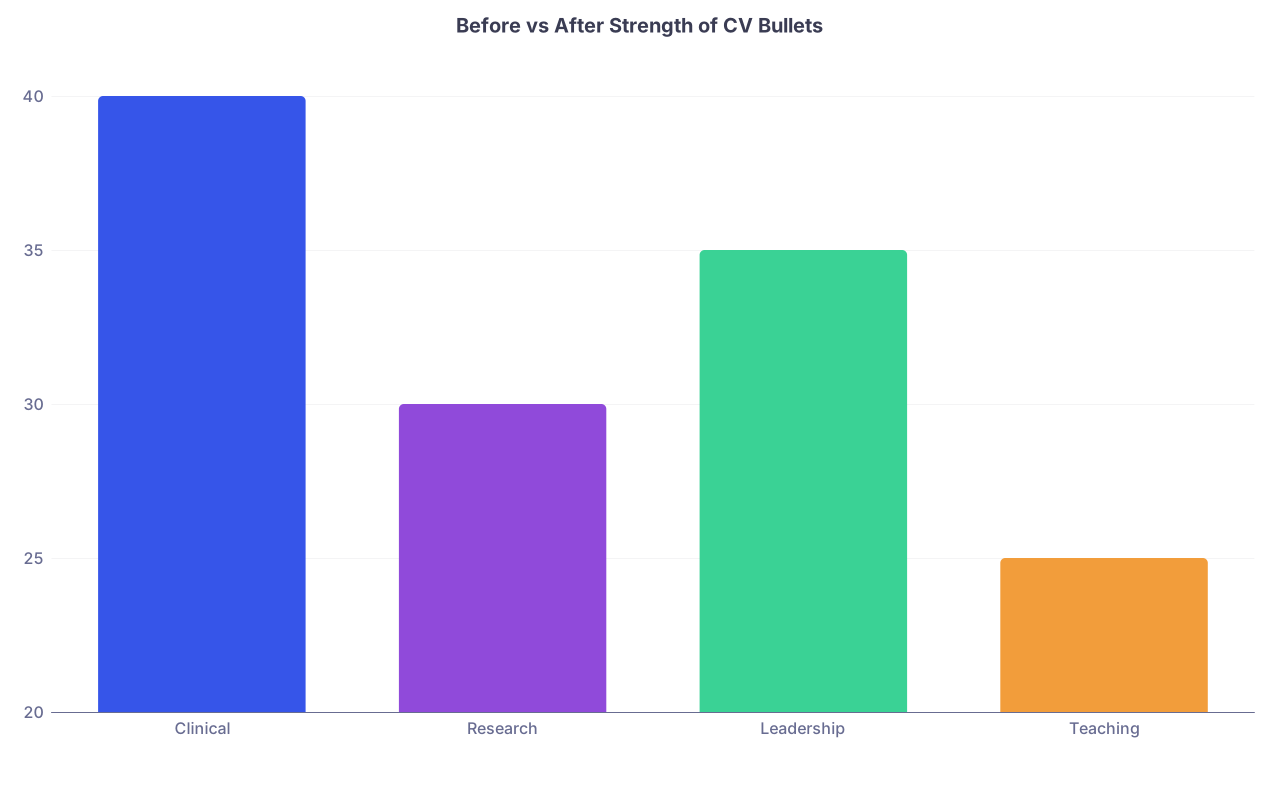
| Category | Value |
|---|---|
| Clinical | 40 |
| Research | 30 |
| Leadership | 35 |
| Teaching | 25 |
(Think of the numbers here as “out of 100” for clarity and impact. Weak bullets often sit in the 20–40 range. After rewriting with specifics, people push them into the 70–90 range.)
4.3: Leadership & Organizational Roles
These get flattened into meaningless lines.
Weak:
- “Treasurer, Student Interest Group”
- “President, Free Clinic”
- “Organized events for class”
Rewrites:
“Managed $8,000 annual budget for Internal Medicine Interest Group, negotiating with vendors and allocating funds for 6 speaker events and 2 skills workshops annually.”
“Led 20-volunteer student-run free clinic team, coordinating weekly schedules and overseeing triage flow for 25–30 uninsured patients per clinic session.”
“Coordinated 3-class OSCE review series attended by 120+ MS2 students, recruiting resident faculty, creating cases, and collecting feedback for curriculum improvements.”
You are highlighting:
- Size (budget, number of people, number of events)
- Frequency (weekly, monthly, per semester)
- What you personally controlled (schedules, budgets, logistics, curriculum)
4.4: Teaching & Mentoring
Teaching lines often look like these:
Weak:
- “Tutored medical students in anatomy”
- “Mentored pre-med students”
- “Led review sessions”
Strip the vagueness.
Rewrites:
“Tutored 6 first-year medical students in anatomy over 12-week block, providing weekly 1-hour sessions focused on clinical correlations and practice questions, with all students passing final exam.”
“Mentored 4 pre-med students through application cycle, reviewing personal statements, conducting mock interviews, and advising on school list strategy.”
“Led weekly Step 1 review group for 10 peers, creating question-based sessions using UWorld and NBME-style questions.”
Again: who, how many, how often, and with what outcome.
Step 5: Make Numbers Your Default, Not an Afterthought
Most students think they “don’t have numbers.” Wrong. You do. You are just not used to quantifying.
Here is where to look for numbers:
- Patients: per day, per week, per session
- Events: number of sessions, talks, clinics
- People: mentees, team members, volunteers
- Money: budget managed, fundraising totals
- Time: weeks, months, hours per week
- Products: posters, manuscripts, protocols, teaching sessions
When you cannot get exact numbers, estimate conservatively.
Bad:
- “Worked with many patients.”
Better:
- “Interacted with approximately 15–20 patients per 8-hour ED shift.”
If you are uncomfortable guessing, anchor it:
- “Typically followed 4–6 inpatients daily on 4-week rotation.”
- “Coordinated monthly clinic sessions (10 clinics total per academic year).”
Numbers create credibility and let programs sense your workload and responsibility quickly.
Step 6: Translate “Soft” Experience Into Residency Skills
This is where most CVs underperform. They list activities, not skills.
Residency program directors scan for a few consistent themes:
- Ownership and reliability
- Efficiency under time pressure
- Communication with patients, families, and teams
- Teaching and mentoring
- System thinking / QI mindset
- Professionalism and follow-through
Your job is to make those show up implicitly through what you choose to highlight.
Look at each bullet and ask: “What does this prove about me as a future intern?”
Examples:
Original weak volunteering bullet:
- “Volunteered at community health fair”
Two different rewrites depending on what you want to signal:
Ownership/organization angle:
- “Coordinated check-in and flow for 150+ attendees at community health fair, directing patients between screening stations and reducing average wait time.”
Communication/patient education angle:
- “Provided blood pressure screenings and brief counseling to 40+ adults at community health fair, using interpreter services for Spanish-speaking participants.”
Same event. Different skill emphasis. You choose the one that fits your narrative and what the experience truly was.
Step 7: Align Bullets With Your Target Specialty
The content is one part. The emphasis is the other.
You do not rewrite your entire CV for each specialty, but you absolutely adjust which bullets and phrasing you feature.
Think like this:
- Competitive surgical fields: highlight procedures, technical tasks, OR flow, stamina, leadership, QI.
- Cognitive fields (IM, neuro, psych): emphasize clinical reasoning, complex patients, continuity, communication, teaching.
- Primary care fields: show longitudinal care, patient education, underserved work, interdisciplinary teamwork.
Example transformation for the same research role:
Base experience: research assistant in oncology clinic.
Internal medicine angle:
- “Extracted longitudinal treatment and lab data for 200+ oncology patients for outcomes study, focusing on chemotherapy toxicity and hospital readmission patterns.”
Radiation oncology angle:
- “Collected and organized radiation dose and treatment field data for 200+ oncology patients, supporting outcomes analysis on toxicity and local control.”
Same job. Different relevance lens.
Step 8: Format Bullets So They Are Scannable in 20 Seconds
You have about 10–20 seconds of real attention on any given CV section. If your bullets are dense walls of text, no one will excavate your brilliance.
Basic formatting rules that actually matter:
- 1–2 lines per bullet. Three is pushing it.
- No paragraphs disguised as bullets.
- Start with strong verbs: “Led,” “Developed,” “Managed,” “Created,” “Coordinated,” “Implemented,” “Presented,” “Analyzed,” “Taught,” “Designed.”
- Use parallel structure inside each section (if you start with past tense verbs, keep them past tense).
Here is a quick “before and after” layout:
Before:
- Assisted with clinic flow and patient care.
- Participated in quality improvement project.
- Helped organize student interest group events.
After:
- Managed rooming and initial intake for 18–22 primary care patients per half-day clinic, recording vitals and updating medication lists in EMR.
- Collected and tracked pre-visit planning data for QI project aimed at increasing depression screening completion rates from baseline.
- Coordinated logistics for 4 interest group events per semester, including speaker invitations, room booking, and advertising to 200+ students.
Now a PD can skim and actually see what you did.
Step 9: Use a Simple “Stress Test” Before Finalizing Bullets
Before you lock in a bullet, run it through this quick test:
Could this line describe 50% of your classmates?
- If yes, it is too generic. Add detail or scrap it.
Can someone outside medicine roughly understand what you did?
- If not, simplify jargon unless it is truly necessary.
Does it sound like someone who will be useful at 3 a.m. in July?
- If the bullet only shows passive observation, you need a different angle.
Example stress test:
Bullet: “Shadowed cardiologist in clinic and hospital.”
- Could this describe half your classmates? Obviously.
- Would a non-medical person understand? Yes, but they would also be bored.
- 3 a.m. intern usefulness? Zero.
Rewrite it or delete it. Shadowing alone is rarely worth a bullet unless you did something substantive like a structured longitudinal experience with defined tasks; in that case, describe those tasks.
Step 10: A Before-and-After Walkthrough (Full Example)
Let me put this together for a sample “Experience” section.
Original CV section:
Clinical Experience
- Participated in patient care on internal medicine rotation
- Helped with ED patients
- Assisted in surgeries
Research
- Assisted with cardiology project
- Participated in data analysis
Leadership
- Treasurer, IM interest group
- Organized events for students
Teaching
- Tutored medical students
- Led review sessions
This is what I see constantly. Now, a realistic, stronger version from the same underlying experiences:
Rewritten CV section:
Clinical Experience
- Followed 4–6 internal medicine inpatients daily on 4-week rotation, completing preround assessments, formulating assessment and plan, and presenting on rounds with senior review.
- Performed focused histories and physical exams on 8–12 emergency department patients per 8-hour shift under resident supervision, proposing differential diagnoses and initial management plans.
- First-assisted on 10+ general surgery cases (laparoscopic cholecystectomies, hernia repairs, appendectomies), responsible for retraction, suction, and subcuticular suturing.
Research
- Abstracted clinical and procedural data from 350+ patient charts for outcomes study on atrial fibrillation ablation, entering and validating data in REDCap.
- Conducted preliminary statistical analysis of arrhythmia recurrence rates using SPSS, generating tables and figures for abstract submitted to American College of Cardiology conference.
Leadership
- Managed $8,000 annual budget as Treasurer of Internal Medicine Interest Group, allocating funds for 6 speaker events and 2 simulation workshops per academic year.
- Coordinated logistics and promotion for 4 residency panel events (average attendance 60+ students), liaising with GME office and resident speakers.
Teaching
- Provided weekly 1-hour tutoring sessions in physiology to 5 first-year medical students over 10-week block, with all students passing final exam after remediation period.
- Led weekly board-style review sessions for 10 MS2 classmates, creating question sets from UWorld and NBME practice exams and facilitating group discussion.
Same person. Totally different signal.

| Step | Description |
|---|---|
| Step 1 | Identify weak bullet |
| Step 2 | Ask 5 detail questions |
| Step 3 | Choose main skill or angle |
| Step 4 | Add numbers and specifics |
| Step 5 | Rewrite with 4-part formula |
| Step 6 | Run 3-question stress test |
| Step 7 | Keep and move on |
Use this flow mentally for every bullet you touch. After a dozen, it becomes automatic.
Final Pass: Prioritize, Then Stop Editing
You have limited time in application season. Do not obsess over microscopic wording tweaks while ignoring big structural problems.
Do this in order:
- Fix the worst, vaguest bullets first (anything with “assisted,” “participated,” or “helped”).
- Make sure each major role (research, major leadership, substantive volunteering, strong clinical work) has at least 2–3 high-quality bullets.
- Trim low-yield fluff (minor shadowing, overly generic activities, high school items) to keep the document clean.
Remember: one powerful, specific bullet beats three generic ones every time.
Key Takeaways
- Weak CV bullets die from vagueness and lack of scale. Strong bullets are specific, quantified, and clearly tied to residency-relevant skills.
- Use a repeatable process: identify weak lines, ask targeted questions, pick a skill angle, add numbers, and apply the 4-part formula.
- Your experiences are probably better than your CV makes them look. The work now is translation, not reinvention.