
It is January. You just opened your ERAS CV draft and scrolled to the “Leadership and Professional Experiences” section. Two bullets: “Class volunteer, 1st year” and “Shadowed chief resident on rounds.” That empty white space underneath? That is where program directors expect to see evidence that you can run a team, own responsibility, and not fall apart when things get messy.
You have under 12 months before you submit. You cannot go back in time and magically become student body president. But you can fix this.
Here is how to build real, credible leadership on your CV in less than a year—without faking anything, padding roles, or pretending that “organized a group chat” is the same as running a committee.
Step 1: Know Exactly What “Leadership Credibility” Looks Like on a CV
Before you chase positions, you need to understand what PDs and selection committees actually respect. They are not looking for titles. They are looking for proof that people trusted you with responsibility and that you delivered.
On a residency CV, strong leadership experiences usually have three features:
Defined role
- You were officially responsible for something.
- Examples:
- “Course Representative, Class of 2026”
- “Founder and Director, Student-Run QI Initiative”
- “Chief Scribe, Emergency Department”
Scope and scale
- It affected more than just you and your friend group.
- Real numbers help:
- “Coordinated 35 volunteers”
- “Managed scheduling for 120 students”
- “Led a 6-person quality improvement team”
Outcome and impact
- Something changed because you were there.
- Concrete impact:
- “Increased event attendance by 40%”
- “Cut clinic no-show rate by 12%”
- “Published abstract accepted at regional conference”
Here is how this translates to bullets PDs actually respect:
- Weak: “Member, surgery interest group.”
- Strong: “Vice President, Surgery Interest Group – Organized 4 faculty panels and 3 skills workshops attended by 90+ students, improved average event attendance from 15 to 35 per session in 6 months.”
Titles alone do not buy you much. Responsibility + results does.
Step 2: Do a 12-Month Reality Check and Set Targets
You have less than a year. So you need a tight, realistic plan, not wishful thinking.
Ask yourself three blunt questions:
Where are you in training?
- Pre-clinical (MS1–2)
- Early clinical (MS3)
- Late clinical / application year (MS4 / Sub-I)
- Already applying / taking a gap year
How many hours per week can you realistically devote?
- 2–3 hours/week → You need focused, high-yield roles
- 4–5+ hours/week → You can drive or build bigger projects
When does your ERAS CV “freeze”?
- Your “story” effectively freezes:
- By June–August for September ERAS submission
- Anything starting before July can still look credible by application time
- Your “story” effectively freezes:
Now set concrete leadership targets for the next 12 months:
- Baseline target (everyone):
- At least 1 clearly defined leadership role with start date ≥ 6 months before ERAS.
- Stronger target (competitive specialties / weaker overall CV):
- 2–3 roles:
- 1 sustained role (6–12 months)
- 1–2 project-based leadership activities (3–6 months with clear outcomes)
- 2–3 roles:
To make this visual:
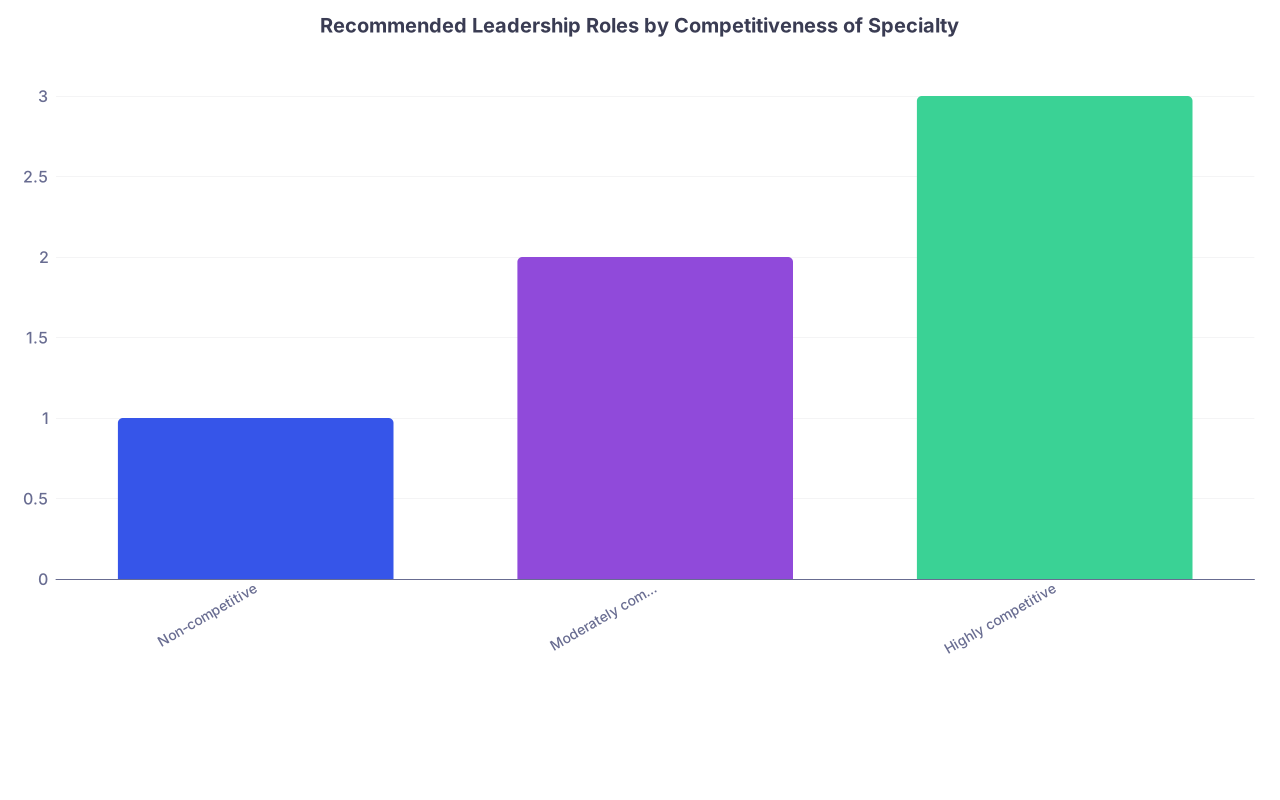
| Category | Value |
|---|---|
| Non-competitive | 1 |
| Moderately competitive | 2 |
| Highly competitive | 3 |
Step 3: Choose High-Yield Leadership Lanes (and Ignore the Rest)
Not every “position” will help you. You do not need seven minor roles. You need 2–3 that actually show substance.
Here are the highest-yield leadership lanes for residency applications.
Lane 1: Formal Roles in Existing Student Organizations
This is the fastest way to get a title tomorrow.
Priority targets:
- Interest groups in your chosen specialty (IM, EM, Ortho, Psych, etc.)
- Student government / curriculum committees
- Free clinic leadership
- Wellness, diversity, or mentoring organizations tied to the medical school
Look for roles like:
- President / Vice President
- Treasurer (if it involves budgeting and planning)
- Events or Education Chair
- Clinic Operations Lead / Volunteer Coordinator
What makes this credible:
- Official title
- Clear responsibilities
- Regular meetings / documented events
How to get one fast:
- Email current leaders directly, not generic listservs.
- Subject line: “Interested in open leadership roles – Class of 2026”
- Offer something specific:
- “I’d like to help organize an ultrasound workshop series this semester.”
- “I can take over scheduling and communication for the journal club.”
- Aim for roles that:
- Start within 1 month
- Have a 6-month runway before you apply
Lane 2: Project-Based Leadership (QI, Research, Education)
If you are late in the game or not interested in student council politics, project-based leadership can outperform titles.
Types of project-based leadership that work:
- Quality improvement (QI) projects
- Example: “Reduced discharge summary turnaround time on internal medicine ward by 20% over 4 months.”
- Research team coordination
- Not just “co-author,” but:
- “Coordinated data collection team of 5, wrote IRB draft, and managed weekly meetings.”
- Not just “co-author,” but:
- Curriculum or workshop creation
- Example: “Designed and led 3-session ECG interpretation workshop for 40 first-year students.”
These can be:
- 3–6 months long
- Start fast if you attach to an existing faculty project
This is where you show:
- Initiative
- Organization
- Ability to get from idea → execution → measurable outcome
Lane 3: Clinical-Adjacent Leadership
Residency programs like clinical relevance.
Good examples:
- Free clinic coordinator
- Scribe chief / training lead
- Simulation lab teaching assistant who schedules and runs practice sessions
- Student coordinator for flu shot or COVID vaccination campaigns
Why these are powerful:
- Direct patient care or systems impact
- Easy to tie into specialty interest
- Good for interview stories (“Tell me about a time you led a team”)
Lane 4: Non-Medical Leadership That Still Counts
You do not have to hide legitimate non-medical leadership. Use it correctly.
Examples:
- Military leadership roles
- Coaching (sports, debate, tutoring programs)
- Business / startup leadership
- Community organizing
These are secondary to medical roles but still useful, especially if:
- Sustained for > 6–12 months
- Clear impact, numbers, and responsibility
Do: “Head coach, local youth soccer team – managed 30 players, 4 assistant coaches, created training curriculum, and organized regional tournament participation.”
Do not: “Helped out with church events sometimes.”
Step 4: 90-Day Sprint – How to Secure 1–2 Legit Roles Quickly
You do not have time for vague intentions. You need a 90-day acquisition plan.
Here is the process I have seen work repeatedly.
Step 4A: Map Your Opportunities (Week 1–2)
Make a quick inventory:
- List:
- All specialty interest groups you belong to
- Your free clinic or community programs
- Research mentors or attendings you know well
- Class reps, student council positions, curriculum committees
Then do this:
- Ask 3 people:
- One senior student (MS4 or recent grad)
- One faculty member you get along with
- One current student leader
- Exact question:
- “I am applying to [specialty] this year and want to take on something with real responsibility. Are there any leadership roles or projects that need someone to own them over the next 6–9 months?”
Write everything down. You are looking for holes:
- “We lost our events chair.”
- “Nobody is running the M3 shelf review sessions this semester.”
- “We have QI projects that died at the planning stage.”
Step 4B: Pitch Yourself With a Micro-Plan (Week 2–3)
When you reach out, you do not say, “Do you have any leadership positions?” That is vague. Instead, propose something defined.
Example email to a specialty interest group leader:
Subject: Help with running [Specialty] skills workshops
Hi [Name],
I’m a [MS2/MS3] interested in [specialty] and saw that the group has not held many events this year. I’d like to help by taking responsibility for a small project.
My specific idea:
– Organize a 3-part [specialty] skills series this spring (one panel, one basic skills workshop, one career Q&A).
– I’ll handle reaching out to faculty, scheduling, room booking, and promotion.
– Target: 25+ students per event.Would you be open to letting me run with this, possibly with a formal role (e.g., events chair or co-chair)?
Best,
[Your Name]
You are doing two things here:
- Showing initiative
- Suggesting a formal title (you want it documented)
Follow the same approach with:
- Free clinic coordinators
- Research mentors (for leading a subproject)
- Course directors (for peer-teaching leadership roles)
Step 4C: Lock In Title + Timeframe (By Week 4)
When someone says yes, nail down three things:
Title
- “Clinical Operations Coordinator”
- “Education Chair”
- “Project Lead”
Start date and expected duration
- “February 2026 – September 2026”
- You want that 6+ month window if possible.
Expected responsibilities
- So you can later write meaningful bullets:
- “Coordinate monthly events”
- “Run 4-session curriculum”
- “Lead data collection team”
- So you can later write meaningful bullets:
If they are hesitant about a formal title:
- Offer: “Happy to serve as ‘[Role]’ informally; would it be accurate to list this as ‘[Title]’ on my CV under your supervision?”
Most people will agree if you are actually doing the work.
Step 5: Lead Like You Are Going to Be Asked About It in Every Interview
Once you have roles, the trap is half-assing them because you are busy. That is how you end up with a line on your CV you pray nobody digs into.
Instead, deliberately lead in a way that produces 3 things:
- Numbers
- Stories
- Evidence
5A: Track Data From Day One
Every leadership role becomes stronger when you can quantify it.
Track:
- Attendance (number of participants per session)
- Frequency (how many events / meetings)
- Outcomes (improvements, money raised, surveys)
- People you managed (volunteers, students, team members)
Create a simple note on your phone or spreadsheet:
- Date
- Activity
- Your role
- Numbers
You will thank yourself in 6 months when you write:
- “Organized 5 workshops (average attendance 30 students, up from 12 before).”
- Instead of: “Organized some workshops.”
5B: Push for One Concrete Improvement Per Role
Do not just preserve the status quo. Improve something.
Examples:
- Free clinic:
- Before: Paper-based scheduling, constant no-shows.
- You: Introduced text reminders, no-show rate dropped from 28% to 19% over 3 months.
- Interest group:
- Before: 1 event / semester, low turnout.
- You: Standardized monthly events, cross-promoted with other groups, attendance doubled.
- Research team:
- Before: Disorganized meetings, slow progress.
- You: Created shared task list and meeting agenda; project moved from stalled to abstract submission in 4 months.
One meaningful improvement is plenty. You do not need to “revolutionize” anything. Just leave something measurably better than you found it.
5C: Document Feedback and Recognition
You will forget this if you do not save it.
Keep:
- Short thank-you emails from faculty (“Thanks for organizing this…”)
- A quick note: “Dr. X commented that our process change helped them finish notes earlier.”
- Any selection:
- “Chosen by peers to coordinate…”
- “Invited by clerkship director to lead session…”
These become:
- Stronger CV language
- Lines in your MSPE/Dean’s letter
- Great material for personal statement and interviews
Step 6: Convert What You Did Into CV-Ready, PD-Friendly Bullets
You can do all the right work and still blow it by writing lousy bullets.
Your leadership bullets need to be:
- Specific
- Quantified
- Outcome-driven
Use this formula: Role – What you led – How big – What changed
Example transformations:
Bad: “Organized teaching sessions for first years.”
Better: “Organized 4 biweekly physical exam review sessions for 60+ first-year students; post-session survey showed 92% reported improved confidence.”
Bad: “Led volunteers at free clinic.”
Better: “Coordinated schedules and training for 25 volunteers at student-run free clinic; implemented standardized intake script that reduced average check-in time by 4 minutes.”
Bad: “Member of QI project to reduce readmissions.”
Better (if you actually led): “Led 4-person QI team implementing a discharge checklist; piloted on 2 medicine teams, associated with 8% relative reduction in 30-day readmissions over 3 months.”
Put leadership roles in:
- Leadership and Professional Experience
- If clearly clinical, also under:
- “Volunteer Experience”
- “Work Experience”
- “Teaching Experience” (if education-focused)
Make sure dates show:
- Ongoing or sufficiently long period (e.g., Jan 2026 – Sep 2026)
Step 7: Timing Strategy – What If You Are Very Late?
Sometimes, you are 4–5 months from ERAS and your CV is bare. There is still salvageable ground.
Here is what you can realistically pull off in 3–5 months:
Fast-Track Options (3–5 Months)
Short, intense project leadership
- Plan and run a 3-part workshop series.
- Lead a time-bounded QI project with a clear endpoint.
- Coordinate a focused community health event (screening day, mental health fair).
Take over a failing initiative
- Find an event or group that has stalled.
- Example:
- “Revived the M3 case conference series that had been inactive for a year.”
Substantial teaching leadership
- Create a structured teaching program for pre-clinical students:
- 4–6 sessions
- Recurring attendance
- Faculty awareness/approval
- Create a structured teaching program for pre-clinical students:
You must:
- Start immediately
- Keep scope narrow, execution sharp
- Collect data as you go
How to Explain Short Duration in Interviews
You can safely say:
- “I realized my leadership portfolio was weak for residency applications, so I looked for a project where I could contribute meaningfully over a short time frame. I took over responsibility for X, and in 3 months we did Y and Z.”
Honest and focused beats pretending you have been doing it for years.
Step 8: Align Leadership With Your Specialty Narrative
Leadership is more powerful when it matches the specialty you are applying to.
Examples:
Internal Medicine
- Leading case conferences, journal clubs, or QI in inpatient medicine.
- Free clinic operations, chronic disease management projects.
Surgery
- Skills workshops, OR shadowing coordination, anatomy TA leadership.
- QI projects in operative scheduling, sterile workflow, or post-op follow-up.
Pediatrics
- Community outreach with kids, vaccination drives, school-based programs.
- Pediatric clinic workflow or asthma education projects.
Psychiatry
- Mental health advocacy groups, peer support program coordination.
- Projects around screening, access to care, or group therapy logistics.
EM
- Trauma simulations, EMS collaboration, ED QI (door-to-doc times, triage).
You do not need 100% alignment, but at least 1–2 leadership roles that naturally connect to your target specialty make your story coherent.
Step 9: Example 12-Month Leadership Build Plan
To make this concrete, here are two sample tracks.
| Timeline (Months) | Moderate Build (1–2 Roles) | Aggressive Build (3+ Roles) |
|---|---|---|
| Months 1–2 | Join specialty group, secure Events Chair role | Take Events Chair + start free clinic operations volunteer |
| Months 3–5 | Run 2–3 events, track attendance and feedback | Start QI project on clinic workflow; co-lead pre-clinical teaching series |
| Months 6–9 | Expand events into small series; finalize impact data | Implement QI intervention; complete 4–6 teaching sessions; coordinate 3–4 clinic shifts/month |
Both trajectories are respectable. The aggressive build is for:
- Competitive specialties
- Applicants with weaker grades/scores who need stronger leadership to stand out
Step 10: Pressure-Test Your Leadership Section Before You Submit
Before ERAS submission, sit down with your CV and ask:
If a PD only saw my leadership bullets, would they know:
- What I actually did day to day?
- How many people I influenced?
- What changed because I was involved?
Can each leadership role answer one of these interview questions cleanly:
- “Tell me about a time you led a team.”
- “Describe a time you improved a process.”
- “What leadership role are you most proud of?”
Does it look real or inflated?
- If a line makes you nervous because you exaggerated, fix it.
- Honest but modest is far better than grand but suspicious.
Have:
- One trusted senior student or resident
- One faculty mentor
…read only your leadership section and ask:
“Does this sound like someone you would trust as an intern?”
If they hesitate, you are not done.
Final Tight Summary
- Do not chase random titles. Pick 2–3 roles with real responsibility, quantifiable impact, and a clear story you can tell later.
- Act like the role will be cross-examined. Track numbers, make one concrete improvement per role, and keep evidence of what you did.
- Start now, be intentional. In under 12 months, you can build credible leadership if you deliberately choose your lanes, secure defined roles, and execute like it matters—because for residency, it does.