
The belief that you “just don’t have enough on your CV” is usually wrong.
The real problem is scattered effort, poor framing, and waiting too long to fix it.
You want a sparse CV fix? Then you need a concrete, time-bound build plan. Not hand‑waving about “getting more involved.”
Here is exactly how to strengthen a thin residency application record in 3–12 months, even if you feel way behind.
Step 1: Diagnose Your CV Like You Would a Patient
You cannot fix what you have not measured. Guessing is how people end up scrambling with useless activities in MS4 or PGY‑1.
Pull up your current CV and compare it against what competitive applicants in your specialty usually have.
| Bucket | Examples |
|---|---|
| Clinical Performance | Clerkship grades, sub‑I, narrative evals |
| Exams | Step 1 (if scored), Step 2 CK, COMLEX |
| Scholarly Work | Posters, abstracts, manuscripts, QI projects |
| Leadership / Service | Positions, initiatives, committees |
| Teaching | Tutoring, near‑peer teaching, curricula |
| Professionalism / Fit | Longitudinal roles, continuity, reliability |
Now do a blunt self‑audit. Literally draw columns or use a simple doc:
- Column A: What I already have
- Column B: What is missing or weak
- Column C: What I could realistically add in 3–12 months
Be specific:
- “1 poster, no publications”
- “Zero leadership roles”
- “No specialty‑specific anything for EM”
- “Good Step 2, mediocre clerkship comments”
Most “sparse” CVs are actually thin in 2–3 key buckets, not everything.
Quick triage rules
- If your Step 2 CK is weak for your specialty → prioritize anything that screams work ethic, reliability, and clinical performance (sub‑I, strong letters, longitudinal projects).
- If your research is zero for a research‑heavy field (derm, rad onc, neurosurg) → you need at least one serious scholarly project started yesterday.
- If your specialty exposure is minimal → you must show commitment: shadowing, specialty interest group, specialty‑focused QI or research, away rotations.
You should come out of this step with 2–3 priority deficits. Not 10.
Step 2: Stop Random Volunteering – Build Anchor Projects
Sprinkling 10 tiny activities on a weak CV is lipstick on a pig. You need anchor projects: things big enough to mention in your personal statement, discuss on interviews, and put under multiple CV sections.
Anchor projects have three traits:
- Longitudinal (≥ 3–6 months)
- Impactful (affects patients, learners, or systems)
- Multi‑use (counts as leadership + QI + teaching, etc.)
Examples of anchor projects that work
- Design and run a near‑peer teaching series for MS2s on physical diagnosis.
- Goes under: Teaching, Leadership, Service.
- Lead a QI project on reducing ED patient handoff errors.
- Goes under: Research/Scholarly, QI, Professionalism.
- Create a student‑led consult note template guide for your hospital EMR.
- Goes under: Systems improvement, Education, Leadership.
Pick one or two anchor projects that directly hit your biggest deficits. Not five.
How to launch an anchor project in 2 weeks
Week 1–2 game plan:
Identify 2–3 potential mentors in your target area
- Example: For QI in medicine – chief resident, program QI lead, or a hospitalist known for QI work.
Send a short, specific email (not “I’m interested in research, any opportunities?” – that email gets deleted or ignored):
Subject: Med student interested in [field/QI/teaching] – can I help with an ongoing project?
Dear Dr. X,
I am a [MS3/MS4/PGY1] interested in [specialty]. My CV is light in [research/QI/teaching], and I want to build something meaningful before application season.I saw that you are involved in [project/committee/topic]. I would be happy to help with data collection, literature review, IRB submissions, or building small educational tools.
Could we schedule a 15‑minute meeting to see where I could plug in and add value?
Best,
[Name, position, contact]Go into that meeting with:
- 2–3 concrete ways you could help (data, chart review, survey design, teaching sessions)
- A realistic time estimate (e.g., “I can commit 4–5 hours per week for 3 months.”)
If you do this with 3 people, you almost always land 1 solid project. I have watched this work repeatedly for “late” MS4s who thought they were done.
Step 3: Use QI as Your Fastest, Highest‑Yield CV Builder
If your CV is thin and time is short, quality improvement (QI) is your friend. It hits multiple buckets: scholarly, systems thinking, professionalism, specialty interest.
Programs love applicants who can improve processes, not just take tests.
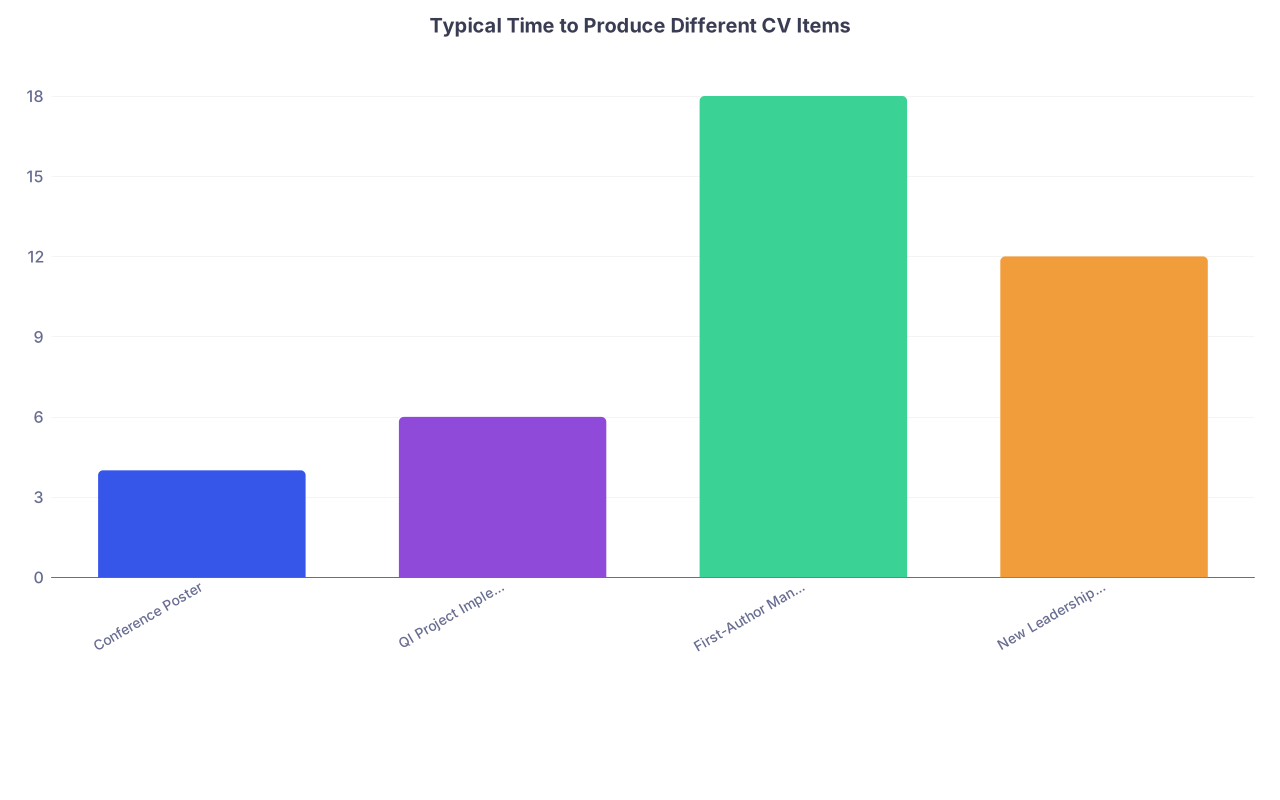
| Category | Value |
|---|---|
| Conference Poster | 4 |
| QI Project Implemented | 6 |
| First-Author Manuscript | 18 |
| New Leadership Role | 12 |
(Time in months for an average student / resident starting from zero.)
Simple QI projects that are actually doable
Pick something small, measurable, and hated by everyone:
- Reduce discharge instruction errors on your medicine ward
- Cut missed VTE prophylaxis orders in surgical patients
- Improve post‑ED follow‑up scheduling for high‑risk patients
- Decrease delayed antibiotic administration for sepsis alerts
Basic template:
- Define the problem in one sentence
- “30 percent of our COPD admissions are missing documented inhaler teaching.”
- Measure baseline for 2–4 weeks
- Simple Excel spreadsheet. 20–50 patients is enough to start.
- Implement a tiny intervention
- A checklist box in the note
- A one‑page nurse education reminder
- A standardized discharge dotphrase
- Re‑measure for another 2–4 weeks
- Summarize and present locally
- Department conference, M&M, resident noon conference
- Turn it into a poster or abstract
- Many hospital or regional QI meetings will accept these quickly.
This one project can become:
- 1–2 CV lines under QI
- 1 poster / abstract
- 1 talking point for interviews
- Evidence of your commitment to a given specialty (if relevant)
Step 4: Manufacture Specialty‑Specific Depth (Even If You Started Late)
Programs hate uncertainty. A thin CV that looks “generic” reads as: this applicant might not actually want our field.
You have to clearly answer: Why this specialty? Why you?
If you are early (≥ 6–12 months before application)
Do three things:
- Join the specialty interest group and actually do something
- Create a small workshop
- Host residency panel nights
- Organize a skills day (suturing, ultrasound, etc.)
- Plug into a faculty mentor in that specialty
- Ask to attend their clinics, OR days, or rounds once a week
- Attach yourself to one scholarly or QI project in that specialty
- Even a small chart review is fine if it clearly links to the field
If you are late (≤ 6 months before ERAS submission)
You cannot build depth across everything. So you focus.
Concrete moves:
- Request an early sub‑I or acting internship in your target field.
- Show up early, stay late, read about your patients, volunteer for tasks. You want a letter that says “This student worked at an intern level.”
- Ask your specialty mentor for a narrow, fast‑track project
- Case report from an interesting patient
- “Mini‑review” for a departmental newsletter
- Extending an existing study with a small add‑on dataset
- Write a very focused personal statement that ties your scattered experiences into one story arc: “I started late, but here is the concrete work I have done in the last X months to commit to [specialty].”
Step 5: Turn “Nothing” Into 3–4 Strong Teaching Entries
Many applicants do not realize how much teaching they already do informally. Programs love applicants who teach.
Here’s how to turn informal teaching into CV‑worthy entries:
Options that work within 1–4 months
- Formalize ad‑hoc tutoring
- If you already help classmates with pharm or anatomy, ask the course director if you can become an official tutor for the next block.
- Start a near‑peer teaching series
- Example: 4‑week “How to survive medicine clerkship” series for MS2s.
- Advertised via email, sign‑in sheet, short feedback form.
- Create a micro‑curriculum
- One‑page “ED approach to chest pain for MS3s”
- Short slide deck on “Basics of ventilator settings” for interns.
Log each session: topic, audience, date, approximate attendance. Now you have:
- “Founder, MS2 Step 1 review series – weekly 1‑hour sessions for 3 months.”
- “Near‑peer teacher, Physical exam workshop for MS1s – recurring.”
You do not need to be a superstar lecturer. You need to be organized and show initiative.
Step 6: Rebuild Leadership Without Fancy Titles
Leadership on a thin CV does not require being president of anything. Programs care about ownership and follow‑through, not name tags.
Real, believable leadership moves
- Run a small team on a project
- Coordinate 3 students collecting data for your QI project.
- Delegate, set deadlines, own the results.
- Take over a disorganized student group
- Fix the mailing list, plan 2 events per semester, document attendance.
- Lead a clinic workflow change
- Work with nurses/MA staff to standardize a pre‑visit checklist.
Document what changed because of your work:
- “Increased event attendance from 5 to 25 average participants.”
- “Cut average patient intake time from 20 to 12 minutes.”
- “Coordinated 4‑person team to complete data collection 4 weeks ahead of schedule.”
That is leadership. Way more compelling than “Member, X Club 2019–2023.”
Step 7: Rewrite Your CV So It Does Not Look Thin
Many applications look worse than they are because the CV is lazy and vague. You cannot afford that.
Common problems I see:
- Bullet points that are job descriptions, not accomplishments
- “Responsible for…” / “Duties included…”
- Missing metrics
- No numbers, no outcomes, nothing measurable
- Jargon or acronyms that only your school understands
How to fix one weak line
Original:
“Volunteer, free clinic”
Improved:
“Student clinician, urban free clinic – provided longitudinal primary care to ~30 uninsured patients over 18 months, including chronic disease management and patient education.”
Another one:
Original:
“Member, internal medicine interest group”
Improved:
“Programming coordinator, Internal Medicine Interest Group – organized 3 resident–student panels and 2 skills workshops (average attendance 25), developed resident mentorship sign‑up process for 40+ students.”
Ask yourself for every line: So what? What changed because I existed?
If you cannot answer, either change how you write it or stop doing that activity and move to something higher yield.
Step 8: Align Your Fix Timeline With the Match Calendar
If you do not map your build plan to the actual ERAS timeline, you will waste effort on things that will not materialize in time.
Here is a realistic build window for most items:
| Activity Type | Minimum Useful Time Before ERAS |
|---|---|
| New QI project | 4–6 months |
| Conference poster | 3–9 months |
| Manuscript submission | 9–18 months |
| New teaching series | 2–4 months |
| New leadership role | 4–12 months |
| New clinical experience | 1–3 months |
If you have 12+ months before applying
You can:
- Start and finish at least one solid QI project
- Get a poster or abstract submitted
- Build a real teaching role
- Accumulate 1–2 substantial leadership experiences
If you have 6–12 months
Focus like a laser:
- One QI or research project tied to your specialty
- One sustained teaching or leadership role
- Strong sub‑I and letters
If you have < 6 months
You are in salvage mode, not perfection mode:
- Double down on:
- Sub‑I / acting internships
- Tight letters of recommendation
- A small, fast, visible project (QI, teaching, or systems fix)
- Reframe your narrative: “Late start, steep ramp‑up, clear direction now.”
Do not start a brand‑new research project that cannot possibly produce anything citable before you apply. That is CV theater, not strategy.
Step 9: Use LORs and Personal Statement To Amplify Your Fixes
Thin CV applicants often over‑focus on raw entries and under‑use the tools that can interpret those entries.
Letters of recommendation (LORs)
You want at least one letter that directly addresses your “thin” area:
- If your research is light → letter from a QI or project mentor emphasizing initiative, persistence, and learning curve.
- If leadership is thin → letter from someone who saw you own a clinic, team, or project.
- If Step scores are average → letter that explicitly says you function at or above the level of stronger test‑takers.
Ask your letter writers directly:
“My application is lighter on [X]. It would help me if your letter could comment specifically on my [work ethic/clinical reasoning/team leadership] during [project/rotation].”
Good attendings appreciate the clarity.
Personal statement
Your statement is not where you apologize. It is where you show the inflection point.
Clean structure:
- A brief clinical or personal moment that explains your specialty interest.
- A frank, one‑sentence acknowledgment of your late or thin start.
- “I came to [specialty] later than many of my peers, but the last year has been defined by deliberate work to close that gap.”
- Concrete evidence: sub‑I performance, QI/teaching/leadership, specialty‑specific mentoring.
- Forward‑looking close: how you will bring this persistence to residency.
You are not asking for pity. You are making it easy for programs to see an upward trajectory instead of a random scatter.
Step 10: Build a Ruthless Weekly Execution Plan
None of this matters if you keep saying “I’ll work on my CV when things calm down.” They will not.
You need a simple weekly structure:
- 1 block of 2–3 hours protected for scholarly/QI work
- 1 block of 1–2 hours for teaching prep or leadership tasks
- 30 minutes for CV / ERAS maintenance (updating entries, tracking outcomes)
Put it on your calendar like a shift. Non‑negotiable.
A basic 8‑week micro‑plan could look like this:
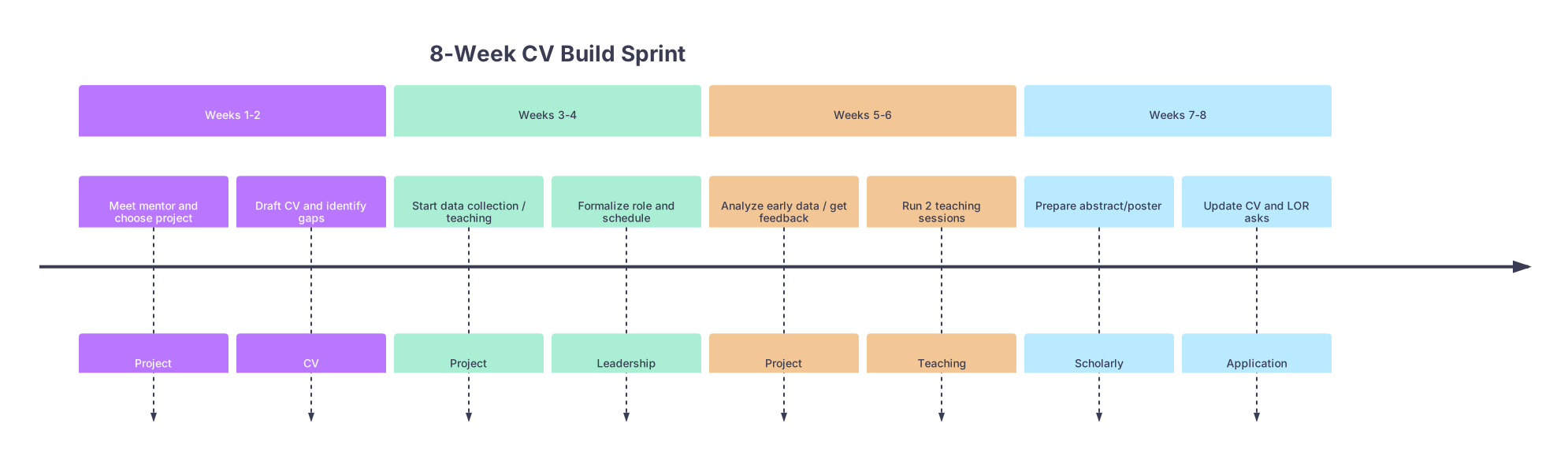
| Period | Event |
|---|---|
| Weeks 1-2 - Meet mentor and choose project | Project |
| Weeks 1-2 - Draft CV and identify gaps | CV |
| Weeks 3-4 - Start data collection / teaching | Project |
| Weeks 3-4 - Formalize role and schedule | Leadership |
| Weeks 5-6 - Analyze early data / get feedback | Project |
| Weeks 5-6 - Run 2 teaching sessions | Teaching |
| Weeks 7-8 - Prepare abstract/poster | Scholarly |
| Weeks 7-8 - Update CV and LOR asks | Application |
You are not trying to become a different person in 8 weeks. You are trying to create 2–3 undeniable signals that you are serious, reliable, and improving.
Putting It All Together: A Sample Before/After
Let me spell out how this looks, because abstract advice will not fix your CV.
Starting point (MS4, 8 months before ERAS)
- Few activities, generic:
- Volunteer, free clinic (1 line)
- Member, IM interest group
- 1 poster from random MS2 summer project, not related to your intended specialty
- Average Step 2, decent clerkship comments
8‑month rebuild plan
Month 1–2:
- Meet with IM QI lead → join project on reducing readmissions for HF patients.
- Start structured near‑peer teaching: “MS3 prep for medicine clerkship” (monthly).
- Take on programming role for IM interest group (plan 2 events).
Month 3–5:
- Collect and analyze QI data.
- Run 3–4 teaching sessions, gather feedback forms.
- Organize 2 IM‑related events with good attendance.
Month 6–8:
- Present QI data at department noon conference; submit abstract to regional IM meeting.
- Get letters from: QI mentor, medicine sub‑I attending, teaching faculty.
- Rewrite CV with outcome‑focused bullets and updated roles.
Resulting CV signals
- QI: “Co‑lead, HF readmission QI project – analyzed 120 admissions, implemented discharge checklist, observed 15 percent reduction over 3 months; presented at departmental conference and submitted abstract to [Meeting].”
- Teaching: “Founder, MS3 medicine prep series – designed and delivered 4 interactive sessions for 35 students with >90 percent rating sessions as ‘very helpful’.”
- Leadership: “Programming coordinator, IM interest group – planned 3 resident panels and 2 skills workshops, increasing average attendance from 8 to 30 participants.”
Exact same person. Very different application.
Key Takeaways
- A “sparse” CV is usually a strategic problem, not a permanent weakness. One or two anchor projects plus better framing can change how your record looks in under a year.
- QI, near‑peer teaching, and small but real leadership roles are fast, high‑yield ways to add depth that programs actually respect.
- Align your efforts with the Match timeline, and then protect weekly time to execute. No magical thinking. Just consistent, targeted work.
FAQ
1. Is it even worth applying this cycle if my CV is still thin?
Sometimes no. If your scores are borderline for your specialty, your CV is very light, and you have not yet started any of the fixes above, a strategic delay (with a structured gap year of QI/research/clinical work) can be smarter than a weak application that burns money and programs. If you can build at least one serious project, obtain strong letters, and clearly show an upward trajectory in the next 6–12 months, then applying can be reasonable. The honest answer depends on your specialty, scores, and how quickly you execute.
2. How many projects or leadership roles do I actually need to be “competitive”?
You do not need a dozen line items. For most non‑ultra‑competitive specialties, 1–2 substantial projects (research or QI), 1 sustained teaching or leadership role, and evidence of good clinical performance with strong letters are enough to move you out of the “sparse and concerning” category. Depth beats breadth. A single, well‑executed QI project plus a real teaching series will always outrank five superficial club memberships.