
The worst thing about having no research on your CV is not the gap. It is wasting another year pretending you will “get involved in research soon” without a concrete plan.
You want residency. You have little or no scholarly output. Programs in your specialty openly say they value research. You are behind. But you are not dead in the water—if you attack this strategically and stop doing what most students do: sending one email every three weeks and calling it “trying.”
Here is how you fix it.
Step 1: Be Honest About Where You Are and What You Need
First, you need a clear diagnosis. No vague hand‑waving.
Ask yourself, right now:
- Do I have zero research items?
- Do I have some exposure (helped but no authorship, or unfinished projects)?
- Do I have posters or abstracts, but no manuscripts?
Then match that to your specialty’s expectations.
| Specialty Type | Competitive Level | Typical Expectation by Programs |
|---|---|---|
| Community FM / IM | Low | Any research is a plus, not required |
| Mid-tier IM, Peds | Moderate | 1–2 posters or abstracts helpful |
| Hospitalist-focused IM | Moderate | QI or clinical projects valued |
| EM, Anesthesia | Moderate-High | Some research or QI strongly preferred |
| Derm, Plastics, Ortho, ENT, Rad Onc | Very High | Multiple pubs/abstracts; strong research |
If you are:
- Applying to highly competitive specialties and have zero research: you need to treat research like a second job.
- Applying to less competitive specialties: even one solid project (poster, QI, case series) can move your application from generic to interesting.
The key point: you are not trying to become an R01-funded PI. You are trying to build credible, documentable scholarly output in 6–18 months.
Your targets should be:
Short term (3–6 months):
- 1–2 case reports, letters, or short communications submitted.
- At least one poster/abstract submitted to a regional or national meeting.
Medium term (6–12 months):
- 1+ accepted abstract/poster.
- 1+ manuscript submitted; ideally accepted or in revision.
- 1 QI project started and documented.
Once those targets are clear, you can work backward.
Step 2: Stop Cold Emailing Random Faculty – Build a Tight Target List
If your current strategy is “email 30 attendings with the subject line ‘Research?’ and hope someone replies,” stop. That is why you have no projects.
You need a focused, systematic approach.
2.1 Build a target list in 1–2 days
Do this like a serious job search:
Go to your institution’s website
- Search your specialty department + “publications” or “research.”
- Open faculty profiles of people who:
- Publish regularly (recent PubMed entries).
- Work in areas you can at least understand.
Pull recent PubMed entries for each faculty
- Look for:
- Case reports
- Retrospective chart reviews
- QI/education papers
Those are entry points for you.
- Look for:
Score each faculty (1–3) on:
- 3 = publishes often, clinical / QI focus, not obviously overbooked with senior researchers only
- 2 = some output, mixed work, may take students
- 1 = very basic or very PI-heavy (likely hard to break in as a novice)
Target the 2s and 3s. You want people who actually finish projects.
If you are at a school without strong research infrastructure, expand your target list:
- Nearby academic centers (especially if you can do away rotations).
- Virtual collaborations (multi-center chart reviews, online QI collaboratives).
- National organizations with trainee sections (ACP, ACOG, ACEP, etc.).
Step 3: Use Emails That Actually Get You Projects
Most student emails are vague, low‑effort, and easy to ignore. You need to send something that:
- Shows you have done your homework.
- Offers concrete, low-risk help.
- Signals that you understand their time is the limiting factor, not yours.
Here is a template that works:
Subject: Medical student available to support existing projects in [Specific Area]
Dear Dr. [Name],
I am a [MS3/MS4/recent graduate] interested in [specialty] and particularly drawn to your work on [very brief, specific topic – 1 sentence referencing a recent paper or project].
I have [briefly list skills: e.g., experience with Excel, basic statistics, data collection, literature review, or prior non-medical research]. I am looking to contribute to ongoing projects where I can help with:
- Data collection or chart review
- Literature searches and reference management
- Drafting sections of abstracts or manuscripts
I can commit [X hours/week] consistently over the next [Y months]. I am comfortable working under close guidance and meeting clear deadlines.
Would you be open to a brief 15–20 minute meeting so I can learn about your current projects and see if there is a place where I can be useful?
Thank you for your time and consideration.
Best regards,
[Name]
[Year, School]
[USMLE/COMLEX scores if strong, optional]
Two critical points:
- You offer specific tasks. Not “anything.”
- You specify time commitment and timeline.
If you send 10 of these to well-chosen faculty, you will get meetings. If you do not, refine and send 10 more. This is a numbers game, but with targeted numbers.
Step 4: Prioritize Fast-Track Project Types
Some projects will not help you in the time frame you have. A basic science lab project starting now will not save your upcoming application cycle. Do not sign onto year-long experiments if you are 6–9 months from ERAS.
You want shorter cycle, high-yield projects:
-
- Fastest path to first PubMed entry for most students.
- You can often identify cases during rotations.
How to operationalize:
- Tell residents and attendings: “If you have an unusual or instructive case, I would like to help write it up.”
- Keep a running list of interesting patients.
- Check with your attending: Is this publishable? Where?
- Use a standard case report structure and journal template from day one to avoid rewrites.
-
- Good balance: feasible, citable, and often needed by faculty.
- Requires IRB, but many mentors have ongoing approved protocols.
Your leverage:
- Offer to do the grunt work: chart abstraction, data cleaning, basic stats (once trained).
- Make yourself the person who makes the data set usable.
Quality Improvement (QI) Projects
- Very residency-friendly; many programs care more about QI than bench research.
- Good for IM, peds, FM, EM, anesthesia, even surgery.
Examples:
- Improving vaccination rates on a ward.
- Reducing unnecessary lab orders.
- Improving discharge instruction documentation.
The key: document it as scholarly:
- Define baseline data, intervention, post-intervention data.
- Aim to present at a hospital QI day or regional meeting.
- Write it as an abstract; submit to a conference.
Education Projects
- Curriculum design, simulation scenarios, OSCE development, etc.
- Especially valuable if you are leaning toward academic medicine.
But: make sure it has an output—poster, workshop, published education brief.
Avoid:
- “We are planning a big RCT starting next year” if you are applying this September.
- Projects where authorship is unclear or where students have historically been buried as “Group Member 12.”
Step 5: Lock in Authorship Expectations Upfront (Without Being Awkward)
I have watched too many students do 80 hours of data work and end up as an acknowledgment sentence. That is not cynical; that is how sloppy authorship planning goes.
You prevent that early, respectfully.
During early meetings, say something like:
“I am very motivated to contribute meaningfully to a project where, if I do enough work and follow through, I can earn authorship. Can we clarify what level of contribution you would consider for authorship on abstracts and manuscripts?”
Good mentors will:
- Outline expectations (e.g., major role in data collection + contribution to writing).
- Make it explicit that authorship is available if you meet those standards.
If they dodge the question or seem vague (“we will see later”), think carefully. You are short on time; you cannot afford “maybe” projects.
Step 6: Treat Research Like a Rotation, Not a Hobby
This is where most students fail. They have a project, they are nominally on the team, but nothing gets finished. Programs do not care that “you helped on some research” if it never turns into something you can list.
You need structure.
6.1 Set hard weekly hours
Minimum if you are serious:
- In preclinical or research time: 8–12 focused hours/week.
- On busy rotations: 3–5 focused hours/week.
Put it on your calendar like a shift. Protect it.
6.2 Use short execution sprints
Break projects into 1–2 week chunks:
- Week 1–2: Complete literature review and outline.
- Week 3–4: Finish IRB draft or data collection template.
- Next 2 weeks: Abstract first draft.
- Next 2 weeks: Manuscript first draft sections.
At every stage, send concrete updates:
“Attached is the first draft of the abstract with background, methods, and results sections completed. Next I will refine the discussion once we finalize the conclusions.”
People respond to students who move work forward without constant chasing.
Step 7: Build Multiple Small Wins Instead of Chasing One Big One
If you have no research, your goal is volume of credible output, not one perfect paper years from now.
An application with:
- 1 accepted poster
- 1 national conference abstract submission
- 1 case report submitted
- 1 QI project presented locally
…looks better than:
- “I am working on a big prospective study, hoping to submit a manuscript someday.”
Aim for a portfolio of smaller wins.
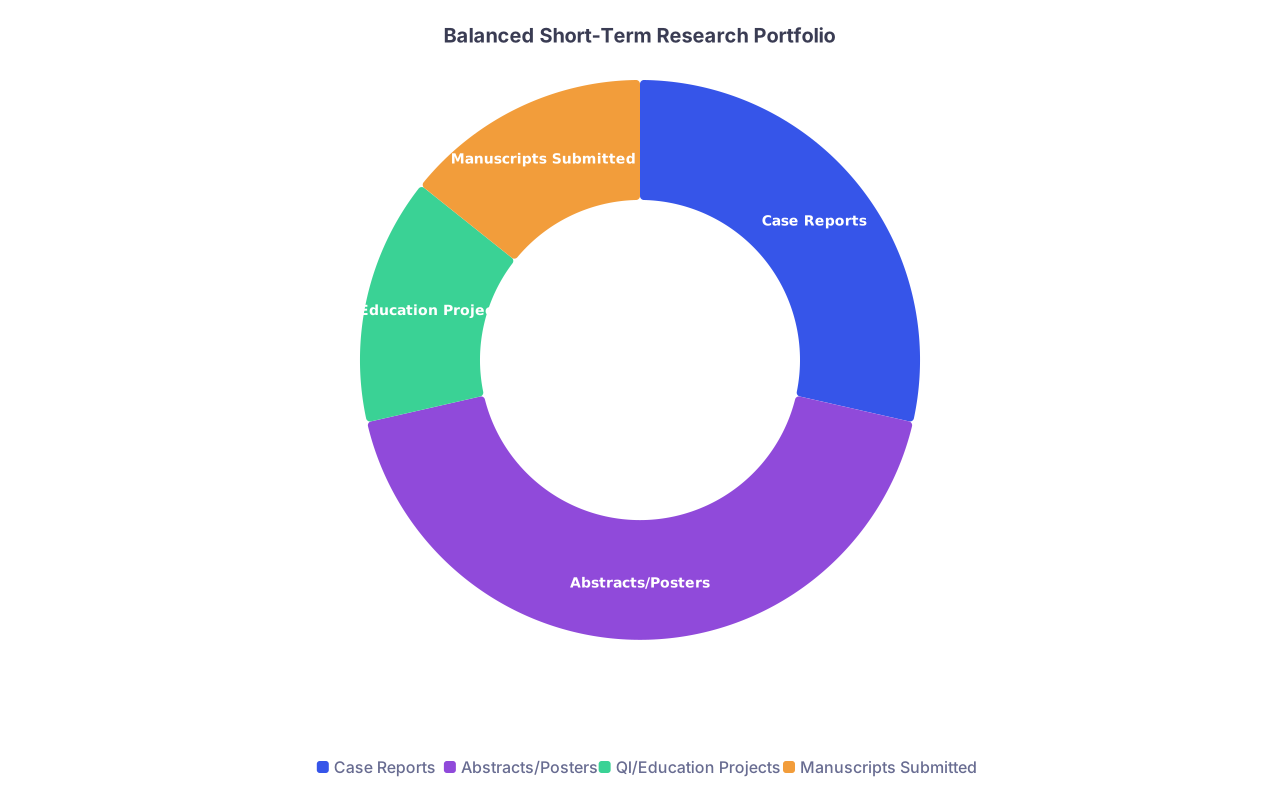
| Category | Value |
|---|---|
| Case Reports | 2 |
| Abstracts/Posters | 3 |
| QI/Education Projects | 1 |
| Manuscripts Submitted | 1 |
This balance makes you more resilient if one paper gets rejected or stalled.
Step 8: Use Conferences as Force Multipliers
Even if you do not get a first-author NEJM paper, you can still look academically engaged. That is often enough for many programs.
Targets:
- Institutional Research Day
- State or regional specialty meetings
- National general meetings (ACP, AAFP, AAP, SAEM, ATS, Society of Hospital Medicine, etc.)
Why conferences matter:
- Abstract acceptance is easier than manuscript acceptance.
- You can list “Accepted abstract” in ERAS even before the meeting happens.
- You meet future letter writers in your field.
Your strategy:
- Ask your mentor early: “Can we target [specific meeting] with this project?”
- Work backward from abstract deadlines (often 4–9 months before the meeting).
- Do not aim only for the biggest national meeting if there is a more realistic regional one with an earlier deadline.
Step 9: If You Truly Have No Access – Create Your Own Scholarly Work
Some of you are in small community programs or international schools with minimal research culture. Fine. You can still build data-backed, citable work. It requires more initiative but less permission.
9.1 Start with structured, publishable “low-barrier” items
Examples:
- Clinical review articles (narrative reviews) in lower-impact or regional journals.
- Educational toolkits (checklists, curricula) submitted to medical education journals.
- Clinical images sections (e.g., classic dermatology, radiology images) where text is minimal but structured.
You still need:
- A faculty co-author for credibility.
- Some basic literature review structure (PRISMA-like if systematic).
You can approach a willing clinician like this:
“I would like to write a structured review on [narrow topic you see often here], with you as senior author. I can handle the literature search and first draft. Would you be open to that if we agree on a target journal?”
Give them a clear, narrow topic, not “everything about sepsis.”
9.2 Quality improvement as your main lane
QI is very doable almost anywhere:
- Identify a specific, measurable problem on your ward or clinic.
- Measure baseline (chart review over X weeks).
- Implement a simple intervention (education, checklist, order-set change).
- Re-measure.
- Write it up: aim first for your hospital QI day, then a small journal or meeting.
You get:
- A project you led.
- A story to tell in interviews about improving care systems.
- A line item under “Scholarly Activity.”
Step 10: Document Everything Aggressively for ERAS
You are not done when the project “exists.” You are done when it is clearly visible on your application.
Types of entries you can legitimately list:
- Peer-reviewed manuscripts (published, accepted, or submitted – marked correctly).
- Abstracts and posters (accepted or presented).
- Oral presentations.
- Institutional QI presentations.
- Online or regional publications (properly labeled).
Keep a running spreadsheet with:
- Project title
- Your role
- Dates (start, submission, acceptance)
- Venue (journal, conference, institution)
- Status (in progress / submitted / accepted / published)
| Project Type | Title (Short) | Role | Status |
|---|---|---|---|
| Case report | Atypical DKA in Teen | 1st author | Submitted |
| QI project | Improving Med Rec | 2nd author | Abstract accepted |
| Poster | COPD Readmissions | 3rd author | Presented |
| Review | Hyponatremia in Elderly | 1st author | In draft |
When ERAS time comes, you will not be guessing dates or scrambling to remember co-authors. You will drop these in cleanly.
Step 11: Reframe the “No Research” Narrative in Interviews
Even with new output, you may not match the research volume of MD/PhD applicants. Fine. You need to control the narrative.
In interviews and personal statements:
Own the prior gap without excuses.
- “I did not prioritize research early in medical school, and I realized later that I was missing an important piece of my training.”
Show your corrective action clearly.
- “Over the last year, I have contributed to [X] projects, including [brief example]. I focused on projects that taught me how to ask answerable questions and finish what we start.”
Connect it to your future as a resident.
- “Now that I understand the workflow—IRB, data collection, abstract and manuscript writing—I feel prepared to continue quality improvement and clinical research in residency.”
Programs care less about where you were and more about whether you can recognize a weakness, fix it, and produce results.
Step 12: Timeline: What You Can Realistically Achieve Before an Upcoming Match
Let us make this painfully concrete. Assume you have 0 research now and 12 months to ERAS submission.
Here is a realistic, aggressive timeline:
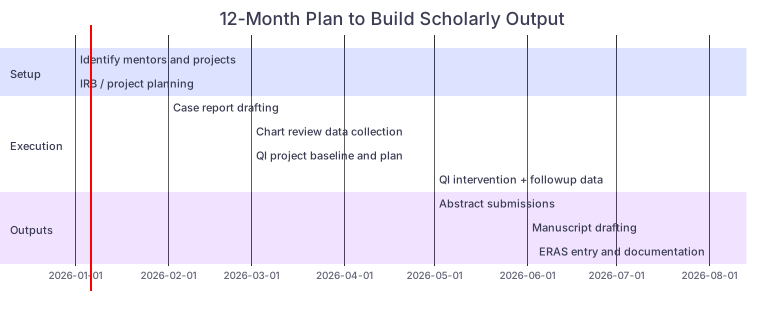
| Task | Details |
|---|---|
| Setup: Identify mentors and projects | a1, 2026-01, 1m |
| Setup: IRB / project planning | a2, after a1, 1m |
| Execution: Case report drafting | b1, 2026-02, 2m |
| Execution: Chart review data collection | b2, 2026-03, 3m |
| Execution: QI project baseline and plan | b3, 2026-03, 2m |
| Execution: QI intervention + followup data | b4, 2026-05, 3m |
| Outputs: Abstract submissions | c1, 2026-05, 3m |
| Outputs: Manuscript drafting | c2, 2026-06, 3m |
| Outputs: ERAS entry and documentation | c3, 2026-08, 1m |
By the time ERAS opens, you can realistically have:
- 1–2 case reports submitted (maybe 1 accepted).
- 1 retrospective project with at least an abstract submitted.
- 1 QI project with local presentation.
- Multiple lines of concrete scholarly work to list.
Is this comfortable? No. But it is doable if you stop waiting for “the perfect project” and start executing.
Step 13: Do Not Ignore the “Soft” Research Skills
The dirty secret: faculty keep students who reduce friction.
If you want repeat projects and stronger letters, learn the unglamorous parts:
- Reference managers (Zotero, Mendeley, EndNote)
- Basic stats vocabulary (p-values, confidence intervals, logistic regression)
- Clean data entry (no random abbreviations, consistent formats)
- Journal formatting basics (cover letters, responding to reviewer comments)
You do not need to be a statistician. You do need to be the student who:
- Names files logically.
- Meets deadlines.
- Sends clean drafts with track changes.
Those are the students mentors think of first when a new project comes up.
Your Move Today
Do not “think about this.” Do one concrete thing right now:
Open a blank document and create a list of 10 potential mentors in your target specialty at your institution (or nearby). For each, write:
- One specific paper or project they worked on.
- One way you could realistically help.
Then send 3 targeted emails using the template above before you close your laptop.
You do not fix a zero‑research CV by worrying about it. You fix it by getting yourself onto real projects, finishing them, and turning them into visible output. Start that process today.