It is January of MS3. Your last shelf exam wiped you out. Your Step 2 date is circled on the calendar. You open up your CV and ERAS draft and feel that sinking feeling:
Decent school. Mid-240s on Step 1 (or a “Pass” and a solid Step 2 practice range). A couple of poster presentations. Some volunteer stuff from MS1. Nothing terrible.
But nothing that screams: “Rank me high.”
You are not a disaster. You are also not a lock for your dream programs. You are in the huge, gray middle where thousands of applicants live. And how you use MS3–MS4 is what separates “solid match” from “why did I slide down my list?”
Let me be blunt: from here on out, you do not have time to do everything. You do have time to do the right things, done aggressively and strategically.
Here is how to upgrade a mid-tier CV—efficiently—between now and Match.
Step 1: Get Ruthlessly Clear on Your Target and Your Gaps
Before you add a single line to your CV, you need to know what actually matters for your specialty and your tier of programs.
1. Pick Your Target Tier and Specialty
If you are still undecided between, say, internal medicine vs anesthesiology vs EM, you cannot “optimize” anything. You will just collect random activities.
Decide:
- Primary specialty target (e.g., IM, gen surg, psych, EM, OB/GYN, radiology, etc.)
- Competitiveness tier:
- Hyper-competitive (derm, plastics, ortho, ENT, neurosurg)
- Competitive (EM, anesthesia, rads, OB/GYN, gen surg at strong places)
- Less competitive but still selective at top programs (IM, peds, psych, FM)
Once you commit to a lane, your decisions get easier.
2. Do a 10-Minute Gap Analysis
Pull up 5–10 current residents’ CVs from programs you like. Many have profiles with bios listing:
- Where they went to med school
- Research output
- Leadership roles
- Special interest areas
Compare yours to theirs.
Be honest and specific:
- Clinical: Honors? Comments about “a pleasure to work with”?
- Research: Any first-author? Specialty-related? Or scattered and weak?
- Leadership: Any real role where you supervised or ran something?
- Service: Anything that shows consistency or depth?
- Networking: Any faculty who would fight for you?
Write down, in plain language:
“I look weaker than them in: ______ and ______. I am competitive in: ______.”
Those blanks are your targets for MS3–MS4. Not “do more stuff.” Fix those.
Step 2: Use Your Rotations as CV Ammunition (Not Just Grades)
Most MS3s think of rotations as: “Get Honors if I can, don’t screw up if I can’t.”
You need to think: “Every rotation is an audition and a letter-of-rec factory.”
1. Turn Attendings into Advocates, Not Just Evaluators
On every key rotation related to your specialty goals:
- Identify 2–3 potential letter writers per rotation (attendings or fellows).
- In week 1, tell them directly:
- “I am strongly leaning toward [specialty]. I want to get feedback and grow as much as I can on this rotation.”
- Ask for real-time feedback:
- “Is there one thing I could do tomorrow that would make me function more like an intern on this team?”
- Ask for specific tasks that hit their pain points:
- Pre-charting
- Drafting notes
- Following up on consults
- Calling families with them listening in
Good letters are not “smart student.” They are:
- “This student functioned like a subintern.”
- “This is one of the strongest MS3s I have worked with in the last 5 years.”
You earn that with initiative plus coachability.
2. Convert Clinical Work into Concrete Bullet Points
Do not just rely on “Clerkship Honors” to show you are good clinically.
You want bullets on your CV that sound like:
- “Developed and implemented a handoff template used by MS3s on the [hospital] medicine service to reduce omissions in sign-out.”
- “Created a 1-page pediatric fever evaluation guide adopted by residents on night float.”
You can do this during rotations if you watch for inefficiencies:
- Is the sign-out format terrible? Propose a better one, pilot it for a week with residents, then write it up as a “quality improvement” or “educational tool.”
- Are students constantly confused about common orders? Build a 1–2 page, faculty-approved tip sheet.
Then you have:
- Something to show programs
- A near-effortless “scholarly activity” or med-ed poster
Step 3: Add High-Yield Research the Smart, Fast Way
You are not going to suddenly become a derm R01 machine in 9 months. But you absolutely can add 2–4 meaningful specialty-related lines to your CV if you stop chasing “cool” and chase “finishable.”
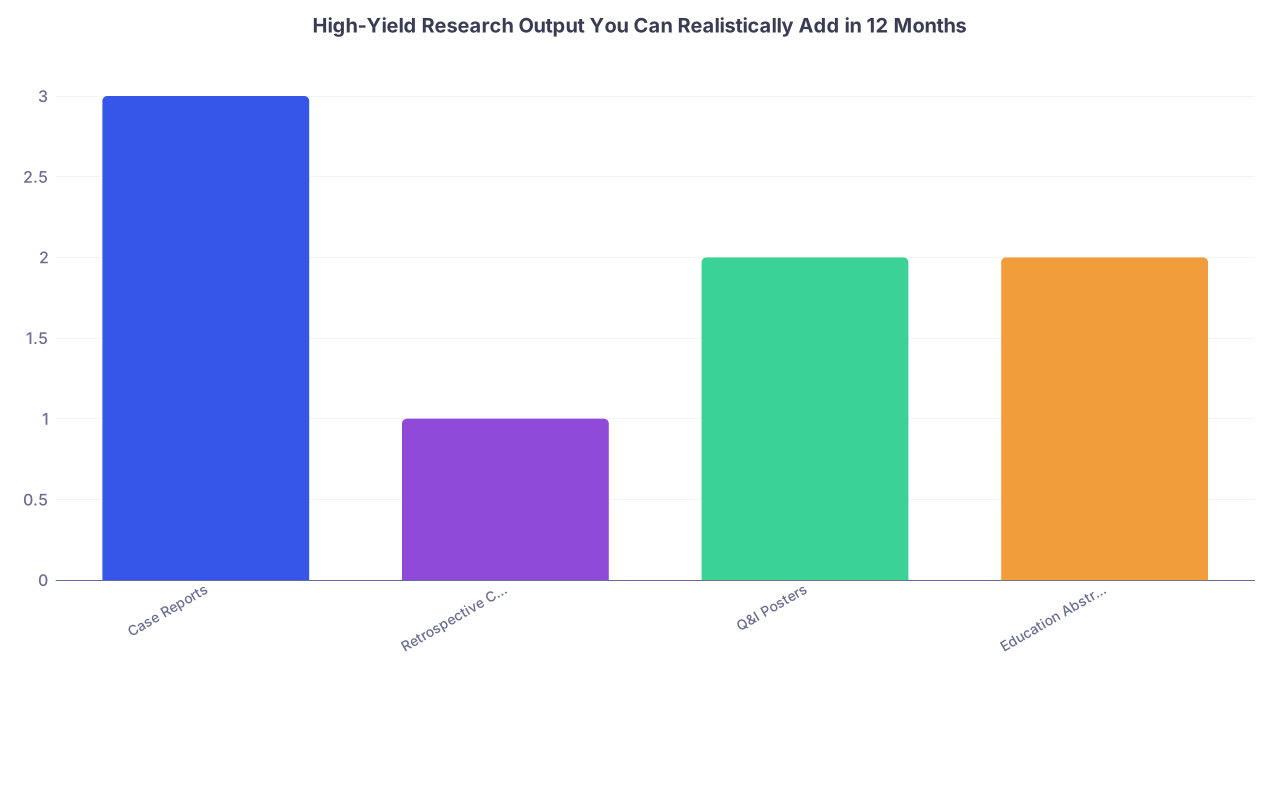
| Category | Value |
|---|---|
| Case Reports | 3 |
| Retrospective Chart Reviews | 1 |
| Q&I Posters | 2 |
| Education Abstracts | 2 |
1. Choose Projects That Can Realistically Finish
Rank research types by speed and control:
- Case reports / case series
- Timeline: 2–4 months to submit
- You control most of the writing
- Retrospective chart review
- Timeline: 6–12 months
- Faster if data already pulled or project is ongoing
- Q&I or med-ed projects
- Timeline: 4–10 months
- Poster at local/regional conferences is realistic
- Basic science / prospective trials
- Too slow for late MS3–MS4 rescue in most cases
You want #1 and #3 on your plate if you are late to the game.
2. How to Actually Get Added to a Project (Not Ghosted)
Faculty get dozens of “do you have any research?” emails. Most are vague and useless.
Do this instead:
Identify 3–5 faculty in your target specialty at your school or affiliated hospitals.
- Look for those with multiple first-/senior-author papers in last 3 years.
- Bonus if they serve on program leadership or are known letter-writers.
Email with a specific ask and a small offer of free labor:
- Subject: “Med student interested in [specialty] – willing to help on existing projects”
- Body (tight):
- Who you are (MS3, interested in X specialty)
- 1–2 sentence background (scores + any prior research)
- Explicit offer: “I am available 4–6 hours/week and comfortable with [chart review / data entry / writing first drafts / basic stats]. I am happy to help on active projects, including case reports, chart reviews, or abstract preparation.”
Add a concrete line:
- “If you have any ongoing projects that need a motivated student to push them across the finish line, I am very interested.”
You are not asking them to invent a project. You are volunteering to finish their half-done work. That is the fastest path to your name on something.
3. Aim for “Submitted” or “Accepted,” Not “Someday”
Programs care more about things that are completed or at least submitted.
Your target by ERAS submission:
- 1–2: Submitted case reports (ideally in your chosen specialty)
- 1–2: Local or regional posters (Q&I, med-ed, or small clinical studies)
If you are in a hyper-competitive field (derm, ortho, plastics) and currently have zero research, you probably need:
- 4–6+ pieces (even if some are posters / abstracts) and
- At least 1–2 things clearly first- or second-author
Is that aggressive? Yes. That is what the competition is doing.
Step 4: Build One Strong, Coherent “Story” Lane
Mid-tier CVs look generic because they are scattered:
- One psych project
- One surgery QI
- Volunteer at a student-run clinic
- Tutor for Step 1
- Some random global health interest
Programs want patterns. Coherent interest.
You fix this by choosing one lane to double down on and then retrofitting your activities around it.
1. Pick a “Theme” That Matches Your Specialty
Examples:
- IM: “Quality improvement and patient safety”
- EM: “Medical education and simulation”
- Psych: “Community mental health and underserved populations”
- OB/GYN: “Reproductive health equity”
- Anesthesia: “Perioperative outcomes and safety”
Once you pick a lane, you:
- Choose research in that theme when possible
- Choose leadership roles that touch it
- Frame past activities in those terms on your CV and in your personal statement
2. Reframe Existing Work to Fit Your Lane
Example: You did gen surg QI on reducing readmissions.
If your lane is “patient safety and QI in IM,” you describe it as:
- “Quality improvement project on reducing postoperative readmissions, developing skills in root cause analysis and PDSA cycles, now applying similar framework to medical readmissions on the medicine service.”
Same project. Different framing. Now it reinforces your story.
Step 5: Leadership That Actually Moves the Needle
Most leadership sections are fluff: “treasurer of student lounge committee” and “co-chair of wellness movie night.”
Those are nice. They do not move applications.
You want leadership that:
- Involves responsibility for other people
- Creates something new or fixes something broken
- Touches your specialty or your theme when possible
High-Yield Leadership Plays in MS3–MS4
Specialty Interest Group leadership (with output)
- Not just “President of EMIG”
- But: “Organized 4 simulation workshops with 20–30 students each; co-developed an EM clerkship prep guide used by >60 MS3s.”
Curriculum or exam resources
- Develop a shelf review series, OSCE prep sessions, or a clerkship survival guide.
- You can list:
- “Co-created a weekly IM shelf review session series, average attendance 15–20 students, with faculty oversight.”
Clinic or community program coordination
- “Coordinated volunteers and scheduling for student-run free clinic, supervising 10–15 volunteers monthly.”
- This signals responsibility and reliability, not just attendance.
Resident-facing contributions
- If residents trust you to help run simulation, morning report, or M&M prep, that is gold.
- You can frame:
- “Assisted chief residents in developing a new format for resident morning report with case-based board review.”
All of those are achievable in <1 year if you stop saying yes to low-yield committees and instead take one or two meaningful roles and go deep.
Step 6: Sub-Internships and Away Rotations as Multipliers
For many programs, your sub-I and any aways are your real audition. These are not just checkboxes; they are your chance to generate strong letters and “we know this person will fit here.”
1. Plan Your Sub-I Timing Strategically
If you are not a top-of-the-heap applicant, earlier sub-Is give you more time to:
- Get letters
- Course-correct if things go badly
- Adjust your application strategy
General rule:
- Try to do a sub-I in your chosen specialty by July–August of MS4.
- If doing aways (e.g., EM, ortho, neurosurg): aim for late MS3 / early MS4 if your school allows.
2. On Sub-Is, Your Goal is to Function Like a Safe, Low-Maintenance Intern
You will not be the smartest person on the team. You can be the most reliable.
Focus on:
- Showing up early, staying a reasonable amount late
- Owning your patients’ data
- Anticipating basic tasks (notes, orders, follow-ups)
- Being the person who says “I’ll take care of that” and does
Then, ask for the letter explicitly:
- “I am applying to [specialty]. If you feel you can write me a strong letter, I would be very grateful.”
If they hesitate or waffle, that is a no. Ask someone else.
You want letters that say, in plain language:
- “We would be happy to have this student as a resident here.”
That is worth more than one additional poster presentation.
Step 7: Patch the Obvious Weak Spots (Fast and Honestly)
Some applicants have one glaring CV problem:
- Very limited clinical exposure to the specialty they say they want
- Zero research in that field
- No real service or continuity work
- Red flags like a failed exam, LOA, misconduct investigation
1. Fix the “I Just Decided This Specialty Yesterday” Problem
If you just switched to a more competitive specialty late MS3, you look unserious if you have no track record.
You cannot go back in time, but you can:
- Get 1–2 shadowing or observership experiences with respected faculty (and document them)
- Start at least one small project in that specialty (case, chart review, QI)
- Get at least one letter from a faculty member in that field who can say: “In the time I have known this student, they have been focused and motivated in [specialty].”
Document shadowing or niche experiences as:
- “Observed 30+ EM shifts at [hospital], focused on resuscitation and acute care, leading to interest in EM as a career.”
- “Participated in [2-day specialty-specific workshop], including simulation and didactic sessions on [topic].”
Is that as good as 3 years of derm research? No. But it is infinitely better than nothing.
2. If You Have a Red Flag, Build a Counter-Narrative
For a failed exam, poor early grades, or a leave of absence, you need a contrasting trend:
- Strong Step 2 (or shelves)
- Strong MS3 core rotation evaluations
- Evidence of reliability and follow-through (leadership, long-term projects)
Programs accept people with rough starts if they clearly see, “That was then. This is now.”
Step 8: Make Your CV Look Stronger Without Lying
You cannot inflate your accomplishments without burning yourself on interview day. But you can absolutely present them more effectively.
| Weak Bullet Point | Strong Bullet Point |
|---|---|
| Helped with research project | Assisted with data extraction and analysis for retrospective chart review of 250 patients with sepsis, preparing abstract for regional conference |
| Volunteered at free clinic | Volunteered twice monthly at student-run free clinic, managing intake and counseling for 10–15 uninsured patients per shift under supervision |
| Member, Internal Medicine Interest Group | Co-organized 3 faculty-led career panels for Internal Medicine Interest Group with average attendance of 25 students |
| Tutored MS1 students | Led weekly small-group review sessions for 6–8 MS1 students in physiology, creating practice questions and tracking progress |
Quick CV Fixes You Can Do in One Weekend
Group related items under themes
Instead of scattered bullets:- “Research experience”
- “Quality improvement experience”
- “Teaching and education”
- “Leadership and service”
This highlights depth in certain areas.
Use action verbs plus impact
Bad: “Involved in project on COPD readmissions.”
Better: “Performed chart review of 150 COPD readmissions to identify barriers to follow-up, informing new discharge checklist.”Cut low-yield clutter
If something:- Was <10 hours total
- Has no clear impact
- Is irrelevant to your story
Either cut it or compress it into a line under “Other experiences.”
Your CV should look like a focused, intentional progression, not like a random activity log.
Step 9: Match Your Strategy to Your Timeline
Your tactics change depending on where you are in MS3–MS4.
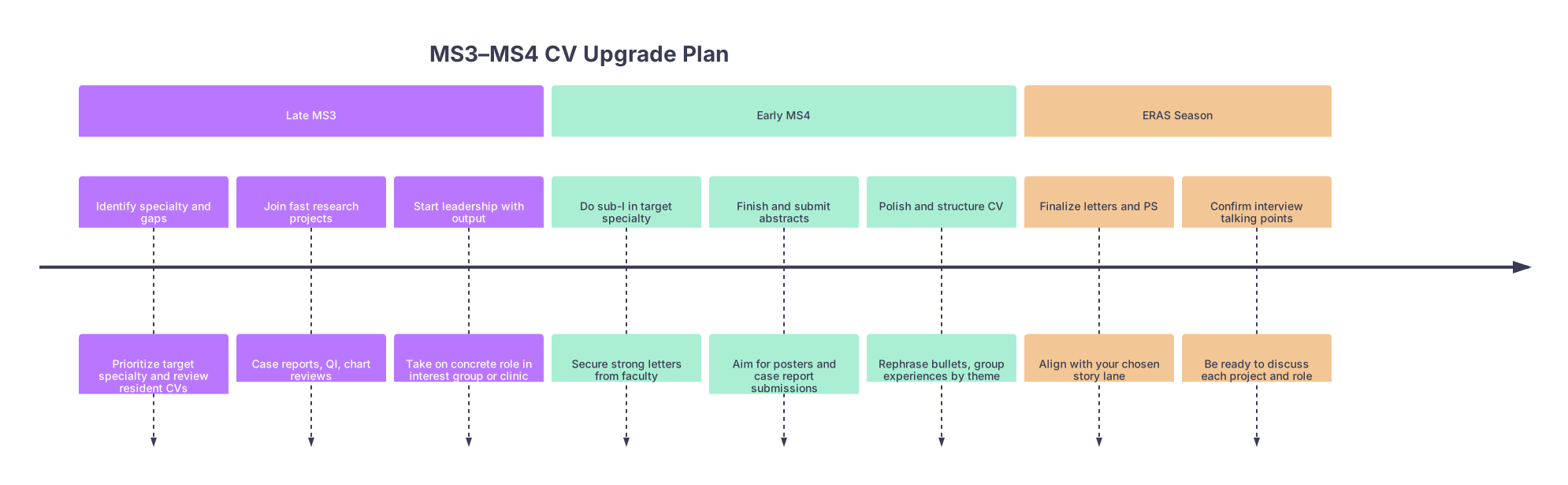
| Period | Event |
|---|---|
| Late MS3 - Identify specialty and gaps | Prioritize target specialty and review resident CVs |
| Late MS3 - Join fast research projects | Case reports, QI, chart reviews |
| Late MS3 - Start leadership with output | Take on concrete role in interest group or clinic |
| Early MS4 - Do sub-I in target specialty | Secure strong letters from faculty |
| Early MS4 - Finish and submit abstracts | Aim for posters and case report submissions |
| Early MS4 - Polish and structure CV | Rephrase bullets, group experiences by theme |
| ERAS Season - Finalize letters and PS | Align with your chosen story lane |
| ERAS Season - Confirm interview talking points | Be ready to discuss each project and role |
If You Are Early–Mid MS3
You have time for:
- 2–3 research or QI projects (small but finishable)
- Real leadership roles
- Developing a strong specialty theme
Focus on starting and finishing 1–2 things per semester.
If You Are Late MS3 / Early MS4
You are in “finish and showcase” mode:
- Push existing projects to submission.
- Take 1–2 roles that have clear deliverables in 3–6 months (e.g., run an OSCE review series, coordinate a clinic schedule, lead 2–3 workshops).
- Nail your sub-I and get strong letters.
If You Are Already in ERAS Season
You cannot change your output much. But you can:
- Improve how your CV is structured and worded.
- Make sure your letters and personal statement highlight your best lane.
- Ask mentors to review your CV for gaps or missed strengths.
Step 10: Do Not Sacrifice Step 2 and Clerkship Performance Chasing Lines
One hard truth: If your CV improves but your Step 2 or MS3 grades tank, you lose. Badly.
Priorities, if you are mid-tier and trying to upgrade:
- Step 2 and core rotation performance
- Strong letters from key rotations and sub-Is
- Finishable research and QI work
- Targeted leadership with tangible output
- Everything else
I have seen plenty of students chase extra posters, then score 15–20 points below their capacity on Step 2 because they were writing abstracts the week before the exam. That is how you upgrade your CV and downgrade your application simultaneously.
Bringing It All Together
You are not trying to become a different person in MS3–MS4. You are trying to:
- Clarify what story you are telling.
- Choose 3–5 concrete things that back that story up.
- Finish them fully and present them well.
Think in terms of an actual, readable narrative:
“I became interested in [specialty] after [X]. During MS3–MS4, I focused on [theme], which led to [research/leadership/service] that taught me [skills]. On my rotations, I worked hard to function like an intern, which is reflected in [letters/grades]. I want to bring that same approach to your program.”
Your job over the next 6–12 months is to gather legitimate evidence for that paragraph.
Your Next Step Today
Do this now:
- Open your current CV and your last few rotation evals.
- Open 3–5 resident bios from programs you like in your target specialty.
- On a single sheet of paper, write:
- My top specialty choice:
- My theme (lane):
- Two biggest gaps vs residents at places I want:
- Three things I can realistically add or finish in the next 6–9 months:
Then pick one gap and send one specific email today—to a faculty member for a project, to an interest group about taking on a defined role, or to a mentor asking which sub-I you should prioritize first.
Do not “plan to improve your CV.” Start one upgrade today and force everything else to build around that.