
You are sitting at your desk, ERAS open on one screen, your old CV on the other. There is a 6‑month (or 1‑year, or 2‑year) hole in the timeline. Your cursor is blinking over the dates, and you are asking yourself: “If I just tighten these dates a bit, maybe no one will notice?”
Stop there. That instinct—to hide, blur, or “fix” the gap—is exactly how applicants get themselves into trouble. Not the gap itself.
You can absolutely match with a gap. I have seen people match with:
- Two years off after failing Step 1 the first time
- Eighteen months caring for a sick parent
- A year and a half of non‑clinical work in tech
- A pregnancy + postpartum gap
- A leave for depression and burnout
They matched because:
- Their story was coherent and honest.
- Their CV and application framed the gap in a structured, purposeful way.
- They could talk about it calmly and confidently, without drama or defensiveness.
That is what you are going to build.
Step 1: Diagnose What Kind of Gap You Actually Have
First, you need to stop treating every gap like the same problem. Program directors do not.
They mentally categorize gaps into a few buckets. Your job is to know your bucket and handle it correctly.

The Main Gap Types
Performance / Academic Gap
- Remediation
- Leave after exam failures
- Repeat year
- Dismissal and re‑entry somewhere else
Health / Family / Personal Gap
- Serious illness (yours or close family)
- Pregnancy, childbirth, postpartum
- Burnout, mental health leave
- Family responsibilities (caregiving, relocation, immigration issues)
Planned Career / Skills Gap
- Dedicated research year
- Additional degree (MPH, MBA, MSc)
- Working in another industry
- Military service, national service
Logistical / System Gap
- Visa issues delaying start
- Graduation timing vs match cycle misalignment
- Repeat attempts at the Match
- Licensing/credentialing delays
Chaotic / Unstructured Gap
- “I did some things here and there, nothing formal”
- Extended time of drifting, vague planning, odd jobs
Programs are most wary of #5 and serious unaddressed performance issues. Not because of “morality,” but because they cannot predict how you will perform in residency.
You cannot change the past. But you can absolutely change whether your gap looks:
- Chaotic vs structured
- Passive vs active
- Avoidant vs accountable
Step 2: Core Rules for Putting a Gap on Your CV
Here is the basic framework I use when I help applicants rewrite their CVs with gaps.
Rule 1: Do not leave time unaccounted for
If you graduated in 2020 and your first listed position after that is in 2023, programs will notice. They will assume the worst until you prove otherwise.
On a CV and ERAS:
- Cover every month from medical school onward.
- If you have a multi‑year gap, break it into logical blocks rather than one large black box.
Example (bad):
- 2018–2020: Doctor, Home Country Hospital
- 2023–present: Research Fellow, University X
Example (salvageable):
- 2018–2020: Doctor, Home Country Hospital
- 2020–2021: Family Caregiver and Part‑time Clinical Assistant
- 2021–2023: Clinical Research Trainee, University X
The second version at least tells a story.
Rule 2: Use neutral, factual labels
Do not label entries with emotionally loaded terms (“Mental health crisis,” “Burnout leave”). The CV is not your therapy note. You are providing structure and context, not confession.
Good labels:
- “Medical Leave”
- “Family Responsibilities and Independent Study”
- “Dedicated USMLE Preparation and Observerships”
- “Transitional Professional Period – Research and Volunteer Work”
Bad labels:
- “Time off because I was very depressed”
- “Period of uncertainty after multiple failures”
- “Burnout and personal problems”
Those details, if relevant, belong in:
- A brief explanation in ERAS “Education/Training Interruptions”
- A short, rehearsed interview answer.
Not as the main title of a CV line.
Rule 3: Show activity, not just absence
You are not trying to erase the gap. You are trying to show what you did with that time that makes you a better intern now.
Even if your primary role was caregiving or recovery, you probably did something that can be framed constructively:
- Online CME
- USMLE prep
- QA/QI projects from home
- Language courses
- Volunteer work
- Part‑time clinical or non‑clinical roles
If you truly did nothing formal, you still structure the gap. We will get to that.
Step 3: How to Word Different Types of Gaps on Your CV
Here is what you actually write. Line by line. Title, dates, bullets.
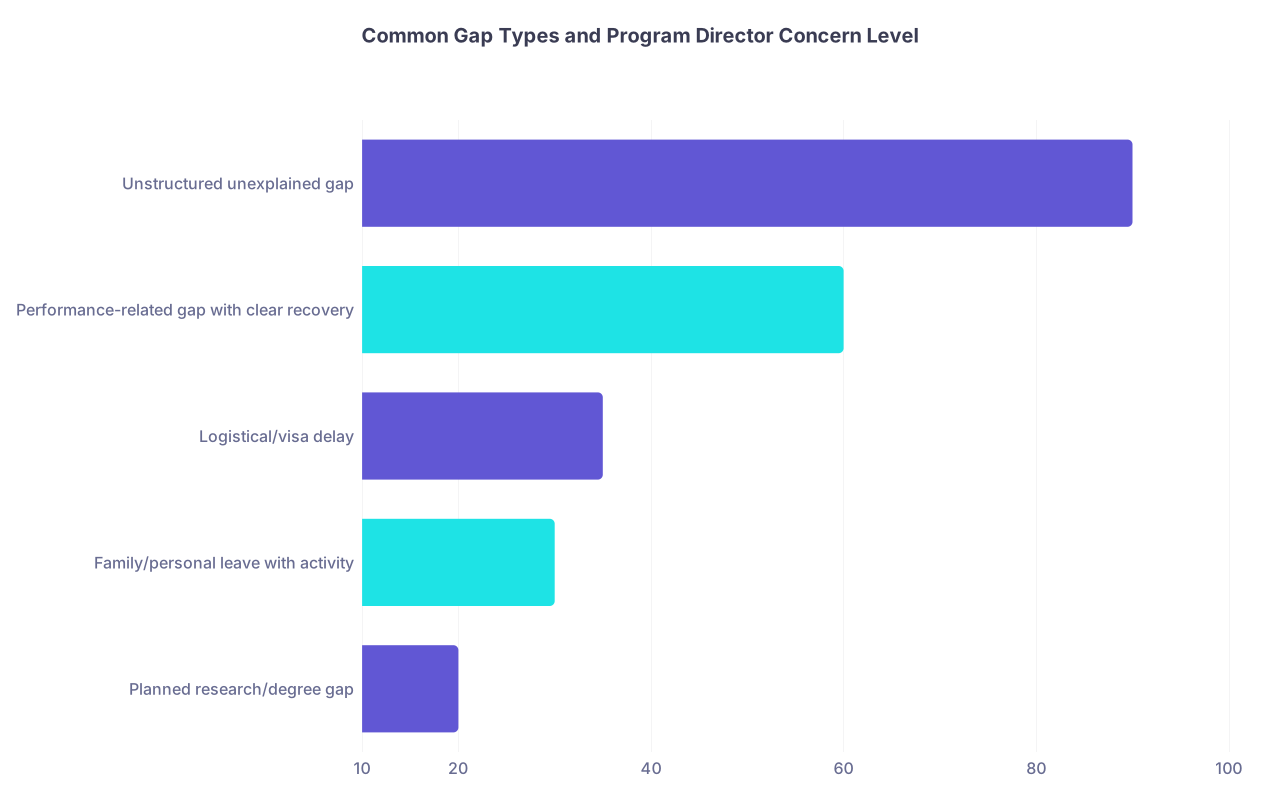
| Category | Value |
|---|---|
| Planned research/degree gap | 20 |
| Family/personal leave with activity | 30 |
| Logistical/visa delay | 35 |
| Performance-related gap with clear recovery | 60 |
| Unstructured unexplained gap | 90 |
A. Performance / Academic Gap
You cannot hide academic remediation. Someone will see it in transcripts or MSPE. The right move is controlled transparency.
Example: Repeating a Year or Remediation
On CV (Education section):
- 2017–2022: MD, XYZ Medical School
- Completed extended curriculum with additional clinical training in Internal Medicine and Surgery
On ERAS “Education/Training Interruption” explanation (1–3 sentences):
- “During the 2019–2020 academic year, I required additional time to meet clinical performance standards in Internal Medicine. I completed a structured remediation plan, repeated the rotation, and subsequently passed all remaining clerkships and licensing exams on first attempt.”
On interview, your script:
- What happened
- What you did to fix it
- How you changed your systems / habits
- How your later performance supports that this is resolved
If the gap involved dismissal and re‑entry elsewhere, you still use the same structure. Do not volunteer every painful detail. Do be honest if directly asked.
B. Health / Family / Personal Gap
Programs are not entitled to your diagnosis. They are entitled to know whether you are ready and able to complete residency.
Example: Medical Leave
CV entry:
- 07/2021–02/2022: Medical Leave and Recovery
- Focused on treatment and full recovery from an acute health condition
- Maintained clinical knowledge through online CME and board review resources
ERAS explanation:
- “From July 2021 to February 2022, I took an approved medical leave to address an acute health condition. I fully recovered, returned to full clinical duties, and have had no restrictions since February 2022.”
If the issue was mental health, the wording can be identical. You do not need to label it “psychiatric.”
Example: Family Caregiving
CV:
- 09/2020–06/2021: Family Responsibilities and Independent Study
- Primary caregiver for a critically ill family member
- Completed online CME in internal medicine, cardiology, and critical care
- Prepared for USMLE Step 2 CK and practiced clinical case review with peers
That one line about CME or board prep shifts you from “out of medicine” to “stayed engaged despite constraints.”
C. Planned Career / Skills Gap
This is the easiest category to frame. People routinely take:
- Research years
- MPH/MBA
- Industry experience
If you did this and you are not showcasing it on your CV, you are wasting an asset.
Example: Research Year
CV:
- 07/2021–06/2022: Research Fellow, Department of Neurology, University ABC
- Studied outcomes in stroke patients receiving thrombectomy
- Co‑authored 2 manuscripts (1 published, 1 under review)
- Presented abstract at AAN Annual Meeting 2022
No one will complain that you were “not working clinically” here. This is a standard, even desirable, path.
Example: Another Degree
CV:
- 09/2020–08/2021: Master of Public Health (MPH), University DEF
- Concentration: Health Policy and Management
- Capstone project on improving transitions of care for high-risk patients
Again, not a “gap.” Just training.
D. Logistical / System Gap
Visa delays, licensing problems, or bad match timing happen. Programs see them every year.
Example: Visa Delay After Graduation
CV:
- 06/2020: MD, LMN Medical University
- 07/2020–04/2021: Transition Period – Licensing and Visa Processing
- Completed USMLE Step 2 CK and Step 3
- Volunteered with local community health organization (telehealth support)
- Participated in online clinical update courses
ERAS explanation:
- “Following graduation in June 2020, my ability to begin US clinical training was delayed by visa processing and licensing requirements. During this time, I completed USMLE Step 2 CK and Step 3, engaged in telehealth volunteer work, and pursued online CME to maintain clinical readiness.”
You convert what could look like “floating” into concrete effort.
E. Chaotic / Unstructured Gap
This is the hardest to fix but still fixable.
Maybe you:
- Retook Step 1 three times
- Did some tutoring, some traveling, some thinking
- Drifted without committing to a job or project
Here is the rule: you cannot invent positions, but you can impose structure on what actually happened.
You sit down and sort your time into buckets:
- Board preparation
- Paid work (even non-medical)
- Volunteer activity
- Self‑directed learning
Then you turn each distinct, sustained bucket into an entry.
Example: “I was just studying and working random jobs”
Let us say from 01/2021–12/2022 you:
- Studied heavily for the boards
- Drove Uber / worked retail
- Occasionally volunteered at a free clinic
Properly structured CV:
- 01/2021–08/2022: USMLE Step Preparation and Clinical Review
- Full‑time preparation for Step 1 and Step 2 CK (UWorld, NBME practice exams)
- Completed online modules in internal medicine and emergency medicine
- 03/2021–12/2022: Part‑time Employment – Retail Associate, Local Pharmacy
- Managed customer interactions and problem resolution in a fast-paced environment
- Developed communication and time-management skills while balancing exam preparation
- 06/2021–03/2022: Volunteer, Community Free Clinic
- Assisted with patient intake and vital signs under supervision
- Supported patient education on chronic disease management
This does not hide the fact that you needed longer. It does show you were not inert.
Step 4: Matching Your CV, ERAS, and Personal Statement
What kills applicants is not the gap itself. It is inconsistency.
I have seen:
- CV says “Research Fellow 2019–2021”
- ERAS timeline shows no position for 2020
- Personal statement says “I took time off to care for family in 2020”
That is a red flag. People start wondering what is real.
Your Consistency Checklist
Dates line up across all documents
- CV
- ERAS Experiences
- Education and Training history
- LoRs if they mention dates
Labels are similar, not completely different
- If you call it “Medical Leave” on ERAS, do not call it “Personal Sabbatical” elsewhere.
The story you tell in your personal statement does not contradict the CV
- If you highlight a “research year” in your personal statement, that year better exist clearly labeled on your CV.
Step 5: How to Write the Actual Bullets for a Gap Period
You already know the big principle: activity, not absence. Now make it concrete.
Do not write fluffy nonsense:
- “Reflected deeply on my life and purpose”
- “Reconnected with my passion for medicine”
One line of that, maybe. But programs want:
- Skills
- Structure
- Outcomes
Good Bullet Patterns
Use 2–4 bullets. Short, factual, and slanted toward residency‑relevant skills.
Patterns you can steal:
“Completed [specific learning activity]: [Type] and [how much].”
- “Completed >4000 questions in UWorld Step 2 CK question bank.”
- “Completed 12 ACCME‑accredited online CME modules in hospital medicine.”
“Maintained clinical engagement through [role] at [place].”
- “Maintained clinical engagement as a volunteer assistant at XYZ free clinic, documenting visits and assisting with patient flow.”
“Developed [skill] by [doing what].”
- “Developed communication skills by working front‑line in a high‑volume community pharmacy.”
“Participated in [project] with [output].”
- “Contributed to data collection for a retrospective study on heart failure readmissions (abstract pending submission).”
Your bullets should make it impossible for someone to say, “So you did nothing for 18 months?”
Step 6: How to Rank the Gap on Your CV
You do not put “Gap Year” as your first and proudest entry. But you also do not bury it so deep it looks like you are hiding.
General rule:
- List experiences in reverse chronological order within each section (Education, Work, Research, Volunteer).
- If your gap activities belong in multiple sections, split them accordingly.
Example:
- If you were caregiving and doing online CME:
- “Family Responsibilities and Independent Study” under “Other Experience”
- Specific CME work might be a brief line under “Professional Development”
Do not create a separate “Gaps” section. That screams insecurity.
Step 7: Turning a Gap into a Talking Point in Interviews
Your CV gets you the interview. Your mouth can lose it if you stumble here.

| Step | Description |
|---|---|
| Step 1 | Interviewer asks about gap |
| Step 2 | State reason briefly |
| Step 3 | Describe constructive activities |
| Step 4 | Highlight what you learned |
| Step 5 | Reassure about current readiness |
Use a 4‑part template:
- Plain statement of the reason (1–2 sentences)
- What you did constructively during the gap
- What you learned or changed
- Clear reassurance about your current readiness
Example: Health Leave
- “In late 2020 I developed a health issue that required an approved leave from training. I focused on treatment and fully recovered over about eight months. During that time, I stayed connected to medicine through online CME and board review.
Since returning, I have completed all rotations and exams without restrictions, and my recent evaluations reflect that I am performing at the expected level. I am fully cleared and ready for the demands of residency.”
Short. Controlled. No oversharing.
Example: Academic Remediation
- “I struggled with time management and clinical reasoning early in my third year and needed additional time to meet expectations in internal medicine. I worked closely with faculty, repeated the rotation, and built a more structured study and pre‑rounding system.
Since then, I have passed all remaining clerkships and Step 2 CK on the first attempt, and my recent evaluations consistently describe solid clinical performance. That experience forced me to fix my process, which I see as an advantage going into residency.”
You are not begging for forgiveness. You are explaining why this will not be an ongoing problem.
Step 8: Common Mistakes That Actually Hurt You
Here is where people sabotage themselves:
Compressing or lying about dates
- Example: Listing employment as “2019–2021” when you only worked Jan–Mar 2019 and Nov–Dec 2021.
- Programs are very used to date games. Some will call. If they catch this, your integrity is done.
Multiple different stories
- Telling one interviewer, “I took time off for research,” another, “for family,” and a third, “for personal reasons.” Word spreads in small departments.
Over‑explaining sensitive details
- You do not need to describe your exact diagnosis, surgeries, legal issues, or family trauma. It makes people uncomfortable and does not help you match.
Sounding apologetic or ashamed
- If you act like your gap is fatal, some interviewers will treat it that way. If you speak about it as a challenging but productive period, that tone often carries.
Pretending the gap “does not count” because you were not paid
- Volunteer work, informal roles, self‑study—these absolutely count as experience. You just have to structure and describe them.
Step 9: Concrete Before‑and‑After CV Examples
You probably learn best from seeing it done wrong then fixed. So here are a couple.
Example 1: Step Failure + Long Study Gap
Original version (what I see too often):
- 2016–2020: MD, XYZ School of Medicine
- 2020–2023: Various activities and personal time
- 2023–present: Observership, Internal Medicine, ABC Hospital
Questions this raises:
- Were you working? Failing exams? Out of medicine entirely?
Rewritten version:
- 2016–2021: MD, XYZ School of Medicine
- Completed extended curriculum with additional time for USMLE preparation
- 07/2021–12/2022: USMLE Step Examination Preparation and Clinical Review
- Dedicated full‑time preparation for Step 1 and Step 2 CK, including >6000 UWorld questions
- Completed online CME modules in cardiology, infectious disease, and critical care
- 01/2023–06/2023: Clinical Observer, Internal Medicine, ABC Hospital
- Observed inpatient rounds and outpatient clinics 5 days per week
- Participated in case discussions with residents and attendings
Nothing magical. Just clear.
Example 2: Family Care Gap with Light Volunteer Work
Original version:
- 2018: MD, Foreign Medical School
- 2018–2020: Family reasons
- 2020–present: Research assistant, University Clinic
Rewritten version:
- 2018: MD, Foreign Medical School
- 07/2018–03/2020: Family Responsibilities and Community Volunteer
- Primary support for an ill family member during treatment and recovery
- Volunteered twice weekly at local community clinic assisting with patient flow and health education
- Maintained clinical knowledge through online internal medicine review courses
- 04/2020–present: Research Assistant, Cardiology Department, University Clinic
- Collect and manage data for observational study on heart failure readmissions
- Co‑authored one abstract submitted to ACC 2023
Same reality. Now actually presentable.
Quick Reference Table: How to Label Gaps
| Gap Type | Suggested CV Label | Typical Bullet Focus |
|---|---|---|
| Medical / mental health leave | Medical Leave and Recovery | Treatment, recovery, CME |
| Family caregiving | Family Responsibilities and Independent Study | Caregiving + study/volunteer |
| Dedicated exam study | USMLE Preparation and Clinical Review | Question banks, CME, outcomes |
| Visa / logistical delay | Transition Period – Licensing and Visa | Exams, volunteer, courses |
| Research year | Research Fellow / Research Assistant | Projects, outputs, skills |
| Non-medical work + study | Transitional Professional Period | Jobs + transferable skills |
Final Check: A Simple 5‑Question Audit for Your CV Gap
Before you send anything out, ask:
- Is every month after medical school accounted for somewhere?
- Would a stranger understand, in one or two sentences, what I was doing in each gap period?
- Do my CV, ERAS, and personal statement tell the same timeline?
- Have I avoided unnecessary personal detail while still being honest?
- Can I explain each gap in 30–60 seconds without rambling or sounding defensive?
If you can answer “yes” down that list, your gap is no longer a landmine. It is just part of your story.
Key Takeaways
- Gaps do not destroy applications. Sloppy, vague, or dishonest handling of them does.
- Your job is to structure the gap: clear dates, neutral labels, and concrete, constructive activities.
- Consistency across CV, ERAS, and your spoken explanation matters more than perfection.
FAQ
1. Should I ever leave a short gap (1–2 months) unexplained?
If it is truly just a month or two between roles, you can often let the natural date ranges cover it (e.g., one job ends 06/2021, next starts 08/2021). You do not need a separate entry for every few weeks off. The problem is when there is a multi‑month or multi‑year block that is obviously unaccounted for. Once you are beyond about 3–4 months, especially in the recent past, it is safer to include a brief, structured entry.
2. Do I have to mention mental health explicitly if that was the reason for my leave?
No. You are not required to share your diagnosis. You can frame it as “medical leave” or “health leave” and focus on the fact that it was treated, you recovered, and you have since functioned without restriction. If asked more directly in an interview, you can still keep it high‑level: “I had a health condition that required treatment and time away; I completed treatment, and I am now stable and cleared.”
3. What if my gap was due to failing the Match multiple times?
You do not label “Failed Match” on your CV. You account for the years with what you actually did: exam prep, observerships, research, work. On ERAS or in an interview, if asked, you can say: “I applied in 2022 and 2023 but did not match. In those years I strengthened my application by doing [specific activities], improved my [scores/clinical experience], and obtained stronger letters. I believe my current application better reflects my readiness for residency.”