
The usual way residents “get feedback” on their CV is lazy and almost useless. You email a PDF to a friend or mentor, they reply “Looks good!” and maybe fix a comma. That will not move your application up a single rank position.
You need a structured peer-review process that forces people to give you brutally honest, specific, actionable feedback—and gives you a clear way to use it without losing your mind.
Here is the system I recommend to residents and MS4s when they are serious about improving their CV for residency.
1. Stop Asking “Can You Look Over My CV?”
That question is your first mistake. It produces vague comments, politeness, and superficial edits.
You must turn “vibe-based feedback” into a clear, fast, structured task for your reviewers.
Define exactly what you want
When you send your CV, you are not asking for a favor in general. You are assigning a small, well-defined job. For example:
- “Please spend 10 minutes max and answer these 5 questions about my CV.”
- “Focus only on red flags, inconsistencies, and anything that sounds exaggerated.”
- “Ignore grammar unless it makes me sound unprofessional. Main goal: content clarity and strength for IM residency.”
If you do not define the job, reviewers improvise. And most people improvise badly.
Choose the right peer reviewers
You want three types of reviewers, each for a reason:
- Near-peers (PGY-1–PGY-3) in your target specialty
- They know what PDs care about this year.
- They remember their own application cycle.
- Senior peer or junior faculty (PGY-3+, chief, young attending)
- They see the resident side: who struggles, who excels.
- Many have sat on recruitment committees or informal review sessions.
- One person outside your specialty
- To check whether your CV is readable to a non-insider.
- Program leadership sometimes skims quickly before interviews; clarity wins.
Do not send your CV to 15 people. You will drown in conflicting advice. Aim for 3–5 high-yield reviewers.
2. Build a Simple, Rigid Review Framework
You are going to give your reviewers a clear structure:
- A standardized format for your CV
- A fixed checklist to fill out
- A deadline and time limit so they actually do it
This is how you turn “brutal feedback” from a personality-dependent accident into a repeatable process.
Use a consistent CV structure
If your CV is chaos, feedback will be chaos. Use a standard order that mirrors what PDs expect.
Here is a simple, residency-focused structure:
- Name and contact info (1 line each, no clutter)
- Education
- USMLE/COMLEX (optional line if appropriate for the CV context)
- Clinical experience (if relevant and beyond standard rotations)
- Research and publications
- Presentations and posters
- Leadership and service
- Teaching and mentoring
- Awards and honors
- Skills and certifications
- Interests (optional but recommended)
Keep it clean. No photos. No fancy colors. No wild fonts. You want content, not graphic design.
| Section | Purpose |
|---|---|
| Education | Shows training path and consistency |
| Clinical Experience | Highlights extra clinical exposure |
| Research | Signals academic potential |
| Presentations | Demonstrates scholarly communication |
| Leadership/Service | Shows initiative and professionalism |
Create a one-page peer-review form
Do not ask for “general thoughts.” Give them a one-page form. Here is the core of it:
Section 1 – First impression (1–2 minutes)
Answer in one line each:
- What specialty do you think I am applying to based on this CV?
- Using only this CV, would you want me on your team? (Yes / No / Unsure) Why?
- One word that describes this CV: _______
Section 2 – Red flag scan (3–4 minutes)
Circle or comment on:
- Any date gaps > 3 months not explained
- Any description that sounds exaggerated or vague
- Any section that feels “padded” or obviously inflated
- Anything that might raise a professionalism concern
Section 3 – Strengths and weaknesses (3–4 minutes)
- Top 3 strengths of this CV:
- Top 3 weaknesses / unclear areas:
- One thing you would absolutely cut:
- One thing that should be moved higher up:
Section 4 – Clarity and impact (2–3 minutes)
On a 1–5 scale (5 = excellent, 1 = poor):
- Overall clarity of formatting: __
- Bullet point strength and specificity: __
- Fit for target specialty: __
- Professional tone: __
Total time: 10–12 minutes. That is deliberate. Short enough that busy residents will do it, structured enough to generate useful data.
Put this form in a Google Doc or fillable PDF and send the link with your CV.
3. Set the Rules That Allow Brutal Honesty
People hold back for one main reason: they do not want to hurt your feelings or damage your relationship.
So you remove that barrier.
Explicitly request harsh feedback
Write something like this in your email or message:
“I am trying to make this CV as strong as possible for residency applications. Please be brutally honest. If a line sounds fake, unclear, arrogant, or weak, I want to know. You will not hurt my feelings—I would rather hear it from you than from a program director reading between the lines.”
Yes, actually say “brutally honest.” People need permission.
Give them psychological cover
Two easy ways:
- Allow track changes or comments only
- “Please use comment mode so I can see everything clearly.”
- This lets them separate their feedback from your actual text.
- Normalize criticism
- “I am getting similar feedback from several people and then consolidating.”
- That signals this is a process, not a personal attack.
If possible, offer to swap CVs. Peer reciprocity changes the tone. When someone knows you are going to see their weaker bullets too, they stop pretending everyone else is perfect.
4. What Reviewers Should Actually Attack
You want reviewers to focus on things that change your match prospects, not whether “comma vs semicolon” is ideal.
Here is what I tell reviewers to look for, and you should too.
1. Red flags and inconsistencies
Ask them to circle comments for:
- Date gaps that are not explained (e.g., 2019–2021 missing anything)
- Sudden shifts with no context (research heavy then nothing)
- Overlaps that look impossible (full-time job + full-time research + full-time school)
- Titles that sound inflated:
- “Lead investigator” as an MS2 for a multi-site trial? Questionable.
- “Director” of a student group with 3 people? Maybe not.
If something makes a peer raise an eyebrow, a PD may do the same.
2. Weak, fluffy, or meaningless bullets
The average residency CV is full of this junk:
- “Participated in research on cardiovascular disease.”
- “Responsible for patient care on wards.”
- “Helped organize events for the student association.”
Ask reviewers to underline any bullet that:
- Could be written by 90% of medical students
- Does not show scale, outcome, or responsibility
- Uses vague verbs: “helped,” “worked on,” “participated in,” “exposed to”
You then know exactly which bullets to rewrite.
3. Misaligned emphasis
Your CV communicates priorities, even if you do not intend to.
- If you are applying to internal medicine and your biggest section is “Hobbies and Interests,” that is a problem.
- If you are applying to ortho and your research section is five lines of psych projects while your ortho exposure is one line of shadowing, that is a problem.
- If your strongest content is on page 2, you are hiding your leverage.
Ask reviewers:
“Do the first half-page and section order accurately reflect my strongest assets for [SPECIALTY]?”
If they say no, you have a structure problem, not just a wording problem.
5. Turn Vague Bullets Into High-Impact Statements
Your peers will flag weak bullets. You then need a system to rewrite them fast.
Use this simple formula:
ACTION verb + WHAT you did + HOW you did it + IMPACT / SCALE
Example transformations
Original:
“Participated in quality improvement project to reduce central line infections.”
Rewritten:
“Led data collection for QI project on central line infections, auditing 120 ICU lines over 6 months and presenting findings that informed new line care checklist.”
Original:
“Helped organize student-run free clinic.”
Rewritten:
“Coordinated weekly scheduling for 25 volunteers at student-run free clinic, improving monthly patient volume from ~40 to ~65 visits while maintaining average wait times under 30 minutes.”
Original:
“Responsible for patient care on wards.”
Rewritten:
“Managed daily care for 6–10 inpatient medicine patients during sub-internship, including pre-rounding, cross-cover calls, and drafting progress notes reviewed by senior residents and attendings.”
You will not have hard numbers for everything. Fine. Use approximate ranges or descriptions. Just avoid empty phrases.
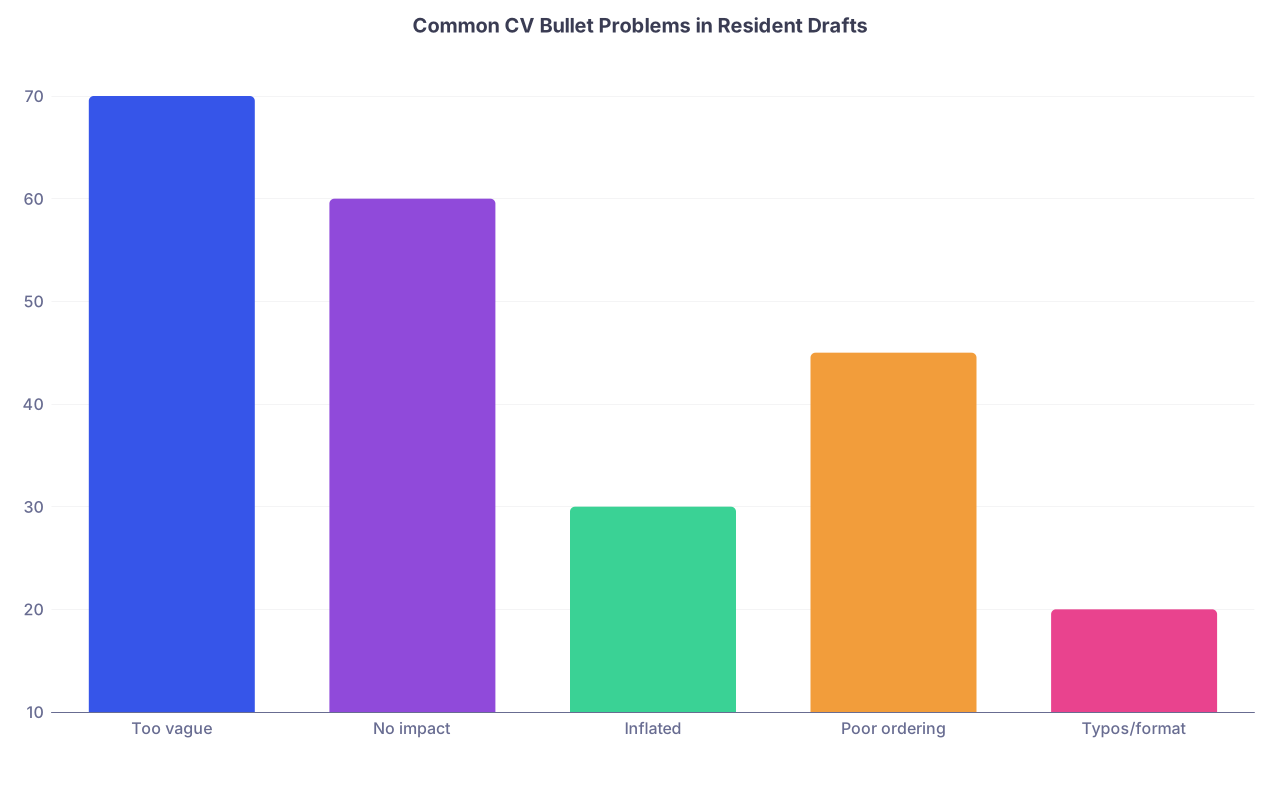
| Category | Value |
|---|---|
| Too vague | 70 |
| No impact | 60 |
| Inflated | 30 |
| Poor ordering | 45 |
| Typos/format | 20 |
6. Run a Two-Round Peer-Review Cycle
One pass is not enough. But you also do not have time for endless tinkering. You want two focused rounds.
Round 1 – Structural and content review
Goal: Fix what is on the CV and where it appears.
Actions:
- Send your CV + peer-review form to 3–5 people.
- Ask them to complete it within 5–7 days.
- When you get them back, do this:
- List recurring comments (appearing in ≥2 reviews).
- Mark any section repeatedly called “confusing,” “weak,” or “too long.”
- Move your top strengths higher (research, leadership, USMLE, etc.).
- Delete or compress anything that multiple reviewers said felt like “padding.”
Do not tweak phrasing yet. Fix structure and content first.
Round 2 – Precision and polish
Now you send it again—but to fewer people and with narrower instructions.
Your message:
“This is my near-final CV. Please focus on:
- any bullet that still sounds vague / inflated,
- section headings or order that still feel off,
- anything that might read badly to a PD in [SPECIALTY].”
This time you want:
- 1–2 near-peers in the specialty
- 1 senior reviewer (chief, attending, or someone who reads applications)
Adjust based on their comments. When two or more reviewers say “this bullet sounds fake” or “this section is confusing,” believe them.
At that point, you stop. Endless polishing is procrastination disguised as productivity.
7. Use a Scoring System to Decide What to Fix First
When you get multiple review forms back, your brain will want to fix everything. That is how you burn hours on low-yield details.
Use a simple scoring system:
For each issue mentioned by reviewers, give:
- Impact (1–3)
- 3 = Could change how programs rank you or whether they see your strengths
- 2 = Affects clarity / professionalism but not core impression
- 1 = Minor style / formatting issue
- Frequency (1–3)
- 3 = Mentioned by 3+ reviewers
- 2 = Mentioned by 2 reviewers
- 1 = Only 1 reviewer
Multiply: Total score = Impact × Frequency
Example:
- “CV looks more like research than EM-focused” – Impact 3, Frequency 3 → 9
- “Bullet on clinic work sounds exaggerated” – 2 × 2 → 4
- “Use consistent dash style in dates” – 1 × 3 → 3
You fix all 7–9s first. Then 4–6s. Ignore or batch the 1–3s for the very end.

8. Avoid Common CV Disasters Your Peers Will Miss
Peers are useful, but they have blind spots. There are common CV problems even good reviewers often under-call.
Problem 1: “Over-stacking” weak research
You list:
- 6 “abstracts in progress”
- 4 “manuscripts in preparation”
- 5 projects where your role is barely more than data entry
This smells like insecurity. PDs see it constantly.
Fix:
- Separate into Published / Accepted, Submitted, and In Progress.
- Only include “In Progress” items where you have a defined, substantive role.
- Stop using “et al.” for small student projects. It looks silly.
Problem 2: Over-sharing personal details in interests
I have seen CVs list:
- “Binge watching Netflix”
- “Reddit and meme culture”
- “Craft cocktails and nightlife”
You may think it is “relatable.” On a residency CV, it is just risky.
Fix:
- Keep interests specific but clean:
- “Trail running (half-marathons),”
- “Home espresso and pour-over brewing,”
- “Science fiction short stories (Asimov, Ted Chiang).”
- 3–5 items, max one line.
Problem 3: Non-standard or cluttered formatting
If your CV looks like a graphic design project, you are signaling you do not understand the audience.
- Mangled margins
- 3+ different fonts
- Embedded icons, logos, headshots
Fix:
- One font (e.g., Calibri, Arial, Times).
- Clear hierarchy: section headings bolded and slightly larger.
- Uniform date formatting: “Aug 2021 – Jun 2023” style everywhere.
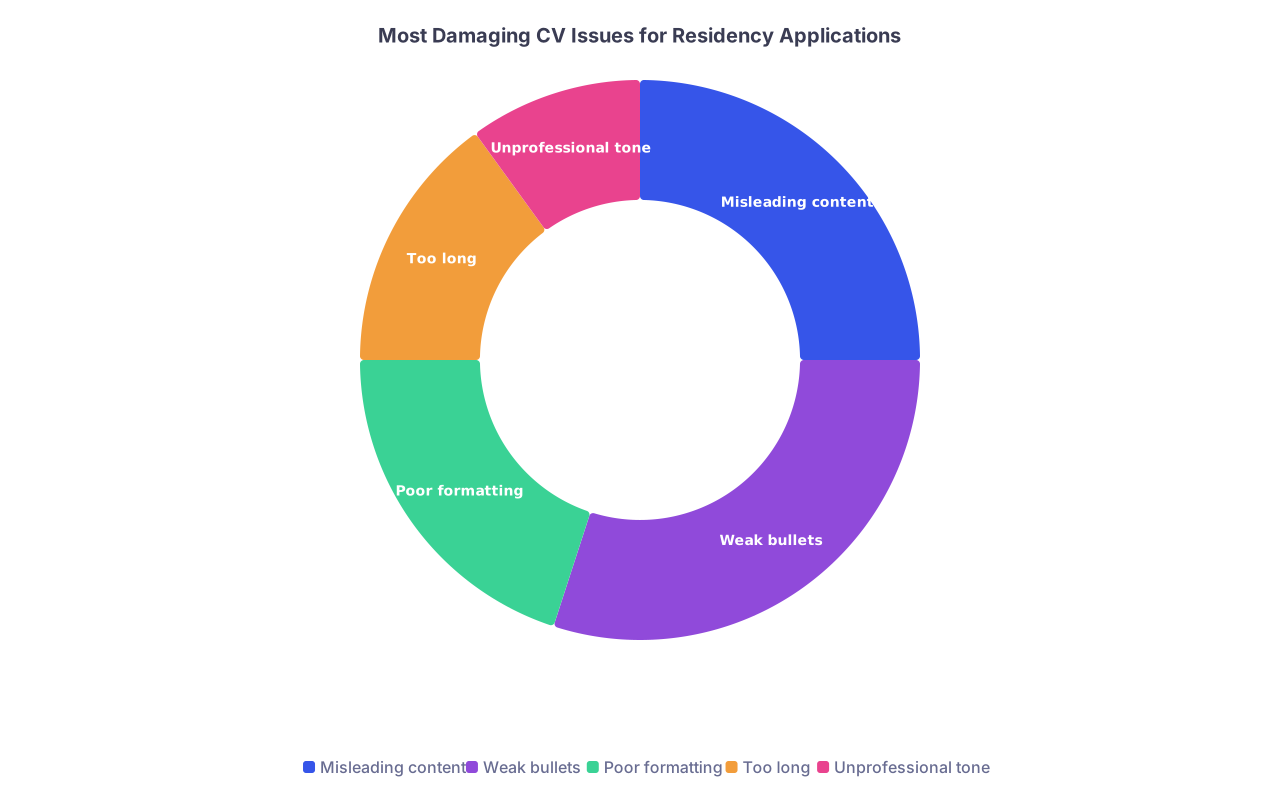
| Category | Value |
|---|---|
| Misleading content | 25 |
| Weak bullets | 30 |
| Poor formatting | 20 |
| Too long | 15 |
| Unprofessional tone | 10 |
9. Run a Live “CV Mortality Conference”
If you want the most brutally honest feedback you will ever get, do this with your trusted peers.
Treat your CV like a case presentation where the patient died and you are dissecting what went wrong.
How to run it
Group: 3–4 residents / MS4s on Zoom or in a conference room.
Process (60–90 minutes total):
- Each person screenshares their CV for 10–15 minutes.
- Everyone else:
- Reads silently for 2–3 minutes.
- Then goes section by section, saying out loud:
- “This helps you.”
- “This is neutral.”
- “This hurts you or wastes space.”
- The owner of the CV is not allowed to defend anything until the end.
Rules:
- No sugarcoating.
- No fixing mid-stream. Only labeling.
- You are diagnosing, not treating, in this session.
Then, after the “mortality” breakdown, give the owner 5 minutes of solution-focused suggestions: reorder, cut, rewrite, emphasize.
If you do not finish everyone in one session, schedule a second. This is more useful than half your “application prep” workshops.

| Step | Description |
|---|---|
| Step 1 | Draft CV |
| Step 2 | Standardize Format |
| Step 3 | Select 3-5 Reviewers |
| Step 4 | Send CV plus Review Form |
| Step 5 | Collect Round 1 Feedback |
| Step 6 | Fix Structure and Content |
| Step 7 | Send Near-final CV |
| Step 8 | Collect Round 2 Feedback |
| Step 9 | Refine Bullets and Polish |
| Step 10 | Optional CV Mortality Conference |
| Step 11 | Finalize CV for Applications |
10. Final Pass: Read It Like a Program Director
Before you send that CV out with ERAS or to away rotations, perform one last test.
The 30-second skim test
Set a timer for 30 seconds. Look only at:
- First half of page 1
- Section headings
- Bolded lines (if any)
Then write down:
- What specialty this person seems to be aiming at
- Top 3 strengths you would ascribe to them
- Any small concern that jumps out
If your own answers are not what you want a PD to see, the CV is still not right.
The “remove your name” test
Delete your name from the top. Ask a peer:
“Read this for 1 minute. Would you fight to rank this person higher for [SPECIALTY]? Why or why not?”
If the answer is mushy, you still have work to do.

FAQs
1. How long should my residency CV be after this whole process?
For most applicants, 2–3 pages is the sweet spot. Less than 2 pages usually means you are under-selling your experiences or missing sections. More than 3 pages is rarely justified outside very heavy research applicants (multiple first-author papers, grants, etc.). If you are at 4+ pages, assume you are including low-yield fluff that needs to go unless a research mentor specifically tells you otherwise.
2. Should I change my CV format for each specialty or program?
Do not reinvent the layout, but yes, you can and should tune emphasis for different audiences. If you are dual-applying (for example, IM and neuro), reorder sections and tweak a few bullets so the most relevant experiences for that specialty surface early. You might maintain one master CV, then produce 1–2 specialty-focused versions, each with the same core data but different framing.
3. Is it worth asking an attending or PD to review my CV, or should I stick to peers?
Both have roles, but attendings and PDs have limited time and a very different threshold for detail. I recommend doing two peer-based rounds first to clean up obvious issues, then—if you have a good relationship—ask one attending or PD for a single, high-level pass. They are best used for “Would this raise any concerns?” and “What stands out to you?” Not for line-editing every bullet.
4. How early before ERAS should I start this structured peer-review process?
Start 8–12 weeks before you plan to certify and submit. That gives you time for:
- One week to draft or update your CV
- 2 weeks for Round 1 reviews and revisions
- 2 weeks for Round 2 reviews and revisions
- Extra buffer for a live “mortality conference” and final polish
If you are reading this late in the season, compress the timeline but keep the structure: at least one solid peer-review round is still better than none.
Open your CV file today and do one thing: highlight every bullet that uses “helped,” “participated,” or “worked on.” Those are your first rewrite targets. Then send the draft, plus a structured review form, to three people who will not lie to you.