
It’s 11:47 p.m. You’ve reread your ERAS application for the 19th time, your brain is fried, and then it hits you like a truck:
You forgot to list a big experience.
Not a tiny two‑hour volunteering thing. A major thing. A year of research. A leadership role. A job that shaped your whole personal statement. And now you’re spiraling:
“Did I just lie by omission?”
“Are they going to think I’m hiding something?”
“Is this match‑ending?”
Let’s walk through this like two people sitting in a call room at midnight, trying not to catastrophize but also…kind of catastrophizing.
First: Is This Actually Dishonest, Or Just a Screw‑Up?
Let me be blunt: programs are used to incomplete applications. They are not used to outright fabricated ones.
Forgetting to list a real thing that genuinely happened is not in the same universe as making something up.
Think about it the way PDs do in their heads (yes, I’ve heard this said almost verbatim by a program director):
Dishonest:
“Claims 3 first‑author pubs that don’t exist on PubMed.”
“Mentions leadership positions nobody at that institution has ever heard of.”
“Has wildly conflicting stories between LORs, PS, and CV.”Human / Disorganized:
“Did a year of research but the ERAS ‘Research Experience’ section is sparse.”
“Talks about tutoring in PS but it’s not listed as an activity.”
“Left off an early college job / activity that still mattered to them.”
What you did fits category two: human error. Annoying? Yes. Fatal? No.
Where things feel dishonest to programs is when:
- The story keeps changing between interview, application, and letters
- The applicant seems to be inflating or faking timelines or roles
- People at the same institution tell different versions
You? You’re sitting there obsessively worried that a missing line item is going to make you look like a con artist. That alone puts you on the other end of that spectrum.
How Big Is This “Major Experience,” Really?
Let’s be real for a second. “Major” can mean very different things when you’re spiraling at midnight versus when an attending skims your app for 90 seconds.
Ask yourself three questions:
Does this experience materially change my story?
- Example: Your whole personal statement is about working as a medical interpreter, but you forgot to list your interpreter job in the Experiences section.
- That’s a real inconsistency.
Is someone else going to mention it in a letter?
- If Dr. X wrote your LOR and mentions you were research coordinator for 1 year on Project Y, but your ERAS has zero research listed, it looks more like sloppiness than lying—but yeah, it’s a visible gap.
Is this something that would change how they rank you?
- A true gap filler (ex: what you did in a full gap year).
- A “nice but extra” (ex: additional volunteer work you were proud of but doesn’t change your core profile).
Here’s the unfluffy reality: most PDs are not zooming in on each experience like it’s a forensic audit. They’re asking:
- Can this person do the job?
- Will they show up, learn, not be toxic?
- Are they remotely a fit for our program?
They are not hunting for missing lines to accuse you of fraud. They don’t have that kind of time.
Will Programs Think I’m Hiding Something?
Your nightmare scenario is probably something like:
“They’ll assume if I forgot this, what else am I hiding?”
Honestly? That’s not how they think unless you give them multiple reasons to mistrust you.
Here’s how this usually plays out in their minds if it comes up at all:
- “Oh, looks like they didn’t list that research year formally. Whatever.”
- “Interesting, they mentioned working during school in the PS, but I don’t see it in activities. Probably ran out of space.”
- “Timeline’s a bit thin, but letters seem consistent. Moving on.”
I’ve seen people:
- Forget to list entire undergrad research labs
- Mis‑enter the dates for a major job
- Put a huge role under “Other” with one line of description
They still matched. Into competitive specialties. At good programs.
You know who gets flagged?
The person whose CV says “Chief of X,” but the letter writer casually says, “He attended some meetings but didn’t really take on leadership tasks.”
Or the applicant who “worked 40 hours/week” throughout med school, but their transcript timeline and everything else look impossible.
For you, the danger isn’t that you look dishonest. It’s that:
- You undersold yourself
- You look a little disorganized
- You feel off and anxious, which could bleed into interviews
Dishonesty? Not really.
What You Can Do Now (Depending on Your Timeline)
Let’s talk damage control, because I know you’re not going to sleep until you have an actual plan.
Scenario 1: ERAS Not Submitted Yet
If you haven’t certified and submitted your application:
- Go back in and add the experience.
- Don’t overcomplicate it. One accurate entry, clean dates, clear role.
- Don’t suddenly rewrite your entire app trying to “rebalance” everything around it.
If you can still fix it, fix it. No drama needed.
Scenario 2: ERAS Submitted, but Before Interview Invites
This is the worst feeling. The “it’s locked, I’m doomed” zone.
Here’s what you realistically can and can’t do:
You cannot:
- Edit experiences after you certify ERAS
- Resend a “fixed” version to some programs and not others
You can:
- Make sure your CV (if separately requested by a program) is correct
- Use any open‑ended questions in supplemental applications to reference it briefly if it’s truly central
- Talk about it naturally if they ask, “Tell me about yourself,” “What did you do during your gap year?” etc.
What you don’t do:
Send every program a panicked email with a paragraph explaining you “accidentally omitted a key experience and hope they won’t judge your integrity.”
That just raises anxiety on their end for something most of them never would’ve noticed.
Use a simple mental filter:
If this experience fills a clear unexplained gap (e.g., a full calendar year between undergrad and med school), then be ready to address it conversationally if asked. That’s it.
Scenario 3: During Interviews
This is where your anxiety starts whispering, “They’re going to bring it up and nail you.”
They probably won’t.
But if there’s a real gap—like a missing research year or job—and they do ask about that period, here’s how you handle it without looking shady:
You:
“I actually realized after certifying my application that I didn’t fully list that experience, which is on me. During that year I worked as a ___ at ___. It was a big part of why I got interested in [X area / residency]. I’m happy to talk more about it if that’s helpful.”
Direct. Short. No groveling.
You’re allowed to:
- Have made a mistake
- Correct it once, calmly
- Move on without turning it into a confessional apology tour
If they push (rare, but let’s go worst‑case), and someone says, “Why wasn’t this on your ERAS?”:
You:
“Honestly, I mis‑entered that section when I was finalizing the application and didn’t catch it until after I certified. That’s my error in attention to detail, not me trying to hide it.”
You owning a small screw‑up maturely reads better than pretending nothing happened.
Scenario 4: Post‑Match Panic (“Did I Commit Fraud?”)
If you’re already matched (or later in the season) and just realized something is missing, your brain goes to:
“Can they revoke my contract? Will GME accuse me of misrepresentation?”
No. They’re not tearing up contracts because you forgot to list your year as a barista or your early research assistant job.
Programs worry about:
- Fabricated degrees
- Fake boards results
- Completely made‑up experiences
Forgetting to list something real is not fraud. It’s just not.
If it still eats at you, when you start residency and fill out employment/onboarding paperwork, list the experience accurately there. That way your institutional HR record is clean and complete, even if ERAS was imperfect.
How This Actually Affects Your Application Competitiveness
Harsh truth: the bigger risk is that you under‑represented yourself.
Programs usually skim:
- Education
- Exams
- Class rank / AOA / honors
- A couple highlighted experiences
- Maybe your personal statement and letters if you made it past initial filters
If the missed thing:
- Would have pushed you from “fine” to “strong”
- Clarified a gap year
- Strengthened your story for a competitive specialty
…then yeah, you might have lost some marginal advantage. But that’s very different from, “They think I’m dishonest.”
To put it in more concrete terms:
| Situation | Likely Program Interpretation |
|---|---|
| Missing minor volunteer activity | They won’t notice / don’t care |
| Missing central gap‑year job or research | Mild confusion if gap is obvious |
| PS mentions job that’s not in ERAS activities | Slightly sloppy, not dishonest |
| LOR discusses role not listed in ERAS | “They under‑entered this experience” |
| Multiple big inconsistencies across app | Possible concern about reliability |
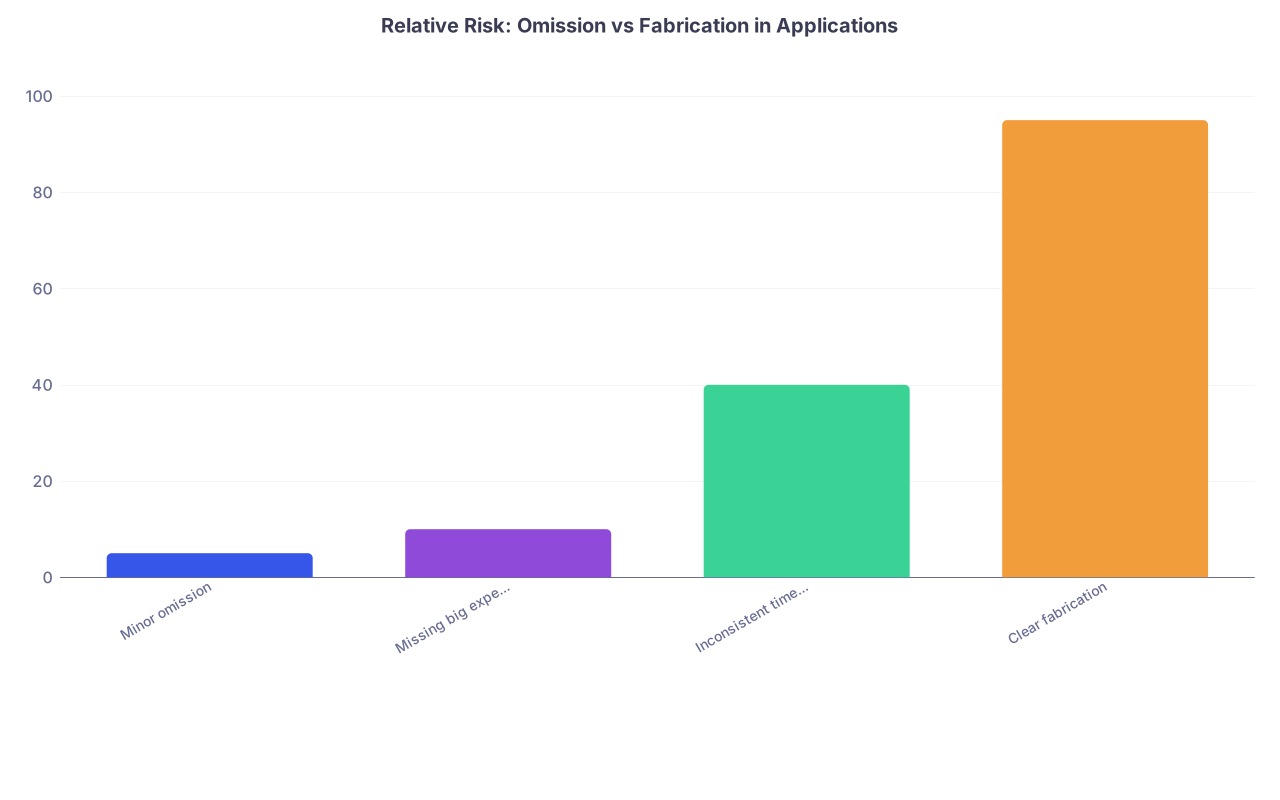
| Category | Value |
|---|---|
| Minor omission | 5 |
| Missing big experience | 10 |
| Inconsistent timelines | 40 |
| Clear fabrication | 95 |
How To Talk About It Without Making It Weird
The real trap here isn’t the omission itself. It’s you getting so anxious that you over‑explain and make it feel bigger than it is.
A few rules:
Don’t lead with apology.
“I need to tell you I made a big mistake on my ERAS…” is how you start a confession, not a conversation.Anchor it to your story, not your guilt.
“Something I actually didn’t fully capture on my ERAS that was important to me was my work as ___.”Keep it factual, not dramatic.
No “I’ve been agonizing about this for weeks” on interview day. That just tells them you’re overwhelmed and spiraling.
You can absolutely bring it up if it’s central and you genuinely get an opening—like “Tell me more about what you did before med school” or “What experience shaped you most?” You’re not forbidden from talking about things that aren’t typed into ERAS.
How To Not Do This Again (Without Becoming Obsessed)
You can’t rewrite this cycle’s ERAS once it’s certified, but you can change your process for anything you touch going forward—CVs, fellowship apps, job applications, etc.
Dirty but effective system:
- Keep a living CV updated yearly (undergrad > now).
- Before any big application, cross‑check: timeline, jobs, research, leadership, licenses.
- Have one sane friend/classmate read it for missing things only (tell them that explicitly).
- Accept that no application is perfect. Because it isn’t.
I’ve never seen a “perfect” ERAS. I’ve seen strong ones, clear ones, honest ones. All of them had at least one thing the applicant later wished they’d done differently.
You’re not uniquely flawed. You’re just now aware of your imperfection in painful HD.

| Step | Description |
|---|---|
| Step 1 | ERAS Submitted |
| Step 2 | Initial Filter: Scores/Region |
| Step 3 | Skim Education/Exams |
| Step 4 | Glance at Experiences |
| Step 5 | Scan Personal Statement |
| Step 6 | Review Letters for Selected Applicants |
Notice what’s not in there: “Zoom in to cross‑reference every line for missing but real experiences.”
FAQ (Exactly 5 Questions)
1. Is forgetting a major experience enough for a program to call this ‘misrepresentation’?
No. Misrepresentation is about false information, not missing true information. You forgot to enter something real—that’s a documentation error. Annoying, yes. Fraud, no.
2. Should I email programs to explain the missing experience?
Usually, no. Unless:
- The missing experience explains a big unexplained gap in time
- Or a program explicitly asks for clarification
Otherwise your email just highlights a problem they never noticed. Save that energy for interviews or future steps.
3. What if my personal statement mentions something I forgot to list in ERAS?
That’s common. It looks a bit sloppy but not dishonest. If asked, you can say:
“I focused on it in my statement but didn’t enter it as a separate experience in ERAS. That’s on me; it was a meaningful role.”
Then briefly describe it and move on.
4. Could this mistake be the reason I don’t match?
Very unlikely on its own. People don’t match because of a combination of things—limited interviews, weaker scores, poor ranking strategy—not usually because they left off a single experience. At worst, you may have lost a bit of “bonus points,” not tanked your whole application.
5. How do I stop obsessing over this one mistake?
Short answer: you probably won’t completely, but you can contain it.
- Admit: “I screwed this up.”
- Decide: “Here’s how I’ll explain it if asked.”
- Commit: “Next time I’ll use a checklist and another set of eyes.”
Once you’ve done those three, the rest is just your anxiety replaying an old tape. You don’t have to keep pressing play.
Key points:
You made a human mistake, not a character‑defining lie.
Programs care far more about whether you’re safe, reliable, teachable—and they don’t have the time or interest to crucify you over a missing line item.