
It’s midnight. You’ve got ERAS open on one screen, your CV on the other, and your eyes keep landing on the same line: “2022–2023: Gap year.”
Your brain won’t shut up:
“What if they think I couldn’t get it together?”
“What if they assume I failed something?”
“What if they just see ‘lazy’ or ‘red flag’ and hit reject?”
You start rewriting the same two bullet points for the tenth time, trying to turn a messy, complicated year into three neat lines that won’t tank your whole residency future.
Let’s talk about that. Because the fear that programs will misinterpret your gap year is huge and honestly, not totally irrational—but also not as fatal as your 2 a.m. brain is telling you.
How Programs Actually Look at Gap Years (Not the Horror Version in Your Head)
Here’s the thing nobody tells you clearly:
Program directors don’t automatically see “gap year” and think “reject.”
They see “gap year” and think one of a few things:
- Is this explained?
- Does it make sense in context?
- Did this person stay engaged in something meaningful?
- Does this raise specific concerns? (health, professionalism, academic issues, legal trouble, etc.)
They’re not looking for perfection. They’re looking for patterns and risk.
If your whole application shows consistency, responsibility, and growth, and then there’s a gap year with a sane explanation? Most will shrug and move on. Especially in 2024+ where non-linear paths are more normal.
Where it gets dicey is when:
- The gap is unexplained or vaguely hand-waved away
- Timelines don’t match what you’re saying
- You clearly try to hide it
- Or the explanation hints at bigger issues and you pretend everything was “amazing” and “transformative” with zero specifics
So yes, a misinterpreted gap year can hurt. But most of the time, the problem isn't the year itself. It’s the way applicants explain—or don’t explain—it.
The Worst-Case Scenarios Your Brain Is Inventing (And How Real They Are)
Let me go straight into the anxious “what ifs,” because I know that’s where your head is anyway.
“What if they assume I failed out or got in trouble?”
They might wonder that… if you leave it blank.
If you had a legit issue—Step failure, LOA for personal crisis, mental health, family illness—programs don’t automatically blacklist you. I’ve seen people match with:
- A failed Step 1 or Step 2 followed by a strong pass and higher scores
- A year off for depression treatment with honest explanation + strong letters
- Time off for family caregiving, then solid performance after return
What freaks them out isn’t “problem happened.” It’s “problem happened and I don’t know if it’s resolved.”
If they can’t tell:
- What happened
- Whether it’s addressed
- What you learned or improved
Then yeah, that can hurt you. But it’s fixable with clear, concise explanation and evidence you’re stable now.
“What if they think I’m not serious because I did something non-clinical?”
This is way overblown in people’s heads.
Say you:
- Worked in a completely non-medical job to pay rent
- Did a random non-health-related job abroad
- Took time to figure out specialty choice
- Did tech, consulting, tutoring, bartending, whatever
Program directors are humans. They know life costs money. They know burnout is real. They know people change paths.
If you frame it as:
- You stayed responsible
- You showed up consistently
- You gained skills (communication, time management, leadership, dealing with difficult people)
- You came back more committed to medicine
Most reasonable PDs won’t care that your gap year wasn’t some perfect “NIH 2-year research fellowship at MGH” story.
“What if they just reject me without asking?”
Some will. That’s the reality. You won’t get to “clarify” with every program.
That’s why your written explanation has to do the heavy lifting. Your ERAS entries, personal statement (if needed), and MSPE (if applicable) are your only voice for many programs. You don’t get a callback to explain the weirdness later unless they already like you.
So yes, a bad or confusing explanation can hurt you. But that’s something you actually control.
How Much Does It Really Hurt? The Real Impact (Not the Apocalypse Version)
Let me be blunt: a gap year is not what usually keeps people from matching.
What really tanks people:
- Multiple failed exams with no upward trend
- Terrible or lukewarm letters
- Unexplained professionalism issues
- Very weak clinical performance
- Disorganized, typo-ridden, incoherent application
- Way too competitive specialty for their stats with not enough backups
A single, well-explained gap year—especially if you:
- Passed your boards
- Have some clinical or academic work before and after
- Have normal letters
- Aren’t aiming for the absolute hyper-competitive top of the heap
…is rarely the fatal blow.
To put this into perspective:
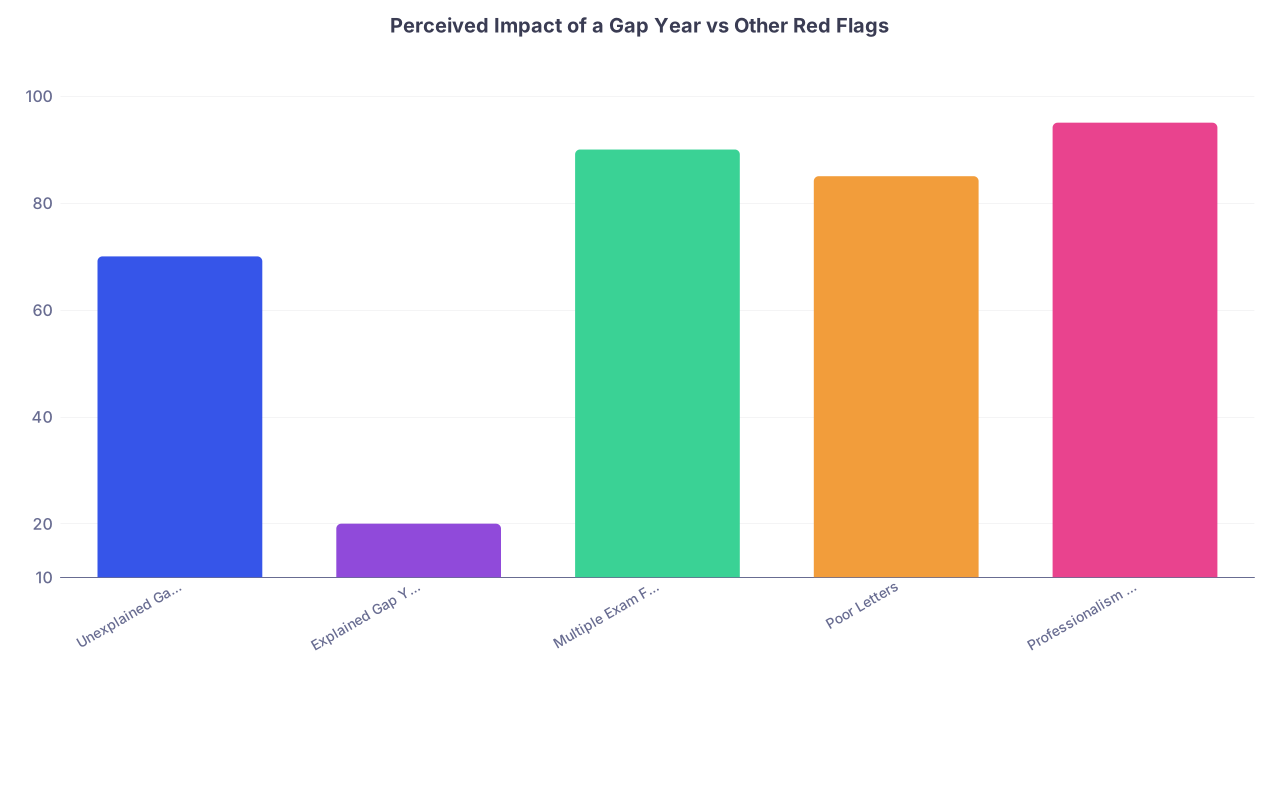
| Category | Value |
|---|---|
| Unexplained Gap Year | 70 |
| Explained Gap Year | 20 |
| Multiple Exam Failures | 90 |
| Poor Letters | 85 |
| Professionalism Issue | 95 |
Roughly how PDs think emotionally (not exact numbers, obviously):
- Unexplained gap year = “hmm, concern, maybe risky”
- Explained gap year = “ok, noted, moving on”
- Multiple fails / professionalism = “probably no”
So does a poorly explained gap year drop you in their eyes? Yeah, a bit.
Is it the same as “I got written up three times for unprofessional behavior”? No. Not close.
How to Keep Programs From Misinterpreting Your Gap Year
This is the part you actually control, and you have more power here than your doom-spiral suggests.
1. Give it a clear, simple label
Don’t overcomplicate it. Name the year in ERAS in a way that makes sense at a glance.
Some examples:
- “Research Fellow – Department of Cardiology, [Institution]”
- “Medical Leave of Absence – Personal/Health”
- “Full-Time Employment – [Company], [Job Title]”
- “Family Caregiving – Full-Time Care for Ill Parent”
Avoid vague nonsense like “Personal Development Year” unless you back it up with specifics. PDs roll their eyes at that.
2. Answer the unspoken questions directly
They’re thinking:
- What did you actually do?
- Why did this happen then?
- Are you stable and ready now?
Your description doesn’t need to be dramatic or emotional. Something like:
“From July 2022 to June 2023, I took a leave of absence from medical school due to a personal health issue. During this time, I focused on treatment and recovery under medical supervision. I have since returned to full-time clinical training, completed my remaining clerkships without further interruption, and continued regular follow-up. This experience strengthened my empathy for patients dealing with health challenges and reinforced my commitment to medicine.”
That’s enough. Clean. Honest. Reassuring.
3. Use the personal statement strategically, not as a confessional dump
You don’t have to write a trauma essay unless the gap is central to your story and you can handle it in a controlled way.
Ask yourself:
- Is the gap already clearly documented elsewhere?
- Is this actually key to why I’m choosing this specialty?
- Will writing about it help me, or will it drag my whole essay into “sob story” land?
If it’s something like “I needed a year to work and support my family,” 1–2 sentences in the PS is plenty, if at all. Don’t build your entire narrative around convincing them you’re not a disaster.

Situations Where Gap Years Raise More Concern (And What To Do)
Some scenarios really do raise PD eyebrows more. Not fatal, but trickier.
1. Multiple gap years or long unstructured time
If you’ve got:
- More than one full year off
- Several months sprinkled throughout with no clear structure
- A long period with absolutely nothing academic/clinical
You need to be extra careful about:
- Showing recent clinical activity (observerships, volunteering, scribing, per-diem work)
- Making a clear timeline (no fuzzy overlaps, no mystery months)
- Framing your story around growth and current stability, not chaos
2. Gap years tied to academic difficulty
If your gap is related to:
- Step 1 or 2 failure
- Remediation
- Repeating a year
You absolutely can still match, but you can’t pretend it didn’t happen.
You need:
- Clear explanation (no excuses, no blaming everyone else)
- Evidence of new strategies (tutoring, new study methods, time management)
- Upward trend (later passes, stronger scores, solid clerkship comments)
Programs are less worried about “you struggled once” and more about “you’ll struggle again under stress and we’ll be the ones dealing with it.”
3. Big non-medical pivot then back to medicine
If you took a year or more to do something seemingly very different—startup, PhD attempt, a different career path—PDs want to know:
- Why did you leave?
- Why are you sure you won’t leave medicine?
- What actually brought you back?
Again, not fatal. But you need to show you’re not going to disappear mid-residency when things get hard.
How Bad Is It If They Do Misinterpret It?
Let’s say worst-case: some programs look at your gap year and assume the worst.
What realistically happens?
You may:
- Get fewer interview invites than your “stats twin” who has a linear path
- Be quietly filtered out by the more rigid or risk-averse programs
- Have to over-apply a bit to cover the uncertainty
But here’s what doesn’t automatically happen:
- You’re not blacklisted from the Match
- You’re not universally rejected
- You’re not doomed to never train in your specialty
I’ve watched people with:
- LOAs for mental health
- One failed Step 1
- Years of working as a server, Uber driver, or retail
- Long pauses due to immigration or family illness
…still match, especially in IM, FM, psych, peds, neurology, pathology, etc. Not always at their dream program. But they matched.
| Gap Year Situation | Relative Risk* |
|---|---|
| Well-explained clinical/research year | Low |
| Non-clinical work, clearly explained | Low–Moderate |
| Unexplained 6–12 month gap | Moderate |
| LOA for health, well-documented | Moderate |
| Multiple years off, vague explanation | Higher |
| Gap + multiple exam failures | Highest |
*Relative risk = relative to a similar applicant without gaps, not “you won’t match.”
So yeah, misinterpretation can hurt. It might knock you down a tier of competitiveness or force you to apply more broadly. But your anxious brain is turning “this could reduce my options” into “this will end my career.” Those are not the same.

| Step | Description |
|---|---|
| Step 1 | Application Received |
| Step 2 | Standard Review |
| Step 3 | Contextualized as Neutral/Positive |
| Step 4 | Concern About Risk |
| Step 5 | Proceed to Overall Fit Review |
| Step 6 | Possible Screen Out or Lower Priority |
| Step 7 | Interview Decision |
| Step 8 | Gap Year Present? |
| Step 9 | Explained Clearly? |
Damage Control If You’re Already Mid-Application
If you’re reading this with ERAS already submitted and feeling that gut-drop of “oh no, I didn’t explain it well,” here’s what you can still do:
- Use interviews to clarify, briefly and calmly, when they ask “Tell me about this gap.”
- Ask your mentor or advisor if a short, focused update letter to selected programs makes sense.
- Make sure your talking points are practiced: no defensiveness, no rambling, no oversharing.
If your application is still in draft, good. You can fix this now by:
- Tightening the wording on your gap year entries
- Making sure the timeline is clean and consistent
- Having one trusted attending, PD, or advisor read your explanation and say, “Yes, this makes sense and is not a red flag.”
FAQ (Exactly What Your 2 a.m. Brain Is Asking)
1. Do I have to explain my gap year, or can I just leave it as dates and titles?
If it’s a straightforward research or work year with obvious structure (like “Research Fellow, Dept of Surgery”), a brief description of duties is enough. If the gap relates to health, academics, family crisis, or is non-traditional, you should give a concise explanation. Silence creates more suspicion than a clean, honest sentence.
2. Will saying I took time off for mental health ruin my chances?
No, not automatically. I’ve seen people match after being open about depression, anxiety, burnout—when they framed it as: it happened, I got treatment, I have systems in place, I’ve been stable, and here’s my consistent performance since. The biggest mistake is either oversharing every detail or pretending nothing happened when your MSPE clearly says otherwise.
3. My gap year was just… messy. Some work, some drifting, nothing impressive. Am I screwed?
No. Don’t try to turn it into a heroic story if it wasn’t. Focus on responsibility (what you did consistently), maturity (what you realized), and current stability (what your last 1–2 years look like). Programs care much more about who you are now than whether you wasted some time at 23.
4. Do I need a whole separate essay just about my gap year?
Usually no. Unless your gap is central to why you’re applying to that specialty and you can tell that story without sounding chaotic. For most people, a short, direct explanation in the experiences section (and maybe one or two lines in the PS if relevant) is plenty.
5. Will my gap year keep me from competitive specialties like derm, ortho, ENT?
Maybe. Those specialties are brutally numbers- and optics-driven. A gap year can be fine there if it’s a strong research year or something that clearly strengthened your application. A vague or problematic gap year will hurt more in these fields than in IM/FM/psych/peds. If you’re already borderline, it might make the edge sharper—but that’s more about the specialty culture than your inherent worth.
6. Is it better to be totally honest, even if the truth is ugly?
Be honest, but measured. They don’t need your therapy notes. They need: what happened in broad terms, that you addressed it, and that you’re solid now. “I took a leave for personal health reasons, received treatment, and have since returned and completed all requirements without further interruption” is honest. A three-paragraph trauma narrative is not helping you.
If You Remember Nothing Else
- A gap year is not an automatic death sentence. An unexplained or badly explained gap year is what hurts.
- You can’t control every program’s assumptions, but you can control how clear, calm, and coherent your story is.
- Programs care more about stability and performance after the gap than about you having a perfectly linear life.
Your brain is trying to turn one imperfect year into your whole identity. Don’t let it.