
It’s 10:47 p.m. You’re back in your apartment after a residency interview. Your suit is on the chair, your shoes are in the hallway, and you’re on the couch replaying every single second of the day like a crime scene reconstruction.
“Why did I say that about work-life balance?”
“Did the PD hate me? He didn’t smile when I mentioned my Step score.”
“Was that joke about night float totally inappropriate?”
You’ve already opened the program’s website three times to see if you “still like them” or if you now “hate them because they definitely hate you.” You’re half an inch away from emailing the coordinator to “clarify” an answer from your interview. Your brain is screaming: Did my interview go terribly? Did I just tank my entire match?
Let’s separate what’s real from what’s your anxiety inventing horror movies.
First, the brutal truth: your perception is almost always distorted
Let me be blunt: applicants are terrible at judging their own interviews.
I’ve seen people walk out saying, “I crushed it, they loved me,” and then never get ranked. I’ve also seen people near tears after an interview, convinced it was a disaster… and then match there.
Your internal “interview went terribly” alarm is wired to:
- Hyper-focus on your worst 30 seconds
- Completely ignore the other 29 minutes
- Misinterpret every neutral facial expression as “they hate me”
You’re tired. You’re stressed. You’ve got your entire future riding on a 15–30 minute conversation with a stranger. Your brain is not exactly an objective evaluator right now.
So I’m going to break this into two buckets:
- Signs you’re overthinking and your interview was probably okay
- Signs there might have been a real problem (and what that actually means)
And then we’ll talk about what to do next, because the urge to “fix it” is probably killing you.
Signs you’re overthinking it (aka classic post-interview spiral)
If any of this sounds like you, you’re in the “normal anxiety” zone, not the “you nuked your future” zone.
1. You’re obsessing over one awkward moment
You keep replaying:
- That one answer where you rambled
- The joke that didn’t land
- The 5 seconds of silence while you thought
- The time you had to say, “Can I take a second to think about that?”
Interviewers expect this stuff. They do dozens of interviews. They’re used to:
- Nervous laughing
- Slightly clumsy phrasing
- “Um” and “like”
- A story that doesn’t come out perfectly
You, on the other hand, are acting like that one answer is the entire application.
It’s not.
Most interviewers are evaluating the overall vibe: Are you normal? Trainable? Not arrogant? Not clearly toxic? That’s it. They’re not reading meaning into a 2-second awkward pause like you are.
2. You’re catastrophizing neutral or tired body language
“I knew it went badly because…”
- The interviewer didn’t smile much
- They didn’t nod as much as another interviewer
- They looked at the clock
- They took notes while you were talking
- They said, “Thank you for your time” in this “cold” way (your interpretation)
Reality check: many attendings and residents are:
- Exhausted
- Bad at small talk
- Naturally reserved
- Trying to stay neutral in their facial expressions
- On their fifth interview of the day / twentieth of the season
I’ve heard faculty literally say, “I try not to react much so I don’t influence the applicant’s behavior.” That flat affect that you’re reading as “I hate you” might just be them trying to be fair.
3. You’re comparing this interview to a “high” from another one
You had that one interview where:
- Everyone laughed
- The chief resident said, “You’d fit in great here”
- They kept going over time “because we were having such a good conversation”
Now anything less than that feels like failure.
Interviews vary wildly depending on:
- Interviewer personality
- Time of day
- How behind the schedule is
- Whether they just came out of a code or a rough patient conversation
A quiet, business-like interview is not a bad interview. It’s just… a different style. Your brain is using the “fun” interview as the baseline and flagging anything below that as “terrible.” That’s not how programs think.
4. You felt nervous and are assuming they saw you as incompetent
You’re thinking:
- “My hands were shaking when I picked up the coffee cup.”
- “I stumbled on my research explanation. They think I didn’t do it.”
- “I lost my train of thought once. They think I can’t think on my feet.”
Programs fully expect applicants to be nervous. If an interviewer dings you for not sounding like a TED Talk speaker under massive stress, that’s on them, not you.
If you were coherent, respectful, and didn’t say anything wildly inappropriate or unethical, you’re almost certainly in the acceptable range.
5. You’re reading way too much into tiny things after the fact
Stuff like:
- “They didn’t ask for my contact info at the end”
- “They didn’t give me their card”
- “They said ‘good luck with the process’ — that must mean they’re rejecting me”
Most of those things are scripted or habit. Many places literally tell interviewers not to say anything that can be interpreted as “we want you” or “you’re ranked highly.”
You’re trying to decode secret messages that probably don’t exist.
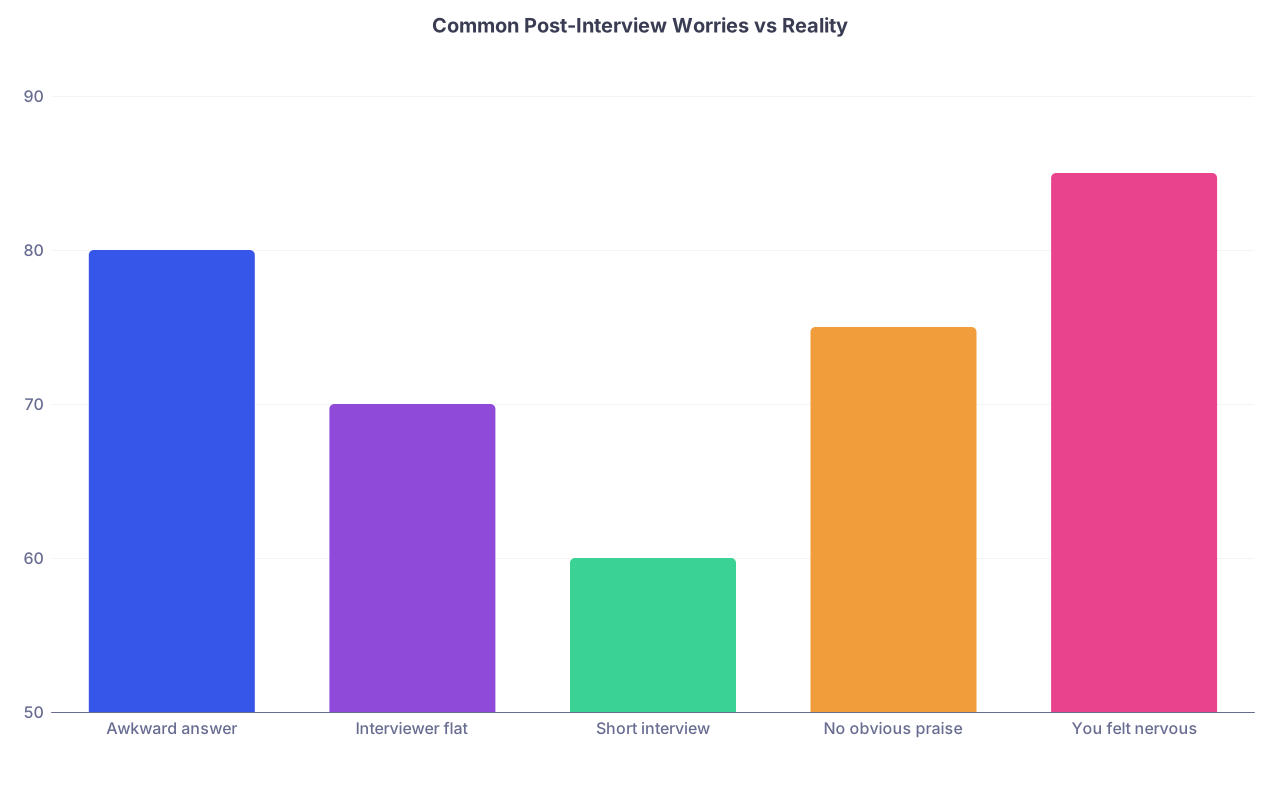
| Category | Value |
|---|---|
| Awkward answer | 80 |
| Interviewer flat | 70 |
| Short interview | 60 |
| No obvious praise | 75 |
| You felt nervous | 85 |
(Values = approximate % of applicants who worry about this at least once. Translation: you’re not special for freaking out. Everyone does.)
Signs there might have been a real problem (and what that actually means)
Now the part you’re really afraid to read.
Yes, sometimes interviews genuinely go poorly. But “poorly” doesn’t always mean “you’ll never match anywhere.” It often just means “this specific program is less likely to rank you high.”
Here are the red flags that are more than just anxiety:
1. You directly contradicted your application or got caught in confusion
Examples:
- You said you did 2 years of research, but your CV clearly shows 4 months
- You couldn’t explain your role in a project you listed as “primary author”
- You gave totally different reasons for a leave of absence than what your dean’s letter implies
This is where interviewers start wondering about honesty or insight. That can hurt.
But even then, context matters. If you were caught off guard, clarified, and seemed genuine, many will give grace. It’s the combination of inconsistency + defensiveness that really gets you in trouble.
2. You said something that sounded unprofessional or ethically shaky
Things like:
- Trashing a previous program, attending, or medical school
- Bragging about cutting corners, bending rules, or ignoring policies
- Making an off-color joke (especially about patients, gender, race, etc.)
- Admitting to something serious without showing insight or remorse
Those can absolutely tank an interview at that specific program.
The good news (if you can call it that): if you’re worried about this because your conscience is yelling at you, you probably won’t repeat the mistake. Many applicants have one interview they mentally write off and still match fine.
3. The interviewer actively pushed back or looked truly concerned
You’re not overthinking if:
- They repeatedly challenged your answers in a tense way
- They explicitly questioned your professionalism or motivation
- The conversation took a turn into “I’m not sure this is the right fit for you” territory
- They brought up major concerns from your file and you gave a weak, evasive answer
Will that doom you everywhere? No. But at that program? It’s a genuine hit.
That doesn’t mean automatic catastrophe. Programs weigh different things differently. Another place might not care at all about the same issue if the rest of you is strong.
4. You realize you didn’t know basic facts about the program
If you:
- Confused them with another program
- Clearly hadn’t read their website
- Asked questions that made it obvious you hadn’t done minimal homework (“So… do you have a night float system?” when it’s on slide 2 of their presentation)
That signals low interest or lack of preparation. Some programs really do hold that against you.
But again: it’s more about relative ranking. If 100 applicants interview and you looked less invested than others, you drop. That’s very different from “blacklisted from the match.”

Reality check: What a “bad” interview actually does to your match chances
Your brain jumps straight to: “One bad interview = I won’t match anywhere.”
That’s not how this works.
The match is a numbers and probabilities game. One shaky interview at one program mainly affects your position on that rank list.
Let me spell it out in something visual:
| Situation | Likely Impact |
|---|---|
| 1 bad interview out of 12 total | Minimal overall; maybe lost 1 program |
| 2–3 so-so interviews, rest OK | Slight hit, but still many chances |
| Multiple interviews with serious red flags | Bigger concern, but still not definitive |
| You think they all went "medium" | Very common; often still match fine |
Programs rank lots of people. You don’t need to be perfect everywhere. You need enough places to rank you high enough.
Also: you are not a reliable narrator of which interviews were “good” vs “bad.” I’ve seen people swear their “best” interview was where they matched and then go back and look at their notes and realize they’d actually rated it “6/10” that night.
Your anxiety is not an accurate metric.
How to tell if you’re overthinking vs there’s a real problem
Use this as a rough mental filter:
You’re probably overthinking if:
- Your main evidence is “they didn’t smile / they seemed tired”
- You’re obsessing over one imperfect answer
- You walked out feeling “okay” but spiraled later
- You care a lot what they thought of you (usually means you were trying, not sabotaging)
You might have had a real problem if:
- You said something you immediately recognized as unprofessional
- The interviewer seemed actively upset, not just flat
- You contradicted your application and couldn’t explain it
- You truly blanked on super basic program details and made it obvious
Even in that second group, it often affects just that one program, not your entire season.
What you should NOT do after a “bad” interview
The impulse to do damage control is strong. It’s also where people dig the hole deeper.
Don’t:
- Email to “clarify” every answer you’re second-guessing
- Send a panicked essay-length thank you note explaining why you were nervous
- Ask the coordinator, “Did I ruin my chances?” (yes, people actually do this)
- Try to argue with or correct something an interviewer said afterward
If you genuinely misspoke about a factual, important thing (e.g., said the wrong date for your graduation, stated a wrong publication status), you can send a short, calm clarification:
“Dr. X, thank you again for the opportunity to interview today. I realized after our conversation that I misspoke about [brief thing] — [corrected one-sentence fact]. I apologize for the confusion and appreciate your understanding.”
That’s it. Not an apology novel.
If you’re just feeling like “I could have sounded smarter,” that’s not something to fix by email. That’s something to accept and move on from.
What you can do to regain some control
You’re not going to feel calm, but you can at least stop making things worse.
Write a quick, normal thank you email.
Same day or next day. 3–5 sentences. Professional, grateful, not clingy. Then stop.Make a reality-based note in your interview log.
Literally write:- What went well
- What felt off
- Any possible true red flags (keep it factual, not emotional)
Future-you will likely look back and think, “Oh, this wasn’t nearly as bad as I felt.”
Extract one improvement for next time.
Maybe you need a better answer for “Why this program?” or a cleaner way to explain that leave of absence. Fix that. That’s productive anxiety.Force a mental boundary.
Decide: “I’m allowed to spiral about this until midnight. After that, I’m done and I focus on the next interview.” Harsh, but you need some line.

| Step | Description |
|---|---|
| Step 1 | Finish Interview |
| Step 2 | Quick reality check |
| Step 3 | Write brief thank you |
| Step 4 | Short factual clarification email if needed |
| Step 5 | Note strengths & weaknesses |
| Step 6 | Prepare for next interview |
| Step 7 | Feel terrible? |
| Step 8 | Actual red flag? |
FAQ (4 questions)
1. I had one truly awful interview. Like, I froze on a basic question. Am I done?
No. One horrible interview happens to almost everyone. It usually just means that specific program is less likely to rank you high. That’s it.
I’ve seen applicants with one or two train-wreck interviews still match at strong programs. The key is: don’t let that one experience wreck your confidence for the rest of the season. Treat it like a bad exam you can’t retake — you learn what you can and move on.
2. The interviewer barely talked and seemed bored. Does that mean I’m out?
Not necessarily. Some people just interview like that. They don’t emote, don’t react, don’t engage much. They might give you a perfectly decent score afterward and you’ll never know.
Unless they were actively hostile or cutting you off, “low energy” from them is not the same as “low score for you.” Your anxiety is filling in blanks you actually don’t have data for.
3. Should I tell another program in a later interview about a bad interaction I had elsewhere?
No. Do not bring other programs’ drama into new interviews. It just makes you look like someone who carries baggage forward or bashes places behind their backs.
If there’s an actual issue that’s in your record (like a professionalism concern) and they ask, you address the underlying event honestly and own your growth. But you don’t say, “Yeah, at X program they really misunderstood me.” That never helps.
4. Be honest: if I feel like every interview went “meh,” is it over?
Not at all. Most people describe their interviews as “fine,” “okay,” or “nothing special.” Programs are not looking for fireworks from every candidate. They’re looking for solid, safe, normal humans they can work with at 3 a.m.
Remember: they don’t rank only the top 5 applicants. They build long rank lists. You might feel “meh” to yourself and still be exactly what they want. Plenty of residents matched to places where they walked out thinking, “Well… that was average.”
Here’s your next step for today:
Grab your notebook or open a doc and write down everything you remember from the interview you’re freaking out about — but only facts, no interpretations. Then highlight three moments that actually went well, even if they were small. You’re training your brain to see the whole picture instead of just the worst 30 seconds.