
The panic spiral after emailing a PD is real—and most of the time, it’s completely out of proportion to what actually happened.
You hit send. Your stomach dropped. Now you’re lying awake thinking: “I emailed a PD and regret it. Did I just destroy my entire application at this program? Are they going to screenshot it and show other programs? Is there some secret blacklist?”
Let me answer that directly:
You almost definitely did not ruin your application.
But let’s walk through the nightmare scenarios your brain is inventing, one by one.
What Actually Happens When You Email a PD
First harsh truth: you’re not the first applicant to send a weird/awkward/overly long/poorly timed email to a PD. Programs get tons of them every season.
Second truth: most of those emails don’t get nearly as much attention as we imagine.
Here’s the unglamorous reality I’ve seen:
- A coordinator opens the email first.
- If it’s routine (“Just confirming you received my Step score”), they handle it or ignore it.
- If it’s a little awkward but not offensive, it gets skimmed, maybe rolled eyes at, and… that’s it.
- PDs are drowning in real work. Your anxiety-ridden paragraph is one drop in a firehose.
Are there emails that actually hurt applicants? Yes. But they’re the exception, and they’re usually obviously bad:
- Rude or entitled wording
- Demanding updates, pressuring for interviews
- Inappropriate familiarity (“Hey John! Just circling back 😄”)
- Comparing programs or trashing another place
- Unprofessional oversharing or emotional dumping
If your email wasn’t any of those? You’re probably fine. Even if it felt “cringey” when you re-read it.
Let’s Put Your Email In a Category
Instead of the vague “I regret it,” I want you to put your email in a bucket. Most fear comes from not naming the thing.

Look at these categories and see where yours actually fits.
| Category | Actual Risk | Typical Outcome |
|---|---|---|
| Routine question | Very low | Ignored or brief reply |
| Awkward / overeager | Low | Mild eye roll, then gone |
| Slightly unprofessional | Low–moderate | Remembered briefly, rarely fatal |
| Truly inappropriate | High | Can hurt or kill chances |
| Offensive / hostile | Very high | Almost always fatal |
1. Routine question
Stuff like:
- “Just wanted to confirm you received my updated Step 2 score.”
- “I’m very interested in your program and wondered if you consider applicants with X visa status.”
- “I’m following up on whether you need any additional documents.”
These are fine. Boring. Forgettable.
If this is your email and you’re spiraling, your anxiety is doing what anxiety does: lying.
2. Awkward / overeager
Examples:
- You sent a long “love letter” to the program.
- You mentioned them as your “top choice” in October… and might say that to multiple programs.
- The tone was a little too informal.
- You followed up twice when you probably should have stopped at once.
Could someone roll their eyes? Sure.
Will it single-handedly sink you in 99% of cases? No.
3. Slightly unprofessional
This is where things get more uncomfortable:
- Typos in the subject line (“Dear Progarm Director”)
- Vague bragging or humblebragging
- A hint of entitlement: “I believe my scores and experiences merit an interview.”
- A mildly guilt-trippy tone: “I really thought I would have heard from you by now.”
This stuff can create a small negative impression. But remember—they’re still weighing your whole application: letters, scores, experiences. A slightly off email is one data point, not the entire story.
4. Truly inappropriate
This is the danger zone:
- Flirting or overfamiliarity
- Complaining about another program
- Implying you deserve special treatment
- Anger, frustration, or demanding language
- Emotional oversharing that feels like a therapy session
These can hurt you. Sometimes a lot. But even then, context matters. Was it a one-off? Was it truly that bad, or are you catastrophizing?
Worst-Case Scenario vs Likely Reality
Your brain:
“They’re going to show this email to the committee, laugh at me, and blacklist me.”
Reality 90% of the time:
- Coordinator: skims email, labels it, maybe replies.
- PD: might never see it.
- Committee: never hears about it.
- Application: judged on the same main things—scores, letters, experiences, interview.
Let’s separate the nightmare from what programs actually do.
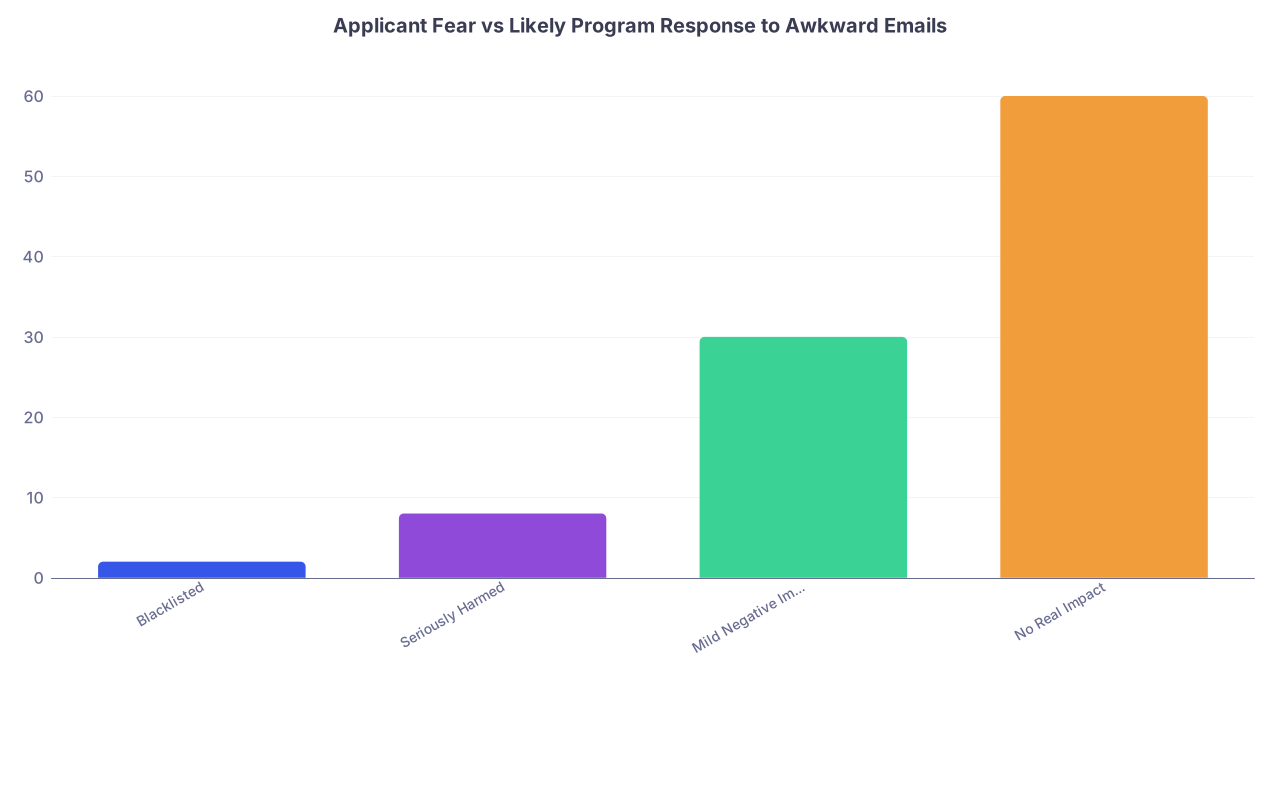
| Category | Value |
|---|---|
| Blacklisted | 2 |
| Seriously Harmed | 8 |
| Mild Negative Impression | 30 |
| No Real Impact | 60 |
Is that exact percentage data? No. But it's roughly what I see season after season. Most emails do nothing. A minority create a tiny ding. Only a handful are truly harmful.
If your email wasn’t clearly rude or inappropriate, it’s very likely in the “mild impression or no impact” zone.
Should You Send a Follow-Up or Apology?
This is where people often make things worse. You send one slightly cringe email. Then you send a second email… about the first email. Now they notice you.
General rule I stand by:
Most of the time, do not follow up just to apologize for a non-offensive email.
You risk:
- Highlighting something they barely noticed
- Coming across as even more anxious/needy
- Doubling the footprint of the original mistake
So when is a follow-up reasonable?
Consider a brief clarifying email only if:
- You realize you sent wrong or misleading factual information (dates, scores, program name)
- You misaddressed the email to the wrong program (“I love your program at [Wrong City]”)
- You accidentally attached something you really shouldn’t have (wrong document, personal file)
In those rare cases, something like this is enough:
Subject: Correction to Previous Email
Dear Dr. [Last Name],
I realized after sending my previous email that I [brief description: e.g., referenced the wrong program name / included the wrong attachment]. My apologies for the oversight—please see the corrected [information/attachment] here.
Thank you for your understanding,
[Name, AAMC ID]
Short. Clean. No over-explaining. You don’t need a dramatic apology letter.
If your “mistake” was just tone, length, or overeagerness? Don’t send a second email. Let it die.
The Paranoia About “Programs Talking” and Blacklists
I know the fear: “What if they warn other programs about me?”
Reality: Programs are not running some group chat where they drag every awkward applicant email. They’re too busy for that.
There are a few rare exceptions where programs might talk:
- Truly egregious professionalism issues
- Boundary violations or harassment
- Dishonesty or fraud
Not “this student said we’re their top choice, and I bet they told that to others too.”
If your email wasn’t ethically or professionally outrageous, you’re not going to end up in some secret exile list. That’s an anxiety myth.
How PDs Actually Judge You (Beyond That Email)
One email is one pixel in a huge picture. Here’s the stuff that carries real weight:
| Component | Relative Importance |
|---|---|
| Letters of recommendation | Very high |
| Board scores (Step 1/2) | High |
| Clerkship performance | High |
| Interview performance | Very high |
| Personal statement | Moderate |
| One awkward email | Low |
I’ve watched committees go through 200+ applications in one sitting. They don’t open the email inbox and do a vibe check first. They look at:
- Do your letters say you’re trustworthy and good with patients?
- Are your scores reasonable for their program’s usual range?
- Did your rotations show you’re safe and collegial?
- If you interviewed: did people want you on their team at 3 a.m.?
Your email is background noise unless it’s dramatically bad. And yours, almost certainly, wasn’t.
How to Stop Obsessing (And Actually Learn From This)
Your anxiety wants you to replay the email in your head until March. That’s not productive. Here’s what is.
Screenshot the email and put it in a “lessons” folder.
Not to torture yourself, but to remind Future You how not to write to PDs.Create a three-rule filter for any future PD communication:
- Would I say this out loud to their face, in a room with other faculty listening?
- Could this be read as entitled, desperate, or inappropriate?
- Is this information either necessary or genuinely helpful?
If you don’t get 3 yeses, don’t send it. Or rewrite until you do.
Decide on a hard limit for outreach.
For example: “I don’t email PDs at all unless I have a clear reason” or “I send at most one short, specific email per program, post-interview.”Shift the focus back to what still matters.
- Are there other programs you can still email appropriately (or not at all)?
- Can you update something meaningful—Step 2 score, new publication, etc.—for all programs at once?
- Can you prepare for interviews instead of rewinding one email?
Your goal now isn’t to undo the email. You can’t. Your goal is to not let this one moment hijack the rest of your season.
Red Flags You Actually Should Worry About
Let me be honest: there are lines that, if crossed, can seriously damage things. If your email had any of these, then, yes, it could be a real problem:
- Insulting language, even subtle (“I hope your program can learn to respond more professionally in the future.”)
- Inappropriate personal comments about faculty, residents, or other programs
- Boundary crossing (personal invites, gifts, “we should grab coffee when I’m in town”)
- Threats or weird pressure (“If I don’t hear back, I’ll have to let other programs know how I was treated.”)
If you’re in this zone, I’d consider quietly involving your dean’s office or an advisor you trust. Not to make a huge deal—but to get real-world perspective and maybe damage control if needed.
For everyone else—the “I sounded too eager” and “I said they were my top choice in October” crowd—you’re in the normal neurotic applicant range. Not the catastrophic range.
Normalize This: Almost Everyone Has a Cringe Moment
I’ve never met a residency applicant who didn’t have at least one:
- Overly intense email
- Slightly desperate post-interview message
- Poorly timed outreach
- Over-sharing about their ranking intentions
PDs and coordinators know this. They watch 24-year-olds under absurd pressure try to sound polished and perfect while their entire future depends on a mysterious algorithm.
They’re not expecting flawless. They’re expecting human.
You’re allowed one clumsy email. Probably more than one. It doesn’t define you.
What You Should Do Today
Don’t send another email. Don’t ask three different PDs to “clarify” if your email ruined anything. That’s how you actually make it worse.
Do this instead:
- Open the email you sent.
- Identify which category it’s realistically in: routine, awkward, slightly unprofessional, or truly inappropriate.
- Unless it’s truly inappropriate or factually misleading, decide right now that you’re not sending any follow-up about it.
- Then open your interview prep or application list and spend 30 minutes improving something you can still control.
That’s your next step.
FAQ: “I Emailed a PD and Regret It”
1. Can one bad email really ruin my chances at a program?
Only if it’s truly bad—rude, unprofessional, inappropriate, or crossing serious boundaries. Awkward, overeager, or slightly cringey emails almost never single-handedly tank an otherwise solid applicant. They might cause a slight negative impression, but they’re one data point out of many.
2. Should I apologize for my email to the PD?
Usually no. Apologizing for a normal or mildly awkward email just draws more attention to it. The only time I’d send a follow-up is if you gave incorrect factual info, attached the wrong document, or misaddressed the email to the wrong program. Then send one short, calm correction and move on.
3. Will programs share my email with other programs and blacklist me?
Unless your email involved major professionalism issues (harassment, threats, obvious dishonesty), it’s extremely unlikely. Programs don’t have time to circulate every slightly weird email they get. There’s no secret widespread blacklist over standard applicant awkwardness.
4. I told more than one program they were my “top choice.” Am I screwed?
No, you’re not uniquely evil—just doing what a lot of anxious applicants do. Is it ideal? No. Could it mildly annoy someone if they somehow find out? Sure. But it’s not usually a reason alone to rank you lower. Going forward, be more precise and honest in how you phrase interest: “I’m very interested” is safer than “You’re my #1.”
5. How can I avoid sending another email I regret?
Create a simple rule: draft the email, then wait at least one hour before sending (longer if you’re emotional). Have a friend, mentor, or advisor read anything going to a PD that isn’t strictly logistical. And ask yourself three questions before you hit send: Is this necessary? Is this professional? Would I be fine with this being read aloud in a committee room?
Now: go open that sent email, be brutally honest about which category it’s in, and then—before you spiral—spend 20 minutes improving something in your control today (interview prep, program list, or future communication templates).