
If you want more consults in residency, you want more reps. More pages, more quick chart dives, more 10-minute bedside assessments, more calls where you have to give a clear plan and own it.
That's what consult-heavy training is. And where you train, community vs academic, changes how much of it you actually get.
What You'll Take Away
- More consults usually means more exposure to complex inpatient decision-making, but not always more autonomy.
- Academic programs often offer higher consult density and subspecialty breadth, while community programs often offer broader generalist ownership.
- The best choice depends on your goals: fellowship and subspecialty depth versus continuity, autonomy, and a more generalist workflow.
What 'More Consults' Usually Means in Residency Training
Consults = volume. How often you're asked to see a patient you don't own. ED at midnight, ICU asking for co-management, floor team with a rash they can't figure out, surgeon worried about hyponatremia before the OR. That's the job.
Why do some residents crave that? Because it compresses learning. You see the weird stuff faster. You get really good at triage, what's emergent, what's not, what needs a bedside eval right now versus what can wait till morning. Your communication gets sharper, too. You have to present a tight one-liner to an attending who doesn't know the patient and a primary team that's already overwhelmed.
Here's the catch I've seen trip up applicants: consults are not autonomy. More consults can mean more reps, but also more layers. In some programs you see 8 consults a day and write a note that a fellow then rewrites and an attending then edits. Lots of activity. Less ownership. In other programs you see 3 consults a day but you're the one making the call, following up, procedures, continuity. That sticks more.
Consult frequency also swings wildly by specialty and hospital. Internal medicine, neurology, ID, cards, consult monsters everywhere. Trauma center? More consults. Big ICU presence? More consults. Small community shop with no in-house subspecialists? Ironically, fewer official consults because there's no one to consult. You just manage it.
Bottom line: don't confuse busyness with training. You want reps that actually teach.
Community vs Academic Programs: Where Consult Exposure Tends to Differ
Academic centers are built to generate consults. Tertiary referrals, transplant patients, LVADs, weird immunology cases that got bounced from three other hospitals. You'll have 15 subspecialty services, fellows on every one, and a culture where primary teams consult early and often. If you want sheer breadth, vasculitis, paraneoplastic syndromes, refractory whatever, academic is hard to beat.
That density comes with structure. More fellows means you might be first call but not final call. More supervision. More "let's run it by Dr. X in electrophysiology." Great for learning nuance. Can feel diluted if you wanted to own the case start to finish.
Community programs flip it. Fewer subspecialty services on site. More generalist exposure. You're not consulting rheum at 9pm because there is no in-house rheum at 9pm. You figure it out. You own the primary management longer, and your attending relationship is tighter, often 1:1, not 1 to a team of 6. I've watched residents in good community programs become incredibly efficient because there's no fellow layer to hide behind.
But don't romanticize it. Some community programs are consult-heavy as hell. Big catchment, high volume ED, no in-house specialists? You'll be slammed with cross-coverage questions and "can you see this" all day. And some academic programs? Surprisingly light on consults for residents. The fellows take everything, or the service is so resident-light that you're mostly holding a pager for your attending's private patients.
It's not community vs academic. It's that specific hospital, that specific staffing model.
What More Consults Actually Gives You
Upside first. It makes you fast.
Pattern recognition goes up because you've seen 40 cases of new-onset afib with hypotension, not 4. You get better at differentials that actually matter at 2am, not textbook lists, but "what will kill this patient tonight." Your handoffs get cleaner. Your ability to walk into a room you've never been in and give a cogent plan in 12 minutes? That's consult training.
If you want fellowship, academic medicine, inpatient subspecialty work, cardiology, GI, ID, pulm/crit, rheum, consult volume is gold. You learn how subspecialists think, you get letters from them, you see the cases fellowship directors expect you to know.
Downside? Consults can fragment your day into confetti. Page, walk, examine, chart review, page back, note, page again, repeat. You lose continuity. You never see if your rec actually worked because you're onto the next one. And the cognitive load of constant context-switching is real. Some residents burn out not from hours but from interruptions.
The sweet spot I've seen: programs where consults are frequent enough to push you, but structured enough to debrief. You see the patient, you commit to a plan, you get 5 minutes of real feedback from your attending, and you actually close the loop with the primary team. Not just "you'll survive." Actually learning.
How to Judge Programs If You Want More Consults
Stop asking, "Do you get a lot of consults?" Everyone says yes. You need numbers.
Here's the framework I give applicants who actually want this:
1. Ask for counts, not vibes. How many new consults per call shift? Per weekend? Per week on the busiest service? What's the average census for the consult service? If they can't answer, that tells you something.
2. Who answers first? You or the fellow or the attending? In some academic programs the fellow takes the initial call and you're second. That cuts your volume in half right there. In community programs you might be the first and only call.
3. Who absorbs the work? How often do fellows, APPs, or e-consults siphon off consults? Capped services? Night float handling consults vs you?
4. Look at the schedule. Rotation block diagram is more honest than marketing. How many weeks of pure consult service vs primary service? How many hospitals? What service lines exist only at the university hospital?
5. Listen to residents when they're tired. When consults spike, what does a normal Tuesday look like? How many pages per hour? How much time do you spend just coordinating? Do you get protected time to teach and learn, or is it just churn?
And balance it. Consults are one variable. Don't chase them if it costs you everything else, autonomy, procedures, outpatient continuity, sleep, sanity. I've seen residents rank a program #1 for consult volume and then be miserable because they never owned a patient longer than 12 hours.
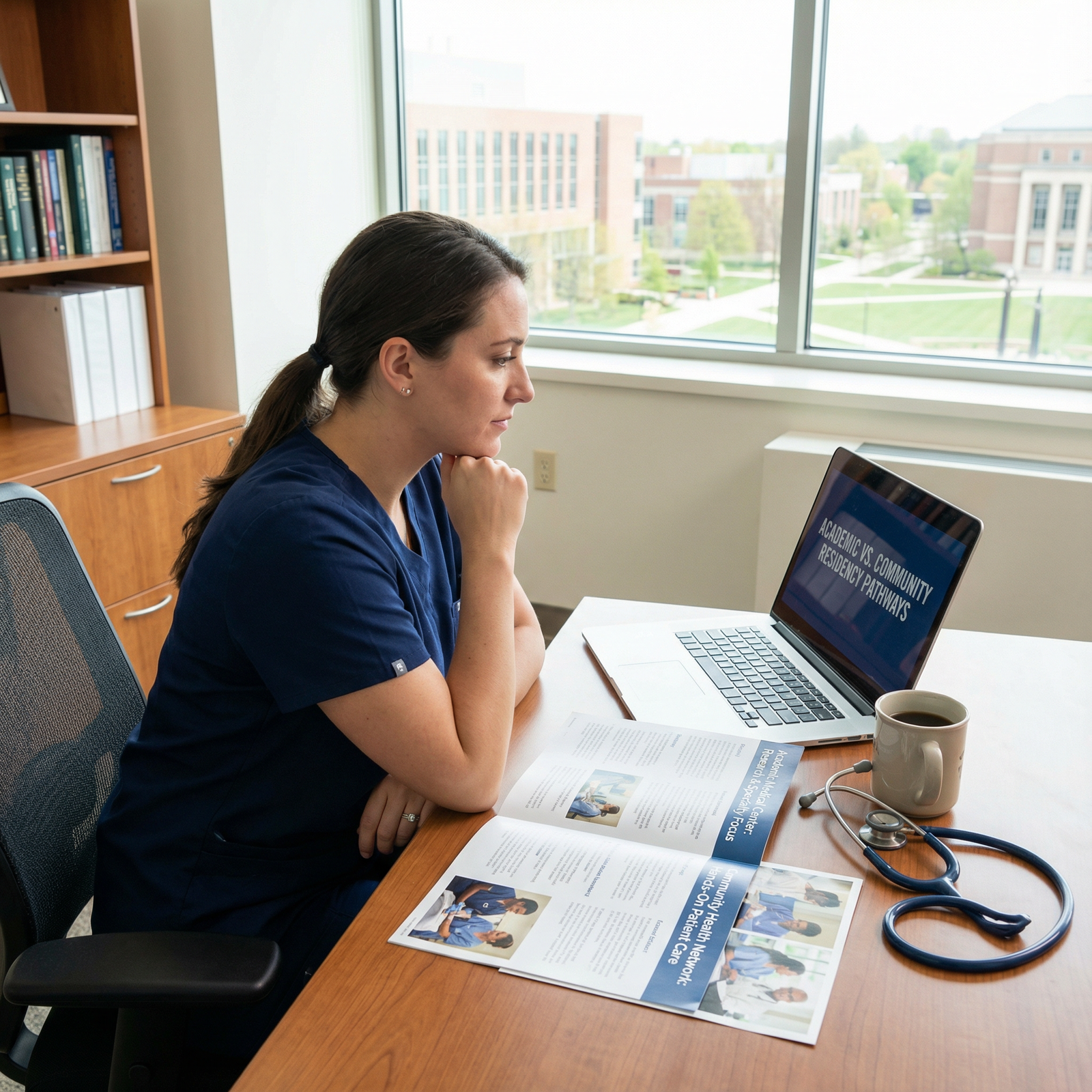
Who Should Prefer Which Setting
Be blunt about what you want after residency.
You'll probably be happier in an academic program if:
- You want complex referrals, zebra hunting, subspecialty depth
- You're aiming for fellowship, especially competitive inpatient fellowships
- You like research, didactics with subspecialists, big case conferences
- You don't mind layers, more supervision, more discussion, less final decision power as a junior
You'll probably be happier in a community program if:
- You want broad ownership. You admit it, you manage it, you discharge it.
- You like efficiency, fewer layers, direct attending access
- You want to be a strong generalist, hospitalist, primary care with inpatient heavy, rural
- You learn best by doing, not by watching a fellow do it
More consults is not automatically better training. I know that's heresy if you're wired to hustle. But good training = high enough volume to be uncomfortable + enough continuity to see the outcome of your decisions. Some people thrive on 10 micro-encounters a day. Others need to follow 6 patients for a week.
Community gives you continuity and efficiency. Academic gives you complexity and subspecialty reps. There's a tradeoff. Own it.
What to Ask on Interview Day and How to Decide
Use interview day like reconnaissance. Not brochure-reading.
Ask these, verbatim:
- How many new consults does an intern/resident see on an average day on your busiest consult service? On call? On a weekend?
- Who takes the first call for consults, resident, fellow, or attending?
- What happens to consults after 5pm and overnight? Do residents field them or does an attending/e-consult service cover?
- How much of the day is documentation/coordination vs bedside evaluation?
- When your consult census spikes, who helps? Is there a cap?
- Can you walk me through yesterday, hour by hour, on consults?
Then listen to what residents say when the program director isn't in the room. Do they complain about paging burden or do they light up talking about a cool case they saw? Do they say "we see a ton but we actually get to do stuff" or "we see a ton and it's just notes"?
Decision rule I use with mentees: rank your top 3 priorities. Not 10. Three. Example: 1) subspecialty exposure for cards fellowship, 2) autonomy on procedures, 3) not being in a fellow-driven program. Now score each program on those three. If consult exposure is #1 because you want academic cards or GI, academic is probably your best bet. If autonomy and continuity are #1, community probably wins, even if it's slightly less consult-heavy on paper.
Action steps before you finalize your list:
- Make your shortlist of 12-15 programs. Tag each one high/medium/low for real consult volume based on what residents told you, not the website.
- Write down fellow presence for each core subspecialty. Fellows everywhere = less direct resident consult exposure.
- Check geography and hospital type. Tertiary quaternary center? VA? Community affiliate? County? Each changes volume.
- Sleep on it, then re-rank by fit, not prestige. Choose the environment that gives you the mix of complexity, autonomy, and support you actually learn best in.
Consult volume matters. It's just not the whole story.