
Publishing in a predatory journal is a serious tactical error on a residency application, but it is not an insurmountable fatal flaw.
Every year, medical students eager to fill the research section of their Electronic Residency Application Service (ERAS) CV fall victim to aggressive open-access solicitations. You receive an unsolicited email praising your previous abstract, promising peer review within 48 hours, and requesting a modest Article Processing Charge (APC). Three weeks later, your paper is online, your money is gone, and you discover the publication is listed on predatory journal registries, unindexed by PubMed, and completely unrecognized by legitimate academic societies.
Program directors are increasingly vigilant. They recognize these predatory entities immediately. When an applicant lists a paper from an enterprise known for fake peer review and pay-to-play publishing, selection committees draw immediate, negative conclusions about the applicant's research literacy, integrity, or both.
You cannot undo the submission, but you can manage the fallout. Doing so requires a cold assessment of the damage, strategic decision-making regarding retractions, absolute transparency on ERAS, and an aggressive counter-strategy of legitimate scholarly production.
This article is for educational purposes only. It is not financial advice, not legal advice, and not tax advice. Figures vary by individual circumstances, so consult a qualified professional before acting.
The Real Consequences of Predatory Publications on Your Residency Application
Residency selection committees do not evaluate all published lines equally. The rise of predatory publishing, defined by dishonest peer-review practices, deceptive metrics, and aggressive solicitation for financial gain, has forced academic medicine to change how applications are screened.
Program directors view a predatory publication through two distinct lenses:
- A Failure of Due Diligence: The applicant lacked the basic academic literacy to distinguish a legitimate scholarly journal from an extortionate commercial enterprise.
- Academic Dishonesty: The applicant knowingly paid a deceptive entity to manufacture a publication line to artificially pad their ERAS profile.
Neither interpretation is favorable. In competitive specialties such as Dermatology, Orthopedic Surgery, Otolaryngology, and Plastic Surgery, where publication counts often serve as an initial screening benchmark, listed entries are routinely spot-checked. Program directors and research faculty frequently verify PMIDs (PubMed Identifiers). When a paper listed under "Peer-Reviewed Journal Articles" yields no PubMed result and routes back to a known predatory publisher based in an obscure offshore domain, the credibility of the entire application collapses.
Data collected across major academic specialties demonstrates that over 60 percent of program directors actively look for red flags in research citations. More than one-fifth of surveyed program directors state they have downgraded or outright rejected applicants specifically due to the presence of predatory journals on their CV.
The damage is not limited to high-volume competitive specialties. Even in Internal Medicine, Pediatrics, and Family Medicine programs, an unindexed or dubious citation raises questions during committee reviews. If a faculty reviewer takes thirty seconds to search for your paper and lands on a poorly formatted site filled with typos and broken links, your research portfolio transforms from an asset into a liability.
Step 1: Determine if Retraction Is Possible or Advisable
Once you realize a paper has been published in a questionable venue, your immediate reaction might be to demand a full retraction. However, dealing with pseudo-journals requires caution. These publishers do not operate under the ethical guidelines established by the Committee on Publication Ethics (COPE).
You must systematically evaluate whether requesting a retraction will resolve the problem or compound it.
Assessing the Options
Scenario A: The Paper Has No Digital Object Identifier (DOI) and Is Not Indexed
If the journal has posted your manuscript on an unindexed website without assigning a permanent DOI, and the site receives virtually no traffic, your best move is often to request withdrawal in writing. Send a formal email to the editorial contact stating:
"I am formally withdrawing my manuscript [Title] from publication, effective immediately. Do not index or distribute this work."
If they ignore you or refuse, but the work is unindexed and invisible to standard database queries (such as PubMed, Scopus, or Web of Science), you may choose to omit the item entirely from your ERAS CV. You cannot be penalized for excluding an unindexed, self-published draft that lacked genuine peer review.
Scenario B: The Journal Demands a "Retraction Fee"
A hallmark of predatory publishers is the withdrawal fee. When you request a retraction, the publisher may demand an additional $300 to $1,000 to remove the PDF.
Do not pay this fee.
Paying a predatory entity a second time yields no guarantee that they will actually remove the paper. In many instances, taking the bait leads to further extortion while the paper remains online. If the publisher refuses to remove the article without payment, document all email correspondence meticulously. Save every sent and received email to a PDF portfolio. This documentation serves as evidence that you acted in good faith to correct the error.
Scenario C: The Paper Is Indexed and Cited
If the manuscript managed to land in Google Scholar or a peripheral index and has already been cited by other authors, attempting to erase it is futile. The paper exists in the public record. In this scenario, attempting to hide the publication will backfire if a committee member uncovers it. You must retain the entry on your application, but you must contextualize it clearly.
Step 2: Contextualize the Publication in Your ERAS Application
Omitting an indexed paper that bears your name is risky. If a program director runs your name through Google Scholar or PubMed and finds an unlisted predatory publication, they may assume you intentionally concealed it. Transparency is your best defense against accusations of dishonesty.
ERAS provides specific fields for publication entries. You must list the citation accurately, but you should use the description or note fields to clarify the status of the work cleanly and objectively.

Practical ERAS Formatting Guidelines
Do not make emotional excuses in your ERAS entry. Do not write paragraphs explaining how you were tricked by an email. Present the facts with clinical precision.
Incorrect Framing (Defensive / Emotional):
"Published in Journal of Medical Advances. I did not know this was a fake journal when I sent it in as an M1 student. They stole my money and published it without my final approval, so please ignore this paper."
Correct Framing (Objective / Professional):
"Author(s): Smith J, Jones A. Title of Article. Journal of Medical Advances. 2023; 12(2): 45-50. Note: Journal subsequently identified as failing standard peer-review criteria; formal retraction requested June 2024. Documented correspondence retained."
Discussing the Issue in Interviews
If a program director brings up the publication during an interview, follow a strict three-part communication framework:
- Own the mistake immediately. State clearly that you made an error early in your academic training by failing to thoroughly vet the publisher's credentials.
- Explain the corrective action taken. State that you formally requested a retraction and documented the process once you recognized the publisher's illegitimate practices.
- Demonstrate growth. Briefly explain the vetting protocols you now use for all subsequent research activities.
A program director who sees an applicant take ownership of a mistake will view that candidate far more favorably than one who makes excuses or tries to shift blame.
Step 3: Bolster Your Research Portfolio to Override the Stigma
A single dubious publication on an otherwise empty CV draws maximum scrutiny. The most effective way to neutralize a predatory entry is to dilute its relative weight by surrounding it with legitimate, peer-reviewed academic accomplishments.
Selection committees operate on patterns. If your CV features one questionable entry from your first year of medical school followed by three legitimate publications in recognized, PubMed-indexed specialty journals during your third and fourth years, the committee will view the early paper as an isolated learning experience.
Prioritizing High-Value Research Output
To recover your research standing, focus on generating high-integrity output before the ERAS submission deadline:
1. Prioritize Case Reports in Established Specialty Journals
While high-impact original clinical trials take months or years to execute, well-crafted case reports or case series can be written, reviewed, and accepted within a much shorter timeframe. Target indexed journals affiliated with national medical societies (for example, Journal of the American Academy of Dermatology Case Reports, BMJ Case Reports, or specialty-specific regional publications).
2. Target National Specialty Conferences
Poster and oral presentations at recognized national or regional conferences (such as the American College of Physicians, American College of Surgeons, or specialty annual meetings) carry weight. Conference abstracts accepted by competitive peer-review committees demonstrate that your work stands up to professional scrutiny.
3. Secure a Faculty Co-Author with an Established Track Record
Never submit a manuscript independently as a medical student. Always publish alongside an established faculty mentor whose name, institutional affiliation, and academic reputation serve as a stamp of legitimacy for the paper.
Long-Term Strategy: Cultivating a Discriminating Research Mindset
To ensure you never place another predatory publication on your CV, you must build a disciplined vetting protocol for every manuscript, abstract, and project you touch moving forward.
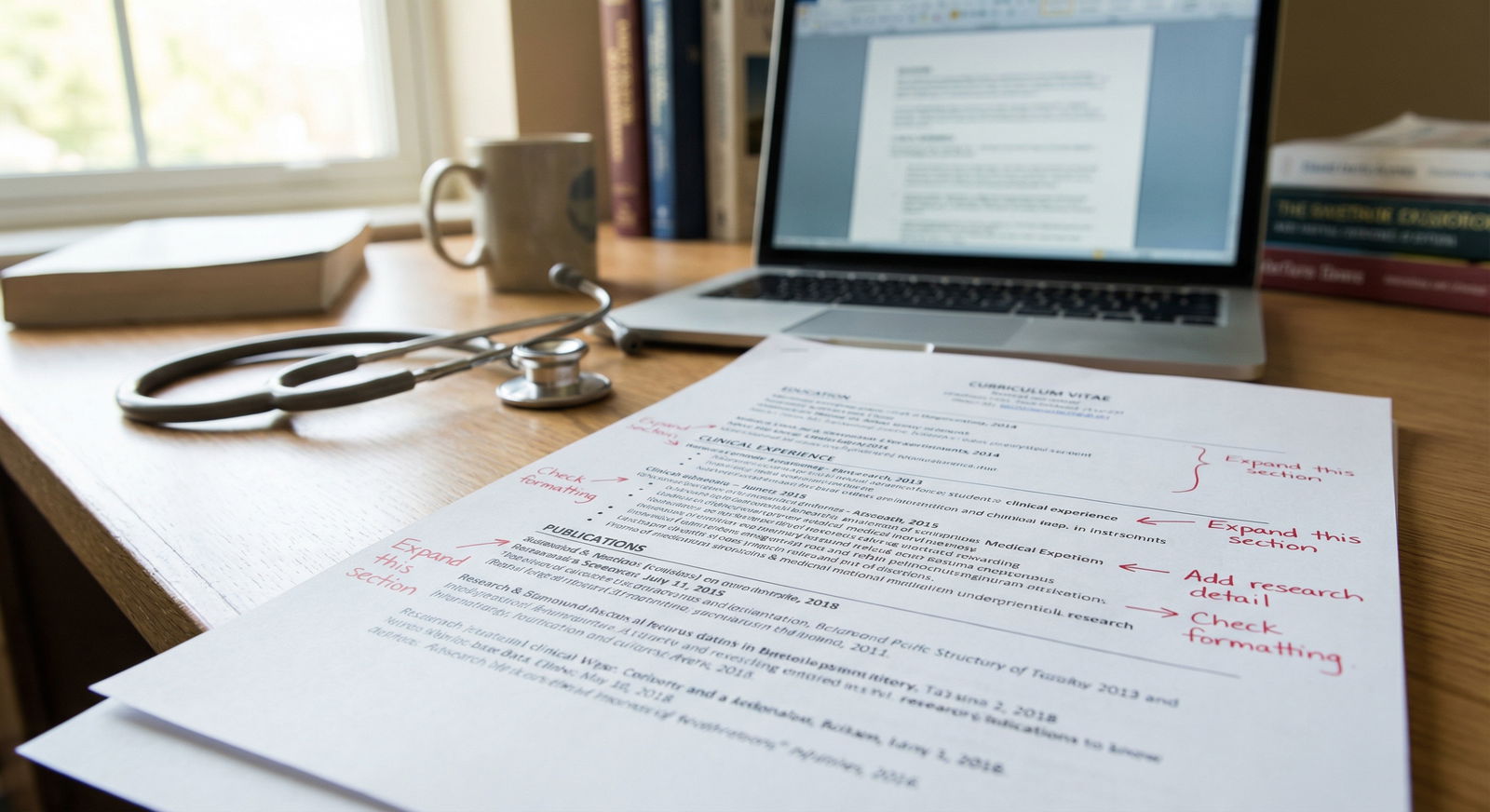
The Four-Step Journal Vetting Protocol
Before submitting a manuscript to any publication, run the title through this explicit checklist:
[ ] 1. PubMed / NLM Catalog Indexing Check
      - Search the journal name in the National Library of Medicine (NLM) Catalog.
      - Confirm the status is "Currently indexed for MEDLINE."
      - Note: Being listed in PMC (PubMed Central) solely due to NIH funding requirements does NOT mean the journal itself is MEDLINE-indexed.

[ ] 2. Directory of Open Access Journals (DOAJ) Verification
      - If the journal is open-access, verify its listing on doaj.org.
      - Legitimate open-access journals undergo strict vetting before DOAJ inclusion.

[ ] 3. Review Editorial Board Credentials
      - Verify that the listed Editor-in-Chief and board members are real faculty at established academic medical centers.
      - Cross-reference board members on their institutional department websites to confirm they actually acknowledge their editorial role for that journal.

[ ] 4. Assess Editorial Timeline Realism
      - Beware of journals offering guaranteed peer review in under two weeks.
      - Legitimate peer review requires recruiting independent expert reviewers, a process that typically takes 4 to 12 weeks minimum.
Using Standard Vetting Resources
Use established tools designed to filter out fraudulent publishers:
- Think. Check. Submit. (thinkchecksubmit.org): A global initiative providing practical tools to assess whether a journal or publisher is trustworthy.
- Cabells Copyrighted Lists: Many university libraries subscribe to Cabells Predatory Reports, which maintains an audited database of deceptive journals.
- Institutional Library Support: When in doubt, send the journal title and website to your university's medical librarian. Medical librarians excel at uncovering deceptive publishing practices and can evaluate a journal's legitimacy within minutes.
Strategic Action Plan
If you have a predatory publication on your record, follow this direct execution plan to clean up your profile before applying for the residency match:
Audit Your Publication History Immediately
- Run every citation on your draft CV through the NLM Catalog and DOAJ. Identify any entry that lacks proper MEDLINE indexing or operates under deceptive open-access models.
Execute the Retraction Assessment
- If the paper is unindexed and invisible, submit a written withdrawal request and omit the line from ERAS.
- If the paper is indexed or locked behind a publisher demanding a fee, retain the entry and draft a clean, professional note indicating that a retraction was formally requested.
Establish Complete Transparency on ERAS
- List the entry accurately without emotional posturing or defensive excuses. Use precise language to document your attempts to resolve the issue.
Build a Counterbalancing Portfolio
- Work with established faculty mentors to publish 2 to 3 legitimate, PubMed-indexed manuscripts, case reports, or national conference presentations prior to ERAS submission.
Prepare Your Interview Narrative
- Practice discussing the issue using a three-part framework: take ownership of the error, explain the corrective steps taken, and highlight the rigorous vetting protocols you now follow.