
42% of ERAS applications mislabel at least one research entry, and a non-trivial number get flagged quietly by PDs for “CV inflation.”
Let me walk you through how not to be in that 42%.
You are not just listing “stuff you did.” You are translating the messy reality of student research—drafts, presentations, rejected abstracts, in-press papers—into the rigid buckets ERAS forces you to choose: Poster, Abstract, Oral, Publication. If you classify incorrectly, you send one of three messages:
- You do not understand academic conventions.
- You are careless with details.
- You are deliberately exaggerating.
All three hurt you. Some more than others.
This is the guide I wish more students had read before clicking “Peer-Reviewed Journal Article” on their two-week-old preprint.
1. The Only Definitions That Matter: ERAS vs Reality
Let me be blunt. Your PI’s lab culture, your school’s “scholarly project” guidelines, and what your friends call their “papers” do not matter here. ERAS has its own logic. You play by that.
We will anchor everything to three questions for each item:
- Has it been accepted?
- Has it been presented?
- Has it been published (or formally indexed/assigned a DOI)?
Everything else is noise.
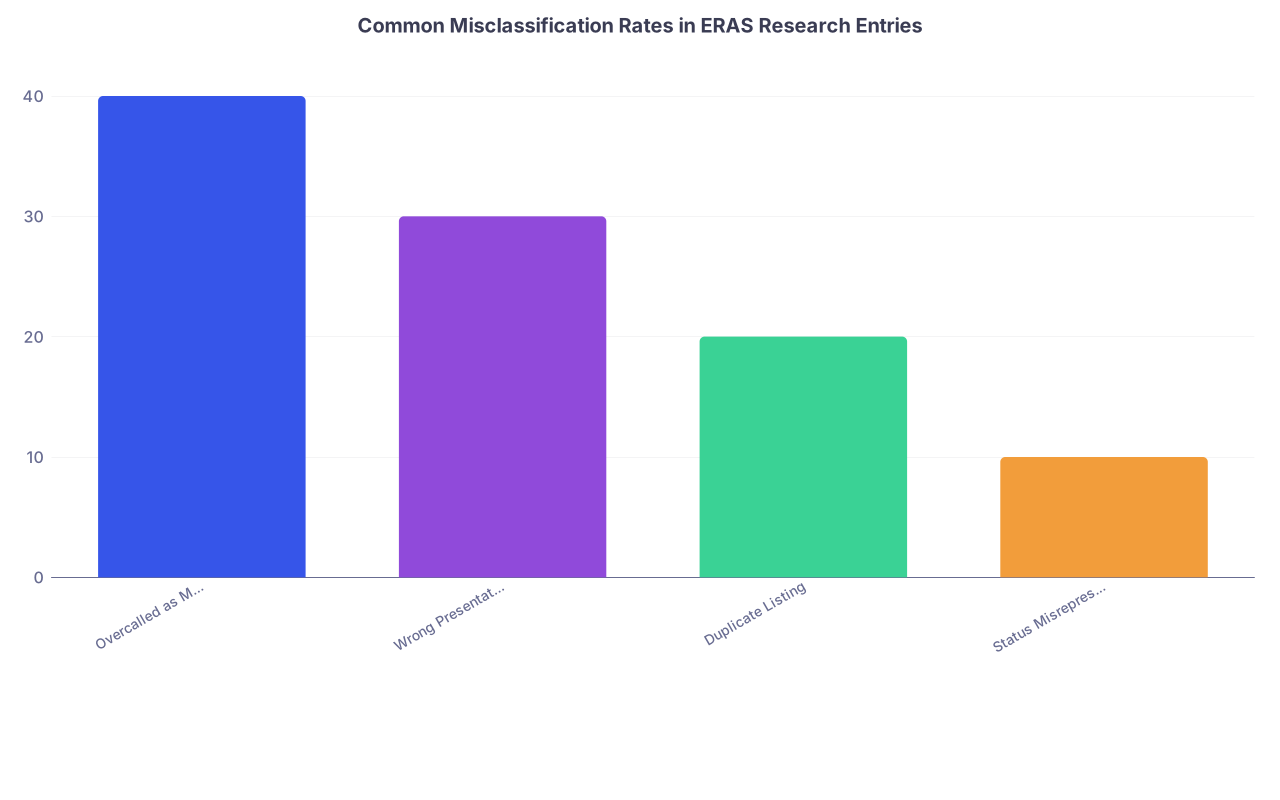
| Category | Value |
|---|---|
| Overcalled as Manuscript | 40 |
| Wrong Presentation Type | 30 |
| Duplicate Listing | 20 |
| Status Misrepresented | 10 |
What ERAS actually cares about
Forget the folklore. ERAS buckets your work into:
- Peer-reviewed journal articles / abstracts
- Other articles (non–peer-reviewed)
- Books or book chapters
- Poster presentations
- Oral presentations
- Other research / presentations
Behind that list is a simple academic hierarchy:
- Published > Accepted > Submitted > In progress
- National > Regional > Local
- Peer-reviewed > Not peer-reviewed
Your job is to be brutally honest about where each line item falls on those axes, then match it to the lowest reasonable classification, not the highest you think you can get away with.
2. Posters: More Misused Than You Think

Most students overcall their poster experience. I have seen “national poster” on ERAS when the reality was a lunch-time med school hallway session with tri-fold boards.
What actually counts as a poster on ERAS
A poster presentation on ERAS should meet all of these:
- You physically (or virtually) presented a poster or e-poster.
- It was part of an organized scientific meeting (local, regional, national, or international).
- Your name appears on the final meeting program / abstract listing.
If the audience was primarily:
- Medical students / school faculty only
- No abstract book or program listing
- No structured scientific session
You are safer calling that “Other Presentations / Local Scholarly Day” rather than a true poster in the sense PDs care about.
How to enter posters correctly
You need to nail four things:
- Title – Exactly as in the meeting program. If the abstract title and the final slide title differ, default to the program.
- Authors – In order, with you exactly where you appear. No “I moved myself up one because I did more work.”
- Conference name and level – Spell out the full name the first time.
- Date and location – Date of the meeting, not when you started the project.
Example of a clean ERAS-style poster entry:
Doe J, Smith R, Nguyen A. “Incidence of Acute Kidney Injury in Post-Op Trauma Patients.” Poster presentation, American College of Surgeons Clinical Congress (National), San Diego, CA. October 2024.
Gray zones that confuse students
E-posters that were just uploaded, no live session
Still a poster. The key is peer-reviewed acceptance and inclusion in the meeting program.Accepted but did not present (could not attend)
You can list it as “Poster (accepted, not presented due to [brief reason])” in the description. Do not pretend you physically presented.Duplicate posters at different meetings
Each poster presentation can be a separate entry. But be transparent: same title/data? Say “Previously presented at [X]” in the later entry’s description.School research day
If there is an actual abstract book or online listing, you can list as “Local poster presentation.” Otherwise, I put these under “Other Presentations” and spell out “Medical school research day poster.”
3. Abstracts: The Most Slippery Category
Abstracts live in the twilight zone between “project on your laptop” and “published paper.” This is also where most CV inflation happens.
| Feature | Abstract (Meeting) | Poster Presentation | Manuscript (Journal) |
|---|---|---|---|
| Peer-review | Often, but brief review | Same as abstract | Full structured peer review |
| Publicly searchable | Sometimes (supplements) | Rarely searchable | Usually PubMed / similar |
| Format | 250–500 word text | Visual board / e-poster | Full article (intro, methods) |
| ERAS category | Journal abstract / other | Poster presentation | Peer-reviewed article |
When is something an “abstract” on ERAS?
There are two main scenarios:
Conference abstract (with or without poster/oral)
- Submitted to a meeting
- Accepted and appears in a conference program or supplement
- Often later “published” in a journal supplement (e.g., Circulation abstracts)
Journal-published abstract only (no full manuscript)
- Appears in a journal as an abstract-only piece
- Has a citation format, volume, issue, and maybe a DOI
You classify based on the strongest verifiable form:
- If your meeting abstract is then published in a journal supplement, that is a journal abstract under “Peer-reviewed journal articles/abstracts.”
- The act of you standing by a board? That is a poster presentation. Separate entry.
So the same project can correctly appear twice on ERAS:
- Once as “Poster Presentation” (conference)
- Once as “Journal abstract” (if in a supplement)
That is not double-counting; those represent different outputs of the same work.
Status: submitted vs accepted vs published
This part is where PDs really roll their eyes.
Use this sequence precisely:
- Submitted – You have sent it. No acceptance yet.
- Accepted – You have formal acceptance from the conference or journal.
- In press / Epub ahead of print – Accepted and in the pipeline at the journal.
- Published – It has volume/issue/pages or Epub date and is live.
On ERAS, for abstracts:
- “Submitted” → You can list under Research Experiences, not as a peer-reviewed abstract.
- “Accepted (conference)” → Poster/oral, maybe “accepted abstract” in description.
- “Journal supplement (in press)” → You can list as peer-reviewed abstract if you have a formal journal acceptance letter.
If you are still refreshing your email, it is not “accepted.”
4. Manuscripts: Where People Get Into Trouble
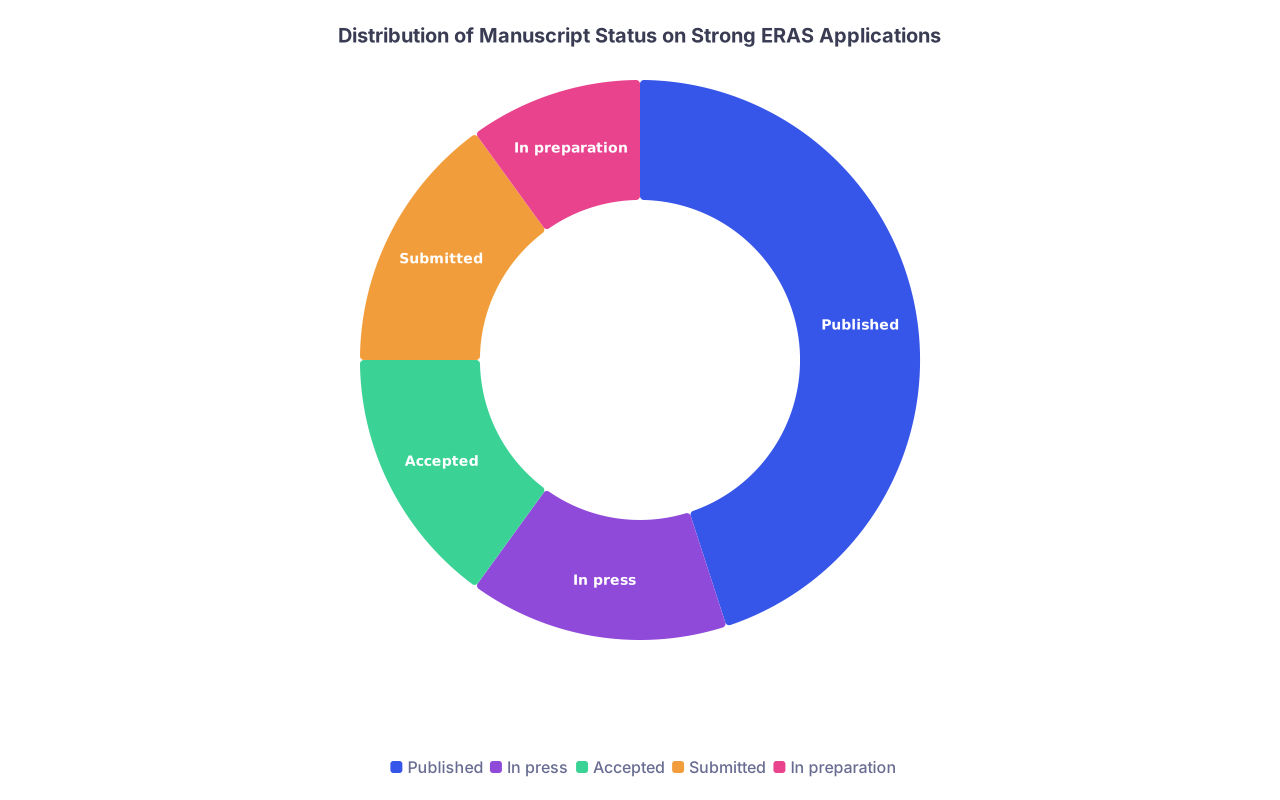
| Category | Value |
|---|---|
| Published | 45 |
| In press | 15 |
| Accepted | 15 |
| Submitted | 15 |
| In preparation | 10 |
This is the category PDs scrutinize hardest. Rightly so. You tick “peer-reviewed journal article,” you are claiming you have done the entire cycle of real science: design, execution, writing, peer review, revision, and acceptance.
What actually qualifies as a “manuscript” on ERAS
On ERAS, under “Peer-reviewed journal articles/abstracts,” a manuscript should meet:
- It has been submitted to a legitimate journal, at minimum.
- Ideally, it has been accepted or is in press/published.
- It has a structured format (intro, methods, results, discussion) or recognized review format.
Here is the problem: ERAS does not police you. You can technically call a Word file on your desktop a “manuscript in preparation.” Many do. PDs know that 80% of “in preparation” never see daylight.
So here is the standard I recommend, which is stricter and safer:
- “In preparation” – Only list if:
- A complete draft exists,
- All co-authors are aware,
- You can name the target journal in the description.
- “Submitted” – You have a manuscript ID and confirmation email. List journal name.
- “Accepted / in press” – You have an acceptance email. Use “in press” until PubMed or full citation appears.
- “Published” – It is live on the journal site with DOI or citation. Use that citation format.
How to enter manuscripts so they do not look inflated
Example progression of one project over time:
MS2 (manuscript submitted):
Patel A, Johnson T, Lee M. “Implementation of a Rapid Response Checklist Reduces Time to Intervention.” Submitted to Journal of Hospital Medicine. Status: Submitted, under review.
MS4 (accepted, in press):
Patel A, Johnson T, Lee M. “Implementation of a Rapid Response Checklist Reduces Time to Intervention.” Journal of Hospital Medicine. In press, accepted November 2024.
Intern year (published):
Patel A, Johnson T, Lee M. “Implementation of a Rapid Response Checklist Reduces Time to Intervention.” Journal of Hospital Medicine. 2025;20(3):145–152. doi:10.1000/jhm.2025.1234.
Notice two things:
- No fake volume or pages.
- Status always explicitly stated when not fully published.
Preprints and online repositories
This gets messy fast.
If your manuscript is on:
- medRxiv
- bioRxiv
- Research Square
- Institutional repository
that is not a peer-reviewed publication. Period.
You can:
- List it under “Other Articles” or “Peer-reviewed articles/abstracts – Preprint”
- Clearly label it “Preprint, not peer-reviewed”
Example:
Garcia L, Wong S. “Machine Learning for Predicting 30-Day Readmissions.” medRxiv (preprint, not peer-reviewed). Posted July 2024. doi:…
If you try to pass a preprint off as a published article, a PD who actually clicks the link will not be amused.
5. How to Decide: Poster vs Abstract vs Manuscript for Each Project
This is where people get tangled. So let me give you a simple classification flow.

| Step | Description |
|---|---|
| Step 1 | Project or Study |
| Step 2 | Poster or Oral |
| Step 3 | Poster + Abstract entries |
| Step 4 | Poster only |
| Step 5 | Research Experience only |
| Step 6 | Manuscript - accepted |
| Step 7 | Manuscript - published |
| Step 8 | Presented at meeting? |
| Step 9 | Submitted to journal? |
| Step 10 | Abstract in program or supplement? |
| Step 11 | Accepted or published? |
Now let us walk through the most common combinations and how to classify them.
Scenario 1: Poster only, no journal, no supplement
- You submitted an abstract to your state ACP meeting, it was accepted as a poster, you presented, and that is it. No journal supplement.
ERAS entries:
- Poster presentation (local/regional/national as appropriate)
- No “journal abstract” entry
Scenario 2: Poster + journal supplement
Classic big-society scenario (AHA, ASCO, etc.).
- Abstract accepted → appears in Circulation supplements
- You present a poster at the meeting
ERAS entries:
- Journal abstract
- Category: Peer-reviewed journal articles/abstracts
- Status: Published (if supplement is out)
- Poster presentation
- Category: Poster Presentation
- Description note: “Abstract published in Circulation supplement.”
Scenario 3: Oral presentation, no publication (yet)
- You win best abstract, are selected for oral, but manuscript is still being written.
ERAS entries:
- Oral presentation (category: Presentations)
- Research experience (category: Research) describing ongoing project
- No manuscript entry unless you have actually submitted a paper.
Scenario 4: Manuscript under review, no presentation
- Pure bench or chart-review work, never submitted to a meeting, but you submitted the full paper to a journal.
ERAS entries:
- Peer-reviewed article (status “submitted,” journal name clearly listed)
- Research experience (optional, to describe your role and methods)
Scenario 5: Local poster + internal PDF abstract booklet
- School research day creates an internal PDF with abstracts; not indexed anywhere.
ERAS entries (conservative):
- Poster presentation – Local (Medical school research day, [School], [City])
- I do not usually list this as a “journal abstract.” You can mention “abstract published in internal research day booklet” in the description if you must.
6. How Programs Actually Read These Sections

Let me be harsh for a moment: most PDs are not counting raw numbers. They are pattern-matching for seriousness, honesty, and consistency.
What they scan for:
- Do the numbers and levels make sense for your school and specialty?
- Are the titles believable for a student?
- Are your roles believable for your training level (MS2 as senior author of an RCT? Really?)
- Do your stories in the interview match what is on ERAS?
Red flags:
- Ten “in preparation” manuscripts, zero published, zero accepted.
- Preprints presented as final articles.
- National-level-sounding conferences that are actually tiny for-profit poster mills.
- Repeated self-promotion in descriptions (“groundbreaking,” “novel,” etc.)
- Discrepancies between what your LOR writer says and what your ERAS entries show.
Clean, conservative classification signals maturity. PDs would rather see:
- 2–3 solid publications,
- 3–5 genuine posters,
- A couple of clear ongoing manuscripts,
than a bloated, over-embellished “15 publications” list where 11 are “in preparation” and 3 are preprints.
7. Advanced Tactics: Making Your Entries Work For You
You are not just avoiding mistakes; you are shaping a narrative.
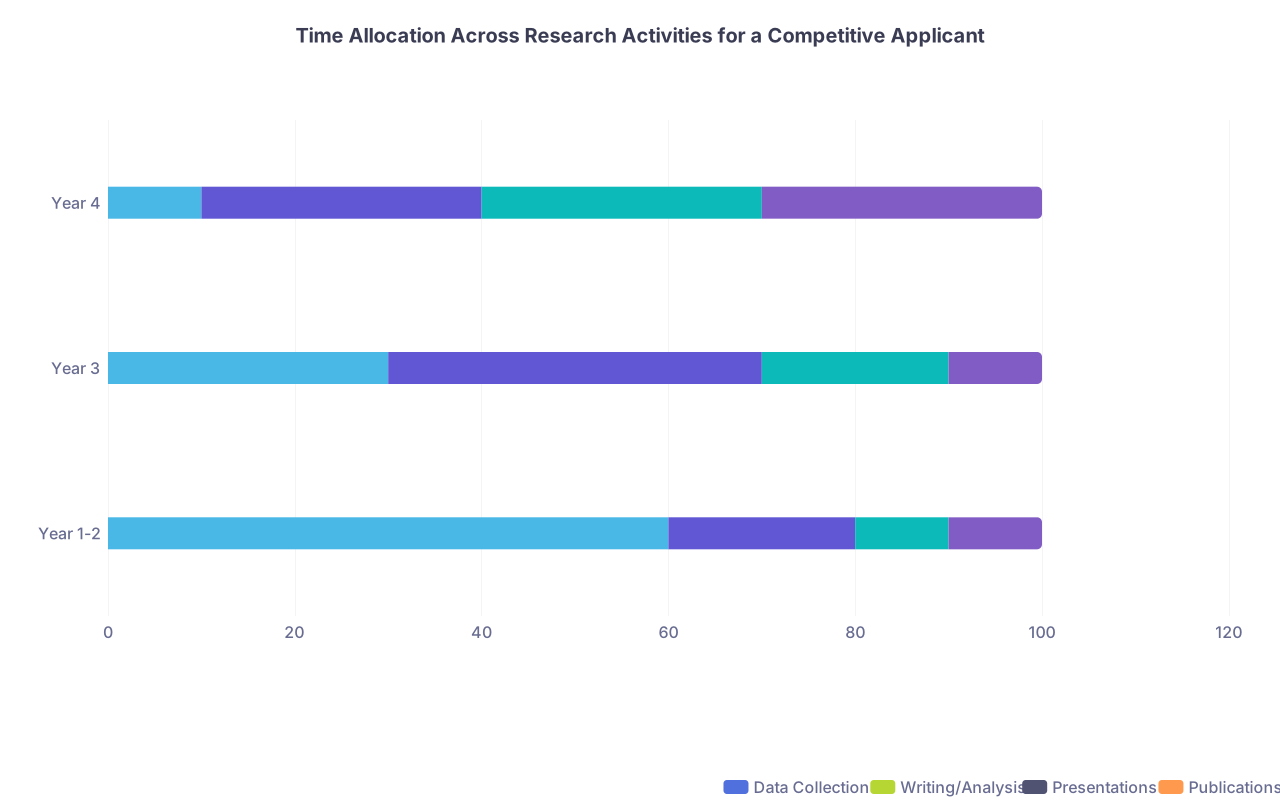
| Category | Data Collection | Writing/Analysis | Presentations | Publications |
|---|---|---|---|---|
| Year 1-2 | 60 | 20 | 10 | 10 |
| Year 3 | 30 | 40 | 20 | 10 |
| Year 4 | 10 | 30 | 30 | 30 |
1. Use descriptions strategically
ERAS gives you a small box. Do not waste it. Use it to:
- Clarify your role: “Designed data collection tool, performed chart review of 200 cases, did initial statistical analysis, drafted results.”
- Clarify status honestly: “Manuscript drafted, targeting submission to [Journal] by Nov 2024.”
- Clarify context: “Local poster competition, won best clinical research poster.”
Avoid fluff. No “passionate about research,” no generic “developed strong teamwork skills.”
2. Show progression
PDs like trajectories. A student who:
- MS1: Joins project, helps with data.
- MS2: Presents a poster locally.
- MS3: Presents nationally.
- MS4: Has a publication out of the same line of work.
…looks much better than a random scattering of one-off things.
Make that clear by tying related entries together in descriptions:
- “Follow-up to prior poster presented at [Meeting 2023].”
- “Manuscript arising from abstract presented at [Conference].”
3. Do not split hairs to inflate counts
I have seen students break one study into:
- 3 posters at the same meeting (slightly different angles),
- 3 “abstracts,”
- 3 “manuscripts in preparation.”
That looks ridiculous.
Rule of thumb: One coherent research question = 1 main line of output that may have:
- 1–2 posters at different meetings,
- 1 journal abstract or supplement,
- 1 main manuscript, perhaps 1 spin-off if truly distinct.
More than that and you start to look like you are slicing things too thin.
8. Avoiding Common ERAS Classification Mistakes (and Fixing Them)

Quick fire-round of errors I see every year, and what you should do instead.
Calling a required school research project a “publication”
- Correct: List under “Research Experience,” maybe “Capstone/Scholarly Project.”
- Do not call it a manuscript unless it was actually written and submitted somewhere external.
Listing quality improvement (QI) posters as “peer-reviewed articles”
- If your QI work was presented at a meeting → poster/oral presentation.
- Only becomes an article if you write and submit a full paper to a journal.
Counting every case logged in a case report series as separate publications (before acceptance)
- If they are ultimately going into ONE article, it is one manuscript.
- You do not list 10 “case reports in preparation” when the reality is 1 multicase paper in draft.
Inflating “national” level
- Some vendors run “international” virtual poster conferences that are essentially pay-to-play. PDs know them.
- Classify honestly in the description: “Virtual online poster session organized by [X], not affiliated with a major medical society.”
Copy-paste inconsistencies
- Titles slightly different across entries.
- Author order changed randomly.
- Dates do not line up.
You fix these now. Before you submit. A PD will not email you to ask which is correct; they will just downgrade how seriously they take your entire application.
9. A Simple Checklist Before You Hit “Submit”

Before you certify and send ERAS, do this:
For each entry, ask:
- Can I prove this with an email, PDF, or link if asked?
- Would I feel comfortable if a PD read this line out loud in an interview?
Posters
- Do all “poster presentations” correspond to real meetings with programs / schedules?
- Are local school events clearly labeled as such?
Abstracts
- Are only abstracts that appear in a meeting program or journal supplement classified as such?
- Are statuses (submitted/accepted/published) clearly stated?
Manuscripts
- Do I have journal names and statuses accurate?
- Are preprints labeled as preprints?
- Have I ruthlessly pruned “in preparation” items that are fantasy?
Global sanity check
- Show your ERAS “Scholarly Work” section to one research-savvy attending or resident.
- Ask them, bluntly: “Does anything here look inflated or misleading?”
If the answer is yes, fix it. Right now. It is much harder to repair your reputation than to remove one overzealous “manuscript in preparation.”
FAQ (Exactly 5 Questions)
1. Can I list the same project as a poster, an abstract, and a manuscript on ERAS without looking like I am double-counting?
Yes, if each entry represents a distinct, real output: a poster presentation at a meeting, a published abstract in a journal supplement, and a full manuscript submitted or published. The key is being transparent in the descriptions. Explicitly connect them (“Manuscript arising from abstract presented at [Meeting]”) and do not alter titles or author order to artificially make them look like separate studies.
2. My abstract was accepted for a poster, but the journal supplement is not out yet. Do I call it a journal abstract?
Not yet. For now, classify it as a “Poster Presentation” with status “accepted, presented [date].” In the description, you can add: “Scheduled for publication in [Journal] abstract supplement (forthcoming).” Once the supplement is actually live and citable, you can add or update a separate “journal abstract” entry in future versions of your CV, but you do not need to scramble to edit ERAS if it happens after submission.
3. How many ‘in preparation’ manuscripts is too many before PDs start rolling their eyes?
More than two or three starts to look dubious unless you have a very strong research background (e.g., MD/PhD, dedicated research year with a famous lab) and your other outputs back it up. For a typical applicant, I recommend listing only projects that have a complete draft and a clear journal target. Anything you only “plan to write someday” belongs in your mental to-do list, not on ERAS.
4. Should I include small local posters from med school research day, or do they look trivial?
Include them if they involved real work and you actually presented. Just label them honestly as “Local poster presentation – [Medical school research day].” For research-light applications, these help show initiative and completion of projects. For research-heavy applicants, they become minor lines but still contribute to the narrative of consistent scholarly activity. They only look bad if you try to pass them off as national or major society conferences.
5. If a PI listed me as middle author on a big paper and I barely remember the project, should I still include it?
Yes, if your name is genuinely on the paper. Authorship is authorship. But be ready to answer basic questions about the study aims and your role. In the description, keep it modest: “Assisted with data collection / chart review.” Do not inflate your contribution. PDs know that early authorship is often limited in scope. What they care about is that you are honest and can explain at least the fundamentals of any work you claim.
With your posters, abstracts, and manuscripts correctly classified, you now look like someone who understands and respects academic norms. The next step is using that credibility in your personal statement and interviews to tell a coherent story of how this work shaped your clinical interests and future plans. That is a deeper strategic conversation—and one you will be ready for now that your ERAS entries are finally clean.