You are three weeks out from ERAS opening. Your friends are stressing about personal statements; you are staring at your CV draft with 18 research items, 4 posters, 3 oral presentations, and a half-finished manuscript that might get accepted next month.
And you have a very specific problem: how do you build a research-heavy CV that looks like focused academic momentum instead of chaotic overcompensation?
Let me walk you through how to structure this like someone who has actually hired residents and fellows, not like a premed club “CV workshop” handout.
Step 1: Understand the Job Your CV Is Actually Doing
Your CV for residency is not a historical document. It is a filtered argument.
The argument is:
“I have a coherent, maturing academic identity and I can produce.”
If you are research-heavy, your CV has to do three things quickly:
- Make your research trajectory obvious at a glance.
- Make your best work impossible to miss.
- Make it easy to verify that you were not a passenger on every project.
Everything about your structure, section order, and formatting either helps or hurts that.
So you do not start with a generic medical-student CV template. You start with your angle.
For a research-heavy applicant, the angle is almost always one of these:
- Future physician-scientist
- Clinician-educator with strong scholarly output
- Subspecialty-focused “mini-expert” (e.g., transplant outcomes, epilepsy imaging, global surgery)
Your CV should be organized so that, on a quick skim of 20–30 seconds, the reviewer can answer:
- What field(s) does this person actually care about?
- Are they productive or just dabbling?
- Do they have any work that is “real” (pubs, major conferences, grants)?
- Would I be able to plug them into my projects and expect results?
If your current draft does not answer those in under half a minute, the structure is wrong.
Step 2: The Ideal Section Order for a Research-Heavy Applicant
Here is the order I recommend for a research-forward ERAS CV / academic CV. This is intentionally different from the generic “education first, then random activities” approach.
| Order | Section |
|---|---|
| 1 | Name and Contact Information |
| 2 | Education and Training |
| 3 | Academic / Research Profile (2–4 lines) |
| 4 | Publications (Peer-Reviewed) |
| 5 | Manuscripts Under Review / In Preparation |
| 6 | Abstracts, Posters, and Presentations |
| 7 | Research Experience |
| 8 | Grants and Funding (if any) |
| 9 | Teaching and Mentorship |
| 10 | Clinical Experience / Leadership / Service |
Let me break that down.
1. Name and Contact Information
Clean. Professional. One line each.
- Full name (no nicknames)
- Email (institutional if you have it)
- Phone
- Current institution and expected graduation year
- Optional: ERAS AAMC ID on later versions
No objective statement, no photo, no quote, no nonsense.
2. Education and Training
Reverse chronological. Medical school first.
Example:
University of X School of Medicine – City, State
MD Candidate, Expected May 2026
University of Y – City, State
BS, Biology, magna cum laude, May 2022
You can add thesis title under undergrad if it is research-relevant.
3. Academic / Research Profile (2–4 line snapshot)
If you are research-heavy, an ultra-brief profile right under education is high-yield. It frames the rest of the CV.
Think of this as your “mini abstract”:
Early-career clinical researcher with 3 years of outcomes research in advanced heart failure and mechanical circulatory support, 4 first-author abstracts at national meetings, and one first-author manuscript in revision at JACC. Interested in a career in academic cardiology with a focus on device optimization and implementation science.
Short. Specific. Numbers included. Field clearly stated.
If you do not have at least:
- a clear field
- a clear method/domain (bench, clinical, data science, education research)
- some concrete productivity
…skip this. But if you do, it helps the reviewer instantly classify you: “This is the LVAD outcomes person.” Good. That is what you want.
Step 3: Publications – How to Make This Section Do Real Work
Publications are your core currency. They go before “research experience” because residency faculty care more about what came out than what you participated in.
How to structure the Publications section
You need subsections. Organized and filtered.
Recommended breakdown:
- Peer-reviewed journal articles
- Published / accepted
- Epub ahead of print is “accepted”
- Preprints (clearly labeled)
- Book chapters (optional, separate)
- Non–peer-reviewed articles (only if actually respectable; otherwise leave out or move lower)
If you have very few publications (1–2), you can keep it as one list. If you have 5+, split out subsections.
Formatting each reference
Use standard citation style (Vancouver or similar). The key rules:
- Your name in bold in every citation.
- Consistent format throughout.
- DOIs optional but helpful.
- If not yet indexed, add “Epub ahead of print” or “In press”.
Example:
Peer-Reviewed Journal Articles
Smith AB, Jones CD, Patel R. Association of early mobilization with ICU length of stay in mechanically ventilated patients. Crit Care Med. 2023;51(4):512–520. doi:10.1097/CCM.0000000000005800
Smith AB, Nguyen T, Lee Y, et al. Machine learning models for predicting 30-day readmissions after heart failure hospitalization. J Am Coll Cardiol. 2024; in press.
Make the bolding precise. If your name is Andrew J. Smith, bold exactly that. Programs scan these sections and count how often you are first or second author in your own work.
Order of publications
Order by:
- Category (peer-reviewed first)
- Within category, reverse chronological by publication date, not by when you worked on it.
- If you have one or two absolute “heavy hitters” (e.g., first-author JAMA), you can list those first within the subsection, then chronological after. But do not get cute with reordering everything; that just looks messy.
Step 4: Manuscripts Under Review / In Preparation – Use This Carefully
This is the most abused section on student CVs. Half the “in preparation” items I see are never written.
You want this section. But only if you are ruthless about what goes in it.
I split it into two lines:
- Manuscripts under review
- Manuscripts in preparation (optional; very selective)
What is allowed under “Under Review”
- Full draft written
- Submitted to a named journal
- You can produce the manuscript if someone asks
- You know the journal and status
Format like this:
Manuscripts Under Review
- Smith AB, White C, O’Malley P. Thirty-day outcomes after ECMO initiation in cardiogenic shock: a multicenter cohort study. Submitted to: Circulation: Heart Failure, July 2025.
Do not fake this. People in academic programs will occasionally ask, “What journal is that under review at? What were the reviewer comments?” If your answers are vague, you look unserious.
What is allowed under “In Preparation”
Use this only if:
- There is real data already collected or the analysis is underway.
- You have a specific target journal in mind.
- You are comfortable describing the dataset and your role in detail at interviews.
Something like:
Manuscripts in Preparation
- Smith AB, Jones CD. Impact of telemedicine follow-up on early readmission after LVAD implantation. Data analysis ongoing. Planned submission to J Heart Lung Transplant.
If you are listing more than 2–3 “in preparation” manuscripts, you are overestimating your bandwidth or padding. Both look bad.
Step 5: Abstracts, Posters, and Presentations – Make the Signal Visible
Many research-heavy students bury their strongest achievements inside a wall of text. Fix that.
You want this broken down into:
- Oral presentations (national / major regional first)
- Poster presentations
- Local / institutional presentations (if numerous, separate)
Order: national/regional > institutional > local/student events.
Example structure:
Conference Presentations
Oral Presentations
- Smith AB, Patel R, Hernandez L, et al. Predictors of early right heart failure after LVAD implantation. Oral presentation at: American Heart Association Scientific Sessions, Chicago, IL, November 2024.
Poster Presentations
- Smith AB, Lee Y, Johnson M, et al. Utilization of telemonitoring for heart failure patients in a safety-net hospital. Poster presentation at: American College of Cardiology Annual Scientific Session, Atlanta, GA, March 2023.
If you have 20+ abstracts, you can:
- Keep “big name” meetings explicitly named (AHA, ACC, RSNA, ASCO, etc.).
- Group smaller, repetitive institutional or local presentations under a brief descriptive line or list only selected ones.
Do not list:
- Every medical school “research day” poster if they are essentially the same project repeated. Either pick the biggest or group them.
Step 6: Research Experience – Show Depth, Not Just Duration
Now you explain the labs, groups, and PIs behind those outputs. This is where the trajectory becomes obvious.
Structure this section as discrete positions, reverse chronological:
Position Title – PI Name, Department, Institution, City, State
Dates (Month Year – Month Year)
1–4 bullet points with actual content, not fluff.
Example:
Clinical Research Fellow – PI: Michael Johnson, MD, Division of Cardiology, University of X, City, State
June 2023 – Present
- Led data collection and analysis for multicenter cohort study of 280 LVAD recipients; first-author abstract accepted for oral presentation at AHA 2024.
- Developed and implemented REDCap database for tracking telemonitoring adherence in 150 heart failure patients.
- Mentored 2 junior medical students on data cleaning and figure preparation.
A few specifics:
- Put your role in the title realistically: “Research Assistant,” “Clinical Research Fellow,” “Student Researcher,” “Summer Research Fellow.” No “Co-PI” nonsense.
- Always name the PI and department. Interviewers often know each other; this gives them instant context.
- Explicitly tie at least one bullet to a concrete output (publication, submitted manuscript, accepted abstract).
Avoid bullet points like:
- “Assisted with data entry and literature review.”
- “Participated in weekly lab meetings.”
These say nothing. Replace with:
- “Abstracted clinical data from 200+ charts into standardized dataset with >98% inter-rater reliability.”
- “Performed STATA analysis for multivariable models assessing predictors of in-hospital mortality.”
You want any skeptical research faculty to think: “This person can actually get work done, not just watch.”
Step 7: Grants and Funding – Small Section, Big Impact
If you have any funding, even small institutional grants, you give it its own section. It signals institutional support and trust.
Structure:
Grants and Funding
Medical Student Research Grant – University of X, Department of Medicine
Role: Principal investigator. Project: “Predictors of early right heart failure after LVAD implantation.” Amount: $3,000. Dates: June 2023 – May 2024.Travel Award – American Heart Association Council on Clinical Cardiology
Awarded for oral presentation at Scientific Sessions 2024.
Even a $1,000 summer funding line looks good. It tells reviewers: someone already bet money on you.
Step 8: Teaching and Mentorship – The Quiet Strength of a Research CV
Programs that care about academics almost always care about teaching. They want people who can explain things, organize others, and eventually supervise.
Do not bury this under “Other Activities.” Give it a clean section:
Teaching and Mentorship
Small Group Tutor, Cardiovascular Physiology – University of X School of Medicine, 2023–2024
Facilitated weekly sessions for 8 first-year medical students; created 10-session problem set focused on clinical integration.Research Mentor – Department of Cardiology, 2023–Present
Supervised 2 preclinical medical students on data collection and basic statistical analysis for LVAD database project; resulted in one co-authored abstract submitted to ACC 2025.
Tie teaching to outcomes when possible. Abstracts, improved course resources, structured curricula.
Step 9: Clinical, Leadership, Service – Keep It Targeted
You still need to look like a functional future resident, not a pure data goblin.
But if your strength is research, you do not need 3 pages of “volunteered four hours at health fair.” You need enough to avoid red flags and signal that you can work in teams and handle responsibility.
Combine smaller categories under one umbrella if you are tight on space:
Clinical Experience, Leadership, and Service
Order by relevance to your specialty or by impact.
Example:
Student Chief, Internal Medicine Subinternship – University of X, 2024
Coordinated schedules and orientation for 24 subinterns; liaised with clerkship leadership to revise expectations document and feedback forms.Volunteer Clinician, Student-Run Free Clinic – City, State, 2022–2024
Conducted supervised visits one evening per week; contributed to clinic QI initiative on hypertension follow-up.
One page for all of this is fine. The center of gravity for your CV is research; do not pretend otherwise.
Step 10: Formatting Rules That Separate Serious from Amateur
Now the part most students underestimate. Same content, structured and formatted differently, yields a different first impression. I have seen it dozens of times on rank meetings.
Global formatting rules
- 11 or 12 pt professional font (Times New Roman, Garamond, Calibri, etc.).
- 0.5–1 inch margins. No weird narrow margins to cram text.
- Section headings in bold, slightly larger or all caps.
- Consistent indentation and spacing; not perfect, but clearly deliberate.
Author names and your role
Bold your name in every author list. Do not italicize, underline, or color-change. Bold is enough.
If there is a non-obvious major role outside authorship on a non-published project (e.g., you built the entire REDCap infrastructure), that belongs in your research experience bullets, not added in parentheses in the citation.
Dates
Align dates to the right for positions. Use Month Year – Month Year, not seasons or vague terms.
Wrong: “Summer 2023”
Better: “June 2023 – August 2023”
For ongoing roles: “June 2023 – Present”
Length
For a research-heavy applicant, 2–4 pages is normal and fine. One page is unrealistic. Six pages of bloated, redundant CV is too much.
Rule of thumb:
- M3 / early M4: 2–3 pages
- Research year / MSTP / heavy output: 3–4 pages
If you are over 4 pages, you are probably repeating low-yield entries, keeping irrelevant high school or early undergrad content, or listing every poster separately when they are redundant.
Step 11: Specialty-Specific Tweaks
Your CV structure is mostly the same across specialties, but emphasis shifts.
For highly academic specialties (radiation oncology, heme/onc, neurology at big centers, etc.)
- Consider splitting publications into “Clinical Research” and “Basic/Translational Research” if you have both and the balance matters.
- Highlight methods in your research bullets: survival analysis, machine learning, imaging segmentation, wet lab methods.
- List major datasets/registries if you used them (SEER, NSQIP, NIS, institutional biobank).
For procedure-heavy but increasingly academic fields (orthopedics, neurosurgery, ENT)
- Make your subspecialty interest obvious: spine outcomes, peripheral nerve repair, skull base tumors.
- For basic science work, naming key techniques (e.g., CRISPR editing in rodent models) can matter more than raw publication count.
- Do not flood the CV with generic “sports medicine shadowing.” Keep the academic focus clear.
For internal medicine, pediatrics, EM with strong research goals
- Highlight QI and implementation projects in research if they had measurable outcomes.
- If you have serious epidemiology or biostats exposure (formal coursework, certificate), mention this under education or a short “Additional Training” section.
Step 12: A Quick Layout Example (Condensed)
Let me sketch a simplified top-half of a strong research-heavy CV for clarity.
Jane Doe, MD Candidate
Email: [email protected] | Phone: (555) 123-4567
University of Z School of Medicine, Class of 2026
EDUCATION
University of Z School of Medicine – City, State
Doctor of Medicine, Expected May 2026
University of Y – City, State
BS, Biomedical Engineering, summa cum laude, May 2022
ACADEMIC PROFILE
Medical student with 4 years of clinical outcomes and imaging research in ischemic stroke and cerebral aneurysms. First-author publications in Stroke and AJNR, 6 national conference abstracts, and 1 ongoing multicenter registry project. Aiming for a career in academic neurology with a focus on cerebrovascular disease.
PUBLICATIONS
Peer-Reviewed Journal Articles
- Doe J, Patel S, Lee M, et al. Early perfusion imaging predicts functional outcomes after mechanical thrombectomy. Stroke. 2024;55(3):612–620.
- Doe J, Nguyen T, Park R, et al. Midterm aneurysm occlusion rates following flow diverter placement. AJNR Am J Neuroradiol. 2023;44(9):1120–1127.
- Smith A, Doe J, Hernandez P, et al. Trends in thrombolysis utilization at a comprehensive stroke center. J Stroke Cerebrovasc Dis. 2022;31(5):106423.
Manuscripts Under Review
- Doe J, Kim Y, Shah R, et al. Weekend effect in mechanical thrombectomy outcomes across a large integrated health system. Submitted to: Neurology, August 2024.
ABSTRACTS AND PRESENTATIONS
Oral Presentations
- Doe J, Patel S, Lee M, et al. Early perfusion imaging predicts functional outcomes after mechanical thrombectomy. Oral presentation at: International Stroke Conference, Phoenix, AZ, February 2024.
Poster Presentations
- Doe J, Nguyen T, Park R, et al. Midterm aneurysm occlusion rates after flow diverter placement. Poster presentation at: American Society of Neuroradiology Annual Meeting, Boston, MA, May 2023.
RESEARCH EXPERIENCE
Clinical Research Fellow – PI: Samuel Lee, MD, Department of Neurology, University of Z
July 2023 – Present
- Coordinated multicenter registry (8 hospitals) of 600+ mechanical thrombectomy cases; led analysis for primary manuscript under review at Neurology.
- Designed and implemented REDCap data dictionary; trained 10 site coordinators on standardized data abstraction.
- Supervised 3 junior medical students, resulting in 3 abstracts submitted to national neurology meetings.
This structure reads like a coherent story: “This is a stroke outcomes person with real output and escalating responsibility.”
That is exactly what you want.
Step 13: Common Mistakes That Kill Strong Research CVs
I will be blunt. I see these constantly, even from objectively strong applicants.
- Mixing posters and publications into one alphabet soup section so no one can tell what is peer-reviewed and what is a school research day.
- Listing 10 “manuscripts in preparation” with no real data collected yet. Everyone who reads these knows what that means.
- Using vague, inflated titles: “Lead researcher,” “Co-PI,” “Project director” for a one-summer student role.
- Presenting your research experience without any mention of outputs, timelines, or your specific analytical work.
- Letting formatting drift: different citation styles, inconsistent bolding, random fonts. This screams “sloppy” to anyone who writes papers for a living.
Clean those up and your existing work often looks twice as impressive.
Quick Visual: Balancing Sections on a Research-Heavy CV
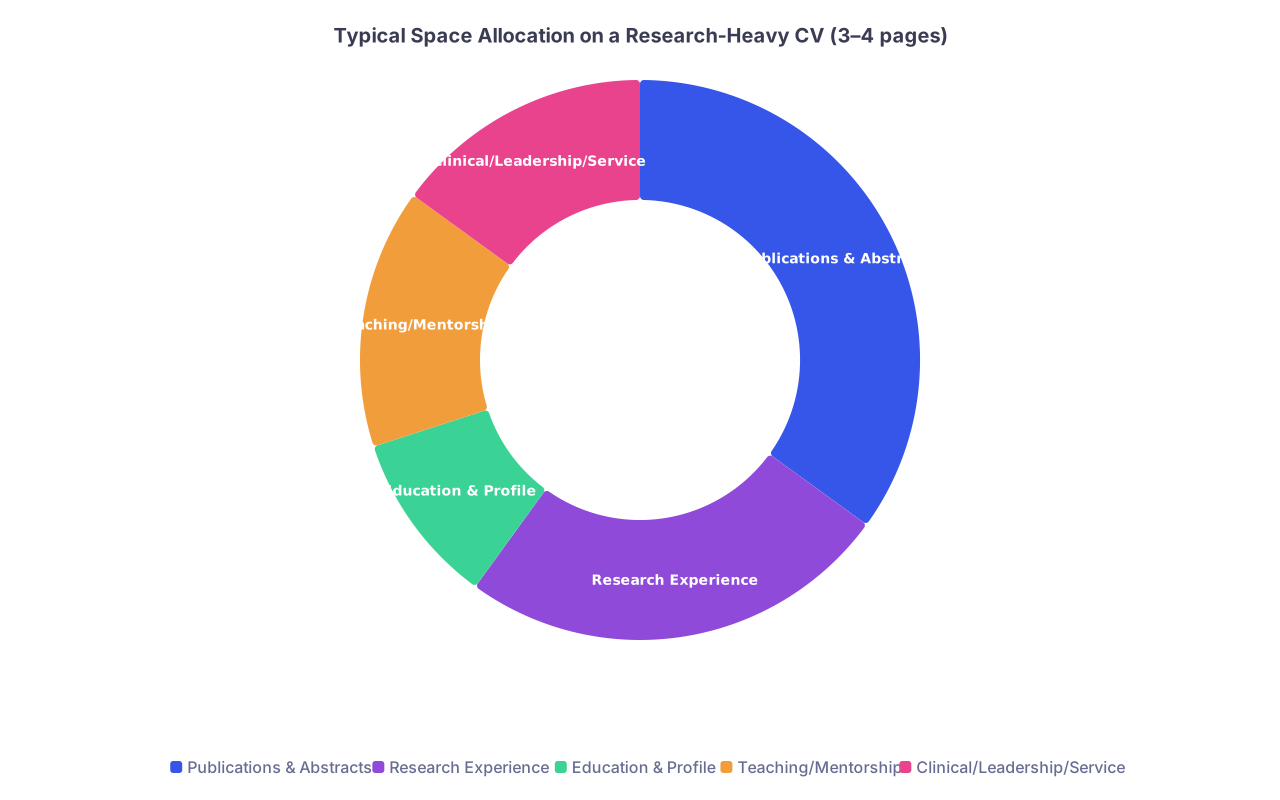
| Category | Value |
|---|---|
| Publications & Abstracts | 35 |
| Research Experience | 25 |
| Education & Profile | 10 |
| Teaching/Mentorship | 15 |
| Clinical/Leadership/Service | 15 |
You do not need these exact percentages, but the idea holds: academics front and center, with enough clinical and leadership context to show you are not one-dimensional.
How All This Plays Out on Interview Day
Last piece. Imagine yourself sitting in front of a PD or research faculty member.
Here is how a well-structured research CV helps you:
- They skim it in 30 seconds before you walk in. They can immediately ask you a deep question about your best project instead of wasting time figuring out what you did.
- You are not burning interview time clarifying, “Well, that one was just a poster, not a publication,” because your sections already made that obvious.
- You come across as someone who has already internalized how academic CVs are supposed to look. Which is exactly what you want if you are pitching yourself as a future academic.
Compare that to the applicant whose work is scattered in “Honors and Awards,” “Research Experience,” and “Extracurriculars” with no coherent narrative. Same number of lines. Half the impact.
Key Takeaways
- For a research-heavy CV, front-load your academic identity: profile, publications, abstracts, and research experience should dominate the top half.
- Use clear sections and ruthless formatting discipline so reviewers can instantly distinguish peer-reviewed work, abstracts, and “under review / in preparation” items.
- Show trajectory and outcomes: each research position should connect to concrete products and growing responsibility, with clinical and leadership sections kept tight but present.
That is how you make a research-heavy CV look like an asset instead of a question mark.