Most residency applicants either under-sell their procedural skills or quietly lie about them. Both are mistakes.
If you are serious about matching well, you must describe your procedural and technical abilities in a way that is accurate, verifiable, and confidence-building—without drifting into fantasy about what you can actually do at 2 a.m. when the intern hands you the needle.
Let me break this down specifically.
Why Programs Care How You Describe Your Skills
Program directors are not just skimming your CV for “central lines” and “lumbar punctures.” They are reading those words and doing risk calculations in their heads.
“Is this someone I can trust on night float?”
“Is this the student who will say ‘I’ve done this before’ and then fumble through an arterial line?”
“Is this a person who knows the difference between seeing, assisting, performing, and supervising?”
They have seen the fallout when applicants overstate competence:
- The intern who wrote “competent in paracentesis” and then did not know where to numb.
- The student who listed “intubations: 10+” but had only ever bag-masked while the CRNA intubated.
- The applicant who clearly cut-and-pasted a procedure list from a friend’s CV.
That is why how you frame your procedural experience matters as much as the content itself.
The 4 Levels You Must Use (And Stop Blurring)
Before we touch your CV, you need a vocabulary that lets you talk precisely about your skills. Most medical schools fail to teach this properly. So students default to vague verbs like “involved in” or misleading ones like “performed” when they really “assisted.”
Use these four levels. Rigorously.
- Observed – You watched, maybe held a limb or the ultrasound probe for someone else, but you did not perform key steps.
- Assisted – You participated in steps under direct supervision but were not the primary operator.
- Performed under direct supervision – You were the primary operator; a supervisor was physically present and scrubbed or at bedside.
- Performed independently (within scope) – You were the primary operator with no direct physical supervision; this is rare for med students in invasive procedures and should not be casually claimed.
Those four buckets can be adapted to nearly every procedure:
- Intubation
- Central line placement
- Paracentesis
- Bedside ultrasound
- Suturing and wound closure
- Joint injections
- LPs, chest tubes, arterial lines, etc.
The moment you mix these levels, your credibility drops.
Structuring Procedural Content on a CV: What Works, What Backfires
You have three main places to show procedural and technical skills:
- CV / ERAS application
- Personal statement (sparingly)
- MSPE / Letters (you do not control, but you can influence)
Where Procedural Skills Belong on a CV
On a standard ERAS-style CV or attached resume, your options:
Clinical Experience or Subinternship Entry
Include a concise “Selected clinical skills” or “Procedural exposure” line under relevant rotations.Dedicated “Technical & Procedural Skills” Section
This works particularly well for surgery, EM, anesthesia, OB/GYN, or any procedural-heavy specialty.Under Research or QI Projects
If you developed or validated a procedural checklist, simulator, or device, list the technical skills there too.
The trap: Do not scatter skills all over the CV with inconsistent wording. You want one coherent framework.
A Clean, Honest Way to Quantify Experience
Vague:
“Extensive experience with central line placement, paracentesis, and lumbar puncture.”
This is what everyone writes. It makes program directors roll their eyes.
Precise:
“Central venous catheterization: 5 performed under direct supervision (IJ, ultrasound-guided), 3 assisted.”
Now you sound like an adult.
Use Structured, Tiered Descriptions
For a dedicated section, I like a structure like:
- Bedside ultrasound – FAST exams: ~25 performed independently on stable ED patients with faculty review; basic cardiac and abdominal scans: 15 performed under direct supervision.
- Laceration repair – Simple interrupted and running sutures: ~30 closures performed under direct supervision; comfortable with face, scalp, and extremity wounds.
- Paracentesis – 4 taps performed under direct supervision (ultrasound-guided), including 1 large-volume.
Notice a few things:
- I use approximate numbers with “~” when appropriate, but not fake high numbers.
- I spell out context (stable ED patients, large-volume, ultrasound-guided).
- I explicitly state supervision level.
If you are early in training and your numbers are low, that is fine. You are not applying for attending jobs.
| Category | Value |
|---|---|
| Simple Sutures | 30 |
| Paracentesis | 5 |
| Central Lines | 3 |
| LPs | 4 |
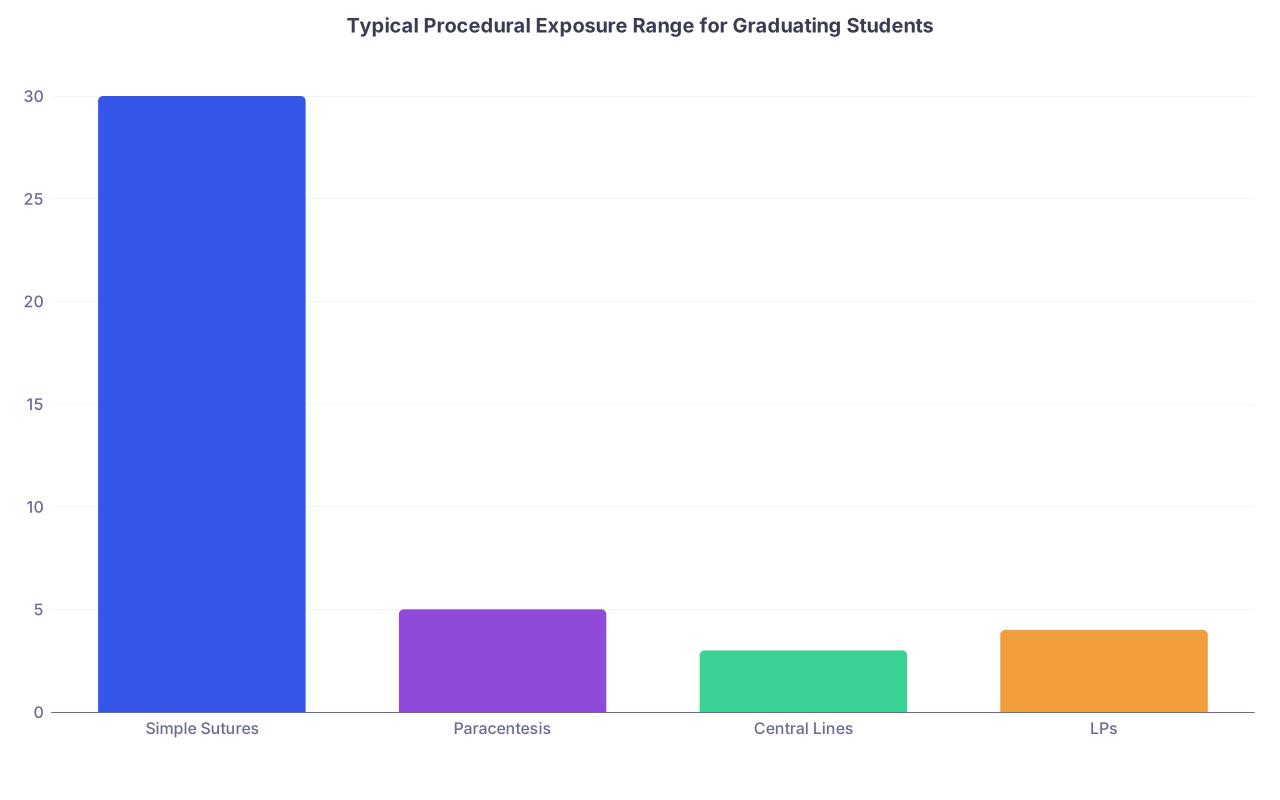
The chart above is an honest ballpark for many students at graduation. If you list 40 central lines as a student at a small community program with no ICU rotation, nobody will believe you. They should not.
Sample CV Language For Different Specialties
Let me give you concrete phrasing that works.
For Emergency Medicine Applicants
Under “Emergency Medicine Subinternship – University Hospital”
Procedural and clinical skills:
- Airway: 4 direct laryngoscopy intubations attempted (3 successful) under direct attending supervision; ~40 bag-mask ventilation episodes.
- Wound care: ~45 laceration repairs (simple and intermediate), majority performed as primary operator with resident or attending supervision.
- Bedside ultrasound: ~30 FAST exams and 10 basic cardiac views performed with real-time attending review.
This tells an EM PD: you have honest numbers, you know your success rate, you are not trying to pretend you are a PGY-3.
For Internal Medicine Applicants
Under “Medical ICU Acting Internship”
Selected procedures and technical skills:
- Central venous access: 3 IJ central lines performed under direct supervision (ultrasound-guided), 2 assisted.
- Arterial lines: 5 placements assisted; 2 performed under direct supervision.
- Paracentesis: 3 therapeutic and 1 diagnostic paracentesis performed under direct supervision; all ultrasound-guided.
- Point-of-care ultrasound: Regular bedside use for volume status and effusion assessment on MICU patients under fellow supervision.
Straightforward. Clear. No inflation.
For Surgery Applicants
Under “General Surgery Subinternship – Trauma & Acute Care Surgery”
Operative and procedural experience (as medical student):
- Basic surgical skills: Regular independent knot tying and suturing at skin and subcutaneous levels; comfortable with instrument and hand ties.
- OR experience: Active assistant in >50 cases (including laparoscopic cholecystectomy, appendectomy, hernia repair, exploratory laparotomy) with progressive responsibility for exposure and closure.
- Chest tubes: 2 placements performed under direct supervision; 4 assisted.
- Central lines: 4 IJ central venous catheters performed under direct supervision.
A surgical PD will not be impressed by a student claiming 20 chest tubes. They will be impressed by someone who can describe realistic numbers and specific roles.
What NOT to Do (Program Directors Notice)
I have read hundreds of ERAS applications and CVs. The same mistakes show up every year.
1. Inflating Numbers to Sound “Competitive”
Example:
“Intubations: 50+” as a third-year student with one EM rotation and no anesthesia.
Most PDs know the typical range of experiences. If your numbers are wildly outside that, you either trained somewhere extraordinarily unusual, or you are exaggerating. They will assume the latter.
Better:
“Intubations: 6 performed under direct supervision, ~20 observed as part of trauma and anesthesia cases.”
2. Hiding Behind Vague Verbs
Bad:
“Involved in numerous central line placements.”
“Participated in paracenteses, thoracenteses, and other bedside procedures.”
“Participated” can mean you put a sticker on the tubing. Or you watched from the hallway.
Better:
“Assisted with guidewire and dilation steps in 5 central venous line placements (IJ approach) under direct supervision.”
3. Listing Procedures You Only Did in Simulation as If They Were Clinical
Sim lab matters. But it is not the same as real patients.
Wrong:
“Chest tubes, thoracentesis, cricothyrotomy, and pericardiocentesis experience.” (all from one sim session)
Right way to phrase it:
“Simulation-based training: completed procedural bootcamp with hands-on simulations for chest tube insertion, emergent cricothyrotomy, and pericardiocentesis.”
You separate simulated from clinical experience. Always.

4. Copy-Pasting Institutional Procedure Lists
Some schools give you a “procedures checklist” or auto-generated log that looks like:
“IV insertion, arterial blood gas, Foley catheter, nasogastric tube, joint aspiration, lumbar puncture, central line…”
Then I see students paste that entire list into their CV as if they personally did all of them. Many did not.
If your school exports a list, curate it:
- Remove procedures you only ever observed or never actually completed.
- For low-frequency ones (LP, central line, chest tube), include numbers and supervision levels.
Sloppy copying screams lack of integrity.
How To Use Numbers Without Letting Them Backfire
Programs do care about numbers, but not in the way students think. They do not need 100 of everything. They need to know that:
- You are honest.
- You have seen enough to not panic when asked to try under supervision.
- You know your limits and when to ask for help.
Reasonable Ranges For Most Graduating Students
These are approximate for a typical U.S. med student with average exposure, not aiming for hyper-procedural experiences:
| Procedure Type | Reasonable Range |
|---|---|
| Simple laceration repair | 20–60 closures |
| Paracentesis | 2–8 |
| Lumbar puncture | 1–5 |
| Central line | 1–6 |
| Chest tube | 0–3 |
If your numbers are significantly above this, you must be able to explain how:
- Multiple EM or ICU sub-Is at a high-volume center
- Global health or off-service rotation with heavy procedural load
- Extra time (5th year, dedicated procedural electives)
If your numbers are lower, you frame it honestly and emphasize your trajectory and technical aptitude with what you have done.
Integrating Technical Skills Beyond “Classic Procedures”
Not every specialty cares about chest tubes. But every specialty cares about technical competence.
Think more broadly:
- Ultrasound skills – FAST, basic echo, early OB, vascular access guidance
- Endoscopy basics – Scope handling, basic navigation as an observer/assistant
- Dermatologic procedures – Shave biopsies, punch biopsies, cryotherapy
- OB/GYN – Vaginal delivery assistance, laceration repair, speculum and bimanual exams
- Psych / Neuro – ECT assistance, rTMS setup, lumbar puncture for neuro applicants
- Radiology – Image-guided biopsy observation, post-processing, 3D reconstruction, advanced PACS use
You can and should list technical skills and platforms too:
- EHR systems (Epic, Cerner, Meditech) used in depth
- PACS navigation and basic image post-processing
- Simulation platforms or VR surgical modules used repeatedly
- Data collection and device use for procedural research (e.g., ultrasound probes, wearable monitors)
Just avoid padding. If you “used Epic,” like everyone else on Earth, that goes low on the priority list.
Using the Personal Statement Without Over-selling
Personal statements are dangerous territory for procedures. Too many students try to sound “hardcore” with procedure-heavy anecdotes that invite skepticism.
The right way to do it:
- Use one meaningful procedural story if it genuinely shaped your interest or learning.
- Focus on your decision-making, humility, and learning curve, not your “heroic” technical prowess.
- Explicitly acknowledge supervision and your stage of training.
Example of balanced language:
“During my MICU subinternship, I was given the opportunity to perform my first central line on a patient with septic shock, under the close guidance of the fellow. I had observed and assisted several times before, but being the primary operator required a different level of preparation and focus. What stayed with me was not the technical success of wire placement on the first attempt, but the deliberate pre-procedure checklist, the pause to reassess after each step, and the fellow’s insistence that I verbalize my next action before moving.”
You are clearly not pretending to be a PICC nurse with 500 lines. You are describing how you think.
Bad language would be:
“I inserted a central line in a critically ill patient, demonstrating my ability to perform complex procedures under pressure.”
That sounds ego-driven and divorced from reality.

| Step | Description |
|---|---|
| Step 1 | Consider procedure story |
| Step 2 | Do not include |
| Step 3 | Include briefly with supervision level |
| Step 4 | Was it formative for your specialty choice |
| Step 5 | Can you describe it without bragging |
| Step 6 | Does it show judgment or growth |
Letters and MSPE: Quietly Aligning The Story
You do not write your own MSPE or letters, but you can make them support the narrative you are building.
Here is how:
- Keep a simple procedure log during rotations with date, procedure, role, teacher.
- When asking for a letter, share a 1-page summary that includes a short list of procedures you did under that attending’s supervision.
- Use the same language in your CV and that summary: “assisted,” “performed under direct supervision,” etc.
Then when your letter says, “He performed several central lines under my supervision with excellent preparation and appropriate humility,” it matches your numbers and phrasing. Alignment builds trust.
Special Case: Low Procedural Experience Without Looking Weak
Plenty of students graduate from schools or tracks with limited procedural opportunities. You are not doomed. You just need to stop pretending and start reframing.
Be honest about volume.
“Limited direct procedural volume due to site structure; most procedures were performed by dedicated procedural teams.”Highlight simulation and deliberate practice.
“Compensated with repeat simulation sessions in lumbar puncture and paracentesis, including X supervised practice attempts on task trainers.”Show your technical learning curve elsewhere.
- Rapidly acquiring ultrasound image acquisition skills
- Precise derm procedures in clinic
- Meticulous wound care and dressing changes
- Strong performance when you did get the chance: “Feedback consistently described as careful, safe, and teachable.”
Programs will take a careful, under-exposed learner over a reckless “I can do everything” student every time.
| Category | Value |
|---|---|
| Clinical procedures | 40 |
| Simulation-based practice | 60 |
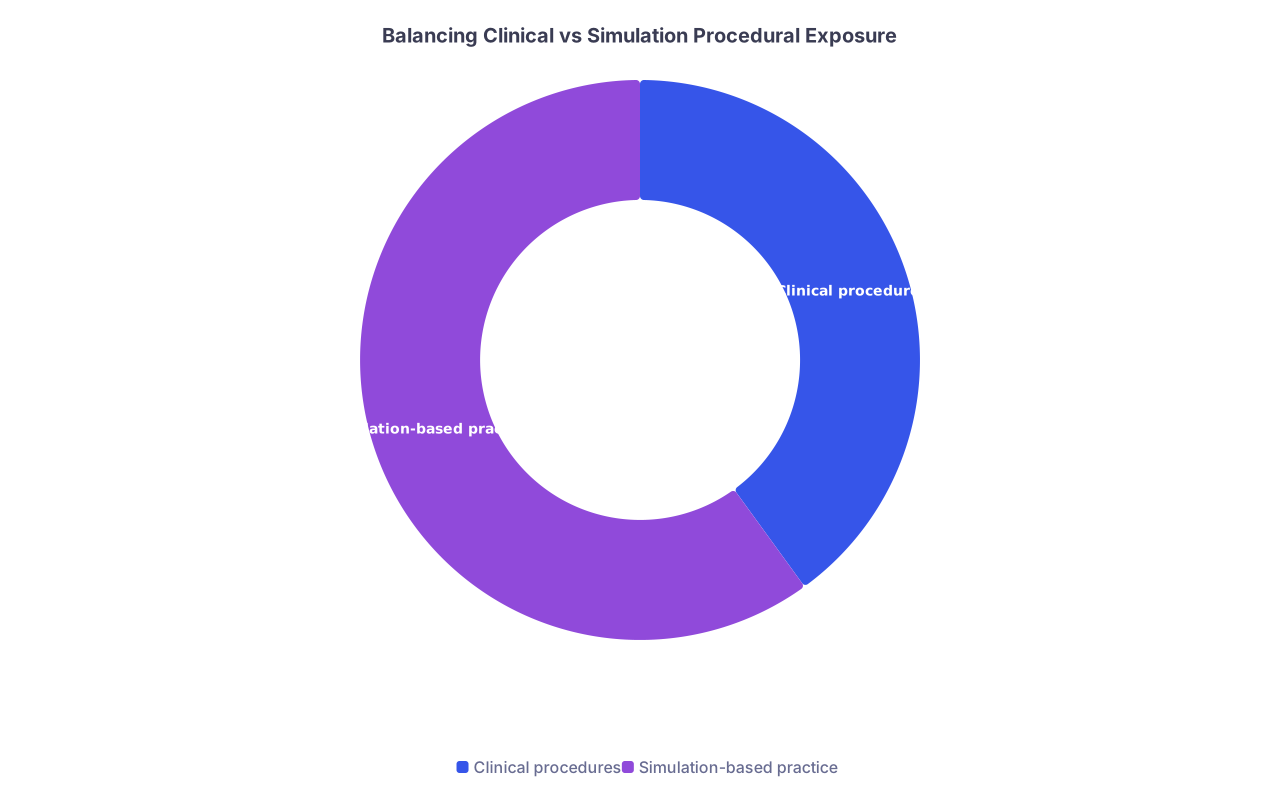
If your breakdown looks like this, you say so. It shows insight, not weakness.
Step-by-Step: How To Clean Up Your CV’s Procedural Section Tonight
You want actionable steps. Here they are.
- List all procedures you have touched – observed, assisted, or performed.
- For each, write down approximate counts in three categories:
- Observed
- Assisted
- Performed under direct supervision
- Cross out anything where “observed” is your only exposure, unless it is truly central to your specialty interest.
- For the remaining procedures, write one line each using this template:
“[Procedure]: X performed under direct supervision, Y assisted; brief context (e.g., ultrasound-guided, in ED or ICU setting).” - Group related procedures under one heading (e.g., “Bedside ultrasound,” “Airway management,” “Vascular access”).
- Insert the cleaned, grouped, and quantified list as either:
- A “Selected procedural and technical skills” subsection under major rotations, or
- A dedicated “Procedural and Technical Skills” section near the end of your CV.
Then go back and scrub every vague verb—“participated in,” “involved in”—from your entire document.

FAQ: Procedural Skills and Your Residency CV
Should I ever write “independent” for a procedure as a medical student?
Very rarely. “Independent” implies no in-room supervision by a resident or attending. For invasive procedures on inpatients, this is almost never appropriate for a student. A better phrase is “as primary operator under direct supervision.” You can use “independent” for less critical tasks (e.g., simple suture removal) but those are not the ones programs scrutinize.What if I genuinely do not remember exact numbers?
Estimate conservatively. Use ranges: “approximately 3–5 lumbar punctures performed under direct supervision.” The direction of error should always be underestimation, not inflation. PDs know these are not audited logs; they care more about honesty and scale than precision to the unit.Can I combine simulation and clinical numbers for a bigger total?
No. Combine them and you mislead the reader. Keep them separate: “3 lumbar punctures performed under direct supervision on inpatients; additional 10 practice attempts in simulation lab.” Simulation has value, but it is not the same as a real, moving, anxious patient.Where in ERAS should I put procedural descriptions?
Use the “Experience” section under each relevant rotation or job, in the description box. You can also create an “Other Impactful Experiences” or “Certifications and Skills” entry that summarizes technical skills. Avoid creating a cluttered “Skills” section with a random bullet list out of context.How do I avoid sounding weak if my procedural exposure is minimal?
You focus on your learning approach, not your raw volume. Emphasize careful preparation, simulation practice, positive feedback on the few procedures you performed, and eagerness to train further. A statement like “limited procedural volume due to institutional structure; proactively sought simulation training and opportunities to assist when available” is far better than pretending you did more.Will programs actually question me about specific numbers in interviews?
Yes, some will. I have heard PDs ask, “You listed 5 central lines—tell me about one that went well and one that did not.” If your numbers are inflated, you will stumble. If you were honest, you will have no problem describing your true level of experience, including what you did not know yet. That authenticity is exactly what they want.
Key points:
Describe procedural and technical skills with explicit supervision levels and honest numbers. Separate clinical from simulation experience and avoid vague verbs or inflated claims. Your goal is not to sound like a mini-attending; it is to show that you are a careful, teachable trainee who already understands where your real competence begins and ends.