
Most residency CVs sound exactly the same—and that alone is killing otherwise strong applications.
Let me be blunt: “Participated in…”, “Responsible for…”, “Assisted with…” make you sound like background noise. Program directors are scanning in seconds, hunting for people who drive outcomes, not people who just stand near them.
You fix that with two things:
- Aggressive, accurate action verbs.
- Concrete metrics.
Not fluff. Not “buzzwords.” Real verbs and real numbers that make a PD’s brain go: “This person gets things done.”
Let me break this down specifically.
How PDs Actually Read Your CV
Most students imagine PDs reading their CV line by line, savoring every bullet. That is fiction.
Here is what really happens. I have watched it in busy offices during interview season:
- They skim in 15–30 seconds on ERAS.
- Their eyes go to:
- Positions/titles
- First word of each bullet
- Any number or percent sign
- Recognizable institutions or journals
- If nothing grabs them quickly, they move on. They might come back later. Usually they do not.
So your job is not to “sound professional.” Your job is to make every line produce a hook:
- Strong first verb.
- Specific subject.
- Tangible result.
Compare:
- “Participated in quality improvement project in internal medicine clinic.”
Versus:
- “Led QI project reducing hypertension follow up no show rate by 18% over 6 months.”
Same student. Same project. One gets remembered.
The Core Formula: Verb + Scope + Method + Metric
If you remember nothing else from this article, memorize this structure:
Strong verb + what you did + how you did it + measurable outcome
You will not use all four pieces in every bullet, but when you can, it is gold.
Example transformations:
Weak: “Helped with patient education on diabetes.”
Strong: “Developed and delivered 20+ diabetes education sessions for clinic patients, documented 30% improvement in attendance at follow up visits.”
Weak: “Involved in research project about sepsis.”
Strong: “Coordinated prospective sepsis cohort study of 220 patients; abstract accepted for podium presentation at regional critical care conference.”
Notice the pattern:
- Starts with a decisive verb.
- Names scale (20+ sessions, 220 patients).
- Shows outcome (30% improvement, conference podium).
That is the language of people PDs can visualize on their team.
Action Verbs That Actually Impress PDs (By Category)
Here is where most guides get lazy. They hand you a 300-word verb list and say “pick some.” That is how you end up with nonsense like “synergized” on a medical CV.
You want verbs that sound like medicine and operations, not corporate jargon. Let me organize it the way PDs think—leadership, systems, scholarship, teaching, and clinical work.
| Domain | Strong Verbs (Examples) |
|---|---|
| Leadership | Led, Directed, Organized |
| Systems/QI | Implemented, Streamlined, Reduced |
| Research | Designed, Analyzed, Authored |
| Teaching | Taught, Mentored, Facilitated |
| Clinical | Managed, Triaged, Coordinated |
Leadership and Initiative
Use these for roles where you owned something: committees, student orgs, projects.
- Led
- Directed
- Organized
- Established
- Launched
- Coordinated
- Chaired
- Oversaw
- Spearheaded
- Initiated
Bad: “Served on student interest group.” Better: “Led 8-member internal medicine interest group, organizing 10+ faculty panels and skills sessions for >120 students annually.”
Systems / QI / Operations
These make you sound like someone who improves a service, not just survives in it.
- Implemented
- Streamlined
- Standardized
- Optimized
- Reduced
- Improved
- Developed
- Piloted
- Integrated
- Audited
Bad: “Participated in quality improvement process.” Better: “Implemented standardized COPD discharge checklist, reducing 30-day readmissions from 22% to 16% over 9 months.”
Research and Scholarship
Key for academic or competitive programs. Use verbs that show intellectual and logistical work.
- Designed
- Conducted
- Analyzed
- Authored
- Co-authored
- Collected
- Curated
- Modeled
- Validated
- Presented
Bad: “Worked on research project for 1 year.” Better: “Designed and conducted retrospective chart review of 340 heart failure admissions; first author manuscript under peer review at Journal of Cardiac Failure.”
Teaching and Mentoring
Every program wants residents who can teach students and juniors without falling apart at 3 a.m.
- Taught
- Mentored
- Precepted
- Facilitated
- Supervised
- Instructed
- Coached
- Oriented
- Led (small groups)
- Evaluated
Bad: “Helped teach anatomy course.” Better: “Taught weekly anatomy review sessions for 25 first year students; created 50-question practice sets, with 4.5/5 average anonymous evaluations.”
Clinical and Patient-Facing Work
You are not an attending, but you can still frame student work in active language without exaggerating.
- Managed (for appropriate student-level tasks)
- Counseled
- Assessed
- Triaged (if applicable)
- Documented
- Coordinated
- Followed up
- Communicated
- Performed (for procedures you actually did)
- Assisted (only when you truly were just assisting)
Bad: “Assisted with patient care.” Better: “Counseled 15–20 hospitalized patients weekly on new diabetes diagnoses under supervision; documented encounters and followed up on outpatient referrals.”
Metrics: The Part Almost Everyone Skips
Numbers are the fastest way to make your CV “pop” in a PD’s scan. They do three things at once:
- Prove that the activity was substantial.
- Show you think in outcomes.
- Provide anchors for interview questions.
You are not expected to have randomized trial level data; directional metrics and reasonable estimates are fine, as long as they are honest.
What You Can Quantify (Even As A Student)
You can usually put a number on:
- Volume:
- “Taught 12 sessions”
- “Screened 180 patients”
- “Called 60 donors”
- Time:
- “Over 2 years”
- “Per week (3–4 hours weekly)”
- “During 8-week subinternship”
- People:
- “Led a team of 6 volunteers”
- “Served 120+ attendees”
- Outputs:
- “Created 10-page protocol”
- “Published 2 peer-reviewed articles”
- “Submitted 3 abstracts (2 accepted)”
- Outcomes/change:
- “Reduced wait times by 25%”
- “Increased clinic attendance from 40% to 68%”
- “Raised $14,000 for free clinic”
If you never tracked numbers, you can usually reconstruct them from:
- Attendance sign-ins
- Clinic schedules
- Meeting minutes
- Email threads
- Abstracts or IRB applications
Do not fabricate. But you can estimate with ranges when exact numbers are not available: “Approximately 100–120 calls,” “10–15 patients per week.”
Before / After CV Examples (Line by Line)
Let us take some ugly, real-world style bullets and rewrite them the way a PD actually respects.
Example 1: Student Leadership
Original:
- “President, Surgery Interest Group”
- “Organized events for classmates interested in surgery.”
Rewritten:
- “President, Surgery Interest Group — Led 9-member executive board; organized 14 skills workshops and faculty panels annually for >100 preclinical students.”
- “Established mentorship program pairing 45 students with 22 surgical residents across 6 subspecialties.”
Why this works:
- “Led” and “Established” are stronger than “Organized.”
- Numbers (9 members, 14 workshops, >100 students, 45 students, 22 residents, 6 subspecialties) create scale.
- PD can instantly picture you contributing to resident recruitment and education.
Example 2: Community Service / Free Clinic
Original:
- “Volunteered at student run free clinic for homeless population.”
- “Helped with referrals and scheduling.”
Rewritten:
- “Volunteer Coordinator, Student Run Free Clinic — Coordinated weekly schedules for 25 student volunteers across 3 clinic sites, maintaining 95% coverage rate over 12 months.”
- “Streamlined specialty referral workflow by creating standardized referral template and tracking spreadsheet, decreasing incomplete referrals from ~30% to <10%.”
Why this works:
- “Coordinated” and “Streamlined” show systems thinking.
- 25 volunteers, 3 sites, 95% coverage, 12 months demonstrate sustained responsibility.
- The outcome metric on referrals screams QI mindset.
Example 3: Research Experience
Original:
- “Worked in cardiology lab; duties included data collection and analysis.”
- “Presented poster at conference.”
Rewritten:
- “Research Assistant, Cardiology Outcomes Lab — Collected and managed clinical data for 260 patients undergoing TAVR; performed multivariable regression analyses using R.”
- “Co-authored abstract accepted for poster presentation at 2024 American College of Cardiology Scientific Sessions.”
Why this works:
- “Collected and managed,” “performed,” “co-authored” are precise.
- 260 patients, specific method (multivariable regression with R), named conference (ACC) all increase perceived rigor.
Specialty-Specific Angles: Tailoring Without Lying
You do not rewrite your entire CV for each specialty, but you can adjust emphasis.
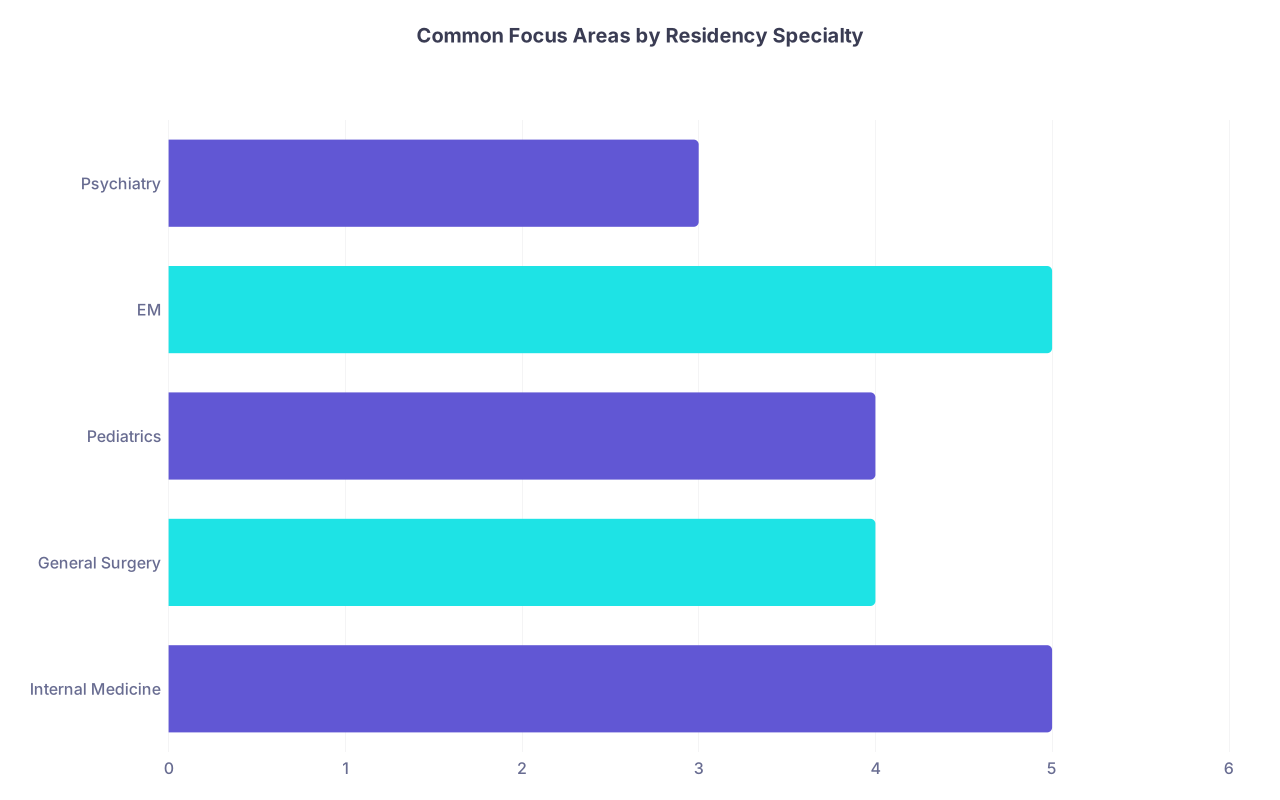
| Category | Value |
|---|---|
| Internal Medicine | 5 |
| General Surgery | 4 |
| Pediatrics | 4 |
| EM | 5 |
| Psychiatry | 3 |
(Think of those numbers as “relative emphasis on leadership/operations and quantifiable metrics”—IM and EM heavily care about systems/QI and throughput, for example.)
Internal Medicine
Words and metrics that land:
- “Reduced readmissions…”
- “Improved follow up appointment completion…”
- “Standardized handoff process…”
Example:
- “Implemented bedside discharge checklist on medicine ward; increased documented follow up appointments from 62% to 85% across 3 months.”
General Surgery
They respect efficiency, throughput, and procedural volume, but do not lie about what you did.
Example:
- “Standardized pre-op teaching script for appendectomy patients; decreased day-of-surgery cancellations from 7% to 3%.”
- “Tracked and logged >80 bedside procedures (arterial lines, paracenteses, thoracenteses) observed or assisted during third year clerkships; independently performed 15 phlebotomies and 10 Foley catheter placements under supervision.”
Pediatrics
Highlight communication, education, and longitudinal relationships.
Example:
- “Developed age-appropriate asthma action plan handouts for 3 age groups; in pilot cohort of 40 families, 85% reported improved understanding of inhaler use on follow up survey.”
- “Mentored 6 middle school students weekly through health careers pipeline program over 9 months.”
Emergency Medicine
They care about throughput, triage, systems.
Example:
- “Participated in ED throughput QI project; redesigned triage documentation template, reducing average door-to-provider time from 62 to 45 minutes in pilot area.”
- “Coordinated weekly simulation sessions for 12 EM-bound students, focusing on ACLS algorithms and trauma primary survey.”
Psychiatry
Emphasize communication, longitudinal follow up, and team collaboration.
Example:
- “Counseled 10–12 patients weekly in outpatient addiction group visits under supervision; documented encounters and coordinated follow up referrals with social work.”
- “Authored case report on first episode psychosis in transgender adolescent; presented at state psychiatric society annual meeting.”
Translating “Nothing Special” into High-Impact Bullets
I hear this constantly: “My experiences are not impressive enough for metrics or strong verbs.”
Wrong. The problem is almost always wording, not substance.
Let me show you how to rescue very ordinary experiences.
Admin / Clerk Roles
Original:
- “Secretary of Internal Medicine Interest Group.”
Reframed:
- “Secretary, Internal Medicine Interest Group — Managed email communication for 150+ members; maintained updated meeting minutes and event calendar, increasing average event attendance from ~10 to 25 students per session.”
Tutor / Peer Educator
Original:
- “Tutored first year students.”
Reframed:
- “Peer Tutor, Physiology — Provided weekly 1-on-1 and small group tutoring to 8 first year students at risk of failing; 7/8 passed final exam with scores ≥10 points above prior midterm.”
Short-Term Project
Original:
- “Participated in two week global health trip.”
Reframed:
- “Global Health Elective, 2 weeks, rural clinic in Guatemala — Screened ~90 patients for hypertension and diabetes; created bilingual educational handout on diet and medication adherence distributed to 60 patients.”
You see the pattern. You are not inventing heroics. You are stating what actually happened—clearly, concretely, and with scale.
Phrases and Constructions to Eliminate
Some wording actively weakens your CV. Remove or minimize these:
- “Participated in…”
- “Exposed to…”
- “Interested in…”
- “Was responsible for…”
- “Assisted with…” (unless describing hands-on procedural assistance)
- “Worked on…”
- “Involved in…”
Replace them with:
- “Led / Organized / Implemented / Coordinated / Developed…”
- “Taught / Mentored / Supervised…”
- “Collected / Analyzed / Presented…”
Watch passive voice creep in as well:
- Passive: “A new handoff template was created and implemented.”
- Active: “Created and implemented new handoff template for 2 inpatient teams, used for >300 patient transfers over 4 months.”
Active voice is not just grammar pedantry. It shows who did the work. Which is what PDs care about.
How To Systematically Rewrite Your CV
Do this once, properly, and your entire application tightens up.

| Step | Description |
|---|---|
| Step 1 | Select old bullet |
| Step 2 | Identify what you actually did |
| Step 3 | Choose strong verb |
| Step 4 | Add scope and context |
| Step 5 | Add metric or outcome |
| Step 6 | Check for honesty and clarity |
| Step 7 | Replace old bullet |
Stepwise:
- Pull up your current CV or ERAS entries.
- For each bullet:
- Ask: “What did I actually do? What changed because I was there?”
- Choose a verb from the categories above that matches your real role.
- Add:
- How many?
- How often?
- For how long?
- Using what tools or methods?
- Ask yourself:
- “Can someone challenge this in an interview and I still feel comfortable?”
- If yes, keep it.
- If no, dial back the number or strength of the verb.
You will need to kill some darlings. Long poetic descriptions are useless. A short, hard-hitting line with a number is better 99% of the time.
Quick Specialty-Neutral Examples by Domain
Here is a compact reference you can mirror as you rewrite.
Leadership:
- “Led 7-member planning committee to launch inaugural residency preparation workshop series for 60 third year students; achieved 92% satisfaction on post-session surveys.”
Quality Improvement:
- “Implemented standardized opioid prescribing guidelines in outpatient clinic; reduced high-dose prescriptions by 28% over 6 months.”
Research:
- “Analyzed EHR data for 410 ICU admissions using SQL; co-authored manuscript accepted in Critical Care Medicine.”
Teaching:
- “Mentored 5 preclinical students in clinical skills; developed OSCE-style practice sessions that improved average checklist scores from 72% to 88%.”
Clinical:
- “Coordinated discharge planning for 10–12 hospitalized patients weekly as subintern; communicated with families, primary care, and social work to ensure follow up.”
You can adapt these skeletons to almost any experience you have.