
Most leadership bullets on residency CVs are useless filler. That is your competition.
If you can write leadership bullets that actually prove responsibility, you will stand out immediately—especially in a pile of “served as,” “helped with,” and “participated in” nonsense.
Let me break this down specifically.
Why Program Directors Ignore Most Leadership Bullets
Here is the blunt truth:
Program directors are not impressed that you were “President of XYZ Club” or “Volunteer Coordinator at ABC Clinic” unless your bullets show three things:
- You had real responsibility.
- You produced specific outcomes.
- You demonstrated skills that transfer to residency (ownership, reliability, team management, systems thinking).
What they actually read for is:
- Who trusted you with what?
- What would have broken if you disappeared?
- Did anything get measurably better because of you?
- Do you sound like someone who will own a patient list at 3 a.m.?
If your bullets do not answer those questions, they are dead space.
So your job is not to list your title. Your job is to prove responsibility with the way you write each bullet.
The Core Formula: How To Turn a Title Into Proof
Most students write bullets as tasks:
- “Organized meetings for student interest group.”
- “Assisted in planning community health fair.”
- “Participated in quality improvement meetings.”
This is background noise.
You need a structure that forces you to show responsibility and impact. Use this spine:
Action verb + Scope of responsibility + Concrete action + Result / metric / change
Think of it as four dials you can turn up or down.
Let’s dissect each.
1. Start with a grown‑up action verb
Bad, mushy verbs:
“Helped,” “Assisted,” “Participated,” “Was involved in,” “Worked on.”
Responsible, ownership verbs:
“Led,” “Directed,” “Oversaw,” “Managed,” “Implemented,” “Designed,” “Built,” “Negotiated,” “Established,” “Streamlined,” “Coordinated,” “Standardized.”
Example shift:
- Weak: “Helped organize free clinic sessions.”
- Strong: “Coordinated weekly free clinic operations…”
Already sounds like you might matter.
2. Make the scope of responsibility painfully clear
This is the piece almost everyone leaves out.
Scope is where you show risk and trust. Numbers help. So do timeframes and coverage details.
Details that show scope:
- How many people you led (“12 volunteers,” “4-class curriculum,” “15-member board”).
- How often or how long (“weekly for 18 months,” “every overnight call shift”).
- Size/scale (“serving 120 patients/month,” “budget of $8,000,” “5 clinic sites”).
Example:
- Vague: “Led interest group.”
- Real: “Led 14-member student-run Internal Medicine Interest Group serving a class of 160 students over 2 academic years.”
Now this is not just a line. It is a responsibility.
3. Describe a concrete action, not a generic role
“Served as” is not an action. It is a placeholder.
You want to show what you actually did that required judgment, planning, or problem-solving.
Good categories of action:
- Built or redesigned a system (schedules, protocols, workflows, databases).
- Negotiated or coordinated across stakeholders (faculty, students, clinics, sponsors).
- Created something from nothing (new elective, new clinic, new initiative).
- Took ownership of something fragile (coverage, safety, evaluation, funding).
Example:
- Weak: “Served as treasurer for student group.”
- Strong: “Managed annual $6,000 budget, including vendor contracts, event expenses, and end-of-year financial reporting to faculty advisor.”
Same role. One sounds like a checkbox; the other sounds like a person you could trust with a night float census.
4. Close with a result that anyone can picture
This is where most bullets die. They stop at “did things.” No change, no outcome.
You need a result:
- “Increased attendance from 20 to 60 per event.”
- “Cut patient wait times by 30%.”
- “Reduced no-show rate from 25% to 10%.”
- “Maintained 100% coverage for 40+ weekly tutoring sessions across 9 months.”
If you do not have exact numbers, use approximate ones that are honest but concrete:
- “~30 volunteers,” “>100 participants,” “3-fold increase,” “nearly doubled.”
Put it together:
- Weak: “Organized community health fair.”
- Strong: “Led planning and on-site logistics for annual community health fair serving ~250 attendees, coordinating 18 vendors and 40 volunteers to deliver 15 free screening stations.”
Now your leadership looks like actual work.
Translating Common Leadership Roles Into Strong Bullets
Let us go role by role. Assume you are filling out the ERAS “Experience” section.
Student Interest Group President
Typical garbage bullets I see:
- “President, Surgery Interest Group.”
- “Organized meetings and events.”
- “Planned suture workshops.”
You can do much better.
Better versions:
- “Led 10-member executive board for Surgery Interest Group, overseeing planning and execution of 12 educational events per year for a class of 180 students.”
- “Negotiated funding and faculty participation for 6 hands-on skills workshops annually, increasing average event attendance from 25 to 70 students.”
- “Standardized the officer transition process by creating a written playbook for recruitment, scheduling, and budgeting, preventing event cancellations after leadership turnover.”
These bullets show:
- Scope (10-member board, 180 students, 12 events).
- Actions (led, negotiated, standardized).
- Results (attendance increase, prevented cancellations).
Free Clinic Leadership / Coordinator
This is gold if written correctly, because it parallels residency responsibilities.
Bad:
- “Clinic coordinator, student-run free clinic.”
- “Responsible for volunteers and scheduling.”
- “Participated in clinic leadership committee.”
Better:
- “Managed weekly operations of student-run free clinic serving ~35 uninsured patients per session, coordinating 12 student volunteers and 2 attending physicians per clinic night.”
- “Built and maintained a volunteer scheduling system that ensured 100% provider and student coverage across 48 clinic sessions per year.”
- “Implemented a new triage protocol for walk-in patients that reduced average check-in-to-provider time from ~90 to ~55 minutes.”
This screams: I understand throughput, coverage, and systems.
Curriculum / Tutoring / Peer Teaching Coordinator
Many students totally under-sell this.
Bad:
- “Tutoring coordinator for underclassmen.”
- “Helped organize review sessions.”
Better:
- “Directed peer tutoring program for first-year medical students, recruiting and training 22 tutors to provide weekly sessions across 5 core courses.”
- “Centralized scheduling and communication for >60 tutoring sessions per month using shared calendars and standardized email templates, improving student satisfaction scores from 3.6 to 4.5/5.”
- “Collaborated with course directors to align tutoring content with exam blueprints, leading to a 15% reduction in first-time course failures over 2 academic years.”
That is responsibility. That is educational leadership, not “I helped a bit.”
Committee Work (Curriculum, Diversity, Wellness, etc.)
Committee roles look fluffy unless you show what changed because you were there.
Bad:
- “Member, Diversity and Inclusion Committee.”
- “Participated in monthly meetings.”
Better:
- “Served as one of two student representatives on School of Medicine Diversity Committee, providing direct input on policies affecting ~600 medical students.”
- “Co-led development of a standardized process for reporting and tracking learner mistreatment concerns, including drafting workflows and communication templates adopted by the Dean’s Office.”
- “Analyzed 3 years of student survey data and presented recommendations that led to creation of a funded student diversity liaison position.”
Now this is influence, not attendance.
Research Project Leadership
Yes, you can show leadership even as a student on a research team—especially if you ran the day-to-day.
Bad:
- “Coordinated data collection for QI project.”
- “Worked with team to analyze data.”
Better:
- “Led day-to-day execution of multi-site QI project on post-op pain management, training 8 student abstractors and standardizing data collection across 3 hospital units.”
- “Designed REDCap database and quality checks that reduced data entry errors from ~18% to <3% on monthly audits.”
- “Organized weekly project huddles, tracking tasks and timelines to ensure on-time abstract submission to national conference.”
Again: scope, system, outcome.
Side‑by‑Side: Weak vs Strong Bullets
| Role | Weak Bullet | Strong Bullet |
|---|---|---|
| Free Clinic Coordinator | Helped run student clinic | Managed weekly operations of student-run clinic serving ~35 patients per night |
| Interest Group President | Organized meetings and events | Led 10-member board to deliver 12 events/year for 180 students |
| Tutoring Program Director | Coordinated tutoring | Directed 22-tutor program delivering >60 sessions/month across 5 courses |
| Research Lead Student | Worked on QI project | Led day-to-day execution of multi-site QI project across 3 hospital units |
| Committee Member | Participated in diversity committee meetings | Co-led development of new mistreatment reporting process adopted by dean |
Read the right-hand column again. Those are the kind of bullets that make a PD pause.
Shaping Your ERAS Experience Entry Around Responsibility
On ERAS, you typically get:
- One line for Organization/Role.
- A short description (3–4 bullets is comfortable).
- Limited characters.
Your goal: every bullet should prove responsibility, not just activity.
Step 1: Decide your “headline responsibility” for that role
Ask yourself:
- What would have fallen apart if I stopped showing up?
- What did people count on me for that others could not easily replace?
That becomes your first bullet.
Example for Free Clinic Director:
- “Managed staffing and operations for weekly student-run free clinic serving ~120 unique patients per month.”
That is your frame. Everything else supports that.
Step 2: Choose 2–3 high-yield domains
For a leadership role, think in domains:
- Operations / logistics
- People management / teaching
- Systems / quality / improvement
- Funding / external relationships
- Innovation / building something new
Pick 2–3 where you truly did work. Then write one bullet per domain.
Example:
- Operations: “Built and maintained coverage schedules for 12 student volunteers and 2 attendings per clinic night, ensuring 100% staffing across 48 sessions annually.”
- QI/System: “Introduced structured pre-visit medication reconciliation checklist that cut charting discrepancies by ~40% on monthly audits.”
- People: “Oriented and trained >30 new volunteers per year using standardized walkthrough and quick-reference guides.”
Now that experience screams “I can handle a ward team.”
Step 3: Pack metrics without bloating
Short but dense wins. Use numbers and ranges instead of storytelling sentences.
For example:
- “Oversaw” → “Oversaw 15 volunteers.”
- “Planned several events” → “Planned 8–10 workshops/year.”
- “Managed budget” → “Managed $6,000 annual budget.”
You do not need paragraphs. You need data.
Quantifying Responsibility When You Do Not Track Numbers
I hear this a lot: “I never tracked exact attendance / budget / patients. Now what?”
You are not writing a legal affidavit. You are writing an honest, approximate description.
Reasonable strategies:
- Use ranges: “20–30 volunteers,” “5–7 events/year.”
- Use “~” or “approximately” when estimating.
- Use “>” (greater than) when a threshold is clear.
Also, you can quantify frequency and duration:
- “Weekly meetings for 18 months.”
- “Monthly lectures over 2 academic years.”
- “Every clinic session for a full year.”
If you truly have no clue, ask:
- Other officers.
- Faculty advisors.
- Admin staff who handle room bookings or budgets.
- Old sign-in sheets, email lists, calendars.
You can reconstruct more than you think in 15–20 minutes.
Tailoring Leadership Bullets to Your Target Specialty
Your leadership story should subtly echo the specialty you want. Not by faking content, but by emphasizing the aspects that matter to that field.
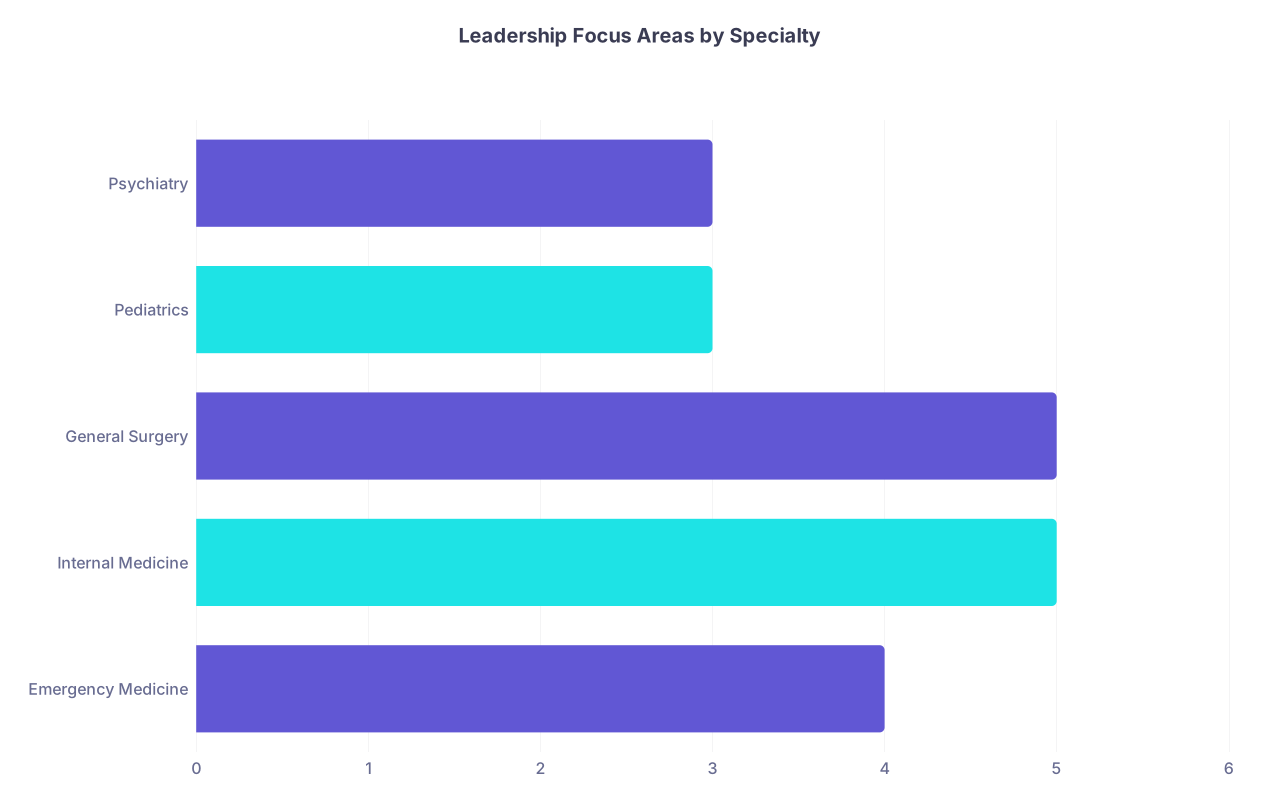
| Category | Value |
|---|---|
| Emergency Medicine | 4 |
| Internal Medicine | 5 |
| General Surgery | 5 |
| Pediatrics | 3 |
| Psychiatry | 3 |
Interpretation (not in the chart): more “5s” → more emphasis on operations, triage, and system responsibility is appreciated.
Examples:
Internal Medicine: Highlight longitudinal responsibility, system improvement, data-driven changes, multi-disciplinary coordination.
“Standardized pre-clinic huddle template used by 3 IM clinic teams.”Surgery: Emphasize ownership, time-critical logistics, OR/clinic throughput, checklists, clear chains of command.
“Created pre-op equipment checklist adopted across 4 resident-led skills workshops, eliminating last-minute case cancellations.”Emergency Medicine: Show triage, flow management, crisis coordination, shift-based operations.
“Coordinated staffing and triage assignments for 24-hour student disaster drill involving 90 participants across 3 hospital zones.”Pediatrics: Parent communication, educational materials, multi-stakeholder coordination (schools, social services), safety.
“Developed standardized caregiver handouts for asthma education used in 2 pediatric clinics, improving teach-back scores from 65% to 88%.”Psychiatry: Policy/advocacy, safety protocols, communication workflows, interdisciplinary teams.
“Helped design and roll out a standardized safety screening workflow for student counseling service, including escalation pathways to psychiatry.”
You do not need to name the specialty in every bullet. Just choose examples that mirror that specialty’s daily work.
Polishing: Language Traps That Make You Sound Less Responsible
You can ruin a strong leadership role by hiding it behind weak phrasing. Avoid these traps.
1. “Assisted with” and “helped”
Unless you clarify what you owned, this tells readers you were a sidekick.
Bad: “Assisted with managing volunteers.”
Better: “Maintained weekly volunteer schedule for 15-person team, arranging coverage for all absences.”
2. Overusing passive voice
Bad: “Meetings were organized and lectures were given.”
Better: “Organized monthly case-based lectures, recruiting 8 faculty speakers and averaging 60+ attendees.”
The more passive voice you use, the more it sounds like things just happened around you.
3. Buzzwords without specifics
“Leadership,” “teamwork,” “communication” mean nothing by themselves.
Bad: “Demonstrated leadership and communication skills.”
Better: “Led 10-minute pre-clinic huddles each week to assign roles, clarify goals, and identify anticipated barriers for ~30 patients on the schedule.”
That shows leadership and communication instead of declaring them.
4. Vague impact words
“Improved,” “enhanced,” “streamlined” are fine only if followed by something measurable or clearly visible.
Bad: “Streamlined clinic workflow.”
Better: “Streamlined clinic intake by combining two forms into one EMR template, decreasing average check-in time by ~5 minutes per patient.”
If you can not show the effect, the verb is fluff.
Real Examples: Before and After Rewrites
Let me walk through three complete transformations.
Example 1: Interest Group
Original:
- President, Anesthesia Interest Group
- Organized events and panels.
- Coordinated with faculty and residents.
- Helped students learn about anesthesia careers.
Revised:
- President, Anesthesia Interest Group
- Led 9-member executive team to deliver 11 educational events per year for ~160 pre-clinical students.
- Secured participation from 7 attending anesthesiologists and 10 residents as panelists and workshop instructors.
- Introduced a structured “Day in the Life” panel format and OR shadowing sign-up system, increasing repeat attendance from ~30% to ~65%.
Now the PD knows: scale, faculty engagement, and a change in student engagement.
Example 2: Community Health Initiative
Original:
- Coordinator, Community Hypertension Screening
- Organized blood pressure screenings.
- Educated patients about HTN.
- Worked with local churches.
Revised:
- Coordinator, Community Hypertension Screening Program
- Planned and staffed monthly blood pressure screening events at 3 local churches, supervising 8–10 student volunteers per session.
- Developed a standardized education script and take-home materials for newly diagnosed or uncontrolled hypertensive patients.
- Created a referral tracking spreadsheet linking screened individuals to follow-up appointments at the student-run clinic, with >70% documented follow-up within 3 months.
Now this looks like someone who can own a population health initiative.
Example 3: Class Officer
Original:
- Class Vice President
- Helped plan class events.
- Served as liaison between students and administration.
- Participated in leadership council meetings.
Revised:
- Vice President, Medical School Class of 2026 (~150 students)
- Represented student concerns at monthly leadership council meetings with the Dean’s Office, summarizing issues and following up on action items.
- Planned and executed 6 major class events per year within a $4,500 budget, including vendor contracts, room reservations, and risk management approvals.
- Implemented anonymous feedback form and quarterly town halls that increased participation in class governance from ~10 to 45+ students per session.
Same role. Completely different perceived responsibility.
Visualizing the Bullet Writing Process
Here is how the thinking process should flow every time you write a leadership bullet.

| Step | Description |
|---|---|
| Step 1 | Leadership Role |
| Step 2 | What did I own? |
| Step 3 | Who/what depended on me? |
| Step 4 | Where did I change something? |
| Step 5 | Add numbers and scope |
| Step 6 | Choose strong action verb |
| Step 7 | Draft bullet |
| Step 8 | Keep bullet |
| Step 9 | Does it show responsibility? |
If you run your experiences through this mental flowchart, your CV will look nothing like the average stack.
FAQs
1. How many bullets should I include for each leadership role on ERAS?
Aim for 2–4 bullets per significant leadership role. Fewer than 2, and you probably are not capturing the scope. More than 4, and you are usually drifting into minor details. Pick the 2–4 bullets that best show ownership, scale, and impact.
2. What if my leadership role was mostly symbolic and I did not do much?
Then you have two options:
Be honest but strategic—emphasize the few moments where you did take responsibility, even if small (e.g., organizing one major event, leading a specific initiative).
If you truly did almost nothing, do not oversell the title. It is better to write strong bullets for roles where you genuinely worked than to pretend a passive title was transformative.
3. Is it acceptable to estimate numbers and metrics?
Yes, as long as your estimates are reasonable and honest. Use approximate language (“~40 patients,” “20–25 volunteers,” “>50 attendees”) when exact numbers are unknown. If you can reconstruct more accurate numbers from sign-in sheets, calendars, or emails, do it. The goal is to convey scale, not litigate exact figures.
4. Should I repeat similar leadership bullets in my personal statement?
Only if the role is central to your story and you add something new. The CV bullets should handle scope, responsibility, and outcomes. The personal statement can highlight your internal experience of that leadership: conflicts, judgment calls, learning moments. Never copy-paste bullets into your statement; use narrative instead of lists.
5. How do I handle leadership that is not obviously medical (e.g., sports captain, teaching assistant before med school)?
You include it if it shows real, transferable responsibility. For example: managing a team, handling conflict, running logistics, or being accountable for outcomes. Then you write the bullets using the same structure: action verb + scope + concrete action + result. For residency, place the strongest medically relevant leadership first, but do not dismiss pre-med or non-clinical roles if they clearly demonstrate ownership and organization.
Key takeaways:
- Titles do not impress program directors; responsibility and outcomes do.
- Every bullet should show scope, concrete action, and measurable or visible results.
- If you write like someone who keeps systems from falling apart, readers will assume you can do the same on a ward team.