
You are staring at your ERAS CV, hovering over the “Teaching” and “Mentoring” parts. You want an academic residency. The PD’s slide deck literally said they “highly value teaching experience.” But your draft looks like:
“Tutored MS1s. Led review session. Mentored premed.”
Flat. Unimpressive. And you know it.
Let me break down exactly how to turn that dead space into something that screams: “This person will be a great resident teacher, future chief, and maybe faculty.”
We are not just listing activities. We are building an academic narrative.
1. What Academic Programs Actually Look For (Not the Fluff You Think)
Academic programs do not care that you “like teaching.” Everyone says that. They care whether you have evidence that you can do three things:
- Teach effectively
- Mentor longitudinally
- Contribute to the educational mission
Those translate into very specific signal types on a CV.
| Signal Type | Strength Level |
|---|---|
| Formal course teaching | Very High |
| Structured small-group teaching | High |
| Longitudinal mentorship | High |
| Peer tutoring programs | Medium |
| One-off review sessions | Low-Medium |
Strong academic candidates usually have layers of this:
- Structured, scheduled teaching (course, small group, lab)
- Longitudinal mentorship of named individuals or cohorts
- Evidence of quality: feedback, selection for roles, recognitions
- Occasionally: educational scholarship (curriculum design, posters)
If your “teaching/mentorship section” right now is three bullet points with none of that structure, we fix that by:
- Clarifying the context (who, what level, how often)
- Quantifying the scope (numbers, frequency, duration)
- Stating the impact (performance, feedback, outcomes)
If you remember nothing else: academic programs are reading your CV asking one question—“Will this person teach my med students and interns well, and will I ever be able to put them in front of a classroom?” Your job is to make the answer “obviously yes.”
2. Where Teaching and Mentorship Actually Belong on ERAS
On ERAS, teaching and mentorship can (and should) appear in multiple places. This is where most people underutilize what they have.
Your teaching-related content can live in:
- Experiences → “Work/Volunteer” (for formal or semi-formal teaching roles)
- Experiences → “Leadership” (if you ran a program, led curriculum)
- Experiences → “Research” (if you did education research)
- Publications/Presentations → Education-themed posters, workshops
- Awards → Teaching awards, peer-teaching honors
- Personal Statement → One or two select examples to illustrate your “academic” angle
The mistake I see repeatedly: people shove everything into one generic “teaching” entry and then never reference it again. Do not do that.
You want:
- 2–4 well-built teaching/mentorship experiences in your main ERAS Experiences section
- If applicable, 1–2 education-related abstracts/posters in the Scholarly Activities section
- A subtle teaching/mentorship theme that shows up in your personal statement and letters
3. Building a High-Impact Teaching Experience Entry
Let’s get concrete. Here is the typical weak entry:
“Peer Tutor, 2022–2024
Tutored MS1s in physiology and pathology.”
That tells me almost nothing. Here is how you fix it.
Think in terms of 4 elements:
- Context: Who and where
- Structure: How often, what format
- Scale: How many learners, how long
- Impact: What changed / how it was received
Here is a much stronger version of that same role:
“Peer Tutor, Preclinical Physiology and Pathology
Institution, Dates
- Selected by course director as 1 of 6 peer tutors supporting first-year medical students in core physiology and pathology curriculum
- Led weekly 1–2 hour small-group review sessions (4–8 students) focused on concept integration and practice questions ahead of block exams
- Provided 1:1 targeted remediation for students at risk of failing, coordinating with academic support services and following progress longitudinally
- Created >50 board-style practice questions and summary handouts shared with entire class (∼150 students) via official course site”
Notice what happened:
- “Selected by course director” → someone trusted you
- “Weekly 1–2 hour small-group” → structured, consistent
- Specific group size and class size → scope and reach
- Creation of materials → not just talking, but designing learning resources
Now compare those side-by-side.
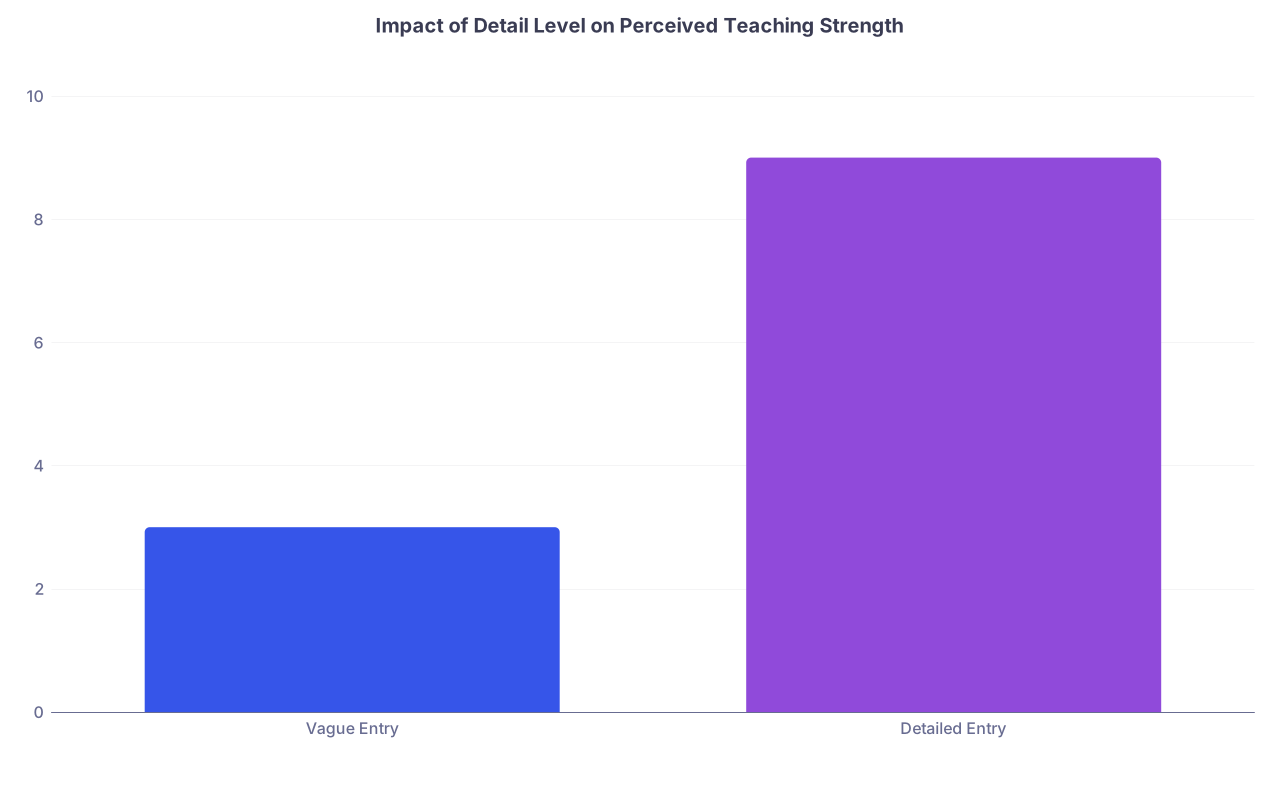
| Category | Value |
|---|---|
| Vague Entry | 3 |
| Detailed Entry | 9 |
Think of that 3 vs 9 as “strength out of 10” in a PD’s mind. Vague = forgettable. Detailed, structured, with impact = this person probably actually taught.
4. Documenting Mentorship Like an Academic, Not Like a Camp Counselor
Mentorship is where CVs usually collapse into mush: “Mentored premeds and undergrads about medical school and research.” Completely generic.
Academic programs want to see:
- Type of mentee (premed, undergrad, MS1, MS2, junior resident)
- Structure (formal program vs organic relationships)
- Duration (one conversation vs ongoing for a year)
- Any measurable outcomes
Let’s rewrite.
Weak:
“Premed Mentor, 2021–2023
Mentored premedical students.”
Strong:
“Mentor, Premedical Mentorship Program
Institution / Organization, Dates
- Matched with 3–4 premedical students per year through structured mentorship program aimed at first-generation and underrepresented students
- Met monthly (in-person or virtual) to review coursework plans, MCAT strategy, and application timelines; maintained longitudinal email follow-up
- Supported 5 mentees who subsequently matriculated to medical school (2 at [Your Institution])
- Collaborated with program director to develop a stepwise “application checklist” that was later adopted as a standard resource for all mentees”
You are showing that you:
- Understand structure and consistency
- Consider outcomes (matriculation)
- Contribute back to program infrastructure (checklist)
That looks like someone who can run a residency mentorship program later.
5. Specific Teaching Modalities You Should Highlight (And How)
You probably have more teaching than you think. The trick is to classify it into recognizable academic “buckets” rather than random ad hoc activities.
The key modalities:
- Small-group facilitation
- Large-group teaching / lectures
- Skills / bedside teaching
- Near-peer or vertical mentoring
- Educational content creation
Small-Group Teaching
Gold standard for academic programs. It tests your ability to guide discussion, not just lecture.
Example entry:
“Small Group Facilitator, MS1 Clinical Skills Course
Institution, Dates
- Facilitated weekly 2-hour clinical skills sessions (10–12 students) for first-year medical students focused on history-taking, physical exam, and oral case presentations
- Provided formative feedback on communication, professionalism, and documentation; used standardized rubrics to guide evaluation
- Participated in faculty development workshops on learner feedback and remediation strategies”
Now you are speaking their language: “facilitated,” “formative feedback,” “standardized rubrics,” “faculty development.” That is academic teaching vocabulary.
Large-Group / Lectures
If you have ever given a formal talk to >20 people, leverage it.
Weak: “Gave lecture on heart failure to MS2s.”
Stronger:
“Guest Lecturer, Second-Year Cardiology Unit
Institution, Month Year
- Delivered a 45-minute interactive lecture on chronic heart failure management to ∼80 second-year medical students, integrating guideline-based therapy and clinical cases
- Designed pre- and post-quiz questions (5 items each) to assess understanding; mean correct responses improved from 62% to 88%
- Received average rating 4.7/5 on anonymous session evaluations”
Now you have:
- Audience size: ~80 students
- Duration: 45 minutes
- Measured impact: pre/post quiz, evaluation scores
Skills / Bedside Teaching
For many of you this starts in clerkships, and grows in sub-Is.
If you are an MS4 who precepted MS3s, or a sub-I who oriented them, that counts.
Example:
“Clinical Teaching, Medicine Sub-Internship
Hospital, Dates
- Informally taught 3 third-year medical students on the team during 4-week sub-internship rotation, focusing on daily SOAP note structure, one-liner formulation, and targeted presentations
- Led brief 10-minute chalk talks 2–3 times per week on common inpatient topics (hyponatremia, COPD exacerbation, chest pain risk stratification) at the whiteboard after rounds”
Do not oversell informal teaching as a formal role, but do not erase it either.
Near-Peer / Vertical Mentoring
Programs like residents who are comfortable mentoring learners just below them. So your mentoring of MS1 or MS2 as an MS3 is relevant.
Example:
“Senior Anatomy Mentor
Institution, Dates
- Served as near-peer mentor for first-year medical students during gross anatomy block; supervised prosection review sessions and examination preparation
- Offered 1:1 support to 4 assigned students, with regular meetings spanning the 10-week block; 3 students improved exam performance by at least 1 letter grade between first and final practical”
Educational Content Creation
Slides, modules, handouts, videos—this is where academic programs see “future faculty” potential.
Example:
“Co-Creator, Online Nephrology Flashcard Deck
Dates
- Developed Anki flashcard deck (∼400 cards) focused on renal physiology and pathology; aligned content with institutional lecture objectives and NBME-style question themes
- Shared resource with class of 160 students; deck became most downloaded file in class’s shared drive (∼130 active users per download metrics)”
Now you are not just a consumer of teaching. You are a content producer.
6. Quantifying Your Teaching Without Lying
Numbers make your teaching real. But they must be defensible. PDs and faculty know when you are making things up.
Reasonable things to quantify:
- Number of learners per session
- Number of sessions per term/year
- Duration of sessions
- Number of mentees
- Number of questions/resources created
- Pre/post performance where you have data
- Evaluation scores, if formally given
Do not claim:
- “Improved Step scores” unless you had real data
- “Increased pass rates” based only on anecdote
- “Improved clerkship shelf mean” because one student told you they did better
Better approach: use approximate language honestly.
Use:
- “∼10 sessions per semester”
- “3 assigned mentees per year”
- “>80 downloads”
- “Average feedback rating 4.5/5”
Skip fake precision. No one believes “23.4% improvement” from your informal tutoring.
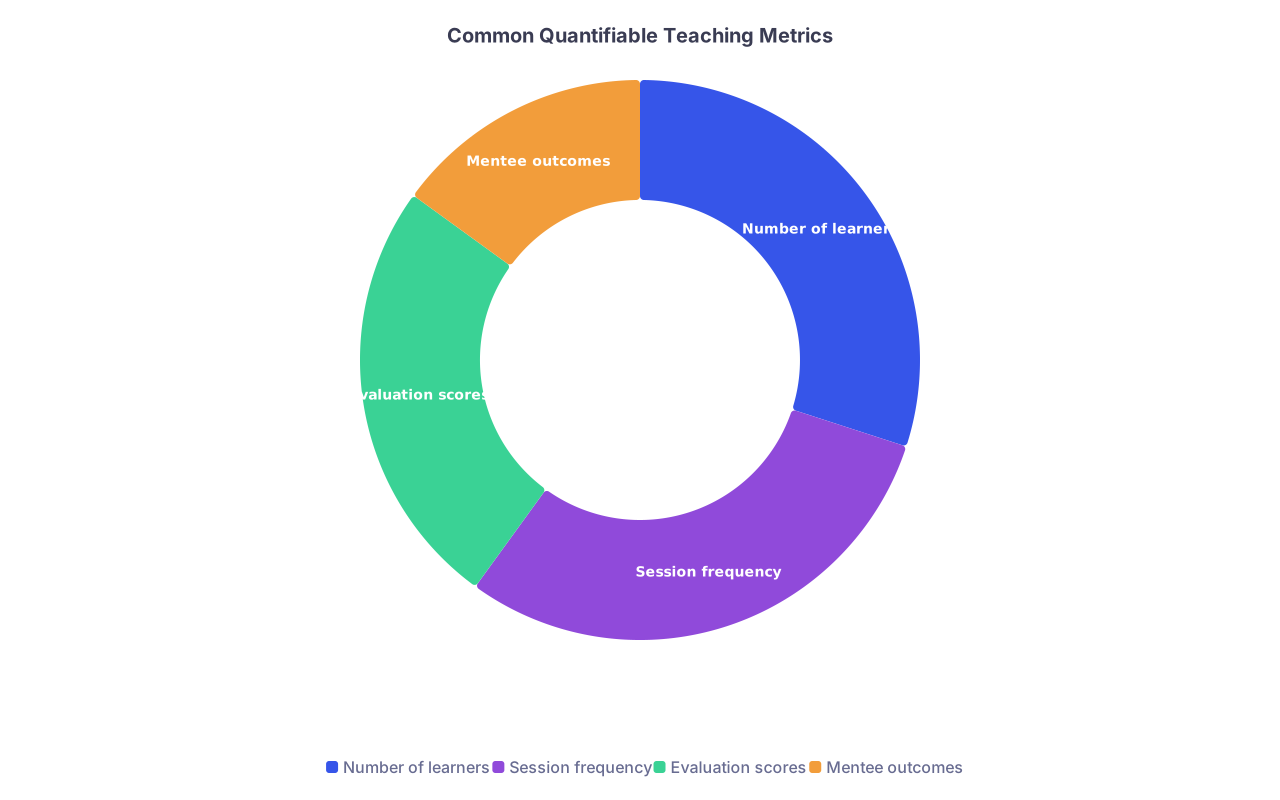
| Category | Value |
|---|---|
| Number of learners | 30 |
| Session frequency | 30 |
| Evaluation scores | 25 |
| Mentee outcomes | 15 |
7. Aligning Teaching and Mentorship With an “Academic Track” Narrative
If you are targeting academic programs, your CV cannot be a random salad of experiences. Teaching and mentorship need to fit into a coherent story:
- Interest in education →
- Repeated teaching roles →
- Increasing responsibility →
- Evidence you enjoyed and improved at it
Think progression over time.
Example progression that reads strongly:
MS1–MS2:
- Volunteer anatomy tutor
- Informal mentor to 1–2 premeds
MS3:
- Small-group facilitator for MS1 clinical skills
- Formal mentor in URiM premed program
MS4:
- Co-leader of peer-teaching organization
- Invited guest lecturer for M2 block
- Education-focused poster at local/regional meeting
That says: this person is naturally gravitating toward education, and people keep trusting them with more.
You can subtly underline this in your personal statement:
- Mention one or two specific, well-described teaching moments that mattered to you
- Tie them to why you are drawn to academic medicine
- Do not repeat your whole CV; just choose illustrations
8. Strategic Placement: Where to Put What on ERAS
Let me give you a rough framework.
On ERAS, for a strong academic-leaning application, you want:
1–2 entries: Formal teaching roles
- “Small Group Facilitator – Clinical Skills”
- “Peer Tutor – Physiology/Pathology”
1–2 entries: Mentorship roles
- “Mentor – Premedical Pipeline Program”
- “Near-Peer Mentor – First-Year Students”
0–2 entries: Educational leadership / curriculum
- “Co-Director – Peer Teaching Organization”
- “Curriculum Developer – Board Review Series”
0–2 entries: Education-related research or scholarship
- “Poster – Implementation of Near-Peer Teaching in Preclinical Curriculum”
- “Workshop – Teaching Physical Exam Skills for MS2s”
For your three “Most Meaningful” ERAS experiences, it is completely appropriate to make one of them teaching/mentorship if you are truly going after academic programs. Just make sure the description is rich, reflective, and specific.
9. Common Mistakes That Make Your Teaching Look Weak
I see the same errors every year. They are easy to fix.
Collapsing everything into one vague line
- “Tutored and mentored various learners over medical school.”
This hides all your effort.
- “Tutored and mentored various learners over medical school.”
Overstating casual help as a formal role
- “Served as clinical instructor for MS3s” when you just answered a few questions on rounds.
Faculty can smell inflation instantly.
- “Served as clinical instructor for MS3s” when you just answered a few questions on rounds.
Zero context
- No mention of who you taught (MS1, premeds, residents), how many, how often.
No verbs that signal educational thinking
- You want words like: facilitated, designed, evaluated, provided feedback, developed materials, aligned with objectives.
No outcomes or feedback anywhere
- Even one line like “Received positive evaluations (average 4.6/5)” changes how credible you look.
Fragmented narrative
- Teaching roles appear as disconnected one-offs. Try to show progression and reinforcement—same institution, increasing responsibility.
10. Two Full Example Sections: Weak vs. Optimized
Let me show you a realistic “before and after” for an applicant aiming at academic internal medicine.
Version A – Weak
Teaching and Mentoring Experiences
- Tutor for MS1 students in physiology
- Taught review sessions for step exams
- Mentored premed students
- Helped third-year students on wards
If I am a PD reading that, I shrug and move on. It sounds like background noise.
Version B – Optimized, Same Underlying Activities
Experiences (selected entries):
- Peer Tutor, Preclinical Physiology and Pathology
School of Medicine, 2022–2024
- Selected by course director as peer tutor for first-year medical students in core physiology and pathology blocks
- Led weekly 1–2 hour small-group review sessions (4–6 students) emphasizing concept integration and NBME-style questions
- Provided 1:1 remediation to 5 at-risk students identified by academic support; all successfully passed the course after targeted sessions
- Created and shared ∼80 board-style practice questions and summary diagrams accessed by majority of class via course site
- Small Group Facilitator, MS1 Clinical Skills
School of Medicine, 2023–2024
- Facilitated weekly 2-hour clinical skills sessions (10–12 first-year students), focusing on history-taking, physical exam, and oral case presentation
- Used standardized rubrics to provide written and verbal feedback on communication, professionalism, and data gathering
- Attended 3 faculty development workshops on feedback delivery and remediation strategies
- Mentor, First-Generation Premedical Program
University, 2021–2023
- Matched with 3–4 premedical students per year through structured mentorship program for first-generation and underrepresented students
- Met monthly to discuss coursework, MCAT planning, and application strategies, with ongoing email follow-up
- 6 mentees applied to medical school during mentorship period; 4 have matriculated (2 to [Your Institution])
- Senior Student Teacher, Medicine Clerkship
Teaching Hospital, 2023–2024
- Informally taught third-year medical students during medicine clerkship and sub-internship rotations
- Led 10–15 minute “chalk talks” on inpatient topics (e.g., hyponatremia, COPD exacerbations) 2–3 times per week using active question-based format
- Helped 3 students structure daily SOAP notes and case presentations; 2 later requested letters describing teaching interactions
Now the same person looks like a junior clinician-educator. Same activities. Better framing.
11. Quick Checklist Before You Finalize Your ERAS Teaching Section
Look at your current entries and ask:
Does each substantial role have:
- Who I taught
- How I taught
- How often and how long
- Any sign of impact or feedback
Can someone reading this see a progression over time?
Would a PD plausibly say:
- “We could put this person as a small-group leader in two years”?
- “They could mentor interns or students on day one as a PGY-2 or PGY-3”?
If the answer is “maybe, sort of,” then you need to tighten and specify more.
FAQ (Exactly 5 Questions)
1. I only tutored classmates informally. Does that count as teaching experience?
Yes, but you must be honest about the level of formality. If you informally organized weekly review sessions for your small group classmates, that can be described as “informal peer teaching” or “student-organized review sessions” with approximate frequency and group size. Do not label yourself as “course faculty” or “official tutor” unless that was explicitly your role. For academic programs, informal but consistent peer teaching is still a positive indicator, especially early in medical school.
2. How many teaching entries are “enough” for an academic residency application?
There is no magic number, but generally 2–4 well-structured, substantial teaching or mentorship experiences in your ERAS Experiences section is solid. More than 6 separate “teaching” entries tends to look fragmented unless you truly had many distinct roles. Depth and clarity of a few roles beats a laundry list of shallow ones. One of your top three “Most Meaningful” experiences being explicitly teaching-related is a strong move if you want an academic program.
3. Should I include teaching outside medicine, like high school or college tutoring?
Yes, especially if you lack robust medical teaching. Prior structured teaching (high school science teacher, MCAT instructor, college chemistry TA) transfers well. Place it chronologically with other experiences, clarify the subject and level taught, and highlight any structured curriculum or evaluation you used. Just do not let pre-med teaching overshadow your medical school teaching if you have both; clinical and near-peer medical teaching should be the centerpiece by the time you apply for residency.
4. How do I handle the fact that I do not have evaluation scores or hard outcomes?
You focus on structure and scope. Describe how often you taught, how many learners, what kind of material, and what your responsibilities were (e.g., facilitating discussion, giving feedback, creating materials). If you received informal positive feedback (students returning, people requesting your notes, being repeatedly asked to lead sessions), you can mention this qualitatively: “Students consistently requested additional sessions and shared materials with classmates.” Just avoid inventing numerical outcomes or fabricated “improvements” you did not measure.
5. Where should I talk about my long-term interest in medical education—CV or personal statement?
Both, but differently. Your CV should show the evidence: specific teaching and mentorship roles written in structured, detailed fashion. Your personal statement should show the meaning: one or two concise stories of teaching or mentorship that shaped how you see your future in academic medicine. Do not re-list your CV; instead, use those experiences to explain why you are drawn to a residency where you will teach students and possibly pursue roles like chief resident, clinician-educator tracks, or education scholarship.
Key points:
- Academic programs want specific, structured, and impactful teaching and mentorship entries, not vague one-liners.
- You should clearly show who you taught, how, how often, and with what results, with honest, defensible numbers.
- Your teaching experiences need to form a coherent progression that supports an academic trajectory, not a pile of disconnected activities.