
63% of residents change their intended career path (academic vs community) between MS3 and the end of PGY1—while submitting ERAS materials that never reflected either path clearly.
That kind of misalignment quietly kills applications. Not because programs dislike you. Because they cannot figure out what you are actually building toward.
Let me break this down specifically: your CV for residency should not look the same if you want to be a tenure-track academic vs the go-to community workhorse who owns the ED board at 5 pm on a Friday. Both are legitimate. Both are competitive. But they signal differently, and your CV is your only reliable signaling tool before interview day.
Step 1: Get Brutally Clear On Your Direction
Forget the generic “I want to be a clinician-educator” line you hear on rounds. That phrase has become white noise. You need functional categories.
There are really three dominant end-states that matter for how you shape your CV:
- Predominantly academic
- Predominantly community-oriented
- Hybrid (usually community-based with some teaching or niche expertise)
If you try to keep all three open equally, your CV ends up bland and unfocused. You look like everyone else. Which is code for: forgettable.
Academic-leaning signals
You are probably academic-leaning if:
- You enjoy data, structure, and asking “why” a bit too much on rounds.
- You read original articles, not just UpToDate summaries.
- You like teaching, but more importantly, you obsess over how to teach better.
- Your favorite attending is the one running an RCT, not the one knocking out 25 discharges by noon.
Academic jobs usually involve some combination of:
- Research and publication
- Formal teaching (students, residents, fellows)
- Leadership in curriculum, quality, or committees
- Subspecialization
Community-oriented signals
You are probably community-focused if:
- You get more satisfaction from a clean board and fast throughput than from writing a paper.
- You like autonomy and efficiency.
- You feel drained by meetings and “scholarship expectations.”
- Your ideal day: high patient volume, direct impact, minimal bureaucracy.
Community jobs lean into:
- Clinical productivity
- Bread-and-butter plus procedures
- Systems efficiency, leadership in operations
- Patient satisfaction, access, continuity
Why this matters for your CV
Programs are reading your CV for coherence, not perfection.
They want to see:
- Does this person know roughly where they are heading?
- Does their track record support that direction?
- Will they take advantage of what our program is actually good at?
If you are applying to an academic powerhouse with:
- Zero research
- No teaching-related anything
- A CV dominated by scribing and barista jobs
…you had better have a very compelling story or clearly pivot your narrative. Conversely, if you are applying to a community-heavy program with ONLY bench research and no real-world clinical or leadership exposure, you look like you will be miserable there.
Step 2: Understand How Programs Read Your CV
Most PDs and selection committee members skim. Hard.
The usual pattern:
- Education and exams (to make sure you clear the bar)
- Research / scholarly work
- Work and leadership
- Volunteer and extracurricular
- Awards and honors
They are scanning for:
- Proof of work ethic
- Evidence of follow-through
- Trajectory of responsibility
- Academic or community "fit"
Here is how the same item can “read” totally differently depending on your path:
“Volunteer, free clinic”
- Academic read: Did you collect data? Build a curriculum? Present outcomes?
- Community read: Did you show up consistently, manage panels, handle chaos?
“Research assistant, cardiology”
- Academic read: Posters? Manuscripts? Your role in study design or stats?
- Community read: Any practical, QI-type impact? Systems changes? Protocol?
The content is the same. The framing is not. You control that framing.
Step 3: Core Differences – Academic vs Community CVs
| Dimension | Academic-Oriented CV | Community-Oriented CV |
|---|---|---|
| Top 3 priorities | Research, teaching, leadership | Clinical work, leadership, service |
| Research section | Detailed, prominent | Concise, impact-focused |
| Teaching activities | Separate, emphasized | Integrated under leadership/work |
| Clinical experience | Quality + academic settings | Volume, responsibility, autonomy |
| QI / systems work | Scholarly framing | Operational / outcomes framing |
For academic careers
Your CV must clearly foreground:
- Research productivity (not just “exposure”)
- Teaching experience with depth
- Scholarly QI or education projects
- Roles that show you can function in academic hierarchies
Weak point I see constantly: students list “Research Experience” but have no outputs. That is not research; that is shadowing a lab.
For community careers
Your CV must foreground:
- Real responsibility in clinical or quasi-clinical roles
- Longitudinal service commitments
- Evidence of reliability and throughput (without using that word)
- Leadership in practical settings (clinic, EMS, student-run clinic, etc.)
The trap here: people think “I do not have research, so my CV is weak.” No. Your CV is weak if you did nothing that shows initiative, ownership, or impact. That can be clinical, operational, or service-focused.
Step 4: Structuring Your CV Differently For Each Path
Same life, different architecture. Here is how I would re-build the sections depending on your direction.
Academic-leaning CV structure
- Education and Exam Scores (if included by your institution)
- Research and Scholarly Activity
- Peer-reviewed publications
- Abstracts, posters, presentations
- Ongoing projects (clearly labeled)
- Teaching Experience
- Small-group precepting
- TA roles
- Curriculum development
- Peer tutoring with some structure
- Leadership and Professional Service
- Committee work
- National organizations (e.g., APSA, specialty societies)
- Editorial roles, if any
- Clinical Experience
- Scribing, MA, EMT, prior nursing, etc.
- Emphasize exposure to academic centers if relevant
- Volunteer and Community Service
- Especially longitudinal or structured roles
Key point: “Research and Scholarly Activity” and “Teaching Experience” go above clinical work. You are telling programs: these are not afterthoughts.
Community-oriented CV structure
- Education and Exam Scores
- Clinical Experience
- Scribing
- EMT/paramedic
- RN/LPN
- Tech/MA roles
- Hospitalist assistant, ED coordinator, etc.
- Leadership and Operations
- Chief scribe, charge nurse, clinic coordinator
- Student-run clinic leadership
- Scheduling / workflow / process improvement roles
- Volunteer and Community Service
- Especially underserved work, local impact, continuity
- Quality Improvement and Systems Work
- ED throughput project
- Clinic access initiative
- Call schedule optimization
- Research / Scholarly Activity (if any)
- Brief, impact-focused description; do not pretend you are applying for an R01
For community-leaning applications, "Clinical Experience" must sit near the top, not buried behind an anemic “research” section.
Step 5: Research – How To Make It Look Like You Belong In Academia
If you are truly aiming at academic programs, research is not optional. It can be clinical, bench, translational, education, QI—but there must be something.
What actually looks strong on an academic CV
Rank order, roughly:
- First-author peer-reviewed paper
- Middle-author peer-reviewed papers (multiple)
- First-author abstract/poster at regional or national meeting
- Oral presentation at reputable meeting
- Named role in prospective or retrospective projects with defined outputs
- QI projects with clear methodology and outcomes, even if local
Do not list:
- “Research assistant” with no description, no dates, no outputs.
- Random hourly work in a lab where your job was washing glassware.
Those belong under “Work Experience,” not “Research.”
How to write research entries
Bad:
“Research assistant, cardiology, 2022–2023”
Better:
“Research assistant, cardiology, 2022–2023
– Coordinated retrospective chart review of 500 heart failure admissions to assess readmission predictors
– Performed data abstraction and contributed to manuscript drafting; submitted to Journal of Hospital Medicine (under review)
– Presented preliminary data as poster at State ACP 2023”
You are giving them:
- Scale (500 admissions)
- Method (retrospective chart review)
- Role (data abstraction, manuscript drafting)
- Output (poster, submitted manuscript)
For the record: “under review” and “in preparation” are fine if used sparingly and truthfully.
If you are community-leaning but have research
Good. Use it differently.
- Emphasize practical impact: “Reduced time-to-antibiotics by 18 minutes.”
- Link to systems: protocols updated, workflow changed.
- Do not flood your CV with 12 lines of methodology. No one at a busy community ED cares.
You can still place research toward the bottom and keep it compact. It becomes a “bonus,” not your main identity.
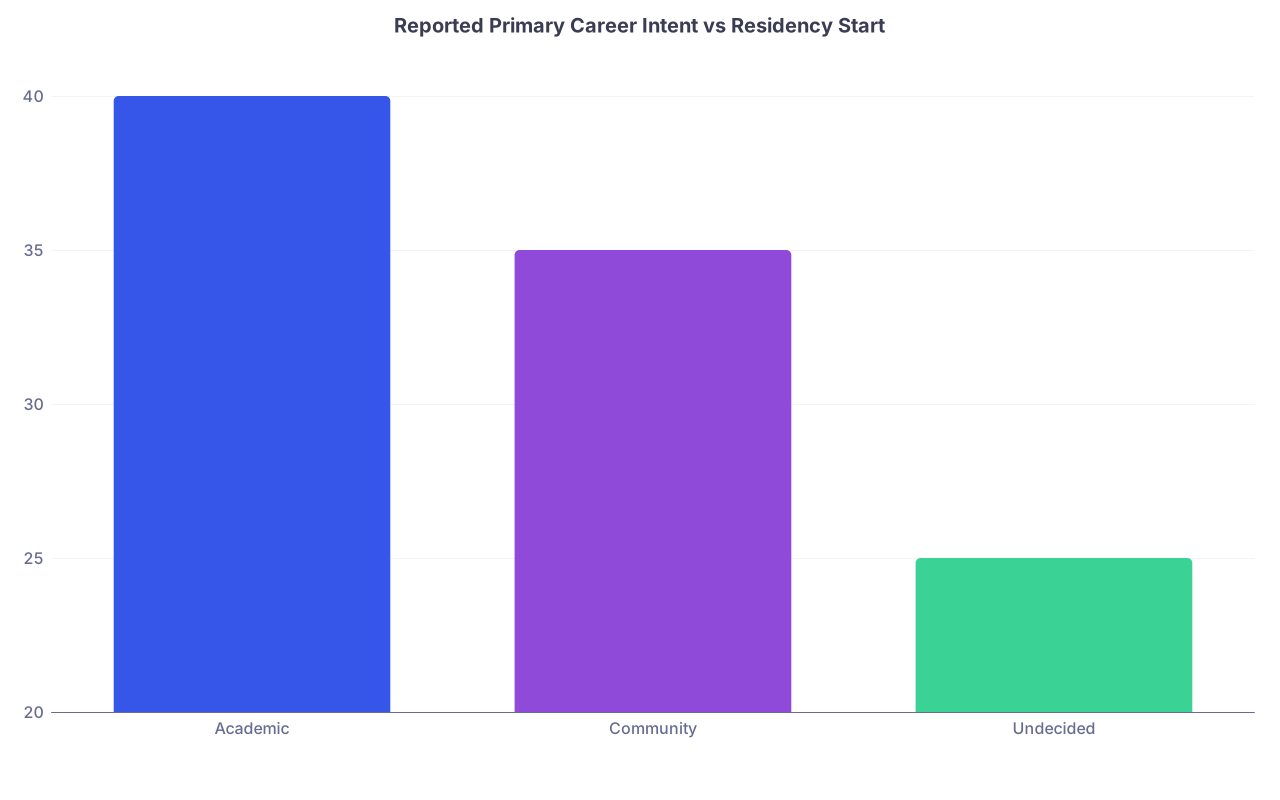
| Category | Value |
|---|---|
| Academic | 40 |
| Community | 35 |
| Undecided | 25 |
Step 6: Teaching – The Most Underused Lever On Both CV Types
Most students radically underreport teaching. Which is insane, because nearly every resident job has a teaching component, academic or not.
Academic CV – build a serious teaching section
Do not just write “tutor.” Flesh this out into a coherent trajectory.
Examples that belong:
- Formal TA roles (anatomy, physiology, OSCE prep)
- Peer-teaching programs (skills labs, question banks, board review)
- Curriculum work (designing sessions, question writing, online modules)
- Workshop or small-group facilitator roles
Describe them like this:
“Small-group facilitator, MS1 cardiovascular pathophysiology, 2023–2024
– Led weekly 10-student sessions reviewing cardiac murmurs and EKG interpretation
– Created 40-question practice set; adopted by course as supplemental resource”
You are telling programs you can:
- Run groups
- Create educational content
- Work within structured curricula
That is exactly what academic departments want.
Community CV – teaching as leadership
You still include teaching, but frame it as leadership and team development.
Example:
“Lead scribe trainer, community ED, 2021–2022
– Trained 15 new scribes in documentation standards and ED workflow
– Developed 4 training checklists; decreased orientation time from 6 to 4 weeks”
This does two things:
- Shows you can develop people
- Shows you improved operations
Both matter a lot more to a community group than your opinion on cognitive load theory.
Step 7: Clinical and Work Experience – Making It Count For Different Audiences
Too many people just list job titles and hope the PD can infer the rest. They can not. Spell out the parts that support your path.
For academic-leaning CVs
You want clinical experience to signal:
- Exposure to academic medicine (if possible)
- Thoughtfulness, not just volume
- Early comfort working with teams
Example:
“Clinical research coordinator, university stroke center, 2021–2022
– Screened ED admissions for trial eligibility; coordinated with neurology, radiology, and ED teams
– Participated in weekly research conference; presented enrollment metrics quarterly”
Here, the academic cues are:
- “University stroke center”
- Conferences
- Presentation of metrics
For community-oriented CVs
You want clinical work to scream:
- Responsibility
- Grit
- Throughput competence
Example:
“ED scribe, high-volume community hospital, 2020–2022
– Documented for 4–6 providers per shift in a 55,000-visit/year ED
– Assisted with pre-charting and order entry under supervision, supporting 2–3 new patients per hour”
Now the signal is:
- Volume
- Fast-paced environment
- Supporting efficiency
That is what community PDs care about: can you survive their reality.
Step 8: QI and Systems Work – The Chameleon Section
Same project, different framing.
Academic framing
“Quality improvement project, inpatient medicine, 2023
– Designed and implemented standardized discharge checklist for heart failure admissions
– Used PDSA cycles and run chart analysis; 30-day readmissions decreased from 22% to 17% over 6 months
– Presented results at regional SGIM meeting”
You highlight:
- Methodology (PDSA, run charts)
- Measurable outcomes
- Scholarly dissemination
Community framing
“Discharge process improvement, community hospital, 2023
– Led small team of residents and nurses to streamline discharge workflow for heart failure patients
– Introduced bedside education script and simplified follow-up scheduling
– Reduced average discharge time by 45 minutes and improved follow-up appointment completion from 60% to 78%”
Here you highlight:
- Team leadership
- Workflow changes
- Operational metrics
Same project. Completely different impression.
Step 9: Choosing What To Cut (Yes, You Must Cut)
One of the biggest differences between strong and weak CVs is not what got added. It is what got removed or minimized.
On an academic CV, you can usually cut or compress:
- Non-clinical, unrelated jobs from years ago (retail, random campus jobs) unless they show major leadership or longevity.
- Short-term, one-off volunteering that shows no trajectory.
- Overly detailed descriptions of technical roles that had no scholarly angle.
If you need space, that high school pharmacy tech job does not need four bullet points.
On a community CV, you can usually cut or compress:
- Token research entries with no real output (“helped with data collection for 2 months”).
- Hyper-detailed methodology on small education projects no one asked for.
- 3–4 student interest group “positions” where your job was sending reminder emails.
The hardest part is being honest: “Does this experience support the story I’m trying to tell?” If not, either cut it, shorten it, or move it to a less prominent section.
Step 10: Matching Programs To Your CV – And Adjusting Slightly
You will not build a different CV for each program. That would be absurd. But you should know how your CV lands in different environments and make small, strategic adjustments.
Academic-heavy programs
Think:
- Large university hospitals
- Research institutes
- Places with NIH funding everywhere
These programs:
- Expect some research or QI
- Love clear teaching trajectories
- Care about your potential as faculty 5–10 years out
What to highlight more:
- Publications, abstracts, QI outcomes
- Teaching and curricular work
- Membership or leadership in academic societies
Community-heavy programs
Think:
- Standalone community hospitals
- High-volume safety-net hospitals
- Hybrid academic-community places without big research arms
These programs:
- Care about whether you will carry the pager without drama
- Want people who show up, work hard, and fit their culture
- Are suspicious of hyper-academic applicants who look like flight risks
What to highlight more:
- Sustained clinical work, especially in real-world jobs
- Leadership in service, operations, or team-based settings
- Longitudinal commitment to communities or patient populations
You do not need two separate lives. You need one life, written two different ways.

| Step | Description |
|---|---|
| Step 1 | Clarify career direction |
| Step 2 | Emphasize research and teaching |
| Step 3 | Emphasize clinical and leadership |
| Step 4 | Structure CV - research high |
| Step 5 | Structure CV - clinical high |
| Step 6 | Trim low-yield non-scholarly items |
| Step 7 | Trim low-yield token research |
| Step 8 | Match to academic-heavy programs |
| Step 9 | Match to community-heavy programs |
| Step 10 | Academic leaning? |
Step 11: A Concrete Before-and-After Example
Let me give you a simplified transformation so you see how this works.
Base experiences (same person)
- ED scribe, 2 years, community hospital
- Research assistant, 1 year, cardiology (1 poster, 1 manuscript under review)
- Tutor for MS1 cardio block
- Co-director, student-run free clinic
- One summer volunteering at a hospice
Academic-leaning CV
Order and emphasis:
- Research and Scholarly Activity
- Poster at state ACC
- Manuscript under review
- Brief description of role and methods
- Teaching Experience
- MS1 cardio tutor with curriculum contributions
- Leadership and Service
- Co-director, student-run clinic (stress QI initiatives, small data collection, presentations)
- Clinical Experience
- ED scribe (focus on learning environment, exposure to academic physicians)
- Volunteering
- Hospice (brief, reflective but concise)
Community-leaning CV
Order and emphasis:
- Clinical Experience
- ED scribe (volume, pace, autonomy, responsibilities)
- Leadership and Community Service
- Co-director, student-run clinic (stress operations: scheduling, team management, continuity of care)
- Volunteering
- Hospice (patient-centered, emotionally demanding work)
- Quality / Operations (if any clinic improvements can be framed here)
- Research and Scholarly Activity
- One line each for poster and manuscript, focused on clinical relevance, not methods
Same life. Two different professional identities.
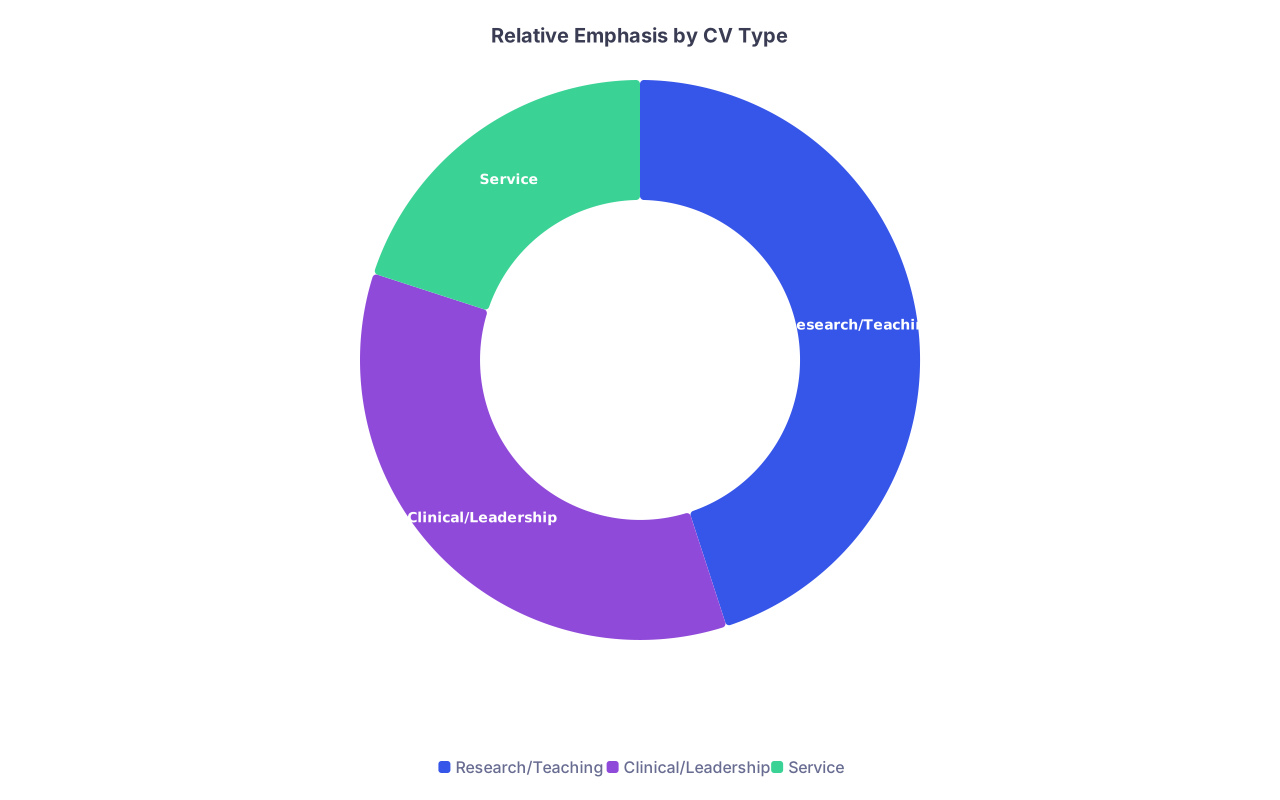
| Category | Value |
|---|---|
| Research/Teaching | 45 |
| Clinical/Leadership | 35 |
| Service | 20 |
(For an academic CV, that distribution is about right. Flip the first two numbers for a community-focused one.)
Step 12: Red Flags That Undermine Both Paths
Some CV problems do not care which path you choose. They hurt you everywhere:
- Endless lists of “memberships” with no roles.
- One-line “research projects” that obviously went nowhere.
- Inflated titles that do not match the actual responsibility.
- Sloppy formatting and inconsistent dates.
- Overstuffed bullet points that say nothing measurable.
If you list yourself as “Director” of something, you had better show scale, outcomes, or at minimum, specific initiatives. Committees and PDs have seen every trick in the book. They can smell padding a mile away.
Step 13: Quick Self-Audit Checklist
Take your current CV. No editing yet. Just look at it.
Ask:
- If a stranger skimmed this for 30 seconds, would they say I am leaning academic, leaning community, or “no idea”?
- Which three sections are visually and substantively strongest? Are those the three that matter for the path I claim to want?
- Does each major experience have at least one bullet that shows scale, responsibility, or outcome?
- Is there anything on here that actually dilutes my story or makes me look unfocused?
If the answer to #1 is “no idea,” you have work to do.
Two key points, to close this out:
- Your CV is not a scrapbook. It is a strategic document that should clearly signal either an academic or community trajectory, even if you keep a foot in both worlds.
- You do not need a perfect record. You need coherence: a believable path, supported by the way you structure, emphasize, and describe what you have actually done.
Get those two right, and most applicants around you will still be handing in generic, unaligned CVs. You will not.