
Most students are underselling their longitudinal clinics so badly they might as well not have done them.
Let me break this down specifically. Longitudinal and continuity experiences are gold for residency programs—evidence you can stick with patients, systems, and teams over time. Yet on most CVs, they show up as one sad line: “Longitudinal primary care clinic, MS2–MS3.” That is wasted real estate.
You are not just listing a clinic. You are proving you understand continuity, follow‑up responsibility, and long‑term patient care. That is exactly what residency is.
This is how you describe it properly—by level of training, by specialty, and by the kind of story your CV needs to tell.
1. Why Longitudinal / Continuity Experiences Actually Matter
Programs do not care that your school forced you to sit in a clinic one afternoon a week. They care what that implies about how you will function as a resident.
Continuity experiences signal several things:
- You understand follow‑up and “owning” patients
- You can build and maintain therapeutic relationships
- You can function in an outpatient, team‑based environment
- You can see change over time (disease control, adherence, social determinants)
- You can show commitment to a population, system, or specialty
Residency is continuity. Panels, follow‑ups, refills, interval history, “what happened since I saw you last time.” Your longitudinal clinic is the closest pre‑residency analog.
Programs in primary care heavy fields (IM, FM, Peds, Med‑Peds, Psych) weigh this heavily. But even surgery and EM care about whether you understand outpatient follow‑up and transitions of care. I have seen EM PDs light up when a student could clearly explain how they followed ED patients into a continuity clinic, tracked outcomes, and adjusted care.
So your task is simple: turn “I was assigned to Dr. Smith’s clinic for a year” into “I carried a growing panel, followed patients longitudinally, and contributed to measurable care improvements.”
2. Where Continuity Belongs On Your CV (Structure Matters)
Do not just cram everything under “Clinical Experience” with no hierarchy.
Your continuity experiences usually fit in 1–3 possible sections:
- Clinical Experience / Longitudinal Clerkships
- Volunteer / Service (for free clinics, community continuity)
- Leadership or Quality Improvement (if you took on a structural or QI role)
If you are building an ERAS‑style CV, continuity experiences for credit usually live under “Education → Clinical Experience” or “Experience → Work/Volunteer” depending on how your school templates it. For a PDF CV, I would use a subheading.
Example structure:
- Clinical Experiences
- Longitudinal & Continuity Clinics
- Core Clerkships
- Sub‑internships
Group your longitudinal items together. It immediately signals to a program director: “This person has sustained, repeated exposure and responsibility.”
3. The Anatomy of a Strong Longitudinal Clinic Entry
Most people list only title, site, and dates. That is lazy.
Your entry needs four parts:
- Position / role title
- Site and setting
- Dates and frequency / duration
- Scope and impact description (2–4 bullets max)
Let’s break each piece down.
3.1 Title: Use Language That Signals Responsibility
“Longitudinal clinic” is vague. Sharpen it.
Stronger options:
- Longitudinal Primary Care Student Provider
- Student Clinician, Longitudinal Internal Medicine Clinic
- Continuity Clinic Student – Family Medicine
- Student Provider, Longitudinal Pediatric Clinic
- Longitudinal Women’s Health Clinic – Student Clinician
Use “student clinician” or “student provider” when you were truly seeing patients, writing notes, and presenting to preceptors.
Bad:
“Ambulatory clinic MS2”
Better:
“Student Clinician, Longitudinal Internal Medicine Clinic”
3.2 Site and Setting: Be Specific, Not Cute
State the institution, clinic type, and population if relevant.
Examples:
- University of X Medical Center, Resident Continuity Clinic (Internal Medicine)
- Y Neighborhood Community Health Center – FQHC, Adult Primary Care
- Z Free Clinic, Student‑run, Uninsured Adult Population
- Academic Children’s Hospital, General Pediatrics Ambulatory Clinic
If it is a free clinic or FQHC, say so. If it is HIV clinic, refugee clinic, safety‑net clinic—name the population. Those details matter.
3.3 Dates and Frequency: Quantify Commitment
Longitudinal implies time and repetition. Show it.
Use:
- Month/Year – Month/Year
- Approximate frequency: “Half‑day per week” / “Two half‑days per month”
- Approximate total sessions or hours (for free clinics / electives)
Examples:
- Aug 2022 – May 2024 (weekly half‑day clinic)
- Jan 2023 – Dec 2023 (2–3 sessions per month; ~120 hours)
That not only proves continuity, it also differentiates between a true longitudinal experience and a 4‑week elective you are trying to stretch.
3.4 Description: Three Pillars – Role, Continuity, Complexity
Every description should contain three things:
- What you did routinely (role and responsibilities)
- How continuity showed up (follow‑up, panel, seeing same patients)
- Any measurable or concrete outcomes (numbers, skills, projects)
Let me give you a clear pattern you can adapt:
Bullet 1 – Role and workflow
Bullet 2 – Continuity and relationships
Bullet 3 – Impact / complexity / system learning
Example for Internal Medicine:
- Evaluated 4–6 adult patients per clinic session, obtained interval histories, performed focused exams, and presented management plans to supervising internist.
- Maintained continuity with a growing panel of ~20 patients with diabetes, hypertension, and CKD, performing medication reconciliation, counseling, and follow‑up planning over 18 months.
- Participated in pre‑visit huddles and post‑visit debriefs with attending, RN, and pharmacist to address adherence barriers, leading to documented A1c improvement in several high‑risk patients.
That is specific. It sounds like a resident‑adjacent role, not a passive observer.
4. Tailoring By Specialty: How To Frame the Same Clinic Differently
Here is the part almost nobody does correctly. The same longitudinal clinic can be described in different ways depending on your target specialty.
You are not fabricating; you are emphasizing the parts the program actually cares about.
4.1 Internal Medicine / Family Medicine / Med‑Peds
Focus on:
- Chronic disease management
- Panel ownership and risk stratification
- Team‑based care (RN, pharmD, social work)
- Preventive care and guideline‑driven practice
- Complex multimorbidity
Example (Internal Medicine focus):
Student Clinician, Longitudinal Primary Care Clinic
University Hospital, Internal Medicine Resident Clinic
Aug 2022 – May 2024 (weekly half‑day clinic)
- Independently evaluated 4–6 adult patients per session, with emphasis on chronic disease follow‑up (diabetes, heart failure, COPD), and discussed management plans with supervising resident and attending.
- Followed a continuity panel of ~25 patients across 18 months, tracking lab trends, adjusting antihypertensives and insulin regimens, and reinforcing lifestyle counseling at each visit.
- Collaborated with pharmacy, nursing, and social work to address barriers to medication access and adherence, arranging assistance programs and close interval follow‑up for high‑risk patients.
Same clinic, framed as someone already thinking like an internist.
4.2 Pediatrics
Emphasize:
- Well‑child care and developmental surveillance
- Vaccinations and anticipatory guidance
- Family‑centered communication
- Longitudinal growth and development
Example:
Student Clinician, Longitudinal Pediatric Clinic
Children’s Hospital, General Pediatrics Ambulatory Clinic
Aug 2022 – May 2024 (weekly half‑day clinic)
- Conducted interval histories and focused exams for 5–7 pediatric patients per session across well‑child, chronic disease, and acute care visits under direct attending supervision.
- Provided longitudinal care to infants and toddlers from newborn visits through age 2, documenting growth, developmental milestones, and vaccination status across multiple encounters.
- Delivered age‑appropriate anticipatory guidance and education to caregivers regarding nutrition, sleep, and safety, and coordinated follow‑up visits for developmental or behavioral concerns.
4.3 Psychiatry
Highlight:
- Longitudinal therapeutic relationship
- Medication titration and monitoring
- Safety assessments, functional outcomes
- Collaboration with therapists, social workers
Example:
Student Clinician, Longitudinal Psychiatry Clinic
Academic Medical Center Outpatient Psychiatry
Jan 2023 – Dec 2023 (bi‑weekly clinics; ~90 hours)
- Performed focused interval histories and mental status exams for patients with MDD, GAD, bipolar disorder, and psychotic disorders, and presented assessment and plan to supervising psychiatrist.
- Maintained continuity with a core group of 10–12 patients over 12 months, participating in medication titration, side effect monitoring, and collaborative goal setting at each visit.
- Participated in multidisciplinary treatment planning with therapists and social workers, including safety planning, disability documentation, and coordination of higher levels of care when indicated.
4.4 Emergency Medicine / Surgery
You might think continuity is irrelevant. It is not. You just emphasize:
- Transitions of care
- Pre‑ and post‑operative follow‑up
- Understanding of outpatient context for acute issues
- Systems and safety net awareness
Surgery example (clinic continuity around OR days):
Student Clinician, Longitudinal Surgical Clinic
Department of General Surgery, Academic Hospital
Jul 2023 – Mar 2024 (weekly half‑day clinic)
- Evaluated pre‑operative and post‑operative patients for hernia, cholelithiasis, colorectal disease, and breast pathology, focusing on interval symptoms, wound assessment, and complication screening.
- Followed select patients from pre‑op consultation through surgery and post‑op visits, reinforcing peri‑operative instructions and monitoring recovery milestones.
- Observed and contributed to surgical decision‑making incorporating imaging, pathology, and patient preferences, providing perspective on longitudinal outcomes after acute surgical interventions.
EM example (transitions + follow‑up):
Student Clinician, ED‑to‑Clinic Continuity Program
Urban Safety‑Net Hospital, Transitional Care Clinic
Jan 2023 – Dec 2023 (2–3 sessions per month)
- Saw recently discharged ED patients for follow‑up of asthma exacerbations, heart failure, uncontrolled diabetes, and minor injuries, performing interval history, medication reconciliation, and targeted exam.
- Helped close follow‑up gaps by confirming understanding of ED instructions, adjusting medications under attending supervision, and arranging subspecialty referrals or social support as needed.
- Tracked outcomes for high‑utilization patients over multiple visits, gaining experience in how outpatient access and social factors influence ED utilization patterns.
You are making an EM PD think: this person understands why those “frequent flyers” keep coming back.
5. Quantifying and Qualifying Without Lying
You have to walk a line: specific and impressive, but honest. PDs can smell overinflated nonsense from a mile away.
Here is how to make it rigorous.
5.1 Use Ranges and Approximate Numbers
You almost certainly do not have exact counts. That is fine. Use approximate but defensible numbers and ranges.
Good:
- “4–6 patients per session”
- “~80 clinic hours over 10 months”
- “Followed a continuity panel of ~15 patients”
Bad:
- “Saw hundreds of patients” (vague and inflated)
- “Managed 50 patients per clinic” (obviously false for a student)
If you supervised junior students or took on extra clinics, say so. But do not invent “panels” that did not exist.
5.2 Avoid Inflated Language About Independence
You were supervised. Claiming otherwise is a red flag.
Better phrases:
- “Independently obtained history and exam, then presented to…”
- “Formulated preliminary assessment and plan for review with…”
- “Under direct supervision, participated in medication adjustment and counseling…”
Do not write: “Managed patients with diabetes, CHF, and CKD” as if you were the attending. You did not. You participated in management.
5.3 Show Complexity With Concrete Tasks, Not Adjectives
Weak:
“Worked with complex patients from diverse backgrounds.”
Stronger:
“Worked with patients facing housing insecurity, limited English proficiency, and low health literacy; used interpreter services and teach‑back to confirm understanding of medication changes.”
You show complexity by specifying barriers and what you did.
6. Special Cases: Longitudinal, Electives, and “Fuzzy” Continuity
Not every experience is a clean weekly clinic. Some are more messy. You can still frame them well.
6.1 Student‑Run Free Clinics
These sit at the intersection of service, leadership, and continuity.
You may have:
- Rotated through as a clinician
- Taken on a “continuity” role for certain patients
- Served as clinic coordinator or QI lead
Split it correctly:
- If you had a defined clinic shift over a long period: list under Clinical or Volunteer as a continuity clinic.
- If you had structural responsibilities (scheduling, EMR build, QI metrics): add a separate Leadership or QI entry.
Example:
Student Clinician, Longitudinal Free Clinic
XYZ Student‑Run Free Clinic, Uninsured Adults
Aug 2022 – May 2024 (2–3 sessions/month)
- Evaluated 3–5 adults per shift as part of precepted student team, focusing on diabetes, hypertension, and chronic pain management, and documented in EMR.
- Provided continuity follow‑up to a subset of patients, tracking A1c and blood pressure trends across repeated visits and reinforcing lifestyle and medication education.
- Coordinated referrals to local safety‑net resources and charity care programs, improving access for uninsured patients requiring imaging and specialty care.
Then, if applicable, separate:
Clinic Operations Lead, XYZ Student‑Run Free Clinic
Aug 2023 – May 2024
- Oversaw student scheduling, orientation, and workflow optimization for 20+ volunteers per month.
- Implemented standardized follow‑up tracking for high‑risk patients, reducing no‑show rate by approximately 15% over 6 months.
Two entries. Different functions. Both stronger together.
6.2 Longitudinal Integrated Clerkships (LICs)
LICs are a different beast. You might have followed patients across inpatient and outpatient settings for multiple specialties.
Do not just write “LIC student.” Break it into:
- One macro‑entry for the LIC structure
- Selective sub‑entries for standout continuity streams (e.g., primary care, OB, psych)
Example macro:
Longitudinal Integrated Clerkship (LIC) Student
ABC Medical School, Community LIC Site
Jul 2022 – Jun 2023
- Completed core clerkships through a longitudinal model, following a panel of ~30 patients across primary care, inpatient, surgical, and obstetric encounters.
- Developed sustained relationships with patients, spanning preventive visits, hospitalizations, ED visits, and peri‑operative care over 12 months.
- Participated consistently with a small cohort of preceptors, receiving ongoing feedback and assuming progressive responsibility for patient care.
Then one targeted sub‑entry:
Student Clinician, Longitudinal Family Medicine Clinic (LIC)
ABC Community Health Center
Jul 2022 – Jun 2023 (weekly half‑day clinic)
- Managed interval visits for a continuity panel of families, including prenatal care, newborn visits, and chronic disease follow‑up, under direct supervision.
- Coordinated care transitions between clinic, L&D, and hospital discharge for pregnant patients and newborns, reinforcing discharge instructions and scheduling follow‑up.
Now your LIC looks like a sophisticated, continuity‑heavy program instead of a cryptic acronym.
6.3 “Soft” Continuity: Following Patients Across Rotations
Sometimes you:
- Keep visiting a patient after your rotation ends
- Go see “your” ED patient on the floor the next day
- Follow a transplant patient from clinic through surgery and ICU
These are best described either in your personal statement, experiences section narrative, or interview stories. On a CV, they tend to be too small and intermittent to warrant their own line, unless it was part of an organized program.
If you must include, phrase it like:
- “Engaged in informal longitudinal follow‑up of select patients across ED, inpatient, and outpatient settings during core clerkships to better understand disease trajectory and system navigation.”
One line under a broader clerkship description is enough.
7. Common Mistakes That Kill The Value Of These Experiences
I have seen the same sloppy errors on hundreds of applications.
Let me list the big ones so you can avoid them.
Listing without context
“Longitudinal clinic, 2022–2023.” No specialty. No role. No frequency. Useless.Overstuffed bullet points
Eight bullets for one clinic. Nobody reads that. Three strong ones beat eight vague ones.Mixing passive observation with active participation
If you mostly shadowed, do not pretend you were primary provider. But do not undersell either. “Observed” vs “evaluated, under supervision” makes a big difference.Copy‑pasting generic school descriptions
PDs recognize boilerplate from School X’s official LIC PDF. Write in your own words what you actually did.No alignment with specialty
Applying to psych? Then your continuity description better mention longitudinal relationships, symptom tracking, functional goals, not just “followed up on labs.”Forgetting outcomes entirely
You do not need fancy numbers, but some sense of “what changed over time” is key: medication optimization, adherence, symptom control, engagement with care.
8. Concrete Before‑and‑After Examples
Let me show you how a mediocre CV line transforms.
Example 1 – Internal Medicine
Weak:
“Longitudinal primary care clinic, University Hospital, 2022–2024.”
Stronger:
Student Clinician, Longitudinal Primary Care Clinic
University Hospital, Internal Medicine Resident Clinic
Aug 2022 – May 2024 (weekly half‑day clinic)
- Performed interval history, focused exam, and EMR documentation for 4–6 adult patients per session under resident and attending supervision.
- Followed a continuity panel of ~20 patients with diabetes, hypertension, and CKD over 18 months, participating in medication adjustment and counseling at multiple visits.
- Used EMR tools to track A1c and blood pressure trends, flag overdue labs, and coordinate follow‑up visits for high‑risk patients.
Example 2 – Free Clinic / Family Medicine
Weak:
“Volunteer, student‑run free clinic 2021–2023.”
Stronger:
Student Clinician, Longitudinal Free Clinic
City Student‑Run Free Clinic, Uninsured Adults
Sep 2021 – Apr 2023 (2–3 sessions/month; ~120 hours)
- Evaluated 3–5 patients per shift as part of precepted student teams, focusing on chronic disease follow‑up and acute complaints for uninsured adults.
- Provided longitudinal follow‑up to a subset of high‑risk patients with poorly controlled diabetes and hypertension, tracking labs and reinforcing medication adherence over multiple visits.
- Coordinated referrals to community resources and low‑cost specialty services, helping patients overcome barriers related to cost, transportation, and insurance status.
Example 3 – Pediatrics LIC
Weak:
“LIC pediatric clinic, Children’s Hospital.”
Stronger:
Student Clinician, Longitudinal Pediatric Clinic (LIC)
Children’s Hospital, General Pediatrics
Jul 2022 – Jun 2023 (weekly half‑day clinic)
- Conducted well‑child and chronic disease follow‑up visits under direct attending supervision, documenting growth, development, and immunization status.
- Followed a cohort of infants from newborn period through 12 months, providing continuity of anticipatory guidance to families across multiple visits.
- Identified and escalated concerns about growth faltering and developmental delay for early intervention referral.
You can feel the difference immediately.
9. Quick Comparison: Strong vs Weak Continuity Descriptions
| Aspect | Weak Version | Strong Version |
|---|---|---|
| Title | Longitudinal clinic | Student Clinician, Longitudinal Internal Medicine Clinic |
| Time/Frequency | 2022–2023 | Aug 2022–May 2023, weekly half‑day clinic |
| Role | Shadowed in clinic | Evaluated 4–6 patients/session under supervision |
| Continuity | Not mentioned | Followed panel of ~20 patients across 12 months |
| Outcomes/Impact | “Learned about chronic disease” | Tracked A1c/BP, adjusted meds with attending, improved control |
This is the gap you need to close on your CV.
10. How Programs Actually Read These Entries
Let me be blunt. PDs and file reviewers skim.
They are looking for:
- Evidence of sustained commitment
- Signs you understand follow‑up and responsibility
- Alignment with the specialty’s day‑to‑day reality
- A pattern across your experiences (not just one off)
They are not scoring you on poetic prose. They are scanning for specific signals:
- “Weekly clinic for 1–2 years” = reliability
- “Continuity panel” or “followed cohort” = longitudinal responsibility
- “Chronic disease management / developmental surveillance / medication titration” = specialty‑relevant skills
- “Collaborated with RN/pharmacy/social work” = team‑ready
If those words and ideas do not appear anywhere in your continuity entries, you are throwing away one of your best differentiators.
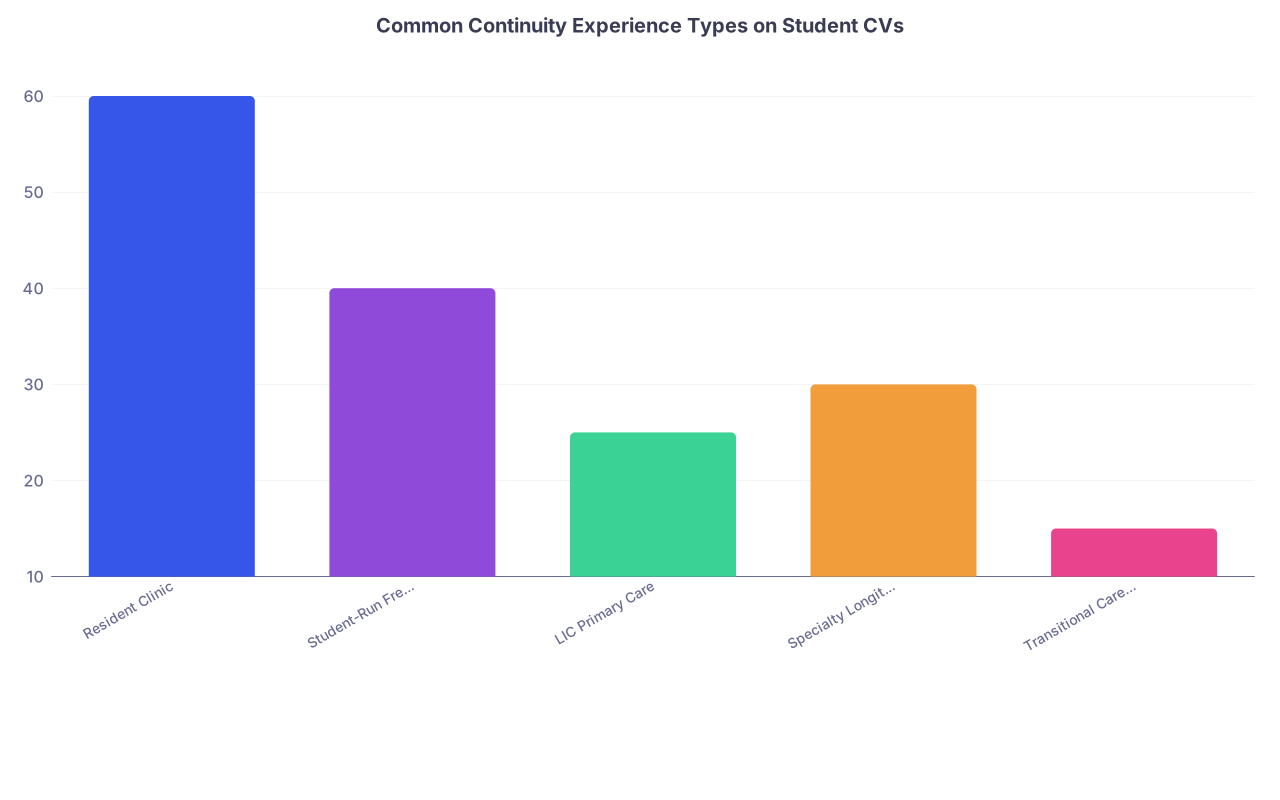
| Category | Value |
|---|---|
| Resident Clinic | 60 |
| Student-Run Free Clinic | 40 |
| LIC Primary Care | 25 |
| Specialty Longitudinal | 30 |
| Transitional Care Clinic | 15 |

| Step | Description |
|---|---|
| Step 1 | Raw clinic experience |
| Step 2 | Clarify role and setting |
| Step 3 | Quantify time and frequency |
| Step 4 | Identify continuity elements |
| Step 5 | Align with target specialty |
| Step 6 | Write 2-4 concise bullets |
| Step 7 | Check for honest specificity |
FAQ (5 Questions)
1. Should I list every single longitudinal clinic separately if I had multiple (e.g., IM, Peds, OB)?
No. Group intelligently. If they were part of one integrated program (like an LIC), have one overarching LIC entry plus 1–2 key longitudinal clinics that are most relevant to your target specialty. If you are applying medicine, prioritize IM and adult continuity; if pediatrics, highlight the pediatric clinic. Do not create six micro‑entries that all look identical.
2. How do I handle continuity experiences that were mostly shadowing with limited direct patient contact?
Be honest but still precise. Use phrases like “observed,” “assisted with,” and “participated in” rather than “evaluated” or “managed.” You can still highlight what you learned longitudinally: seeing disease progression, following diagnostic workup over months, or watching therapeutic relationships develop. Just do not present yourself as a primary provider if you were not.
3. Can I mention specific outcomes like A1c improvement if I did not personally design an intervention?
Yes, if you frame it correctly. You can say, “Participated in longitudinal care of high‑risk patients whose A1c improved from >10 to <8 over multiple visits as part of the clinic’s diabetes management program.” That credits the team and the system, while showing you understand what improvement looks like. Avoid “I reduced A1c” language unless you truly led a targeted intervention.
4. Where should I put continuity experiences that were technically “electives” and not core requirements?
Still under your Clinical or Experience section, labeled as “Elective” if needed. Programs do not care about the registrar’s labeling; they care about time, responsibility, and relevance. If it was longitudinal (multiple months, repeated sessions), it belongs alongside other continuity clinics, not buried under a generic “Electives” line with no detail.
5. How many bullets per clinic entry is ideal on an ERAS‑style application?
Two to four. Any less and you probably have not captured role, continuity, and impact. Any more and reviewers stop reading. Your goal is one bullet for core responsibilities, one for the continuity aspect, and one (optional) for complexity or impact. If you need more than four bullets, you are usually better off splitting that experience into two entries (e.g., clinician role and leadership/QI role).
Key takeaways:
First, treat longitudinal and continuity experiences as proof of future residency performance, not as throwaway lines. Second, structure entries to show role, frequency, continuity, and concrete impact, and align the emphasis with your target specialty. Third, be specific and honest—no fluff, no inflation, just clear evidence you understand what it means to follow patients over time.