
You're a Muslim resident with diabetes. Ramadan is around the corner. Can you actually get accommodations to fast safely without tanking your evaluations or your health?
The short answer is yes. The long answer is that the system won't just hand them to you. You have to force the machinery of Graduate Medical Education (GME) to work in your favor.
This is a highly specific, high-stakes scenario. Managing a chronic metabolic condition while observing a rigorous religious fast during the most grueling years of your medical career is not for the faint of heart. We need to cover your legal rights, the exact request process, and the practical ward-level strategies to protect both your health and your training.
Here is the reality of the Islamic calendar: Ramadan shifts backward by about 11 days each year. This means it cycles through the seasons. Eventually, it will land in the dead of summer. When that happens, you are looking at 15 to 16 hours of fasting during the longest, hottest days of the year. Understanding your rights and building an accommodation playbook right now means you are prepared whenever those long summer days finally arrive. You don't wait until the sun is blazing to figure out how to manage your insulin. You prepare in the winter.

Fasting during Ramadan isn't just skipping lunch. It means absolutely no food and no water from dawn (Fajr) to sunset (Maghrib). Depending on the season and your geographic location, that window typically spans 12 to 16 hours.
For a person with diabetes, this is a profound physiological stress test. Diabetes management during fasting requires meticulous monitoring to prevent hypoglycemia, hyperglycemia, and severe dehydration. When you stop eating, your glycogen stores deplete. If you are on insulin or insulin secretagogues, your risk of a dangerous hypoglycemic event skyrockets. Conversely, if you alter your medication too aggressively to avoid lows, you risk severe hyperglycemia and diabetic ketoacidosis.
If you experience a sudden hypoglycemic emergency during a procedure, learn about your options for mid-rotation emergency accommodations.
Now, layer residency on top of that. As a resident, you are already managing irregular hours, chronic sleep deprivation, and high-stress clinical situations. Sleep deprivation alone increases insulin resistance and cortisol levels, throwing your blood sugar out of whack even if your diet is perfect. Adding a 16-hour fast without institutional support creates an unnecessary and frankly dangerous risk.
I've seen residents try to "tough it out." They hide their hypoglycemia, push through the brain fog, and end up making medical errors or passing out in the call room. You cannot compromise patient safety to prove your dedication to your faith or your program. Your blood sugar does not care about your religious obligations, and your patients do not care about your fasting. They need a sharp, alert physician. Adding fasting without a structured safety net is a recipe for a medical emergency.
Many trainees wonder about the prevalence of accommodation requests and approval rates across different residency programs.
Let's get the legal reality straight. You are not asking for a favor. You are asserting your rights under federal law. You have two massive legal shields here: the Americans with Disabilities Act (ADA) and Title VII of the Civil Rights Act.
Under the ADA, diabetes is unequivocally recognized as a disability. It substantially limits major life activities, specifically endocrine function. Because of this, your residency program is legally required to provide reasonable accommodations. They cannot discriminate against you, and they must actively engage in an interactive process to find a workable solution.
Simultaneously, Title VII applies to residency programs at institutions receiving federal funding, which is virtually all academic medical centers receiving Medicare/Medicaid GME dollars. Title VII requires employers to reasonably accommodate sincerely held religious practices. Fasting for Ramadan is a core religious practice.
These laws don't just protect you from outright discrimination. They actively require programs to provide meaningful accommodations unless doing so creates an "undue hardship." Let me be blunt: adjusting a call schedule or allowing you to step off the floor for five minutes to check your glucose is almost never an undue hardship for a hospital employing dozens of residents and hundreds of nurses.
Do not let program administrators gaslight you into thinking your request is a burden. If a Program Director tells you, "It's just too hard to adjust the schedule for one person," they are legally incorrect. The burden of proof for "undue hardship" is incredibly high. They have to prove it would fundamentally alter the nature of the training program or cause severe financial strain. Swapping your night float shift with a willing co-resident does not meet that bar. Know your leverage. Use it.
If you walk into your Program Director's office two weeks before Ramadan, you have already lost. GME scheduling is a logistical nightmare. Chief residents build those schedules months in advance. If you ask late, they will use "scheduling constraints" as an excuse to deny you.
Start early. Begin the accommodation conversation at least 2 to 3 months before Ramadan begins. This gives the chief residents and the GME office time to actually build the schedule around your needs.
Next, get bulletproof documentation. You need a letter from your endocrinologist or primary care physician. Do not just get a note that says, "Patient has diabetes and is fasting." That is useless. The letter must explicitly detail your medical management needs during the fasting window. It should state that you require the ability to break your fast immediately if your blood glucose drops below a specific threshold (e.g., 70 mg/dL). It should state you need scheduled breaks for insulin administration and continuous glucose monitoring. It should explicitly recommend avoiding 24-hour call shifts without guaranteed, protected meal access.
Be brutally specific about what you need. Vague requests get vague, unhelpful accommodations.
- Modified call schedules: "I need to be off the 24-hour call rotation and placed on a day-shift or short-call schedule for the 30 days of Ramadan."
- Adjusted meal breaks: "I require a guaranteed 15-minute break at exactly 7:45 PM to break my fast and administer insulin."
- Open monitoring: "I need explicit permission to check my continuous glucose monitor and treat hypoglycemia openly in the OR and during procedures."
Put it in writing. Email your Program Director and the GME HR liaison. Create a paper trail. If they deny you, you need that denial in writing to escalate to your institution's disability office or legal counsel.

What does a "reasonable accommodation" actually look like on the wards? It varies wildly depending on your specialty and the flexibility of your specific program. Here is what residents successfully negotiate.
Schedule Modifications This is the most common and most critical accommodation. For Internal Medicine and Pediatrics, this usually means adjusted shift timings to minimize overnight fasting burdens. You might be floated to day shifts and taken off the night float rotation entirely for the month. It also means reduced consecutive call nights. For Surgery, it means modified OR schedules. You shouldn't be scrubbing into a 10-hour Whipple procedure at 2:00 PM when you haven't had water since dawn. You get assigned to morning cases or shorter, predictable add-on cases. In Emergency Medicine, it means shift length limits, capping you at 8 or 10 hours instead of 12, and avoiding the midnight-to-8 AM shifts.
Dietary Accommodations You need guaranteed meal breaks at appropriate times. If Maghrib (sunset) is at 7:42 PM, you need to be off the floor at 7:30 PM. You cannot be told to "just wait until the admission is done." You also need guaranteed access to quick-acting carbohydrates. The resident workroom should be stocked with juice boxes, glucose tabs, or dates specifically for your hypoglycemia management.
Medication Timing Flexibility You need permission to take oral medications and insulin at times appropriate for your health during the fasting window. If your endocrinologist shifts your basal insulin to the pre-dawn meal (Suhoor), you need the schedule to allow you to be awake and alert enough to dose it safely, rather than rolling out of bed at 4:00 AM after a 28-hour shift.
Getting the paperwork signed by the GME office is only half the battle. Executing the plan on the chaotic hospital wards is the rest.
Proactive communication with your attending physicians and your program director before each Ramadan block is essential. Don't wait for problems to arise. On day one of the rotation, pull your attending aside. Say, "I am fasting for Ramadan and have diabetes. My Dexcom is active. If it alarms for a low, I will need to step out for three minutes to drink juice. Here is my plan for coverage while I step out." Set the expectation immediately.
Have a hard backup plan for emergencies. Know exactly who to call if you experience hypoglycemia during a procedure or a critical moment. If you are scrubbed into a lap chole and your sugar drops to 60, you cannot just power through. You need an explicit, pre-arranged agreement with your attending that you can step away, scrub out, treat the low, and scrub back in without facing punitive evaluations for "lack of stamina."
Track your glucose patterns relentlessly. Use your CGM data. During the first week of Ramadan, track your time-in-range and identify your personal risk factors. Are you dropping low at 3:00 PM every day? Share this data with your endocrinologist and your care team to tweak your basal rates. Show your Program Director your data. Prove that you are managing your condition responsibly. When programs see objective data, they are much more likely to maintain your accommodations without pushback.
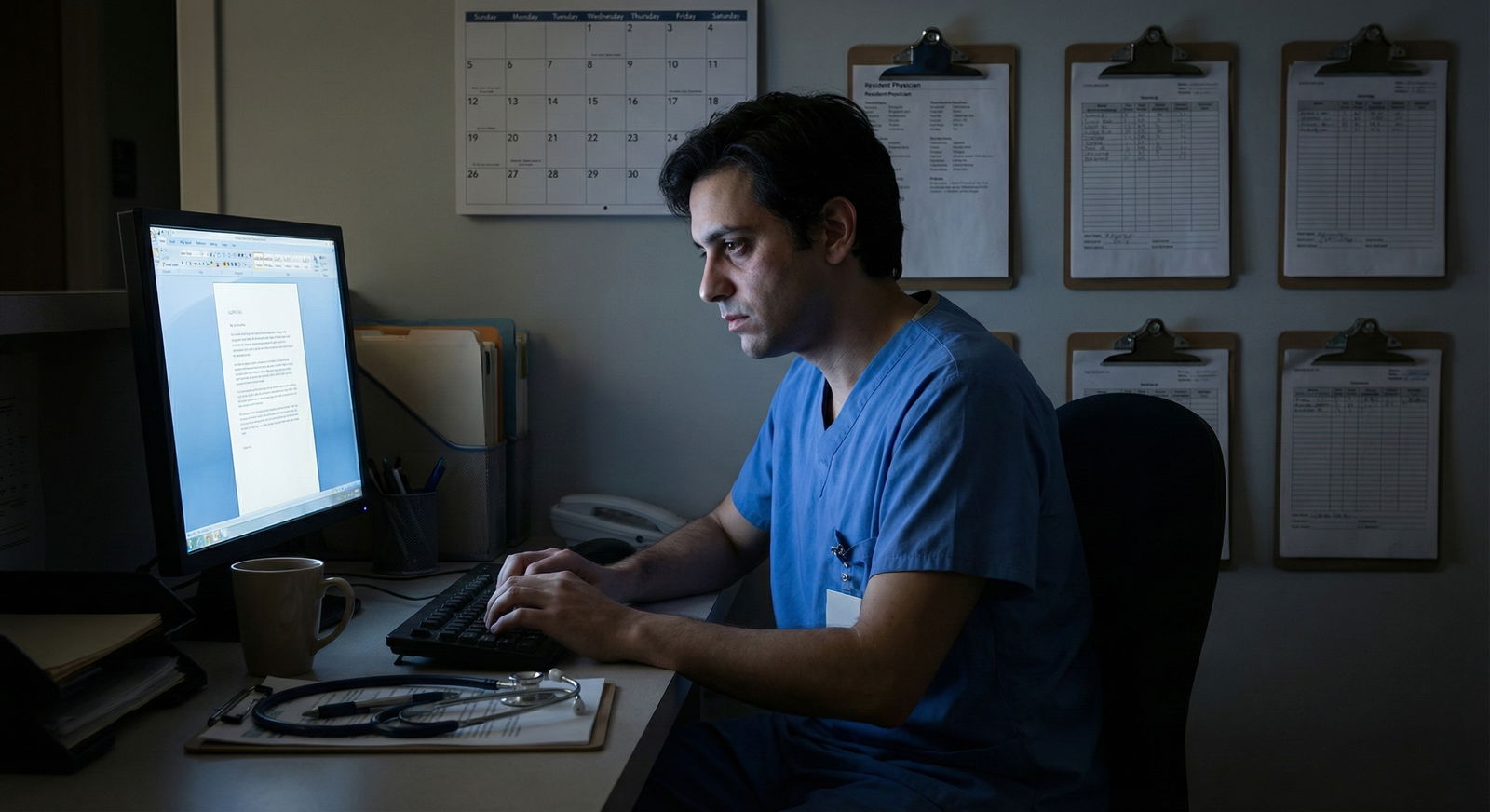
You have clear, enforceable legal rights to accommodations for both your disability (diabetes) and your religious practice (Ramadan). Do not let anyone in the hospital hierarchy convince you otherwise.
Remember that the accommodation process is a conversation, not a one-time request. Maintain ongoing communication with your program. If a specific accommodation isn't working in practice, go back to the table and renegotiate.
Your health comes first. This isn't just about your personal well-being; it's about patient safety. Poorly managed diabetes affects your cognitive function, your reaction time, and your ability to provide safe patient care. Accommodations benefit everyone in the hospital.
Document every interaction, advocate for yourself relentlessly, and connect with Muslim resident organizations like the Muslim American Society or local hospital Muslim Medical Associations for peer support. You are not the first resident to navigate this, and you won't be the last. Lean on the community, know your rights, and protect your health. You can be a devoted Muslim, a well-managed diabetic, and an exceptional physician. You just need the right framework to make it happen.